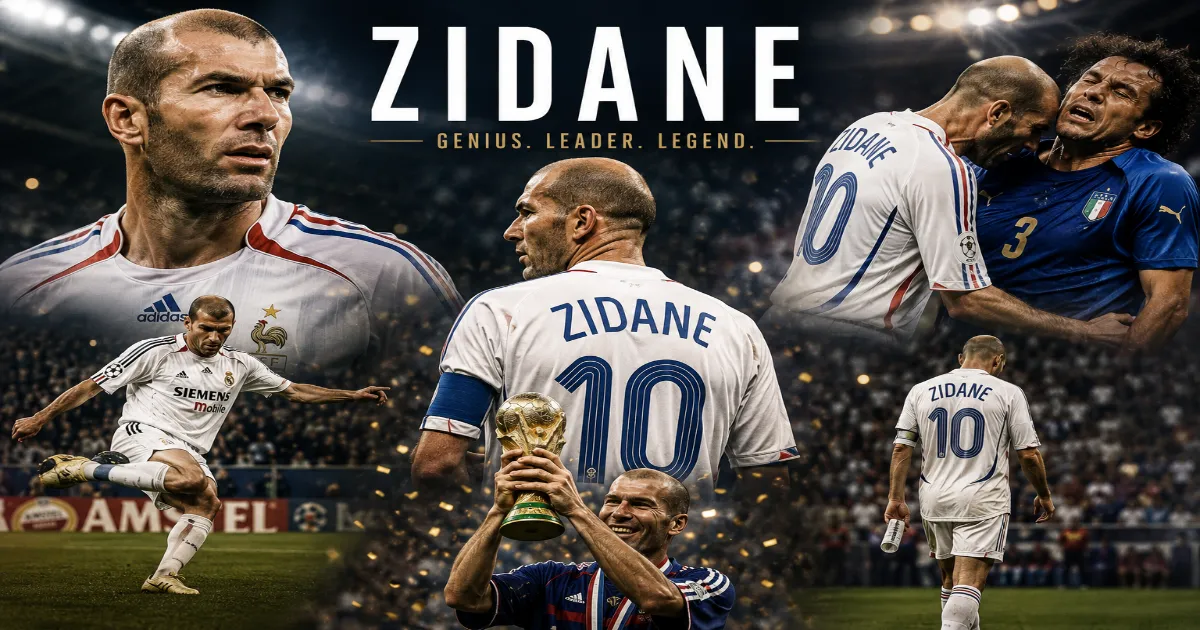
Zinedine Zidane is one of those footballers whose reputation cannot be reduced to a list of trophies or statistics. His career contained almost every ingredient required for sporting immortality: extraordinary technique, major international success, iconic club performances, a Ballon d’Or, one of the most famous goals in Champions League history, an unforgettable World Cup final, and later an extraordinary transformation into an elite manager.
More Than a Footballer: How David Beckham Built a Global Brand That Will Outlast His Career
But Zidane’s greatness was never simply about what he won. It was about how he played. He could slow a match down without actually slowing the game, receive the ball in impossible spaces, escape pressure with a single movement and make technically difficult actions appear almost effortless. His career also contained contradictions that make his story more fascinating rather than less impressive. The same player who could remain almost unnervingly calm for 120 minutes could lose his composure in one extraordinary moment.
His career, therefore, is best understood not as a collection of highlights but as a study of what made an elite midfielder different from everyone else — and why Zidane remains such an important reference point for modern football.10 Football Documentaries Every Fan Needs to Watch at Least Once
Why Zinedine Zidane Was Such a Unique Midfielder
Zidane was difficult to classify because he combined qualities that normally belonged to different types of midfielders. He had the creativity of a traditional No. 10, the physical presence to operate in central midfield and the technical security of a player who could receive the ball under almost any kind of pressure.
His first touch was arguably his defining weapon. Zidane rarely needed multiple touches to solve a problem. A single control could take the ball away from a defender, change his body orientation and create the next passing option simultaneously. His famous turns and drag-backs were not tricks performed for entertainment; they were functional movements that allowed him to escape pressure and immediately move the team forward.
His upbringing helped shape that style. Growing up in Marseille’s La Castellane housing estate, Zidane developed his football in tight spaces where close control and improvisation were essential. The source article describes how those early surroundings influenced the qualities that later became his trademark: close turns, disguised passes and the ability to control the ball in extremely congested areas.
Unlike a pure attacking midfielder who constantly searched for the final pass, Zidane could control the rhythm of an entire match from deeper positions. He could receive possession, attract pressure, turn away from it and then decide whether the next action should be a pass, dribble or acceleration.
That combination made him especially dangerous in major matches. The bigger the occasion became, the more comfortable Zidane appeared.
Zidane’s 1998 World Cup Impact
If one tournament transformed Zidane from an exceptional footballer into a global icon, it was the 1998 FIFA World Cup.
Playing at home, France reached the final against Brazil with Zidane at the centre of their attacking structure. He had already become one of the country’s most important players, but the final gave him the perfect stage to define his international legacy.
Zidane scored two goals in the 1998 World Cup final, both headers from set pieces. France won 3–0 and captured the World Cup for the first time in their history. Those two goals became more than match-winning contributions. They turned Zidane into the face of a French football generation.
The significance extended beyond the football itself. Zidane, the son of Algerian immigrants from the Kabylie region, had grown up in a working-class Marseille environment before becoming the central figure in France’s greatest football triumph at the time. The source material notes how his success became associated with the idea of a diverse French national identity often expressed through the phrase “Black, Blanc, Beur.”
His international success did not stop there. France won Euro 2000, with Zidane playing another starring role, and he was awarded the Ballon d’Or in 1998? No — his Ballon d’Or came in 1998, immediately following his World Cup-winning year. That recognition confirmed what his performances had already suggested: Zidane was now regarded as the best player in the world.Who Is Gianluigi Buffon? The Journey of Italy’s Legendary Goalkeeper
Zidane’s Real Madrid Peak
Zidane joined Real Madrid in 2001 for a then-world-record transfer fee and became one of the defining players of the Galácticos era.
The squad around him was extraordinary. Luís Figo, Ronaldo, Raúl and Roberto Carlos were among the stars sharing the dressing room, but Zidane quickly established himself as the team’s creative centre.
His Real Madrid peak was not necessarily about producing huge scoring numbers. It was about controlling important games.
He could dictate the tempo from midfield, create chances without forcing the final pass and manipulate defenders through his body movement. When Real Madrid needed someone to take responsibility in possession, Zidane was often the player trusted to receive the ball.
His greatest club moment arrived in the 2002 Champions League final.
The 2002 Champions League Final: The Volley That Became Art
Real Madrid faced Bayer Leverkusen in the Champions League final in Glasgow.
The decisive moment arrived when Roberto Carlos floated a high cross toward the edge of the penalty area. Zidane adjusted his body and struck the ball with his left foot while moving away from the direction of the pass.
The technique was extraordinary.
Rather than meeting the ball squarely, Zidane generated the perfect combination of timing, balance and placement. His volley flew into the far corner, giving Real Madrid a 2–1 victory and their ninth European Cup/Champions League title.
The goal remains one of the most recognisable strikes in Champions League history because it represented so much of Zidane’s football in a single action: balance, technique, improvisation and composure under pressure.
It is difficult to imagine a more appropriate signature goal for the player.
Zidane vs Ronaldinho: Elegance Against Explosiveness
Comparing Zidane with Ronaldinho is fascinating because both players represented extraordinary technical creativity, but they expressed it differently.
Ronaldinho played with visible spontaneity. His game was built around acceleration, dribbling, deception and improvisation. He could turn a defender inside out with a change of direction or produce a piece of skill that seemed to exist purely because he had imagined it.
Zidane’s creativity was more controlled.
He was less interested in overwhelming opponents with speed and more interested in manipulating space. A Zidane movement could appear almost slow-motion, yet defenders would find themselves a step behind because he had already anticipated their reaction.
| Zidane | Ronaldinho |
|---|---|
| Controlled tempo | Explosive tempo changes |
| Exceptional first touch | Exceptional dribbling |
| Midfield orchestration | Attacking creativity |
| Physical elegance | Elastic movement |
| Game management | Individual improvisation |
| Major international success | Major club and international success |
Neither style was objectively superior. They represented two different definitions of technical genius.
Zidane vs Iniesta: The Midfield Conversation
Andrés Iniesta provides another useful comparison because both players possessed an extraordinary ability to operate in tight spaces.
Iniesta was generally more fluid and economical in his movements. His ability to receive, turn and release the ball quickly made him central to Barcelona and Spain’s possession-based football.
Zidane was more physically imposing and more theatrical in his execution. He could dominate a match through his presence in a way that felt different from Iniesta’s more understated control.
The biggest distinction may be their relationship with tempo.
Iniesta often accelerated possession through quick combinations. Zidane could change the speed of the entire match himself.
That is why comparing the two purely through goals or assists misses the point. Their value was often found in what happened between those statistics — the ability to take responsibility for possession when the match became uncomfortable.El Fenómeno: Why the Ronaldo Nazario Career Remains the Most Complete Journey in Football History
Zidane’s Greatest Performances
Zidane’s career contains numerous performances that deserve to be studied, but several stand above the rest.
His two-goal performance against Brazil in the 2006 World Cup quarterfinal remains one of the strongest examples. Against the reigning champions, Zidane produced a masterclass in controlling the game and repeatedly escaped pressure from Brazil’s midfield.
The performance became particularly famous because Zidane appeared to be playing at a different rhythm from everyone else. His body feints and close control repeatedly left Brazilian players reaching for the ball.
His 1998 World Cup final performance obviously belongs in the conversation, as do his performances during France’s run to the 2000 European Championship.
At club level, the 2002 Champions League final is unavoidable, but Zidane’s wider Real Madrid career contained countless examples of the same qualities.
2006 World Cup Final and the Headbutt
Zidane’s final competitive match as a professional produced one of football’s most unforgettable images.
France faced Italy in the 2006 World Cup final, and Zidane scored with a remarkable Panenka penalty early in the match.
The game eventually reached extra time at 1–1.
Then came the moment that permanently changed how his career is remembered.
In the 110th minute, Zidane headbutted Italian defender Marco Materazzi in the chest. The referee showed him a red card, ending Zidane’s playing career on the pitch.
France subsequently lost the final on penalties.
The incident remains inseparable from Zidane’s legacy because it created an extraordinary contradiction. A player famous for elegance and composure ended his career with an act of uncontrolled aggression.
Yet reducing Zidane’s career to the headbutt would erase almost everything that came before it. The source article makes precisely this point: Zidane’s final act was violent and baffling, but it does not cancel the decades of football that preceded it.
That contradiction is part of why the moment remains so culturally powerful.
Zidane’s Transition From Player to Coach
Zidane did not immediately become one of football’s greatest managers after retirement.
His transition was gradual.
He first worked within Real Madrid’s structure before becoming an assistant and eventually taking charge of the first team in 2016.
That appointment produced one of the most remarkable managerial runs in modern Champions League history.
Zidane won the Champions League in 2016, 2017 and 2018, making Real Madrid the first team in the modern Champions League era to win the competition three consecutive times.
His managerial success was particularly impressive because he did not attempt to turn Real Madrid into a completely different team overnight. Instead, he understood the strengths of his squad and created an environment in which elite players could perform at their best.
What Made Zidane Successful as a Manager?
Zidane’s biggest managerial strength may have been people management.
He understood what star players needed, when to trust them and when to make changes. He also possessed enormous credibility within the dressing room because the players knew that he had experienced the biggest matches himself.
His tactical approach was not based on creating an overly complicated system. Instead, Zidane prioritised balance, structure and giving his best players enough freedom to make decisions.
That approach worked particularly well with players such as Cristiano Ronaldo, Luka Modrić, Toni Kroos and Sergio Ramos.
His substitutions also became an important part of his managerial identity. Zidane frequently showed the courage to change games from the bench rather than simply waiting for the starting XI to solve problems.
Most importantly, he understood that managing Real Madrid was as much about psychology as tactics.
Zidane’s Legacy in Modern Soccer
Zidane’s influence extends beyond the trophies attached to his name.
Modern midfielders are increasingly expected to combine technical ability, positional intelligence, resistance to pressure and tactical flexibility. Zidane demonstrated the value of those qualities long before the modern data-driven language of football became dominant.
He also showed that elegance can be functional.
His football was beautiful, but the beauty was not separate from effectiveness. The turn that looked artistic was often the movement that escaped a pressing opponent. The first touch that looked effortless was often what created the passing lane. The slow body movement was frequently what caused the defender to commit first.
That is why Zidane remains relevant when modern midfielders are analysed.
He wasn’t simply entertaining.
He was efficient through elegance.
5 Matches That Best Explain Zidane’s Greatness
If someone had never watched Zidane play and wanted to understand why he remains so highly regarded, five matches provide a remarkably effective introduction.
1. France vs Brazil — 1998 World Cup Final
Result: France 3–0 Brazil
Zidane scored twice as France won their first World Cup. It was the match that transformed him into a national icon and established him as one of the defining players of his generation.
2. Real Madrid vs Bayer Leverkusen — 2002 Champions League Final
Result: Real Madrid 2–1 Bayer Leverkusen
The famous left-footed volley alone makes this match essential viewing. More importantly, it demonstrates Zidane’s ability to produce decisive technical quality on the biggest club stage.
3. Brazil vs France — 2006 World Cup Quarterfinal
Result: Brazil 0–1 France
This may be the purest example of Zidane controlling a major match through technique and intelligence. Against a Brazil team filled with legendary attacking talent, Zidane dictated the rhythm and helped France reach the semifinals.
4. France vs Italy — 2006 World Cup Final
Result: 1–1, Italy won on penalties
This match explains Zidane’s complexity as much as his greatness. He produced an outrageous Panenka penalty, controlled periods of the final and then ended his career with the headbutt that resulted in his dismissal.
It is impossible to understand Zidane without understanding both sides of this match.
5. Real Madrid’s 2017 Champions League Final
Result: Juventus 1–4 Real Madrid
As a manager, Zidane led Real Madrid to another Champions League triumph. The victory demonstrated that his influence had survived his transition from player to coach. His team became the first in the modern Champions League era to successfully defend the trophy and then complete a third consecutive title.
The Real Reason Zidane Remains Unforgettable
Zidane’s career cannot be measured through one statistic.
He won the 1998 World Cup, Euro 2000, the Ballon d’Or, the Champions League and domestic honours as a player. Then he returned to Real Madrid’s dugout and won three consecutive Champions League titles as a manager.
But his legacy goes deeper than the trophy cabinet.
It is the image of him receiving the ball with a defender closing from behind and somehow knowing exactly where the pressure is coming from.
It is the roulette turn.
The disguised pass.
The left-footed volley in Glasgow.
The two headers against Brazil.
The performance against Brazil in 2006.
The Panenka in the final.
And, inevitably, the headbutt.
Zidane’s career is memorable precisely because it contains both perfection and imperfection. He could appear almost impossibly composed and then, in one moment, remind the world that the person underneath the footballer was still human.
That is why decades after his retirement, Zinedine Zidane remains one of football’s most unforgettable figures. Not because he was flawless, but because when he was at his best, football looked almost impossibly easy.
And very few players in history have ever made the impossible look so effortless.
From Backyards to Academies: USA Youth Soccer World Cup 2026 and the Making of a New Generation
▪️▪️ Follow us on Facebook ▪️▪️
About the Author

2 thoughts on “Zinedine Zidane’s Greatest Moments: The Career That Defined a Generation”