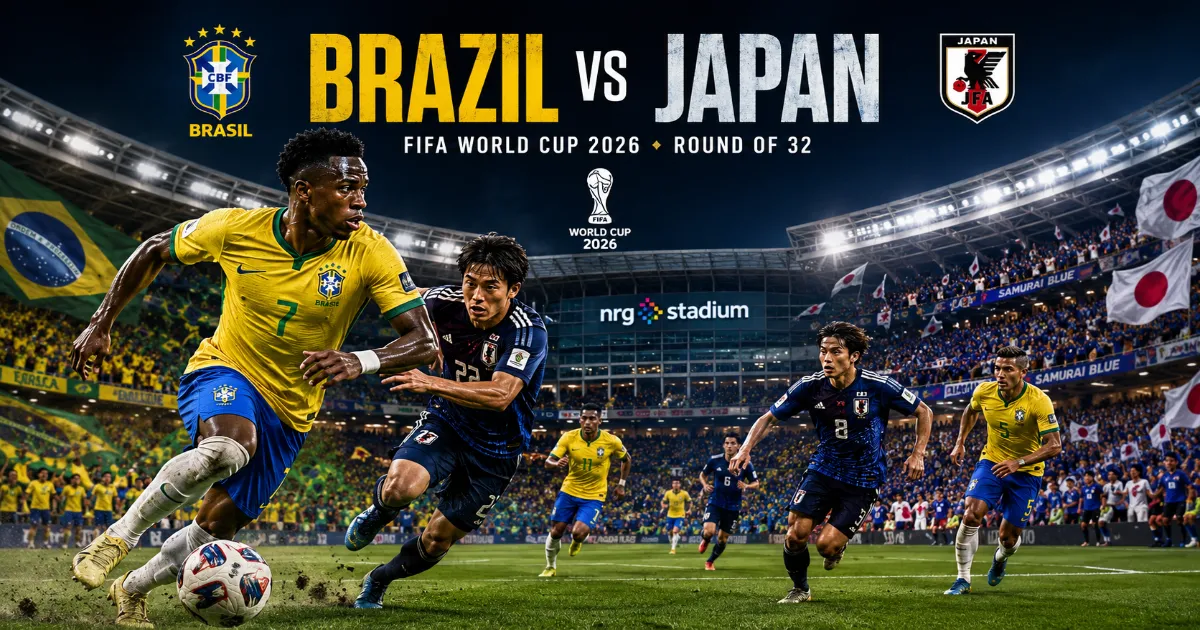
Brazil vs Japan: The Five-Time World Champions Face Asia’s Boldest Upset Threat — and Nothing About This Round of 32 Clash in Houston Should Be Taken for Granted
Brazil vs Japan at NRG Stadium pits Vinicius Junior’s group-stage masterclass against a Japanese side that has already beaten two Group F opponents — this is not a routine fixture for the Seleção, and the stats from both group campaigns suggest a match of genuine tactical complexity
Venue: NRG Stadium, Houston, Texas Kickoff: 1:00 PM ET, Monday June 29, 2026 Round of 32 | World Cup 2026
THE STAKES AND THE NARRATIVE
Brazil enter this match carrying the weight of an expectation that five World Cup titles, the world’s most passionate football culture, and the memory of 2022’s quarter-final elimination to Croatia have placed on Carlo Ancelotti’s squad. The Seleção topped Group C with seven points and a +6 goal difference — three wins, ten goals scored, four conceded — and they did so with a combination of individual brilliance, system coherence, and the specific star quality that makes Brazil the tournament’s most watched side regardless of who they face.
Japan arrive as Group F’s second-placed side, having drawn with Sweden and beaten Tunisia convincingly, and — crucially — having pushed the Netherlands to a 2-2 draw that demonstrated Japan’s capacity to perform against elite European opposition. The Samurai Blue under Hajime Moriyasu have developed a playing identity over the past two cycles that is genuinely fearless: a high press, rapid transitional play, and an individual quality that their J-League and European-based players have elevated to a level that commands genuine respect.
The warning for Brazil is embedded in football history: Japan knocked out Germany and Spain in the 2022 World Cup group stage. They do not fear reputations.
BRAZIL’S GROUP STAGE — ANCELOTTI’S SELEÇÃO TAKES SHAPE
Brazil’s group stage campaign was the most watched narrative of the tournament’s opening phase — and for good reason. Carlo Ancelotti, taking charge of his first World Cup as a manager, has brought a structural clarity and a player-management sophistication to the Brazilian national team that predecessors in this role have rarely managed to provide.
Group C Results:
- Matchday 1: Brazil 3-0 Haiti (goals not yet confirmed in available data)
- Matchday 2: Brazil 1-1 Morocco (scorers to be confirmed)
- Matchday 3: Brazil 3-0 Scotland — Vinicius Junior scored twice in the final group match to top Group C with seven points and a +6 goal difference
Brazil advanced to the knockout stages of the World Cup in style after Vinicius Junior netted twice in a 3-0 win over Scotland in their final Group C match. The five-time champions topped Group C with seven points and a +6 goal difference.
The Star Performers:
Vinicius Junior is the tournament’s most dangerous forward and Brazil’s unquestionable talisman in 2026. His pace and directness have posed consistent problems for every defence Brazil faced in Group C. Operating primarily from the left wing, cutting inside onto his right foot to shoot and outside to deliver, Vinicius creates with and without the ball in ways that no single defender can contain without specific system-level support. He has scored at this World Cup and his energy and confidence levels are visibly high entering the knockout phase. If Brazil are to make a deep run, Vinicius will be the player whose performances define that journey.
Raphinha has contributed from the right wing with the technical quality his club form at Barcelona demands he bring — a creative player who draws defenders before releasing passes into central zones. His combination play with Vinicius across the Brazilian attack has been the most aesthetically pleasing element of the Seleção’s group campaign.
Rodrygo operating through the middle has been the tactical intelligence in Brazil’s attacking structure — not a traditional centre-forward but a player with the movement and the connection to create space for Vinicius and Raphinha simultaneously.
Bruno Guimarães in midfield has provided the Brazilian structure its defensive stability — his cover work, his ball-winning in central zones, and his distribution have allowed the system to function without the defensive vulnerability that has historically plagued Brazilian teams operating with attacking full-backs.Vinícius Júnior FIFA World Cup 2026: Profile, Stats & Career | StrikerReport
Brazil’s Tactical Identity: Ancelotti has built Brazil in his familiar 4-3-3 image: solid defensive structure, creative full-backs (though managed more cautiously here than at club level), midfield control through Guimarães, and a devastating front three with the positional flexibility to interchange. Against Japan’s high press, Brazil will need to be disciplined in their build-up — Ancelotti has noted that playing through pressing systems is the principal tactical challenge for any team facing Japan.Neymar FIFA World Cup 2026: Profile, Stats & Career | StrikerReport
Knockout Strategy: Brazil against Japan will attempt to establish possession early and draw the Japanese press high before playing through it with incisive vertical passing. Vinicius’s ability to run behind defensive lines in transition is the single greatest threat to Japan’s left-sided defensive corridor. Ancelotti will also use set pieces — Brazil are an aerial threat from corners — as a complementary route to goal.
JAPAN’S GROUP STAGE — THE SAMURAI BLUE’S FEARLESS CAMPAIGN
Japan’s Group F campaign was the group stage’s most tactically impressive from an Asian nation. Their results across three matches against the Netherlands, Tunisia, and Sweden demonstrated a squad with genuine attacking quality and defensive organisation that was never breached twice in any single match.
Group F Results:
- Matchday 1: Netherlands 2-2 Japan
- Matchday 2: Japan 4-0 Tunisia
- Matchday 3: Japan 1-1 Sweden (advance in second on goal difference)
Japan secured second place after a 1-1 draw with Sweden, doing enough to stay ahead of Sweden in the race for the automatic knockout berth.
The 4-0 win over Tunisia was the headline scoreline — but the 2-2 draw with the Netherlands on Matchday 1 was arguably the more revealing performance: Japan going toe-to-toe with a Dutch side that finished Group F as winners, staying level despite conceding twice, and showing the attacking quality and mental resilience that Moriyasu has made the Samurai Blue’s defining characteristics.
The Star Performers:
Takumi Minamino has been Japan’s most creative attacking player — his movement between the lines and his ability to operate as both a goalscorer and a creator make him the player Brazil’s midfield will need to track most carefully. His work rate without the ball — pressing for sustained periods — adds a defensive dimension that Japan’s system specifically relies upon.
Daichi Kamada in the central midfield role has orchestrated Japan’s transitional moments — the pass that starts the counter, the run that creates the numerical advantage. His reading of the game is exceptional.
Keito Nakamura has provided width and direct running that has created problems for the full-backs of every team Japan faced. Against Brazil’s attack-minded left-back positioning, Nakamura’s runs into the right channel behind the defensive line could be the most important positional battle of the entire match.
Japan’s Tactical Identity: Moriyasu’s Japan press with remarkable organisation and intensity. They win the ball high, transition fast, and attack with combinations of pace and precision that have dismantled European defences at recent World Cups. Their defensive unit is compact — a back four that maintains shape, supported by industrious midfielders who track back without hesitation.
Knockout Strategy: Japan will press Brazil’s build-up as high as the Brazilian defensive line allows, attempt to force errors in central areas, and attack the spaces behind Brazilian full-backs in transition. The Samurai Blue know Brazil’s attacking quality makes extended possession sequences in their own half dangerous — the game plan is to keep it short in possession and long in ambition.
THE TACTICAL MATCHUP THAT DECIDES EVERYTHING
The critical phase in Brazil vs Japan will be the first twenty minutes. If Japan’s pressing intensity disrupts Brazil’s build-up and produces a transition opportunity that leads to an early goal, the game template becomes one that Japan are explicitly built to exploit. Brazil chasing, Brazil opening up, Japan counter-attacking. That is the Japan game plan.
If Brazil absorb the early press, establish possession, and create opportunities for Vinicius to run at Japan’s defensive line with the ball at his feet, the quality differential should tell over ninety minutes. The five-time champions have too much individual quality for Japan’s defensive unit to contain indefinitely.
The 2022 World Cup showed that assumptions about quality differences are routinely overturned at this tournament. Japan are not here to make up the numbers. Brazil have been warned.
PREDICTION
Brazil have the superior individual quality and the system coherence to manage this fixture — but it will not be comfortable in the way the group stage implied. Japan will make the first thirty minutes dangerous. A key save from Alisson, a Vinicius transition goal midway through the first half, and Brazil’s defensive structure holding in the second half under pressure from Japanese set pieces is the most likely sequence.
Prediction: Brazil 2–1 Japan Vinicius Junior to score once. Japan to equalise before Brazil’s class tells in the final quarter.
FINAL GROUP STAGE RECORDS ENTERING THE ROUND OF 32
Brazil (Group C — 1st place, 7 points):
- Results: Won vs Haiti | Won vs Morocco | Won 3-0 vs Scotland (Vinicius Jr x2)
- Goals scored: 10 | Goals conceded: 4 | GD: +6
- Top scorer: Vinicius Junior
Japan (Group F — 2nd place, 5 points):
- Results: Drew 2-2 vs Netherlands | Won 4-0 vs Tunisia | Drew 1-1 vs Sweden
- Goals scored: 7 | Goals conceded: 3 | GD: +4
- Key players: Minamino, Kamada, Nakamura
▪️▪️ Follow us on Facebook ▪️▪️
About the Author