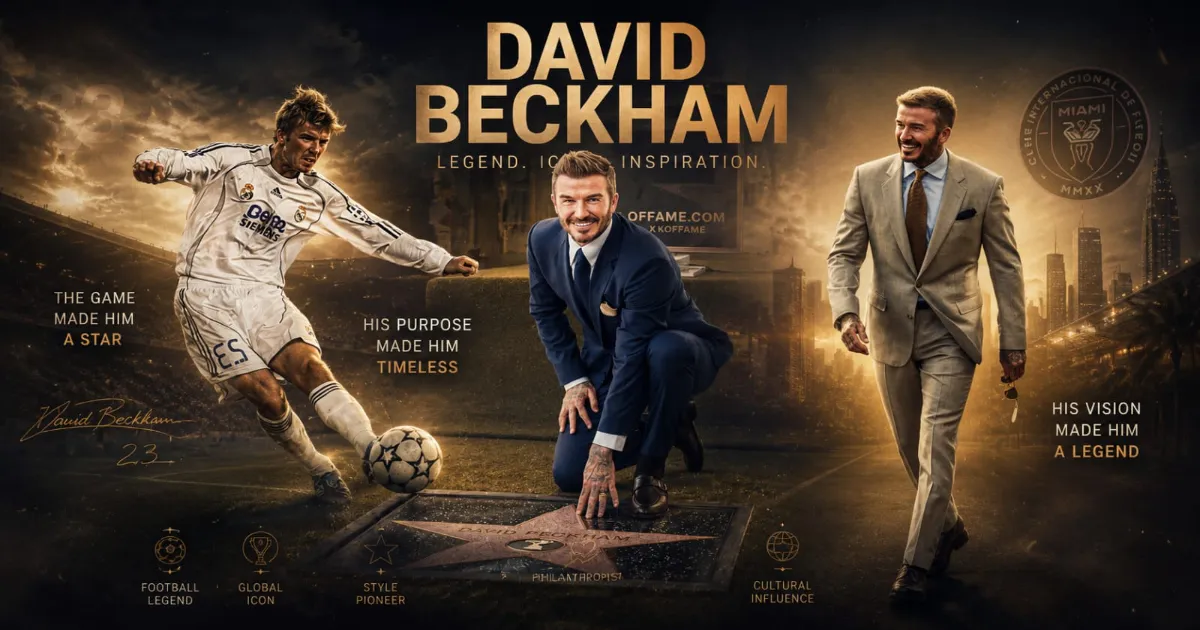
David Beckham Global Brand: From Manchester to MLS and Beyond the Beautiful Game
He was never just a footballer. Understanding David Beckham means understanding how sport, celebrity, and commerce became permanently intertwined in the twenty-first century.
There is a photograph that tells you almost everything. It was taken sometime in the late 1990s, outside a London hotel, and in it David Beckham is wearing something that no English footballer had worn publicly before — not with that kind of confidence, not with that particular combination of self-awareness and ease. It is not a photograph about football at all. It is a photograph about persona. About the deliberate, careful, and ultimately brilliant construction of an identity that would outlast any trophy, any club, any league.
David Beckham played football at the highest level for over two decades. He was genuinely, measurably excellent at it. But the David Beckham global brand is a phenomenon that cannot be understood through football statistics alone, because it was built in the spaces between the goals — in the marriages, the fashion campaigns, the charity commitments, the team changes, and finally in the extraordinary ownership story that brought him to Miami and, eventually, to the sport’s fastest-growing market.
To understand how it happened, you have to go back to Leytonstone.
The Boy from East London
David Robert Joseph Beckham was born on May 2, 1975, in Leytonstone, East London, to a working-class family who were, by his own account, obsessed with Manchester United. His father Ted held a season ticket to Old Trafford. His grandmother supported the club. The household ran on football in the way that some households run on religion — as an organising principle, a source of meaning, a shared vocabulary.
Beckham joined Manchester United’s youth academy as a teenager after being spotted in a talent competition run by the club itself. He trained under Eric Harrison, the youth coach responsible for producing what would eventually become one of the most celebrated academy generations in English football history — the group that included Gary Neville, Nicky Butt, Paul Scholes, Phil Neville, and Ryan Giggs. These were not just talented young players. They were, in retrospect, the last generation of English footballers who grew up in a football culture that was genuinely local, unglamourised, and rooted in communities rather than brands.
Beckham’s first team debut came in 1993. His real emergence, though, was gradual — careful, measured — under Sir Alex Ferguson, who trusted the youth product but also understood his limitations. Beckham was not the fastest player in the squad. He was not the most powerful, the most physically imposing, or the most technically versatile. What he had, in quantities rarely seen in professional football, was work ethic, delivery, and an ability to strike a dead ball that was simply without peer in the English game at the time.
His crossing was geometrically precise. His free kicks were bent with a consistency that seemed to belong more to engineering than to athletics. And he had vision — not the same vision as a Scholes or a Cantona, who could see pass angles that others couldn’t, but a different kind: a vision for space, for the moment when a ball delivered early to the far post would arrive exactly where a striker was running.
1996 and the Goal That Changed Everything
On August 17, 1996, in a Premier League fixture against Wimbledon at Selhurst Park, David Beckham struck the ball from the halfway line and watched it arc over Neil Sullivan in the Wimbledon goal and drop under the crossbar. He had spotted the goalkeeper off his line. He had acted on that observation with absolute technical certainty from sixty yards.
It was one of the most watched goals in the early era of satellite football television. It ran on highlight programmes for weeks. It was, in the language of a pre-social-media world, viral. And it did something important: it established Beckham not just as a footballer to watch, but as a footballer who produced moments — singular, beautiful, shareable moments that existed beyond the context of a single match.
This was, whether anyone knew it or not at the time, the foundation of a personal brand. The goal was the first piece of content.
Under Ferguson, Beckham won six Premier League titles, two FA Cups, and the 1999 UEFA Champions League — the night in Barcelona when Manchester United came from behind in injury time to beat Bayern Munich in what remains the most dramatic Champions League final in the competition’s history. Beckham’s corner delivery for Teddy Sheringham’s equaliser is one of the most consequential set-piece deliveries in the history of club football. It arrived at exactly the right pace, at exactly the right height, into exactly the right zone. It was the summary of his craft in three seconds.
Victoria, Posh, and the Construction of a Dual Icon
In 1997, David Beckham began a relationship with Victoria Adams — Posh Spice, member of the Spice Girls, the defining pop act of mid-1990s British cultural life. Their engagement in 1998 and marriage in 1999 was the moment the David Beckham global brand became something categorically different from anything football had produced before.
Suddenly, here was a footballer whose personal life commanded as much media attention as his professional performances. The tabloid interest was relentless. The magazine covers were constant. Victoria and David Beckham became, almost overnight, the most photographed couple in Britain — and, very quickly, in significant parts of Europe and Asia too.
This was not accidental. It reflected a series of choices — about who to employ as agents and advisers, about which endorsements to accept and which to decline, about how to present themselves publicly and what to protect privately — that demonstrated a commercial intelligence that operated well beyond the football industry’s standard frame of reference.
They hired the right people. They said the right things. And they created the right image: aspirational, glamorous, hard-working, family-oriented. It was an image that translated across cultures and demographics in a way that few personal brands in sport have managed before or since.
Real Madrid: The Galáctico Experiment
The 2003 transfer to Real Madrid, for a fee of around £25 million, was controversial at the time. Ferguson had reportedly decided that Beckham’s influence off the pitch was becoming too large — that the circus surrounding him was incompatible with the focused, private culture Ferguson demanded at Old Trafford. The parting was not entirely amicable.
At Real Madrid, Beckham joined a squad of superstars — Ronaldo, Zidane, Figo, Raúl — assembled under the Galácticos policy of president Florentino Pérez, which prioritised marquee signings capable of generating commercial revenue as much as tactical coherence. It was, in retrospect, a transfer that made complete sense from a brand perspective even if it created genuine difficulties on the pitch.
Beckham’s four years at the Bernabéu were not his most decorated. Real won La Liga in his final season, 2006-07, but Beckham struggled for consistent selection and was regularly used from the bench. The Spanish football media was, at times, brutally critical. He was seen as a luxury player in a squad already drowning in luxury.
But the commercial impact was extraordinary. Real Madrid’s global shirt sales spiked. The club toured Asia with Beckham as the primary draw, and in Japan, South Korea, and China, he generated the kind of crowd response that major clubs now deliberately engineer. He was the template for what later became standard practice in European football — the high-profile signing whose value is calculated not only in goals and assists but in merchandise revenue, commercial partnerships, and broadcast market expansion.
Los Angeles Galaxy and the MLS Question
In January 2007, David Beckham signed for Los Angeles Galaxy in Major League Soccer on a contract reported to be worth up to $250 million over five years when image rights and ancillary revenue were included. It was the most discussed sports contract in years, and it raised a question that nobody in football had seriously asked before: what exactly is a footballer worth when you separate the athletic performance from the cultural value?
The answer, in Beckham’s case, was very large indeed.
His five years at Galaxy — with a loan spell at AC Milan — were complicated. He arrived in a league that was physically demanding, tactically variable, and far less forgiving of passengers than its reputation suggested. Beckham worked hard. He trained rigorously. He took the league seriously in a way that some observers had doubted he would. Galaxy won the MLS Cup in 2011 and 2012, with Beckham playing an important role in the second title run.
But his most lasting contribution to MLS was not on the pitch. It was structural. His arrival legitimised the league in the global football conversation in a way that no marketing campaign could have achieved. The Beckham Rule — the designated player mechanism introduced to allow Galaxy to sign him outside normal salary cap constraints — became a permanent feature of MLS roster construction, enabling subsequent high-profile signings that gradually elevated the league’s competitive standard and international profile.
His time in America also seeded what would become his most significant football venture.
Inter Miami and the Ownership Chapter
As part of his original Galaxy contract, Beckham had negotiated an option to purchase an MLS expansion franchise at a pre-agreed price. He exercised that option in 2018. Inter Miami CF — co-owned with Jorge Mas, José Mas, and others — was officially admitted as an MLS club and began play in 2020.
The early years were difficult. Results were poor. The stadium situation was complicated. Questions arose about whether the project had been rushed, whether the sporting structure was adequate, whether Beckham’s ownership group had underestimated the complexity of building a football club from the ground up in a market without deep football roots.
And then, in the summer of 2023, Lionel Messi chose Miami. Not Barcelona. Not a Saudi league. Not Paris. Miami.
The Messi arrival transformed Inter Miami and, arguably, transformed American soccer. The Leagues Cup run, the Messi goals, the sold-out stadiums, the global media coverage — all of it reflected back on Beckham’s ownership with a validation that no amount of careful planning could have guaranteed. He had built the infrastructure for this moment, attracted the right investors, maintained the right relationships, and waited for the right player.Harry Kane FIFA World Cup 2026: England’s Captain, Record-Breaker & Last Chance at Glory
It was the same instinct that had driven every important decision in the David Beckham global brand story: identify where the future is heading, position yourself within it before anyone else does, and be patient enough to let the moment arrive.
The Business Ecosystem
Today, the Beckham brand operates across multiple industries simultaneously. He holds equity in Formula One through a reported stake-related arrangement, maintains fashion and fragrance lines that have generated hundreds of millions in revenue across two decades, serves as an ambassador for Adidas, Qatar tourism, various luxury goods companies, and a rotating portfolio of global partners.
He has produced an acclaimed Netflix documentary — Beckham — that reintroduced him to younger audiences as a three-dimensional human being rather than a tabloid archetype. The series was watched by millions and generated genuine critical respect, not something that football documentaries routinely achieve.
His Academy projects in the United States and United Kingdom connect the commercial operation to genuine grassroots football development. His charity work spans UNICEF and multiple anti-poverty initiatives. These are not token gestures. They form part of a carefully maintained public identity that has evolved from footballer, to celebrity, to businessman, to — in his own preferred framing — someone trying to build something lasting.
What the Beckham Story Actually Means for Football
The David Beckham global brand provokes two contradictory reactions in football. The first is admiration: here is someone who maximised every asset available to him, made smart decisions at every fork in the road, and built something that will outlast most clubs’ trophy cabinets. The second is unease: did the commercial operation distort the sporting story? Did the brand come to overshadow the footballer?
The honest answer is that both things are true. Beckham was a genuinely elite footballer for the best years of his career — a player whose technical gifts in the delivery of a ball were world-class, whose reading of wide positions in the Treble-winning Manchester United system was tactically intelligent, and whose set-piece contribution to major moments was beyond statistical measurement.
He was also a man who understood, earlier and more clearly than almost anyone else in sport, that the game was changing — that television, sponsorship, global broadcast rights, and social media were creating a new kind of sports celebrity whose influence could extend far beyond the pitch and far beyond retirement.
He positioned himself for that world while still playing in the old one. That, more than any goal or trophy, is the remarkable thing.
Argentina 2022: Messi, Mbappe and the Greatest World Cup Final Ever Played
▪️▪️ Follow us on Facebook ▪️▪️
About the Author

1 thought on “More Than a Footballer: How David Beckham Built a Global Brand That Will Outlast His Career”