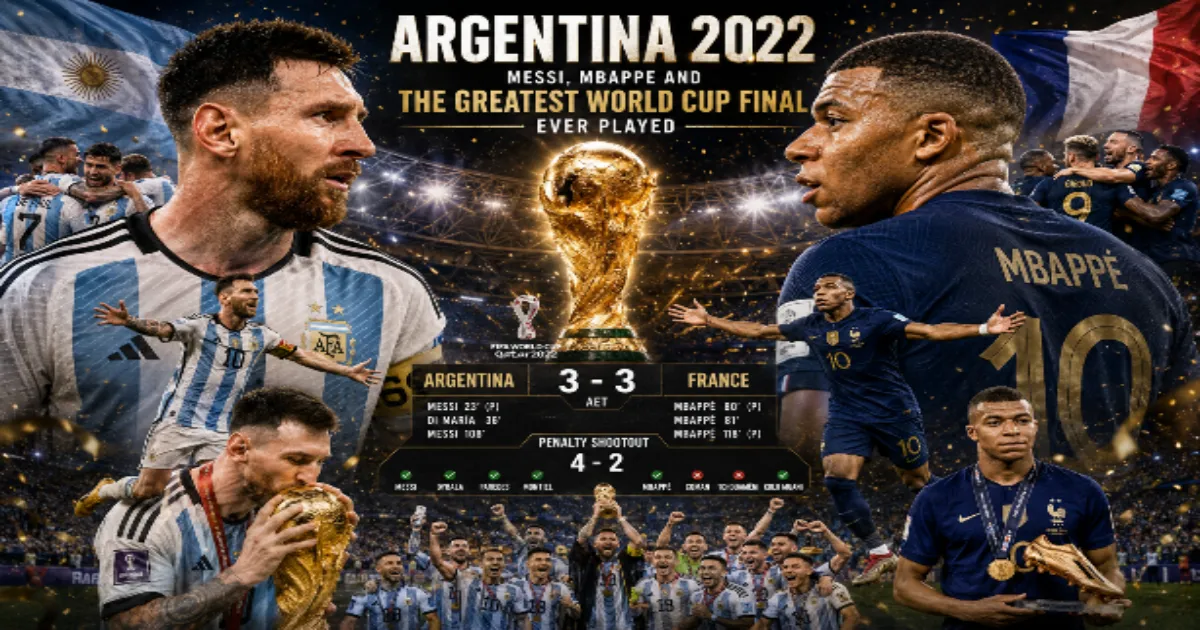
Inside the Argentina 2022 World Cup Final: How Argentina Survived Mbappe’s Hat-Trick
Six lead changes. A hat-trick scored by the losing player. Extra time. A penalty shootout. And, at the end of it, a 35-year-old finally lifting the one trophy his career had somehow never produced. If a screenwriter pitched the 2022 World Cup final as fiction, no editor would believe it. It happened anyway, on December 18 in Lusail, and it instantly became the standard against which every future final will be measured.
FIFA World Cup Third-Place Match Report: England Survive France Rally, 6-4
Spain Won the FIFA World Cup 2026: How La Roja Conquered the World Again
The Road That Set the Stage
To understand why the final landed with such force, it helps to remember the tournament Argentina had just survived to get there. They opened the 2022 World Cup with a stunning 2-1 defeat to Saudi Arabia, a result so shocking it briefly threatened to derail the entire campaign before it had really begun. From that low point, Lionel Messi’s side rebuilt themselves match by match, grinding past Mexico and Poland, edging Australia in the round of 16, surviving a brutal, foul-heavy quarter-final against the Netherlands that went to penalties, and then dismantling Croatia 3-0 in the semi-final behind a Messi masterclass that included an assist so good it humiliated a defender on live television.
France, meanwhile, arrived in the final as defending champions chasing history. No nation had retained the World Cup since Brazil in 1962, and Didier Deschamps’ squad, despite injuries that had wiped out key players like N’Golo Kanté and Paul Pogba before the tournament even started, had cruised through their own bracket with a calm efficiency built around Kylian Mbappe’s pace and Antoine Griezmann’s deep-lying creativity. Both teams arrived at Lusail Stadium with genuine claims to be the tournament’s best side, and for the first eighty minutes, only one of those claims looked remotely justified.
A Final That Forgot to Settle Down
For long stretches early on, this looked like a coronation, not a contest. Argentina, playing with the calm authority of a team that had finally figured something out about itself, took control almost immediately. Lionel Messi opened the scoring from the penalty spot in the 23rd minute after Ángel Di María was fouled inside the box by Ousmane Dembélé — composed, low, unstoppable, exactly the way he’d opened so many big nights before in a Argentina shirt that had so often carried more weight than support.
Then came the goal that should have ended the suspense altogether. A flowing move down the left side built patiently through midfield, five or six Argentine touches strung together without France managing a single meaningful intervention, finished off by Di María himself in the 36th minute after he’d already been the chief creative outlet of Argentina’s best spells. At halftime, France hadn’t managed a single shot on target. Didier Deschamps’ side looked, for the only sustained period all tournament, genuinely out of ideas, with Olivier Giroud isolated up front and Mbappe drifting wide without service.
And then Kylian Mbappe happened.
Two Minutes That Changed Everything
With France down 2-0 and barely into the final ten minutes of normal time, Deschamps made the substitutions that turned the match on its head, introducing fresh legs in midfield to finally get the ball forward with purpose. Randal Kolo Muani’s introduction immediately created the foul that led to a penalty, and Mbappe won and converted it in the 80th minute, sending Emiliano Martínez the wrong way. Ninety-seven seconds later, he struck again — a ferocious half-volley off a Marcus Thuram knockdown that flew past Martínez before the Argentine goalkeeper could properly react. In under two minutes of game time, a final that looked completely decided was suddenly level at 2-2. It remains one of the fastest, most violent shifts in momentum any World Cup final has ever produced, and it transformed Mbappe instantly from a brilliant supporting actor into the player single-handedly keeping his nation’s hopes alive.Messi World Cup Goals: Every Goal, Every Record and Every Defining Moment From 2006 to 2026
Argentina, visibly rattled after dominating for so long, had to find something extra once the match moved into extra time. They got it almost immediately. In the 108th minute, Lautaro Martínez’s initial effort was saved by Hugo Lloris, but the loose ball broke kindly to Messi just inside the box, and he forced it home from close range with his body rather than any real backlift — his second goal of the night, and the goal that, for a few brief minutes, looked like it would be the World Cup-winning moment of his entire career. Argentina led 3-2 with roughly twelve minutes of extra time remaining, and the Lusail crowd, overwhelmingly draped in sky blue and white, allowed themselves to believe it was finally over.In His Own Words: 10 Kylian Mbappe Quotes That Define the Man Behind the Myth
Mbappe wasn’t finished, and France refused to accept the script being written for them. A handball penalty conceded by Gonzalo Montiel in the 118th minute gave Mbappe the chance to complete an astonishing hat-trick, and he buried it with the same coolness he had shown all night, sending Martínez the wrong way for a second time. 3-3. Full time and extra time combined had now produced six goals, three separate lead changes, and a French forward who had scored a World Cup final hat-trick — only the second in the tournament’s history, after Geoff Hurst’s famous treble against West Germany in 1966.
The Shootout
After 120 minutes of football that had already exhausted every emotion available to a neutral viewer, the World Cup final came down to a penalty shootout for only the third time in the competition’s history. Emiliano Martínez, who had been little more than a spectator for long periods given how open and attacking the match had become, suddenly turned into Argentina’s single most decisive figure. He saved Kingsley Coman’s tame, low attempt to open the shootout and got enough of a fingertip touch on Aurélien Tchouaméni’s effort to push France behind in the sequence, even though replays showed the ball had technically already crossed the line by the time he made contact. Mbappe and Kolo Muani converted theirs without hesitation, but it wasn’t enough. Gonzalo Montiel, last to step up for Argentina, sent his kick low into the corner, and the celebrations that followed were less a celebration than a release — eleven players, a packed bench, and an entire backroom staff collapsing into each other after ninety minutes of normal time, thirty minutes of extra time, and a shootout had finally, mercifully produced a winner.
What the Numbers Actually Show
Strip away the emotion and the statistics still support the case that this was the most complete final the World Cup has ever produced. Mbappe became the first man to score a hat-trick in a World Cup final since 1966, and remarkably, he still ended up on the losing side of the result — a historical first of its own kind. Messi, in turn, finished the tournament with seven goals and three assists across seven matches, was named the tournament’s best player for a second World Cup running, and capped a club career that had won nearly every honor available with the one trophy that had stubbornly eluded him for over a decade and a half. Argentina became world champions for the third time in their history, matching the achievements of 1978 and 1986, while France came within a single shootout kick of becoming the first nation to retain the World Cup since Brazil in 1962 — a feat that would have been every bit as historic had Mbappe’s heroics carried them all the way.
Why It Will Be Remembered Above the Rest
World Cup finals are rarely genuinely great matches as contests; tension usually wins out over quality, and the football itself often disappoints relative to the size of the occasion surrounding it. The 2022 World Cup final broke that pattern almost completely. It had a dominant, near-perfect first half from one side, a stunning individual response from one of the two best players on the planet, extra-time drama in both directions, and a shootout that delivered the perfect symmetry of a goalkeeper’s save deciding the destiny of the trophy at the very last possible moment. It gave Messi the missing piece of an otherwise complete legacy, and it gave Mbappe a performance so good that losing barely diminished how it will be remembered.Lionel Messi on Retirement: His Thoughts on Legacy, Argentina, and World Cup 2026
There have been finals with arguably more historical weight attached to them — 1970, 1986, even 1998 carried different kinds of cultural and national significance at the time. But for pure, unscripted drama, for a match that genuinely could have gone either way right up until the very last kick of the shootout, nothing in World Cup history quite compares to what Argentina and France produced together in Lusail. The 2022 World Cup final didn’t just crown a champion and complete one of football’s great individual stories. It quietly rewrote what people now expect from a final, and for years to come, every contender stepping out for that match will be chasing a standard that one extraordinary night in Qatar set almost entirely by accident.
The Human Stories Behind the Scoreline
Strip away the tactics and the numbers, and what made the 2022 World Cup final resonate so deeply was how cleanly it mapped onto two very different career arcs. Messi had spent nearly two decades being measured against an impossible standard, his brilliance at Barcelona somehow treated as incomplete because the international trophy cabinet stayed bare. Argentina’s 2014 final defeat to Germany, and the heartbreak of the 2015 and 2016 Copa América final losses that followed it, had hardened a narrative that Messi’s genius simply didn’t translate at the very top of the international game. The 2021 Copa América title had already started to dismantle that argument. Lusail finished the job. By the time he lifted the World Cup, briefly wrapped in a black bisht handed to him during the trophy ceremony, the conversation around his career had permanently changed shape.
For Mbappe, the final told an almost opposite story — not a career capped, but a career accelerating in real time. At 23, he had already won a World Cup in 2018 as a teenager, and in Lusail he produced arguably the single greatest individual performance ever delivered in a final, only to leave with nothing but a runners-up medal and a Golden Boot for finishing as the tournament’s top scorer with eight goals. Rather than diminishing him, the defeat seemed to confirm that whenever the next World Cup arrived, he would walk into it as one of the sport’s defining figures, carrying unfinished business of his own.
A Final That Changed How Finals Are Judged
In the years since, the 2022 World Cup final has settled into a strange but fitting role: the match every broadcaster now reaches for when they need to illustrate what the sport, at its absolute peak, is capable of producing. It gets replayed not for nostalgia alone, but because it keeps holding up under scrutiny — the football was as good as the occasion demanded, which almost never happens at this level. Argentina’s third World Cup, completed in the most dramatic way the competition has ever allowed, didn’t need exaggeration to become legendary. The 120 minutes did that work on their own.
▪️▪️ Follow us on Facebook ▪️▪️
About the Author

3 thoughts on “Argentina 2022: Messi, Mbappe and the Greatest World Cup Final Ever Played”