The 2018 World Cup Russia: France’s Second Star and the Tournament’s Best Moments
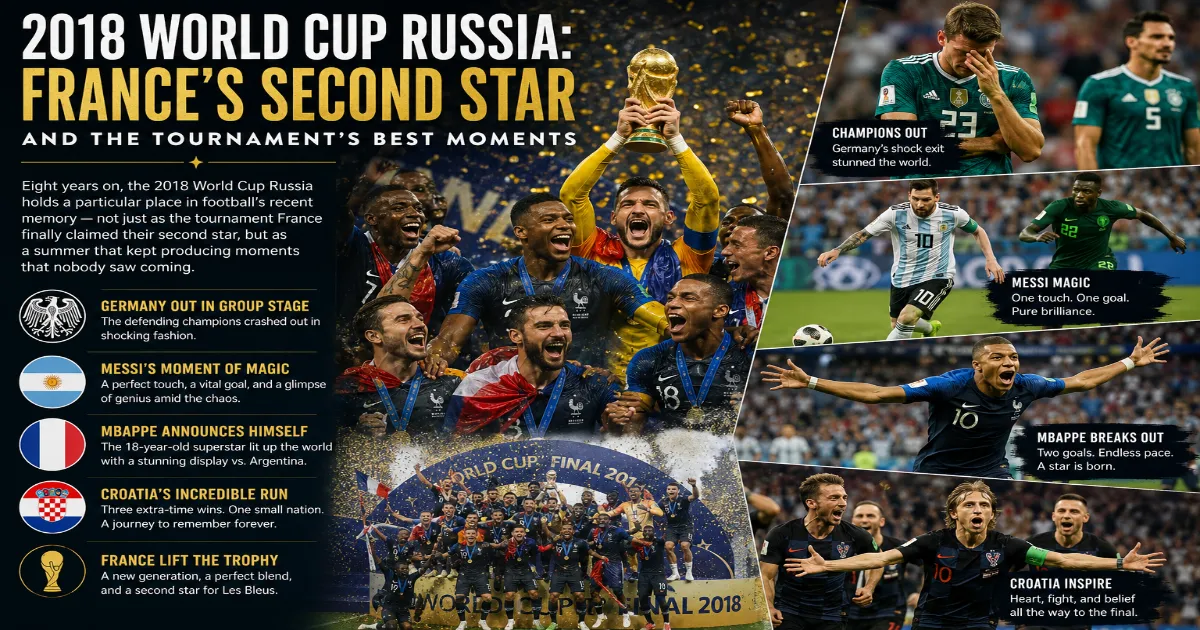
Eight years on, the 2018 World Cup Russia holds a particular place in football’s recent memory — not just as the tournament France finally claimed their second star, but as a summer that kept producing moments that nobody saw coming. Germany went home in the group stage. Argentina and Portugal followed in the round of 16. England actually won a penalty shootout. And Croatia, a nation of just four million people, reached the final on the back of three consecutive knockout victories that went to extra time and still managed to look like the most exciting team of the entire tournament for long stretches. Russia 2018 was, for all its political controversy off the pitch, a month of football that delivered almost everything the sport is capable of.World Cup 2026 Prize Money: What Every Team Actually Earned
From Tunisia to Spain: Every World Cup 2026 Team Ranked
ASEAN Championship 2026 Preview: A 30th Anniversary Like No Other
FIFA World Cup 2026 Attendance Record: How Big Was It, Really?
The Beginning Nobody Expected
The tournament announced its intentions almost immediately. Germany, the defending champions and widely regarded as one of the tournament’s three or four likely winners, drew their opening Group F match against Mexico 0-0 and then lost it. Hirving Lozano’s early goal from a first-time finish held up for the full ninety minutes, producing one of the tournament’s most memorable images: thousands of Mexicans celebrating so intensely in Mexico City that seismologists reportedly recorded minor ground vibrations in the city, an urban legend that turned out to be substantively true. Germany’s group stage implosion continued through a nervy win over Sweden — salvaged by Toni Kroos’s absurd last-minute free kick into the top corner — before a defeat to South Korea in the final group match sent them home without a point from their last two games. The defending world champions, eliminated in the group stage for the first time since 1938. The 2018 World Cup had declared very loudly that nothing was going to be straightforward.
Argentina’s Chaos and Messi’s One Perfect Moment
Argentina’s group stage was the tournament’s most entertaining disaster. Defensively disorganized, tactically inconsistent, and carrying the weight of a nation’s expectations almost entirely on Lionel Messi’s shoulders, they stumbled through Group D with a draw against Iceland, a 3-0 thrashing by Croatia, and a nervy late win over Nigeria. The Croatia match was the low point — Messi missed a penalty, goalkeeper Willy Caballero gifted Croatia their second goal with a horrific failed back-heel clearance in his own area, and Ivan Rakitić’s goal finished the humiliation.
But the Argentina-Nigeria match that followed produced one of the single greatest individual moments of the entire 2018 World Cup Russia. With Argentina needing a win and trailing at the break before equalizing through Messi, the tournament’s defining image from the group stage arrived in the second half: Messi controlling a driven pass with a first touch of such effortless perfection that it looked like the ball had been magnetized to his boot, holding off a defender, and finishing calmly. Argentina eventually won through an Oghenekaro Etebo own goal, scraped through to the round of 16, and were eliminated there by France in what turned out to be one of the tournament’s key moments.Spain Are World Champions: The Story of Their 2026 Triumph
Why So Much of the World Wanted Argentina to Fail
France vs England Live Score: Third-Place Playoff FIFA World Cup 2026, Goals & Highlights
France’s Journey in FIFA World Cup 2026: How the Dream Ended
The France vs. Argentina Masterclass
The round of 16 match between France and Argentina was the best single knockout game Russia 2018 produced, and it announced Kylian Mbappe to the world in a way that no club or international match had yet managed. At eighteen years old, Mbappe ran at Argentina’s defense repeatedly with a pace that looked qualitatively different from anything else happening on the pitch, won the penalty that Griezmann converted for France’s opening goal, and then scored twice in the second half to cap a 4-3 win — the last of those goals finishing a move he had started himself, forty meters upfield.
Mbappe became the second teenager after Pelé to score twice in a World Cup knockout match, a statistical company that reflects exactly how staggering the performance was. France had gone into the tournament as one of the obvious title favorites but without a clear idea of exactly how their best attacking combination worked. After Argentina, it was completely clear: Mbappe’s pace was the weapon everything else would be organized around, and Didier Deschamps spent the rest of the tournament making sure it stayed intact.
Belgium’s Run and the Match of the Tournament
If France vs. Argentina was the best knockout match, France vs. Belgium in the semifinal was the tournament’s most compelling tactical contest. Belgium, having produced some of the most exciting attacking football of any side in Russia with Kevin De Bruyne, Eden Hazard, and Romelu Lukaku all at or near their peak, ran into a Deschamps side that was simply not going to allow them the space those players need. Samuel Umtiti’s header from a Griezmann corner in the 51st minute was the game’s only goal, and watching both teams’ coaches in their respective technical areas as the clock wound down, each making micro-adjustments in real time, was a reminder of quite how much modern elite football is a manager’s game as much as a player’s.
The Belgium side of that era has since been discussed frequently as the most talented national team never to win a major tournament. That’s perhaps true of the collection of individual abilities in that squad — De Bruyne, Hazard, Lukaku, Thibaut Courtois, Dries Mertens, Toby Alderweireld. But France didn’t defeat them by being lucky. They defeated them by being more tactically organized, more difficult to break down, and more clear-eyed about how their own best players could hurt the opposition without unnecessarily exposing their defensive shape.Belgium’s World Cup Journey Ends in the Quarter-Finals Against Spain
Croatia and the Will to Win
Croatia’s run to the final was the tournament’s great romantic narrative, and it deserves to be treated as something more than simply a nice story, because the quality required to do what they did was genuinely exceptional. Reaching the final via three consecutive knockout victories that each went beyond ninety minutes — against Denmark on penalties, against Russia on penalties, and against England in extra time — required a combination of physical resilience, mental composure, and individual quality that very few national sides could sustain for that long. Luka Modrić was the tournament’s best player, a verdict almost nobody has seriously disputed in the years since, and his performances in each of those knockout matches showed a midfielder who had completely mastered the balance between controlling a game’s rhythm and producing the decisive moments when his side needed them most.
England’s semifinal defeat remains one of the more complicated emotional experiences for their fanbase, partly because for long stretches it felt like 2018 might actually be the year. Gareth Southgate had galvanized a squad without excessive star power into a genuinely unified, well-organized team, they won their first penalty shootout since 1996 against Colombia in the last eight, and they led Croatia in the semifinal through Kieran Trippier’s early free kick. Then Perisić equalized with a spectacular half-volley, and Mario Mandžukić’s extra-time winner ended England’s run, leaving them with their best World Cup result in 28 years but still short of the final.Croatia vs Ghana: Modric’s World Cup Farewell or Ghana’s Breakthrough — Group L’s Win-or-Go-Home Thriller
A Final for the Ages
The 2018 World Cup Russia final between France and Croatia delivered the spectacle the tournament deserved, though not in the way most neutrals expected. France won 4-2, but the match was far more chaotic and closely contested than that scoreline suggests. Mandžukić gave Croatia the lead with a first-half own goal from a Griezmann free kick, then equalized early in the second half with a finish that briefly made the competition genuinely open. Antoine Griezmann added a penalty in contentious circumstances — the handball by Ivan Perišić that prompted the VAR review and subsequent spot-kick remains one of the most debated moments of the match — before Paul Pogba and Mbappe added further goals to put it beyond any realistic comeback. Mandžukić’s late consolation made it 4-2, but Croatia never truly threatened to repeat the kind of late-tournament heroics they had managed to pull off earlier in the knockout rounds.
France’s second World Cup title, twenty years after the first on home soil in 1998, was built on a very different kind of football. The 1998 side, with Zidane orchestrating everything in midfield, was celebrated for its elegance as much as its effectiveness. Deschamps’ 2018 team was rather more direct and less immediately beautiful, with a defensive solidity and a specific reliance on Mbappe’s pace to carry the ball through transitions. Critics called it functional at the expense of artistry. Deschamps’ response, effective across the summer, was essentially that winning a World Cup was not an aesthetic competition.
The Moments That Will Last
Beyond the headlines, the 2018 World Cup Russia left a collection of images that will stay in football’s collective memory for the long term. Toni Kroos’ last-gasp free kick against Sweden, struck with his eyes apparently already looking ahead. The Belgian bench’s reaction when Nacer Chadli scored a stoppage-time winner against Japan to complete a 3-2 comeback from 2-0 down at half-time. Russia reaching a quarterfinal on home soil and eliminating Spain in a penalty shootout while the host nation’s fans produced the kind of noise that explains why tournament football, for all its organizational imperfections, remains the sport at its absolute most emotionally raw. Modrić holding the Golden Ball on a Moscow night and becoming the first player since Ronaldo in 2014 to win the award and not be named on the winning squad — a detail that somehow felt right, given how much more valuable than any trophy his performances had been across the tournament.
What It Left Behind
The 2018 World Cup Russia left football with Kylian Mbappe fully confirmed as the sport’s next dominant figure, France confirmed as world champions for the next four years, and a generation of debates about tactical pragmatism vs. attacking expression that are still running today. It left Croatia with a country’s worth of pride in a squad that reached the final of world football’s biggest competition and was unlucky to lose it, and Germany with a genuine reckoning about the gap between reputation and current quality that took several years and a complete squad rebuild to start closing again. It was, in short, a tournament that mattered — not just for what it decided, but for everything it set in motion.
Argentina 2022: Messi, Mbappe and the Greatest World Cup Final Ever Played
▪️▪️ Follow us on Facebook ▪️▪️
About the Author