Belgium Beat Senegal 3-2 After Extra Time in a World Cup 2026 Classic at Lumen Field
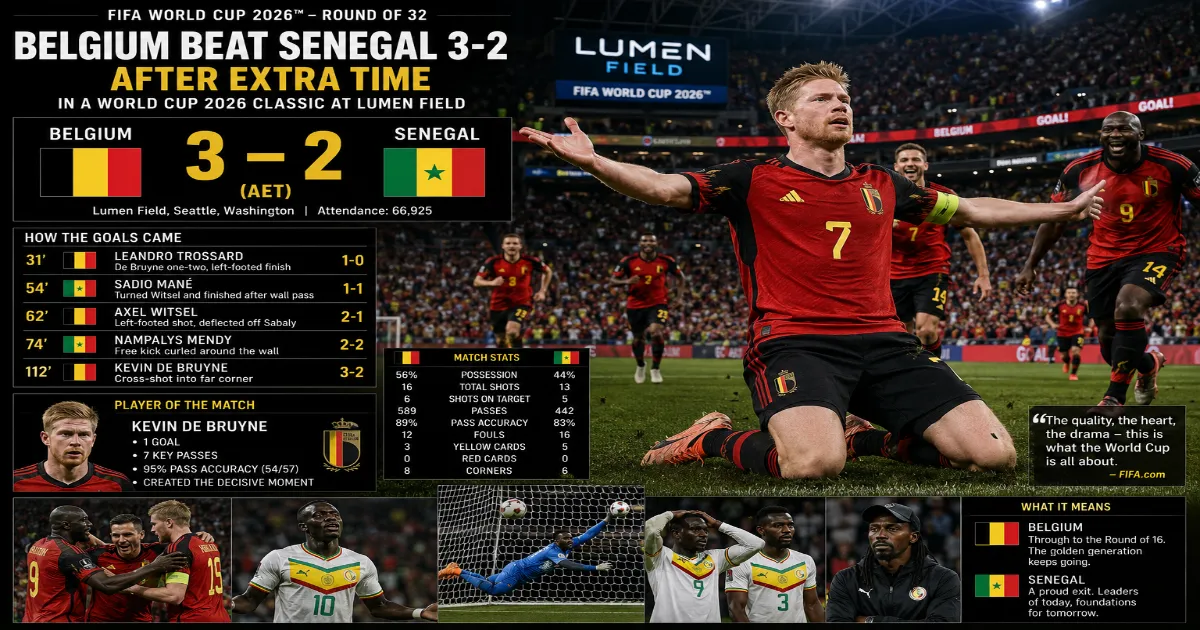
Belgium 3 – 2 Senegal (AET) | Lumen Field, Seattle, Washington | Attendance: 66,925
There were people inside Lumen Field on Tuesday who had never watched a football match before in their lives. You could tell them from the veteran supporters by how many times they checked their phones during play, trying to find something — anything — to anchor the emotional turbulence that a Belgium vs Senegal match of this quality puts you through for a hundred and twenty minutes. By the time Kevin De Bruyne’s cross-shot slid into the far corner deep in the second period of extra time to give Belgium a 3-2 lead that finally held, even the first-timers had abandoned their phones entirely. Nobody can explain to you what a match like this does to an audience. You just have to be inside the stadium when it happens.
A Slow Build That Caught Fire
Neither side came out looking to impose itself immediately, and in retrospect there was something deliberately cautious about the opening thirty minutes — two teams aware of how evenly matched they were, feeling for a foothold rather than committing to a style. Belgium sat in their familiar 4-2-3-1 shape, with Yannick Carrasco and Leandro Trossard as the wide men and De Bruyne operating just behind a Lukaku who appeared, in the opening stages, to be running slightly below his best pace. Senegal were organized and direct, with Ismaïla Sarr providing early width and threatening twice from set piece situations in the first quarter hour.
The goal that broke the deadlock arrived out of a spell of relative quiet. In the 31st minute, Trossard drifted infield from the left, exchanged a sharp one-two with De Bruyne, and placed a left-footed finish across Édouard Mendy into the bottom right corner. Trossard’s run, timed perfectly to exploit the space between Senegal’s holding midfielder and centre-back, was a piece of movement that exposed a fractional hesitation in the Senegalese defensive shape and punished it instantly. Belgium 1-0 Senegal, and the tie had found its tempo.
Mané Reminds Everyone
Senegal’s response was not to panic. It was almost the opposite — a deliberate, calm reset in which Aliou Cissé’s side began moving the ball through the lines with considerably more purpose than they had managed in the opening half-hour. The equalizer, when it arrived in the 54th minute, was built on exactly this renewed composure. Pape Matar Sarr played a diagonal pass into the feet of Sadio Mané, who had dropped deep to collect it, turned Axel Witsel in a single movement and drove forward before playing a wall pass with Iliman Ndiaye that pulled the return ball into the box with enough pace to wrong-foot Koen Casteels. Mané’s finish from eight meters was the kind of movement-plus-quality combination that has defined his career — not spectacular in its execution, but so precise that it never looked like it might go anywhere other than the net. 1-1, and Lumen Field produced the kind of noise you feel physically rather than just hear.
Lukaku’s Intervention and Senegal’s Answer
Belgium restored their advantage within ten minutes of the equalizer, and Romelu Lukaku was at the center of it. A long ball forward from Toby Alderweireld was controlled by Lukaku, who held off Kalidou Koulibaly with a combination of physical strength and positional awareness before rolling the ball sideways into the path of Axel Witsel arriving from deep. Witsel’s left-footed effort deflected off Youssouf Sabaly and looped over Mendy, a cruel bounce that left the Senegalese goalkeeper motionless. Belgium 2-1, and with thirty minutes of normal time remaining, the golden generation appeared to have one foot in the last sixteen.
Senegal, to their considerable credit, did not accept that verdict. A driving run from Ismaïla Sarr in the 74th minute drew a foul thirty meters from goal, and from the resulting free kick, Nampalys Mendy bent a right-footed effort around the Belgian wall and into the left corner of the net with a technique that suggested he had been practicing that exact delivery for most of his career. 2-2. Eighty-five minutes gone, five remaining in normal time, two teams locked together in a knockout match that neither side could find a way to separate. The referee’s whistle for full time sent the tie to extra time in front of a crowd that had by this point stopped caring about neutrality entirely and was simply cheering everything.
Extra Time’s Decisive Moment
Extra time produced thirty minutes of increasingly tense, increasingly physical football from two sides who had given everything across the first ninety. Chances were fewer but the moments that arrived carried more weight — Mendy saving brilliantly from a Dries Mertens header in the 95th minute, Amadou Onana’s fierce drive from the edge of the area skimming the crossbar at 104 minutes, Mané shooting wide from a position that the crowd behind the Belgian goal was already celebrating before the ball ran harmlessly across the face of goal.
Then, in the 112th minute, came the moment the match, and perhaps the tournament, will be most remembered for. De Bruyne received the ball on the right of the Senegalese penalty area, took one touch to set his feet, and drove a near-post cross-shot — the ambiguous delivery that a goalkeeper has to commit to before knowing whether it’s meant as a cross or a shot — that skimmed the far post and rolled into the corner of the net. De Bruyne turned without celebrating immediately, almost as if he was waiting to confirm it had actually gone in, then raised both arms as the Belgian bench erupted and the stadium noise hit a level that shook the scaffolding on the upper tier of the structure. Belgium 3-2.
What the Final Eight Minutes Felt Like
Eight minutes plus stoppage time of a World Cup Round of 32 knockout match, defending a one-goal lead against a Senegalese side with the energy of a team that believes it can still score. The final eight minutes at Lumen Field were, in any honest account, almost unbearable to watch. Every Senegalese set piece drew a collective intake of breath. Every Belgian clearance produced a release. Alderweireld, at 37 years old and playing what seems almost certain to be his last World Cup match, put his body into every challenge without hesitation. Casteels, who had been largely untested through normal time, was required to make an outstanding reflex save from Boulaye Dia in the third minute of stoppage time that preserved the lead almost as decisively as the goal that created it.
The referee’s final whistle, when it came, produced scenes that will go into the image archive of this World Cup: De Bruyne down on his knees, Lukaku embracing Mertens, Cissé standing alone on the touchline with his arms clasped behind his back for a long moment before composing himself to shake hands with Domenico Tedesco. Two sets of players for whom this tournament carried the unmistakable weight of a last chance. One set going home. One going through to the last sixteen.
Tactical Footnote
The match confirmed something tactically significant about Belgium that their group stage had hinted at but not quite proven: this side, even in the later stages of its golden generation, retains the quality to beat genuinely difficult opponents in one-off knockout matches as long as De Bruyne is operating anywhere close to his best level. His goal was the decisive contribution, but his general control of Belgium’s build-up play in the second half and extra time — completing passes under intense Senegalese pressure that kept Belgium moving forward when the opposition’s physical intensity might otherwise have suffocated them — was the less visible but arguably more important factor in a result that sends Belgium into a quarterfinal they couldn’t have been certain of reaching after the full time whistle had failed to separate them.
For Senegal, a tournament that once again showed the quality of the current generation of Senegalese football ends without the deep run the talent in this squad deserved. Mané, Koulibaly, and Mendy have now played their last World Cup. The next generation inherits a platform they helped build from the ground up.
About the Author