USA 2-0 Bosnia-Herzegovina: Hosts Advance With a Clinical World Cup 2026 Statement
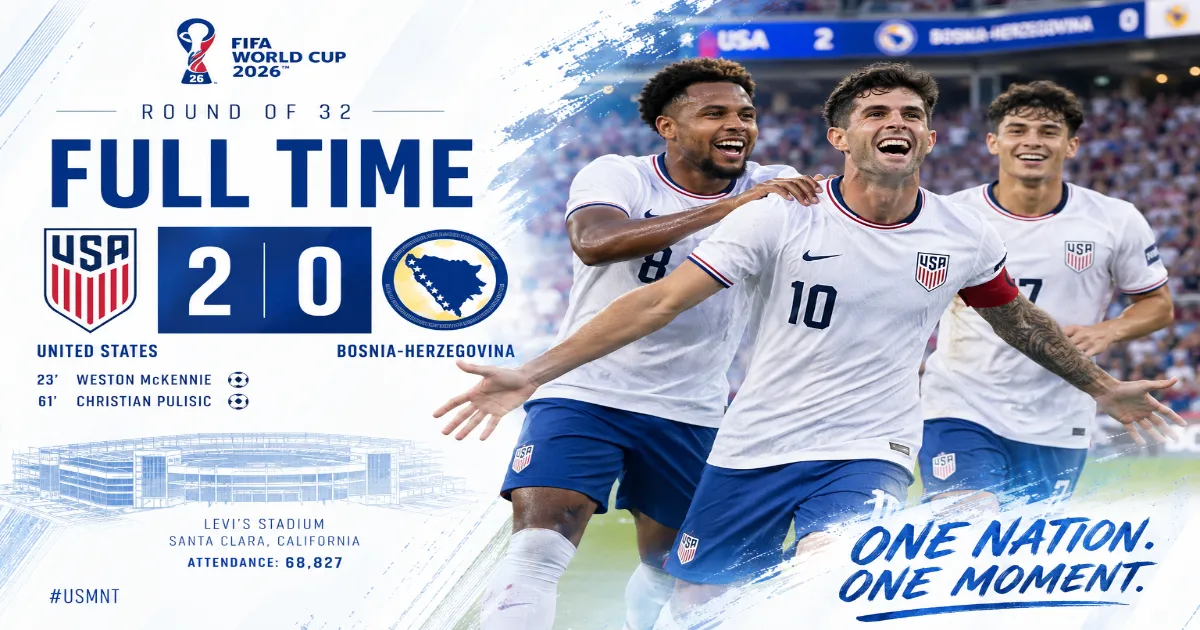
United States 2 – 0 Bosnia-Herzegovina | Levi’s Stadium, Santa Clara, California | Attendance: 68,827
There will be bigger wins at this World Cup. There might even be bigger performances from this USMNT squad before the tournament is over. But as statements of intent from a host nation that has spent the better part of a decade telling the world it belongs at this level — rather than just hosting it — the United States’ 2-0 dismantling of Bosnia-Herzegovina at Levi’s Stadium was as unambiguous as they come. No VAR drama. No late scramble. No penalty shootout reprieve. Just a performance controlled from start to finish, by a team that looked, for the first time in their World Cup history, completely comfortable at this level.From Backyards to Academies: USA Youth Soccer World Cup 2026 and the Making of a New Generation
The Next Pulisics: 10 USMNT youth talent Who Could Star at the 2030 World Cup
MLS 2026: Season Preview, Top Players & Why Soccer Is Exploding in America
Game State: Clinical From the First Whistle
Mauricio Pochettino set his side up in a 4-3-3 with Christian Pulisic operating centrally behind the striker, Tyler Adams anchoring the midfield, and Weston McKennie and Gio Reyna providing the energy on either side of him. The shape wasn’t surprising — Pochettino has used it consistently in big matches — but the intensity with which the United States pressed Bosnia in possession from the very first minute was markedly sharper than anything they had shown in the group stage.
Bosnia-Herzegovina, organized in a 5-3-2 that Sergej Barbarez had clearly set up to frustrate and absorb, found themselves unable to play out from their defensive block with any consistency. The press triggered early, with Pulisic leading it from the front and the wider midfielders pinching in to close the lanes that would normally allow a back five to work the ball across the defensive line. Within fifteen minutes, two Bosnian attempts to build possession from the goalkeeper had ended in turnovers inside Bosnia’s own half.
The Next Pulisics: 10 USMNT youth talent Who Could Star at the 2030 World Cup
The Goals That Decided It
The first arrived on 23 minutes and was, in its construction, almost a textbook demonstration of what Pochettino has spent two years trying to build. Gio Reyna received the ball on the right of the midfield block, played a sharp one-touch pass into Pulisic’s feet on the edge of the area, and continued his run inside the defender to receive a return ball in space. Reyna’s first-time cutback across the face of goal was met by an arriving run from McKennie, whose low, placed finish into the bottom right corner was taken with the composure of someone entirely untroubled by the occasion. The United States 1-0 Bosnia-Herzegovina, and the 68,827 inside Levi’s Stadium produced the kind of collective noise that Northern California isn’t typically associated with producing for association football.
Pulisic doubled the lead in the 61st minute, and if McKennie’s goal illustrated the team’s collective movement, Pulisic’s illustrated the individual quality that has carried him to this moment in his career. Collecting a deflected clearance on the edge of the box, he took one controlling touch to set his right foot and drove a low, daisy-cutter finish into the far corner, the goalkeeper wrong-footed by the placement rather than the pace. It was Pulisic’s fourth goal across the group stage and knockout rounds combined, making him the highest-scoring American at a single World Cup since Brian McBride’s three goals in 2002 — a comparison that lands differently now than it would have a year ago, given how much the standard of opposition has risen.
Bosnia’s Limitations and What They Showed
In fairness to Bosnia-Herzegovina, this was never the heaviest of draw brackets for a side that reached the Round of 32 as one of the eight third-placed qualifiers — the new format’s mechanism for rewarding consistent group-stage performances that fall just short of automatic qualification. Barbarez’s side showed the defensive resilience that got them through the group stage against stronger individual opposition in places, with goalkeeper Ibrahim Šehić making three good saves in the second half that prevented the scoreline from becoming a more emphatic reflection of the performance gap. But the fundamental limitation was clear from early: without sufficient quality in the press-resistant midfield positions, Bosnia couldn’t sustain any meaningful attacking possession long enough to threaten Matt Turner with any regularity.
The only serious moment of danger for the USA came in the 38th minute when Edin Džeko, operating as the deeper of Bosnia’s two centre-forwards, found space between Adams and McKennie and drove a shot from the edge of the area that Turner pushed away. It was a reminder that at 38 years old, Džeko remains a player of quality even at the very end of his international career, but also that a single moment of quality from a striker working almost entirely without service is not the foundation for a comeback in a match this controlled.
What Pochettino Has Built
The honest answer to the question of how good this United States side actually is will only become clear in the rounds ahead — the Round of 16 and beyond, against the kind of organized, technically superior opposition that doesn’t allow the same space in behind that Bosnia-Herzegovina’s back five conceded on the counter. But the performance metrics from this match suggest a team meaningfully more cohesive than the one Pochettino inherited in 2023. The pressing intensity in the first forty-five minutes registered as some of the highest of any team in this tournament, the defensive organization in transition was excellent throughout — Turner wasn’t asked to make a save from a clear-cut chance, which matters as much as the two goals — and the clinical conversion of chances, long a weakness of American football, looked like something that has been addressed rather than simply hoped for.United States v Belgium Preview: Pochettino’s Men Chase History
Reyna, in particular, continues to develop into the creative link the squad has sometimes lacked at its best. His role as the connective tissue between Adams’ deep press-resistance and Pulisic’s goal threat operated at a level this match that should concern whoever the US face next. Adams himself, meanwhile, turned in the kind of midfield-anchoring performance that explains why Pochettino rebuilt the team’s entire midfield structure around his particular skill set — winning the ball, distributing simply, and reading the game’s transitions before they develop.
Numbers That Tell the Story
The United States finished with 63% possession — their highest in any World Cup match ever — completed 87% of their attempted passes, registered ten shots with six on target, and conceded zero shots from clear-cut chances across the entire ninety minutes. For a country whose footballing narrative has historically been defined by resilience, passion, and the occasional upset of a larger footballing nation, those numbers represent something qualitatively different: a side that didn’t just compete — it controlled.
The Road Ahead
The United States advance to face Spain in the Round of 16 — a tie the entire tournament has been quietly anticipating since the draw. Spain, despite their own slightly uneven group-stage performances, remain one of the two or three technically superior sides left in the competition. This match gives every indication that the USMNT is capable of making it competitive, which for a nation still constructing its footballing identity at the highest level, may be the most encouraging aspect of the entire result.
The host nation is through. The host nation, for the first time, looked like they genuinely belonged.
Also reads :
Home Advantage or Home Pressure? The USMNT’s 2026 World Cup Report Card
Group D FIFA World Cup 2026: Can Anyone Stop the USMNT on Home Soil?
▪️▪️ follow us on facebook ▪️▪️
About the Author