Australia vs Egypt Preview: Two Nations Who Have Never Won a World Cup Knockout Match Collide in Arlington — and Whatever Happens, Football History Gets Rewritten
Australia vs Egypt at AT&T Stadium is a genuinely rare World Cup occasion — neither nation has ever recorded a knockout-stage victory at the tournament, and with Mohamed Salah’s fitness in doubt after a bandaged exit against Iran, both Mat Ryan’s defensive resilience and Egypt’s reliance on their global superstar will be tested simultaneously
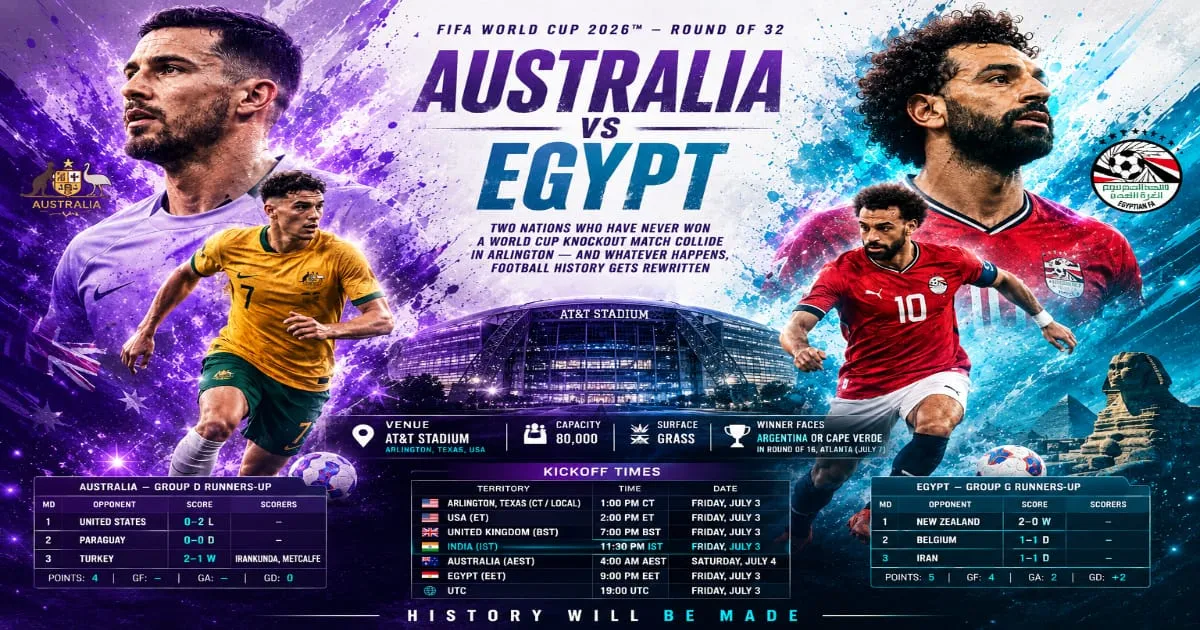
📍 VENUE & KICKOFF TIMES
| Territory | Time | Date |
|---|---|---|
| 🏟️ Arlington, Texas (CT / Local) | 1:00 PM CT | Friday, July 3 |
| 🇺🇸 USA (ET) | 2:00 PM ET | Friday, July 3 |
| 🇬🇧 United Kingdom (BST) | 7:00 PM BST | Friday, July 3 |
| 🇮🇳 India (IST) | 11:30 PM IST | Friday, July 3 |
| 🇦🇺 Australia (AEST) | 4:00 AM AEST | Saturday, July 4 |
| 🇪🇬 Egypt (EET) | 9:00 PM EET | Friday, July 3 |
| 🌐 UTC | 19:00 UTC | Friday, July 3 |
Venue: AT&T Stadium, Arlington, Texas, USA Capacity: 80,000 | Surface: Grass Winner faces: Argentina or Cape Verde in Round of 16, Atlanta (July 7)
A MATCH WHERE HISTORY IS GUARANTEED, REGARDLESS OF THE RESULT
There are World Cup fixtures where the historical stakes belong entirely to one side. Australia vs Egypt is not one of those fixtures. This is a genuinely rare occasion where both competing nations carry the exact same absence on their record books: Australia have never gone beyond the Round of 16 in their previous World Cup appearances, while Egypt have never advanced past the group stage in the modern era, making this a genuine milestone opportunity for whichever side prevails in Arlington.
Strip away the betting markets, the Mohamed Salah storylines, and the tactical analysis for a moment, and sit with that fact plainly: neither Australia nor Egypt has ever won a World Cup knockout match. Not once, between them, across decades of combined tournament history. Whoever wins at AT&T Stadium on July 3 will be doing something their country has genuinely never managed before. The Socceroos will be keen to claim their first-ever knockout win after falling short against eventual champions Argentina in the Round of 16 in Qatar.
That shared absence of knockout pedigree makes the psychological and tactical picture of this match considerably more layered than the bookmakers’ modest favourite-versus-underdog framing suggests.
EGYPT’S GROUP STAGE — CONSISTENCY, SALAH, AND A LATE FITNESS SCARE
Group G Results:
| MD | Opponent | Score | Scorers |
|---|---|---|---|
| 1 | New Zealand | 2–0 W | — |
| 2 | Belgium | 1–1 D | — |
| 3 | Iran | 1–1 D | — |
Points: 5 | GF: 4 | GA: 2 | GD: +2 | Group G Runners-Up
Egypt’s group stage was remarkably consistent. Drawing with Belgium, one of Europe’s established powers, and holding Iran while beating New Zealand points to a side that is difficult to put away. Egypt sealed its place in the knockout rounds with a 1-1 draw against Iran, but was denied top spot in Group G after Belgium thrashed New Zealand 5-1 to edge the Pharaohs on goal difference — a cruel piece of arithmetic that cost Egypt the group win despite their own result going exactly as required.
But the story emerging from that final group match carries more immediate consequence than the standings alone suggest. Mohamed Salah came off in the 57th minute in the Egypt-Iran match and was seen having his left leg bandaged. It’s still unclear whether Egyptian star player Mohamed Salah will play in the match against Australia. For a side whose attacking identity is built so significantly around a single individual, that uncertainty represents the single most important piece of team news heading into Arlington.
Star Players:
Mohamed Salah — the standout name by some margin, and the player around whom Egypt’s entire attacking structure is organised. Salah had a hand in five of Egypt’s six group-stage goal contributions, which sums up both his importance and the puzzle Australia have to solve — assuming he is fit to start. His decision-making in the final third, his finishing from inside and outside the penalty area, and his ability to drop into pockets of space that create overloads for Egypt’s other attackers have made him the single most influential individual performer for any African nation at this tournament. If his leg injury restricts his availability or effectiveness against Australia, Egypt’s attacking ceiling drops considerably.
Omar Marmoush — Egypt’s secondary attacking outlet and the player most likely to benefit if Australia’s defensive attention is disproportionately focused on Salah. His movement and his finishing instincts inside the box provide Egypt with a genuine alternative source of goals that prevents their attack from being entirely one-dimensional.
Egypt’s Tactical Identity: Egypt navigated a group with genuine pedigree in it. Their approach has been built around patient possession in midfield, width through their full-backs, and Salah’s individual quality providing the decisive difference in tight matches. Their defensive record — two goals conceded across three matches — reflects a well-organised structure that has not been significantly breached even against Belgium’s attacking quality.
Knockout Strategy: Hossam Hassan’s Egypt will look to control possession against Australia’s more direct approach, using their technical superiority in midfield to dictate tempo and create the spaces Salah — if fit — and Marmoush can exploit. If Salah is unavailable or restricted, Egypt’s plan must adapt toward a more collective attacking approach built on patient build-up and set-piece opportunities, where their organisation has been consistently reliable.
AUSTRALIA’S GROUP STAGE — THE SCENIC ROUTE TO ARLINGTON
Group D Results:
| MD | Opponent | Score | Scorers |
|---|---|---|---|
| 1 | United States | 0–2 L | — |
| 2 | Paraguay | 0–0 D | — |
| 3 | Turkey | (late winner) W | Irankunda, Metcalfe |
Points: 4 | GF: variable | GA: variable | GD: 0 | Group D Runners-Up
Australia took the scenic route through Group D — a flat opener against the hosts, a Paraguay draw that kept things in their own hands, and a late winner over Turkey that secured second on goals scored. The Socceroos backed into the last 32 on four points and a level goal difference, surviving a scrappy Group D alongside the USA, Paraguay and Turkey. It was not a campaign built on dominance — it was built on resilience, organisation, and the ability to find a single decisive moment when the group stage’s final match demanded it.
Star Players:
Nestory Irankunda — the Socceroos’ liveliest attacking spark, with a substitute’s goal in the group stage. His directness and pace on the flanks give Australia an attacking dimension that their more conservative overall approach does not always showcase. If Australia do find a goal against Egypt, the odds are it starts with him.
Connor Metcalfe — a midfield runner offering a secondary threat that Egypt will have to keep tabs on. His goal in the group stage and his energy in transitional moments make him the player most likely to provide Australia’s second source of attacking threat alongside Irankunda.
Mathew Ryan — the experienced goalkeeper with 104 caps, expected to continue in goal and central to any defensive resistance Australia mount against Egypt’s technical midfield and Salah’s individual quality. His distribution and shot-stopping under pressure will be tested far more rigorously against Egypt than it was across Australia’s group stage matches.
Australia’s Tactical Identity: Their 5-3-2 is well organised; the doubt is whether they can string together anything sustained against a side as assured on the ball as Egypt. Australia’s approach under their current setup prioritises defensive solidity and compactness over expansive possession-based football — a pragmatic structure built to frustrate technically superior opponents and create opportunities through set pieces and transitional moments rather than sustained build-up play.
Knockout Strategy: Australia will sit in their compact defensive shape, deny Egypt’s midfield the space to dictate tempo, and rely on Irankunda’s directness and Metcalfe’s late runs to convert the limited opportunities their structure generates. Australia have the defensive structure to drag it into the mud — and against an Egypt side whose attacking fluency depends significantly on Salah’s specific contribution, disrupting that single individual factor represents Australia’s clearest path to their first-ever World Cup knockout win.
THE SALAH QUESTION AND THE TACTICAL VERDICT
Everything about this match’s likely tactical shape depends substantially on one specific piece of team news: whether Mohamed Salah is fit enough to start, and if he starts, how restricted his movement and intensity will be following the bandaged left leg seen in the Iran match. Egypt with a fully functioning Salah are a meaningfully different attacking proposition than Egypt without him or with him operating at reduced capacity.
Egypt hold the better player, the stronger goal difference and the cleaner blueprint for a game like this. Australia have the defensive structure to drag it into the mud. The most realistic path to a result, regardless of Salah’s specific availability, runs through a low-scoring, tightly contested match where a single moment — a Salah strike, a Marmoush finish, an Irankunda counter-attack — decides which nation finally claims its first-ever World Cup knockout victory.
PREDICTED SCORE: Egypt 1–0 Australia Salah starts, manages his minutes carefully, and still finds the moment of quality that has defined Egypt’s entire group campaign. Australia’s resilience makes this far closer than the scoreline ultimately suggests — but Egypt’s superior technical quality, even compromised, is enough to deliver the historic first knockout win that has eluded both nations for generations.
Egypt’s Round of 16: vs Winner of Argentina vs Cape Verde, Tuesday July 7, Atlanta
FINAL GROUP STAGE RECORDS
| Team | P | W | D | L | GF | GA | GD | Pts |
|---|---|---|---|---|---|---|---|---|
| Egypt (Group G Runners-Up) | 3 | 1 | 2 | 0 | 4 | 2 | +2 | 5 |
| Australia (Group D Runners-Up) | 3 | 1 | 1 | 1 | — | — | 0 | 4 |
Read more article:
About the Author