Diego Maradona: Hero, Villain, Legend — The Full Life Story
There is a particular kind of athlete whose life story stops being a biography and starts being mythology, where fact and exaggeration blur together so completely that even the people who lived through it struggle to separate the two. Diego Maradona belongs entirely to that category. He was, depending on who you ask and which decade of his life you’re discussing, the greatest footballer who ever lived, a national savior, a disgraced cheat, an addict, a political symbol, and eventually a tragic figure whose body simply gave out under the weight of everything that had come before. All of those descriptions are accurate. None of them, alone, comes close to the whole story.
Villa Fiorito
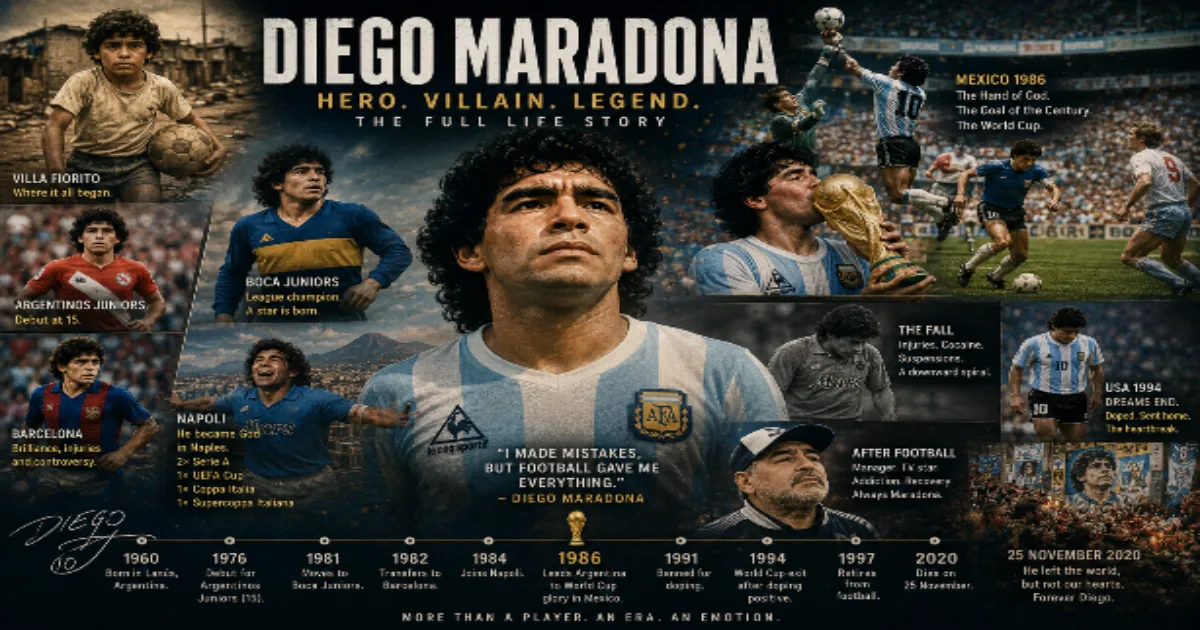
Diego Armando Maradona was born on October 30, 1960, in Lanús, Argentina, and grew up in Villa Fiorito, one of the poorest shantytowns on the outskirts of Buenos Aires. The family home had no running water for years, and Maradona later described his childhood with a bluntness that became characteristic of how he discussed his own life — not as a tragedy to be pitied, but as a fact to be stated plainly. Football was the one constant escape available to him, and by the time he was eight years old, local scouts in Buenos Aires were already talking about a kid who could do things with a ball that grown professionals couldn’t manage.
He joined the youth ranks of Argentinos Juniors and made his first-team debut at just fifteen years old, in October 1976, ten days before his sixteenth birthday. Footage from that period shows a player who looked physically unremarkable next to grown professionals but who controlled the ball with a low center of gravity and close control that simply didn’t match anything else on the pitch. Within a few seasons, every major club in Argentina, and several across Europe, were paying close attention.
Boca, the World Cup Snub, and Barcelona
Maradona moved to Boca Juniors in 1981, winning the Argentine league title in his only full season at the club and cementing himself as the country’s brightest young star. That same year, however, brought one of the more controversial decisions of his early career — not made by him, but about him. César Luis Menotti, Argentina’s head coach, left the 17-year-old Maradona out of the squad that won the 1978 World Cup on home soil, judging him too inexperienced for the tournament. Maradona would later say that missing out on that World Cup, watching his country lift the trophy without him, hurt more than almost anything else in his career up to that point.
He didn’t have to wait long for his chance. In 1982, Barcelona paid what was then a world record transfer fee to bring him to Spain, and his time at Camp Nou produced moments of brilliance alongside a string of misfortune that bordered on the absurd. He suffered a serious bout of hepatitis that sidelined him for months, and shortly after returning to fitness, he had his ankle broken in a horrific tackle by Athletic Bilbao’s Andoni Goikoetxea, an injury that required months of further recovery. His time in Spain is often remembered for one final, ugly note as well — a mass brawl during the 1984 Copa del Rey final against Bilbao, broadcast live on Spanish television, after which Maradona’s reputation in Spain never fully recovered.
Naples and the Birth of a Religion
If Barcelona represented frustration, what followed in Naples represented something closer to deification. Maradona signed for Napoli in 1984 for another world record fee, joining a club that had never won the Italian league title in its history and was regarded, fairly or not, as a provincial underdog in a competition dominated by the wealthier clubs of the north. Naples itself, a city that had long felt looked down upon by the rest of Italy, saw in Maradona something it desperately wanted — proof that it could compete with, and beat, the country’s traditional powers.
He delivered exactly that. Napoli won its first-ever Serie A title in the 1986-87 season, with Maradona as the unquestioned heart of the team, and added a second title in 1990 along with a UEFA Cup triumph in 1989. The city’s relationship with him went well beyond ordinary sporting admiration. Murals of his face still cover entire buildings in Naples today, and for a generation of Neapolitans, Maradona’s arrival represented one of the few moments their city felt like it stood above the rest of the country rather than beneath it.
Mexico 1986: The Hand of God and the Goal of the Century
If Naples made Maradona a deity in one city, the 1986 World Cup in Mexico made him one across the entire footballing world. Argentina arrived as a talented but unproven side, and Maradona simply willed them to the title almost single-handedly, contributing five goals and five assists across the tournament — a level of individual influence on a World Cup-winning campaign that has rarely, if ever, been matched before or since.
Two moments from that tournament defined how the rest of football would remember him forever, and they sit on opposite ends of the moral spectrum in a way that feels almost too neat to be true. In the quarterfinal against England, with the score level, Maradona punched the ball into the net with his hand, completely unseen by the referee, to give Argentina the lead — an act that became forever known as the “Hand of God.” Four minutes later, in the same match, he produced what is still widely regarded as the single greatest individual goal in World Cup history, collecting the ball in his own half and dribbling past five England players, including goalkeeper Peter Shilton, before slotting it into an empty net.
That single match, containing both the most notorious act of cheating and the most celebrated individual goal in the tournament’s history, captures the entire Maradona paradox in ninety minutes. He was capable of both kinds of brilliance, often within minutes of each other, and seemed entirely unbothered by the contradiction.
The Long Decline
What followed Mexico ’86 was a slower, sadder story than the triumphant first half of his career suggested was coming. Cocaine use, which had reportedly begun during his time in Barcelona, escalated significantly during his years in Naples, fueled in part by associations with organized crime figures that Maradona himself later admitted to. In 1991, he failed a drug test in Italy and received a fifteen-month ban from football, effectively ending his time at Napoli in disgrace rather than celebration.
He returned for the 1994 World Cup in the United States with Argentina, producing two impressive performances before being expelled from the tournament after testing positive for ephedrine, a banned stimulant. The image of Maradona being led away from the pitch by a doping official, confused and furious in equal measure, became one of the defining and most uncomfortable images of his playing career’s final chapter. He drifted through brief spells at smaller clubs afterward, his body increasingly unable to match the demands his talent had once made look effortless, before retiring in 1997 following a short, largely symbolic return to Boca Juniors.
Life After Football
Retirement did not bring stability. Maradona’s struggles with cocaine addiction continued well into the 2000s, accompanied by serious weight gain and at least one medically induced coma following a cocaine-related heart episode in 2004 that briefly appeared to threaten his life. He underwent gastric bypass surgery the following year and experienced a period of improved health, even hosting his own television talk show in Argentina, where his magnetic, unpredictable personality translated surprisingly well to the format.
His managerial career produced a similarly mixed record to his post-playing personal life. He took charge of the Argentine national team for the 2010 World Cup in South Africa, guiding them through the group stage before a heavy 4-0 quarterfinal defeat to Germany ended the tenure. Subsequent club jobs in the United Arab Emirates, Mexico, and elsewhere produced occasional moments of success but rarely the sustained stability his reputation as a player might have suggested.
Death and a Nation’s Grief
Diego Maradona died on November 25, 2020, of a heart attack at his home in Buenos Aires province, at the age of 60. The Argentine government declared three days of national mourning, and tens of thousands of people lined up for hours outside the presidential palace in Buenos Aires to file past his coffin. Tributes poured in from every corner of the football world, from teammates and rivals alike, many of whom had spent decades publicly debating his flaws while privately never doubting his genius.
The scenes of grief that followed his death said something important about how Argentina, and football more broadly, had come to view him by the end. The arguments about doping bans, addiction, and personal scandal hadn’t disappeared, but they had become secondary to something larger: a recognition that very few human beings have ever made a sport feel as alive, as unpredictable, and as capable of pure joy as Diego Maradona did every time he had a ball at his feet.
Hero, Villain, Legend
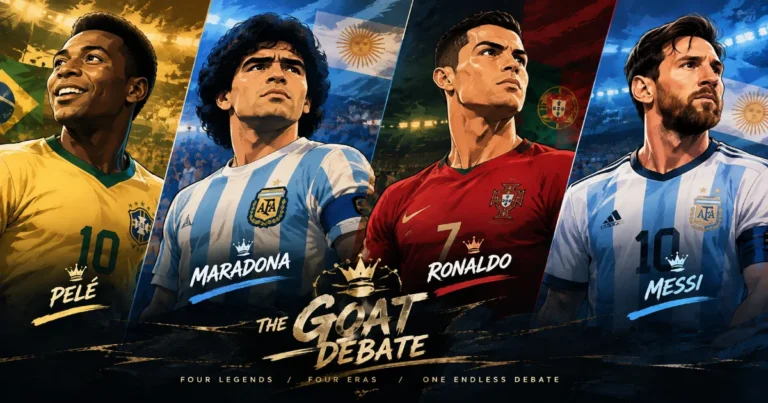
Trying to sum up Diego Maradona in a single word has always been a losing exercise, which is precisely why three words fit better than one. He was a hero to Naples and to Argentina, a villain to English football fans who never fully forgave the Hand of God, and a legend to absolutely everyone who watched him dribble past five players in Mexico and understood, instantly, that they were watching something that wouldn’t be repeated. Decades on, with Messi having long since matched and arguably surpassed his trophy haul, the debate over who was truly the greatest still somehow tends to circle back to Maradona — not necessarily because the statistics favor him, but because no career in football’s history has ever managed to be quite this much, all at once.
That, in the end, may be the truest tribute available to him. Other players are remembered for what they won. Diego Maradona is remembered for how completely he made people feel something — joy, fury, awe, heartbreak, sometimes all four within a single match — and football has rarely, if ever, produced anyone capable of doing that so consistently across an entire lifetime.
: Hero, Villain, Legend — The Full Life Story
There is a particular kind of athlete whose life story stops being a biography and starts being mythology, where fact and exaggeration blur together so completely that even the people who lived through it struggle to separate the two. Diego Maradona belongs entirely to that category. He was, depending on who you ask and which decade of his life you’re discussing, the greatest footballer who ever lived, a national savior, a disgraced cheat, an addict, a political symbol, and eventually a tragic figure whose body simply gave out under the weight of everything that had come before. All of those descriptions are accurate. None of them, alone, comes close to the whole story.
Villa Fiorito
Diego Armando Maradona was born on October 30, 1960, in Lanús, Argentina, and grew up in Villa Fiorito, one of the poorest shantytowns on the outskirts of Buenos Aires. The family home had no running water for years, and Maradona later described his childhood with a bluntness that became characteristic of how he discussed his own life — not as a tragedy to be pitied, but as a fact to be stated plainly. Football was the one constant escape available to him, and by the time he was eight years old, local scouts in Buenos Aires were already talking about a kid who could do things with a ball that grown professionals couldn’t manage.
He joined the youth ranks of Argentinos Juniors and made his first-team debut at just fifteen years old, in October 1976, ten days before his sixteenth birthday. Footage from that period shows a player who looked physically unremarkable next to grown professionals but who controlled the ball with a low center of gravity and close control that simply didn’t match anything else on the pitch. Within a few seasons, every major club in Argentina, and several across Europe, were paying close attention.
Boca, the World Cup Snub, and Barcelona
Maradona moved to Boca Juniors in 1981, winning the Argentine league title in his only full season at the club and cementing himself as the country’s brightest young star. That same year, however, brought one of the more controversial decisions of his early career — not made by him, but about him. César Luis Menotti, Argentina’s head coach, left the 17-year-old Maradona out of the squad that won the 1978 World Cup on home soil, judging him too inexperienced for the tournament. Maradona would later say that missing out on that World Cup, watching his country lift the trophy without him, hurt more than almost anything else in his career up to that point.
He didn’t have to wait long for his chance. In 1982, Barcelona paid what was then a world record transfer fee to bring him to Spain, and his time at Camp Nou produced moments of brilliance alongside a string of misfortune that bordered on the absurd. He suffered a serious bout of hepatitis that sidelined him for months, and shortly after returning to fitness, he had his ankle broken in a horrific tackle by Athletic Bilbao’s Andoni Goikoetxea, an injury that required months of further recovery. His time in Spain is often remembered for one final, ugly note as well — a mass brawl during the 1984 Copa del Rey final against Bilbao, broadcast live on Spanish television, after which Maradona’s reputation in Spain never fully recovered.
Naples and the Birth of a Religion
If Barcelona represented frustration, what followed in Naples represented something closer to deification. Maradona signed for Napoli in 1984 for another world record fee, joining a club that had never won the Italian league title in its history and was regarded, fairly or not, as a provincial underdog in a competition dominated by the wealthier clubs of the north. Naples itself, a city that had long felt looked down upon by the rest of Italy, saw in Maradona something it desperately wanted — proof that it could compete with, and beat, the country’s traditional powers.
He delivered exactly that. Napoli won its first-ever Serie A title in the 1986-87 season, with Maradona as the unquestioned heart of the team, and added a second title in 1990 along with a UEFA Cup triumph in 1989. The city’s relationship with him went well beyond ordinary sporting admiration. Murals of his face still cover entire buildings in Naples today, and for a generation of Neapolitans, Maradona’s arrival represented one of the few moments their city felt like it stood above the rest of the country rather than beneath it.
Mexico 1986: The Hand of God and the Goal of the Century
If Naples made Maradona a deity in one city, the 1986 World Cup in Mexico made him one across the entire footballing world. Argentina arrived as a talented but unproven side, and Maradona simply willed them to the title almost single-handedly, contributing five goals and five assists across the tournament — a level of individual influence on a World Cup-winning campaign that has rarely, if ever, been matched before or since.
Two moments from that tournament defined how the rest of football would remember him forever, and they sit on opposite ends of the moral spectrum in a way that feels almost too neat to be true. In the quarterfinal against England, with the score level, Maradona punched the ball into the net with his hand, completely unseen by the referee, to give Argentina the lead — an act that became forever known as the “Hand of God.” Four minutes later, in the same match, he produced what is still widely regarded as the single greatest individual goal in World Cup history, collecting the ball in his own half and dribbling past five England players, including goalkeeper Peter Shilton, before slotting it into an empty net.
That single match, containing both the most notorious act of cheating and the most celebrated individual goal in the tournament’s history, captures the entire Maradona paradox in ninety minutes. He was capable of both kinds of brilliance, often within minutes of each other, and seemed entirely unbothered by the contradiction.
The Long Decline
What followed Mexico ’86 was a slower, sadder story than the triumphant first half of his career suggested was coming. Cocaine use, which had reportedly begun during his time in Barcelona, escalated significantly during his years in Naples, fueled in part by associations with organized crime figures that Maradona himself later admitted to. In 1991, he failed a drug test in Italy and received a fifteen-month ban from football, effectively ending his time at Napoli in disgrace rather than celebration.
He returned for the 1994 World Cup in the United States with Argentina, producing two impressive performances before being expelled from the tournament after testing positive for ephedrine, a banned stimulant. The image of Maradona being led away from the pitch by a doping official, confused and furious in equal measure, became one of the defining and most uncomfortable images of his playing career’s final chapter. He drifted through brief spells at smaller clubs afterward, his body increasingly unable to match the demands his talent had once made look effortless, before retiring in 1997 following a short, largely symbolic return to Boca Juniors.
Life After Football
Retirement did not bring stability. Maradona’s struggles with cocaine addiction continued well into the 2000s, accompanied by serious weight gain and at least one medically induced coma following a cocaine-related heart episode in 2004 that briefly appeared to threaten his life. He underwent gastric bypass surgery the following year and experienced a period of improved health, even hosting his own television talk show in Argentina, where his magnetic, unpredictable personality translated surprisingly well to the format.
His managerial career produced a similarly mixed record to his post-playing personal life. He took charge of the Argentine national team for the 2010 World Cup in South Africa, guiding them through the group stage before a heavy 4-0 quarterfinal defeat to Germany ended the tenure. Subsequent club jobs in the United Arab Emirates, Mexico, and elsewhere produced occasional moments of success but rarely the sustained stability his reputation as a player might have suggested.
Death and a Nation’s Grief
Diego Maradona died on November 25, 2020, of a heart attack at his home in Buenos Aires province, at the age of 60. The Argentine government declared three days of national mourning, and tens of thousands of people lined up for hours outside the presidential palace in Buenos Aires to file past his coffin. Tributes poured in from every corner of the football world, from teammates and rivals alike, many of whom had spent decades publicly debating his flaws while privately never doubting his genius.
The scenes of grief that followed his death said something important about how Argentina, and football more broadly, had come to view him by the end. The arguments about doping bans, addiction, and personal scandal hadn’t disappeared, but they had become secondary to something larger: a recognition that very few human beings have ever made a sport feel as alive, as unpredictable, and as capable of pure joy as Diego Maradona did every time he had a ball at his feet.
Hero, Villain, Legend
Trying to sum up Diego Maradona in a single word has always been a losing exercise, which is precisely why three words fit better than one. He was a hero to Naples and to Argentina, a villain to English football fans who never fully forgave the Hand of God, and a legend to absolutely everyone who watched him dribble past five players in Mexico and understood, instantly, that they were watching something that wouldn’t be repeated. Decades on, with Messi having long since matched and arguably surpassed his trophy haul, the debate over who was truly the greatest still somehow tends to circle back to Maradona — not necessarily because the statistics favor him, but because no career in football’s history has ever managed to be quite this much, all at once.
That, in the end, may be the truest tribute available to him. Other players are remembered for what they won. Diego Maradona is remembered for how completely he made people feel something — joy, fury, awe, heartbreak, sometimes all four within a single match — and football has rarely, if ever, produced anyone capable of doing that so consistently across an entire lifetime.
▪️▪️ Follow us on Facebook ▪️▪️
Argentina 2022: Messi, Mbappe and the Greatest World Cup Final Ever Played
Neymar Lifestyle Comeback: The Fortune, the Fight, and the Final World Cup
Messi World Cup Goals: Every Goal, Every Record and Every Defining Moment From 2006 to 2026
About the Author