The 1970 Brazil World Cup Team: The Greatest Side to Ever Play the Game?
Ask ten football historians to name the greatest team of all time, and at least seven will say Brazil 1970 before you finish the question. It’s the answer that has survived decades of statistical scrutiny, tactical re-evaluation, and the arrival of genuinely brilliant modern sides — Spain’s 2010-2012 era, Pep Guardiola’s Barcelona, France’s 2018 vintage. None of them have fully dislodged Mexico ’70 from its perch. Understanding why requires looking past the nostalgia and actually examining what that Brazilian side did on the pitch, because the tactical case turns out to be just as strong as the romantic one.
A Squad Built From Crisis
It’s easy to forget that Brazil arrived at the 1970 World Cup carrying real anxiety rather than swagger. They had been eliminated in the group stage of the 1966 tournament in England, a humiliating exit for a nation that had won two of the previous four World Cups. Pelé, kicked relentlessly out of that tournament by opposing defenders with little fear of punishment, had reportedly considered walking away from international football altogether. The federation went through three different head coaches in the eighteen months before the tournament, eventually settling on João Saldanha before a mix of political pressure and Saldanha’s own combative personality led to his removal just months before the World Cup began. Mário Zagallo, a World Cup winner himself as a player in 1958 and 1962, took over with barely any time to leave his own tactical fingerprint — and somehow built the most attacking, fluid system the tournament had ever seen anyway.
This context matters because it punctures the idea that the 1970 Brazilian World Cup team was some inevitable, preordained masterpiece. It was assembled under real pressure, with real doubts about whether Brazil could even get out of its own group, let alone win the tournament outright.
The Front Five That Changed Attacking Football
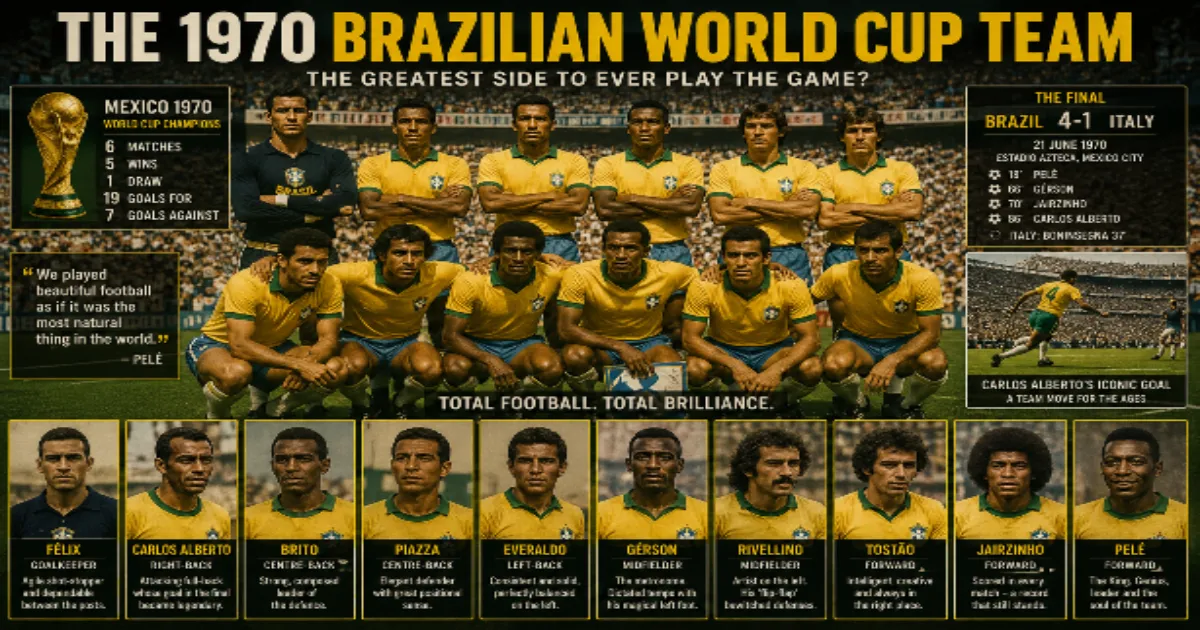
What made this Brazil side different from anything before it, and arguably anything since, was the sheer density of attacking talent it fielded simultaneously without sacrificing structure entirely. Pelé played as the focal point, dropping into pockets and combining rather than simply staying central and waiting for service. Jairzinho operated from the right but drifted infield constantly, scoring in every single match of the tournament — still the only player in World Cup history to manage that feat across an entire campaign. Tostão, recovering from a serious eye injury that had nearly ended his career less than a year earlier, played as a false nine of sorts, dropping deep to link play and create space for the runners around him. Rivellino patrolled the left, equally capable of beating a man with his trademark “flip-flap” move or switching play with a long diagonal pass. And behind all four of them sat Gérson, the deepest of the group, dictating tempo with a left foot that could change the angle of an attack in a single touch.
Five attacking players, all technically excellent, all capable of playing in more than one position, all given license to interchange freely. Most international sides of the era organized around a single creative outlet. Brazil had five, and somehow none of them got in each other’s way.
Carlos Alberto and the Goal That Explains Everything
If one moment crystallizes why this team still gets discussed in reverent terms more than fifty years later, it’s the fourth goal in the final against Italy. The move begins deep in Brazil’s own half, passes through nearly the entire outfield XI, and ends with right-back Carlos Alberto arriving at full sprint to smash a first-time shot into the corner of the net — a goal that requires no slow-motion replay to appreciate, because it was constructed in real time, in front of nearly 108,000 people in the Azteca Stadium, against a defensively excellent Italian side that had conceded almost nothing all tournament.
What’s often missed in highlight reels is what that goal says about the team’s structure. A right-back finishing a move that traveled through nine outfield players tells you everything about how positionally fluid this Brazil side actually was. Carlos Alberto wasn’t an auxiliary attacker bombing forward occasionally — he was a genuine extra attacking option that opposing defenses had to account for on every single possession, which meant Brazil effectively played with more attackers than any opponent could realistically track.
The Defense Nobody Talks About
The conventional story of the 1970 Brazilian World Cup team focuses almost entirely on the attack, and for good reason, but it tends to flatten a more complicated truth: this defense was not actually as porous as its reputation suggests, even if it wasn’t the side’s strongest department. Brazil conceded seven goals across six matches, a perfectly respectable return for a team that scored nineteen. Goalkeeper Félix had a mixed tournament by his own admission, and the back line built around Carlos Alberto, Brito, Piazza, and Everaldo was functional rather than spectacular. But the broader tactical genius of this Brazil side was making defensive solidity almost beside the point. When you control possession this completely and create this many chances, the opponent simply doesn’t get enough opportunities to expose whatever defensive gaps exist.
This is a lesson that modern possession-based sides would later formalize into doctrine — that the best defense is sustained attacking control — but Brazil 1970 was doing it instinctively, more than two decades before pressing triggers and possession metrics became standard parts of football’s tactical vocabulary.
The Final Against Italy
The 1970 World Cup final remains one of the most one-sided showcases in the competition’s history, and it arrived against an Italian side that genuinely deserved its place in the final, having ground out a famous 4-3 extra-time win over West Germany in the semifinal, a match still referred to in Italy as the “Game of the Century.” Italy’s catenaccio system had suffocated almost every opponent it faced that tournament. Brazil dismantled it anyway, winning 4-1 with a performance that felt less like a tactical battle and more like a public demonstration of a different sport being played at a higher resolution.
Pelé opened the scoring with a header, his combination of jumping timing and hang time making the goal look almost effortless against a defense that had conceded next to nothing all tournament. Italy equalized before Brazil pulled away in the second half, with Gérson, Jairzinho, and finally Carlos Alberto putting the result beyond doubt. By full time, even Italian supporters in the stadium had reportedly applauded the Brazilian performance — a rare gesture of respect from a nation watching its own team lose a World Cup final.
Why This Team Still Wins the Argument
The case against the 1970 Brazilian World Cup team usually comes down to one argument: the era. Football in 1970 was less tactically sophisticated, less physically demanding, and played against a smaller pool of genuinely elite opposition compared to the modern game. There’s some validity to that critique, and it’s worth taking seriously rather than dismissing outright.
But the counter-argument has aged remarkably well too. No team since has combined this level of individual technical quality across an entire starting XI with this degree of attacking freedom and still won the tournament outright. Spain’s golden generation arguably matched Brazil’s technical density but built its success on patient possession rather than the vertical, joyful attacking football Brazil produced. Modern sides that play with similar attacking ambition tend to sacrifice defensive solidity in ways Brazil largely avoided by simply controlling games from start to finish.Neymar Returns as Ancelotti Targets Sixth Title: Brazil’s Powerful 26-Man Squad for FIFA World Cup 2026
There is also the matter of legacy and influence. Brazil 1970 didn’t just win a World Cup — it changed how the sport was marketed, broadcast, and remembered. It was the first World Cup televised in color globally, and the footage of Pelé, Jairzinho, and Carlos Alberto in those iconic yellow shirts became the visual template for what attacking football was supposed to look like for the next half-century. Coaches still reference this team’s shape and freedom when explaining what they’re trying to build, more than fifty years after the final whistle blew in the Azteca.
The Players Who Became Legends in Their Own Right
Part of what cements this team’s reputation is how many of its individual members went on to define their positions for decades afterward, even outside the context of that single tournament. Pelé’s case needs little elaboration; by 1970 he was already a two-time World Cup winner, and Mexico simply added a third star above the crest and removed any lingering doubt about his status as the sport’s defining figure. Jairzinho’s achievement of scoring in every match of a World Cup remains unmatched more than fifty years later, a record that has survived eras of far greater squad depth and rotation. Carlos Alberto’s final goal became so iconic that it is still used in coaching sessions today as the textbook example of a team move finished with conviction rather than hesitation.
Even the less celebrated names from that squad carried real influence forward. Gérson went on to become one of Brazilian football’s most respected voices in retirement, frequently consulted on tactical matters well into his eighties. Rivellino’s dribbling technique, particularly his signature elastico-style move, became a staple that generations of Brazilian wingers would study and attempt to replicate. Zagallo himself would go on to work as part of Brazil’s coaching staff during their 1994 World Cup win, making him the first person to be involved in four separate World Cup-winning campaigns in different capacities — a quiet but remarkable footnote to a coaching career that began, almost accidentally, with this very team.
That density of lasting individual impact is itself part of the argument for this side’s greatness. It wasn’t simply that eleven good players happened to peak in the same tournament. Several of them went on to shape the next several decades of the sport in some way, whether through records that still stand, techniques still being taught, or institutional roles in Brazilian football that extended their influence long after their playing careers ended.The 1966 World Cup: England’s Greatest Achievement Revisited 60 Years On
The Verdict
Greatest ever is always going to be a subjective argument, shaped by era, nostalgia, and personal taste in football. But few teams in the sport’s history have combined this much individual brilliance with this much collective fluidity and walked away with the trophy as comfortably as Brazil did in 1970. Whether or not you call it the single greatest side ever assembled, it’s hard to argue against it being the most influential — the team every subsequent generation of attacking football has, knowingly or not, been chasing ever since.
▪️▪️ Follow us on Facebook ▪️▪️
Endrick FIFA World Cup 2026: Brazil’s Prodigy Returns — Profile, Stats & Prediction
About the Author