Only eight nations have ever been crowned world champions — here’s how they stack up in the race for the most World Cups in football history
There is no bigger prize in football than the FIFA World Cup, and yet in nearly a century of trying, only eight countries have actually managed to lift it. That scarcity is what makes the conversation around the most World Cups won by a single nation so compelling. Since Uruguay hosted and won the very first tournament in 1930, the trophy has been passed between a tight circle of footballing superpowers — nearly all of them from Europe or South America.
As the 2026 edition unfolds across the United States, Canada and Mexico with a record 48 teams, it’s the perfect moment to look back at every nation that has ever climbed to the summit of the sport. Some have built dynasties. Others caught lightning in a bottle just once. This is the definitive countdown of the countries with the most World Cups, ranked from one triumph to five.
The Eight-Nation Club: A Quick Overview
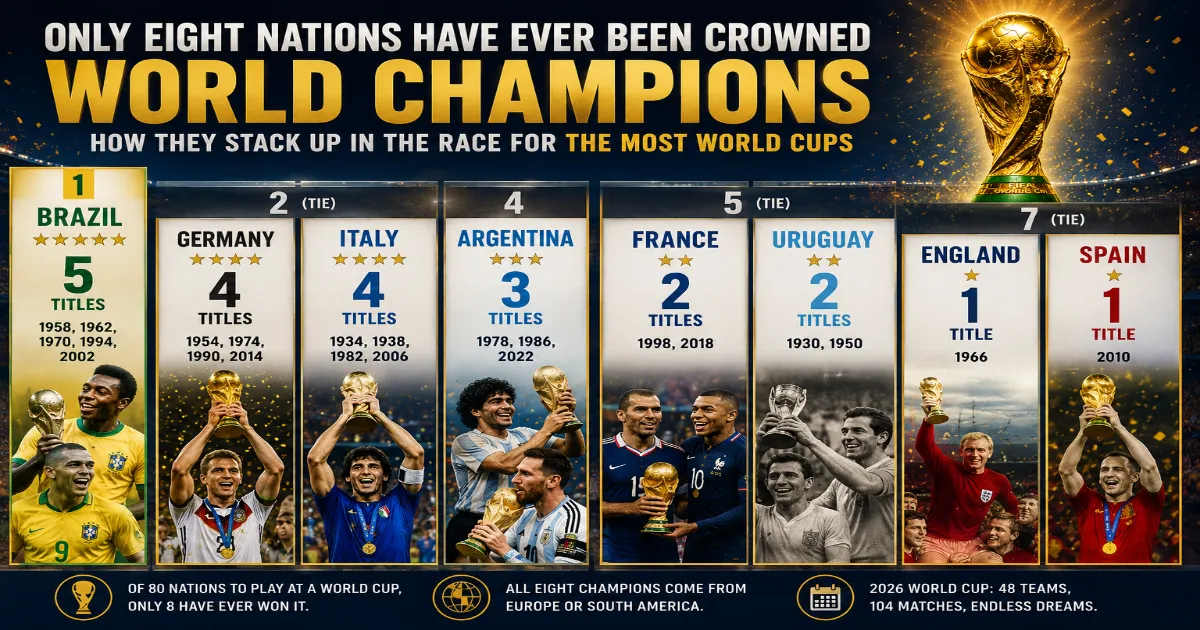
Before diving into the countdown, it’s worth appreciating just how exclusive this list is. Of the 80 nations that have appeared at a World Cup finals tournament, only 13 have ever reached the final, and only 8 have actually won it. Every single champion has come from either UEFA (Europe) or CONMEBOL (South America) — no team from Africa, Asia, North America, or Oceania has ever won the World Cup, though the expanded 48-team format for 2026 is designed in part to widen that gap of opportunity over time.
Here’s the full breakdown of the nations with the most World Cups, before we rank them one by one.
| Rank | Nation | Titles | Years Won |
|---|---|---|---|
| 1 | Brazil | 5 | 1958, 1962, 1970, 1994, 2002 |
| 2 (tie) | Germany | 4 | 1954, 1974, 1990, 2014 |
| 2 (tie) | Italy | 4 | 1934, 1938, 1982, 2006 |
| 4 | Argentina | 3 | 1978, 1986, 2022 |
| 5 (tie) | France | 2 | 1998, 2018 |
| 5 (tie) | Uruguay | 2 | 1930, 1950 |
| 7 (tie) | England | 1 | 1966 |
| 7 (tie) | Spain | 1 | 2010 |
Now, let’s go through the countdown in detail.
7 . Spain — 1 Title
Spain spent decades as a nation of brilliant individual talents that consistently underachieved on the world stage, often bowing out in agonizing fashion to smaller footballing nations. That changed dramatically between 2008 and 2012, when a golden generation built around Xavi, Andrés Iniesta and a suffocating tiki-taka passing style won three consecutive major tournaments. The centerpiece was the 2010 World Cup in South Africa, where Spain ground out a string of 1-0 victories, capped by Iniesta’s extra-time winner over the Netherlands in the final. It remains Spain’s only World Cup, but it arrived at the peak of arguably the most dominant possession-based team the sport has ever produced.Lamine Yamal FIFA World Cup 2026: Profile, Stats & Career | StrikerReport
7. England — 1 Title
England’s solitary World Cup came on home soil in 1966, when Bobby Moore lifted the trophy after a 4-2 extra-time win over West Germany at Wembley — a final still remembered for Geoff Hurst’s controversial hat-trick, including the goal that may or may not have crossed the line. Nearly six decades later, that triumph remains the benchmark against which every England generation is measured. Deep runs at recent tournaments, including the 2018 semi-final and the 2022 quarter-final, have kept hope alive, but the wait for a second star on the shirt continues.Harry Kane FIFA World Cup 2026: England’s Captain, Record-Breaker & Last Chance at Glory
5. Uruguay — 2 Titles
Uruguay holds a unique place in World Cup history as the tournament’s very first champion, beating Argentina 4-2 in front of a home crowd in Montevideo in 1930. Twenty years later came an even more famous triumph: the 1950 “Maracanazo,” when Uruguay stunned host nation Brazil 2-1 in front of nearly 200,000 spectators at the Maracanã, silencing a country that had assumed the title was already won. Despite a population of just 3.4 million, Uruguay remains one of only eight nations with multiple World Cups, a testament to a footballing culture that consistently punches above its weight.
5. France — 2 Titles
France’s first World Cup arrived in 1998 as tournament hosts, with Zinedine Zidane scoring twice in a 3-0 demolition of Brazil in the final. Two decades later, a new generation led by a teenage Kylian Mbappé won again in Russia, defeating Croatia 4-2 in one of the most entertaining finals in tournament history. France also came agonizingly close to a third title in 2022, only for Argentina to edge them on penalties after a legendary 3-3 draw. With Mbappé still in his prime, France remains one of the favorites to add to their tally in future editions.
4. Argentina — 3 Titles
Argentina’s World Cup story is inseparable from two of the greatest players the sport has ever seen. Diego Maradona single-handedly dragged Argentina to glory in 1986, including his infamous “Hand of God” and his mesmerizing solo goal against England in the same match. Argentina’s first title had come earlier, in 1978, as tournament hosts. But it was 2022 that completed the nation’s most emotional chapter: Lionel Messi, in what was presumed to be his final World Cup, finally claimed the trophy that had eluded him, inspiring Argentina to a dramatic penalty shootout win over France in Qatar. That victory pushed Argentina level with the world’s best on the all-time table and cemented Messi’s status as an all-time World Cup great, with a tournament-record 20 career goals across six editions.
2. Italy — 4 Titles
Italy’s dominance came in two distinct eras. In the 1930s, under fascist-era manager Vittorio Pozzo, the Azzurri won back-to-back titles in 1934 and 1938 — still one of only two nations, alongside Brazil, to ever retain the World Cup. Italy’s next triumphs came decades later: a talismanic 1982 win built around Paolo Rossi’s six-goal tournament, and a gritty 2006 victory in Germany, sealed on penalties against France after Zidane’s infamous headbutt on Marco Materazzi in the final. Remarkably, Italy has now missed three consecutive World Cups, including 2026, a stunning fall for a nation with four stars on its badge.
2. Germany — 4 Titles
Whether competing as West Germany or a unified nation, Germany has been the most consistent force in World Cup history, reaching a record eight finals overall. Their titles came in 1954 (the “Miracle of Bern,” a shock win over a heavily favored Hungary side), 1974 (on home soil, with Franz Beckenbauer lifting the trophy), 1990 (beating Argentina in a rematch of the 1986 final), and 2014 in Brazil, where a 7-1 semi-final demolition of the hosts paved the way to a 1-0 extra-time win over Argentina in the final. Germany’s blend of tournament pedigree and ruthless efficiency has made “typical German” a shorthand phrase in football for a team that always finds a way.Football’s Greatest Players Ever: The Definitive 25-Player Ranking
1. Brazil — 5 Titles
No nation has more World Cups than Brazil, and it isn’t particularly close. The Seleção’s five titles — 1958, 1962, 1970, 1994 and 2002 — span generations of the sport’s most iconic players, from Pelé and Garrincha to Ronaldo and Ronaldinho. Brazil is also the only country to have played in every single World Cup finals tournament since 1930, a remarkable streak of consistency. The 1970 side, built around a peak-form Pelé, is still regularly cited as the greatest international team ever assembled, while the 2002 triumph in Japan and South Korea saw Ronaldo score twice in the final to complete his redemption arc after the trauma of the 1998 final. Brazil’s dominance is precisely why the phrase “most World Cups” is almost synonymous with the country in footballing conversation worldwide.Rodrygo Brazil World Cup 2026: The Quiet Assassin Ready to Explode on the Biggest Stage
Why Have Only Eight Nations Ever Won?
It’s a fair question, and the answer comes down to a combination of history, depth, and margin for error. The World Cup is a knockout-heavy, month-long tournament where a single bad day — an injury, a refereeing decision, a missed penalty — can end a campaign instantly. Nations like the Netherlands, Hungary, Sweden, Czechoslovakia and Croatia have all reached a final without ever winning, underlining how thin the line is between eternal glory and eternal near-misses. Meanwhile, the traditional strength of youth development systems in Brazil, Argentina, Germany, Italy, France, Spain, England and Uruguay has allowed those nations to consistently produce world-class talent across multiple generations, reinforcing their grip on the competition.
Where Does 2026 Fit In?
The 2026 World Cup, jointly hosted by the United States, Canada and Mexico, is the largest in history, featuring 48 teams and 104 matches. Argentina enter as defending champions after their 2022 triumph, while Brazil, Germany, France, England and Spain are all in the mix to add another star to their crest. The expanded format has also brought newcomers like Cape Verde, Curaçao, Jordan and Uzbekistan to football’s biggest stage for the first time, a reminder that while the list of champions has stayed small for nearly a century, the pool of hopefuls chasing them keeps growing.
Final Word
Ranking the nations with the most World Cups isn’t just an exercise in nostalgia — it’s a map of football’s history itself, tracing the sport from Uruguay’s pioneering 1930 win through Brazilian magic, German efficiency, Italian resilience, and the modern brilliance of Messi’s Argentina and Mbappé’s France. Whether the 2026 tournament adds a ninth name to this list or simply extends one of the existing dynasties, the race for World Cup supremacy remains the most prestigious storyline in world sport.
🔹🔹 follow us on facebook 🔹🔹
About the Author