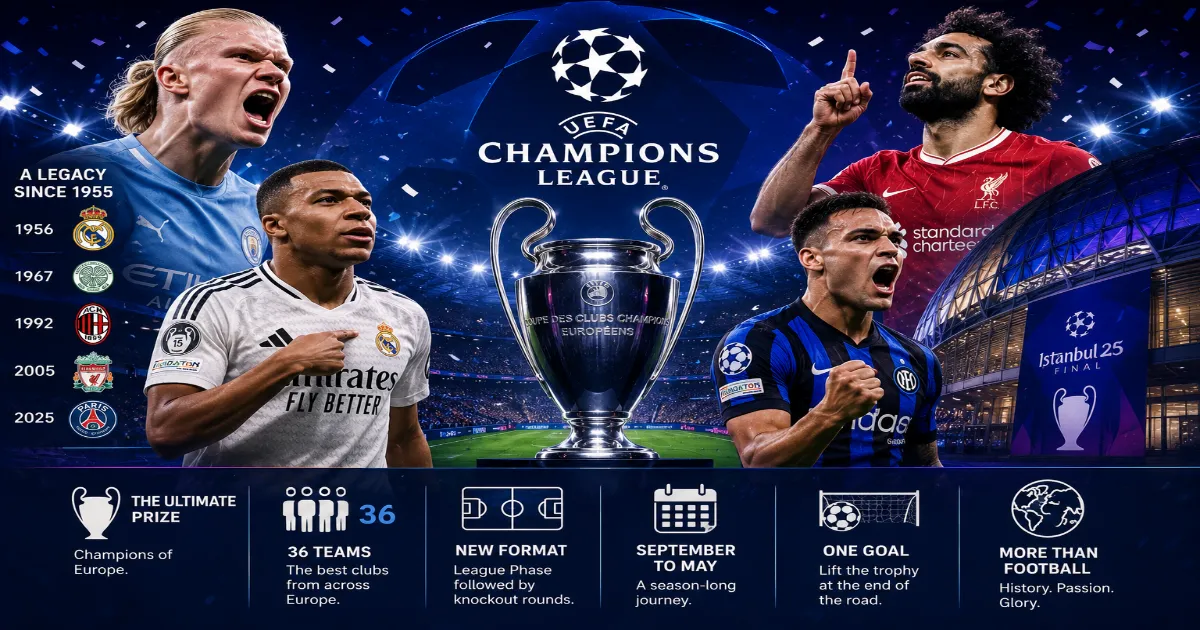
A complete breakdown of European club football’s biggest prize — how the Champions League works, where it came from, and what it takes to reach the final
Ask any club footballer what trophy they want most, and the answer is almost always the same: the Champions League. Organized by UEFA, it is the most prestigious annual club competition in world football, bringing together the best teams from across Europe every season for a knockout-heavy chase toward a single final. Below, we break down exactly what the Champions League is, how its format works after a major 2024 overhaul, the history behind the trophy, and precisely how a club earns its place in the competition.
What Is the Champions League, Exactly?
The Champions League is UEFA’s flagship club competition, contested each season by clubs that qualify primarily through their finishing position in their domestic league. Unlike the World Cup, which crowns a national team once every four years, the Champions League is an annual club tournament, running from late summer through to a single-match final in late May or early June. The winners are recognized as the champions of European club football and earn the right to compete in other prestigious fixtures, including the UEFA Super Cup against the Europa League winners and a place at the FIFA Club World Cup.
The competition currently features 36 clubs from across UEFA’s member associations, with participation determined by a mix of domestic league performance and each country’s overall coefficient ranking, which reflects how well its clubs have performed in Europe over recent seasons.
A Brief History of the Champions League
The competition traces its roots back to 1955, when it launched as the European Champion Clubs’ Cup — commonly known simply as the European Cup — open only to each country’s reigning domestic champion. Real Madrid dominated the early years in spectacular fashion, winning the first five editions between 1956 and 1960 and setting a benchmark for sustained excellence that still defines the club’s identity today.
The competition underwent its biggest rebrand in 1992, when it adopted the “UEFA Champions League” name and introduced a group stage, gradually expanding eligibility beyond just domestic champions to include multiple qualifiers from Europe’s strongest leagues. That shift transformed the tournament from a straightforward knockout cup into the sprawling, multi-billion-dollar spectacle recognized today.
Real Madrid remains the most successful club in the competition’s history, with 15 titles overall — a tally built across two distinct eras, from the five-in-a-row start in the 1950s to a modern dynasty that included three titles in four years between 2016 and 2018, plus their most recent triumph over Borussia Dortmund in 2024. AC Milan (7 titles), Liverpool (6), Bayern Munich (6) and Barcelona (5) round out the competition’s most decorated clubs.
The 2024–25 season marked a genuine turning point for the competition, with UEFA scrapping the traditional group-stage format after more than two decades in favor of an entirely new structure. Paris Saint-Germain won that inaugural new-format season, defeating Inter Milan 5-0 in the final for their first-ever Champions League title. They followed it up by successfully defending the trophy in 2025–26, beating Arsenal on penalties in Budapest to become just the second club — after Real Madrid’s 2016-18 run — to win back-to-back titles in the modern Champions League era.Saudi Pro League Stars at World Cup 2026: Ronaldo and SPL’s Global Impact
How Does the Champions League Format Work?
For decades, the Champions League followed a familiar pattern: 32 clubs split into eight groups of four, playing each other home and away, with the top two from each group advancing to a straight knockout round of 16. That system was retired after the 2023–24 season and replaced with what’s widely known as the “Swiss model,” borrowed from the pairing system used in competitive chess.MLS 2026: Season Preview, Top Players & Why Soccer Is Exploding in America
Here’s how the new format breaks down:
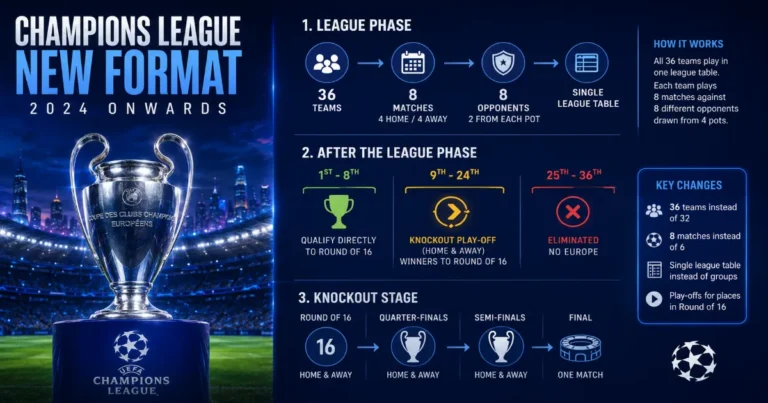
1. League Phase (36 teams). Instead of small groups, all 36 qualified clubs are placed into a single combined table. Each team plays eight matches — four at home, four away — against eight different opponents, drawn from four seeding pots based on UEFA coefficient. Every club faces two opponents from each pot, ensuring a mix of high-profile matchups and comparatively easier fixtures spread across the season, roughly between September and January.
2. Automatic Qualification (positions 1–8). Once the league phase concludes, the top eight teams in the combined standings advance directly to the round of 16 without playing an additional match.
3. Knockout Phase Play-offs (positions 9–24). Teams that finish between 9th and 24th enter a two-legged play-off round. The higher-ranked sides (9th–16th) are seeded against the lower-ranked sides (17th–24th), with the winners of each tie completing the round of 16 lineup.
4. Elimination (positions 25–36). Clubs that finish 25th or lower are eliminated from Europe entirely for the season — unlike the old format, there is no longer a parachute into the Europa League.
5. Traditional Knockouts. From the round of 16 onward, the competition reverts to the format fans know best: two-legged home-and-away ties through the quarter-finals and semi-finals, followed by a single, winner-takes-all final at a neutral venue.
How Do Clubs Qualify for the Champions League?
Qualification for the Champions League is built around two pillars: domestic league performance from the previous season, and each national association’s UEFA coefficient ranking, which is recalculated annually based on how that country’s clubs performed in European competition.Chinese Super League: The Rise, Fall and Uncertain Future of China’s Top Flight
In practical terms, this is what qualification currently looks like:
- Top four associations (currently England, Spain, Germany and Italy) each receive four automatic spots, generally awarded to the top four finishers in their respective domestic leagues.
- Fifth and sixth-ranked associations (recently France and the Netherlands) receive three and two spots respectively.
- Associations ranked seventh through tenth each receive one automatic spot, typically for their domestic champion.
- Title-holder spots are reserved for the reigning Champions League and Europa League winners, ensuring both clubs have a route into the following season even if they underperform domestically.
- Qualifying rounds fill the remaining places through two separate paths: the Champions Path, for domestic league winners from lower-ranked associations, and the League Path, for runners-up and other high finishers from mid-tier leagues. Each qualifying tie is played over two legs.
- Additional coefficient-based slots can also be awarded to a country’s leagues based on recent European performance, a mechanism that occasionally shifts a spot from a lower-ranked league to a higher-performing one the following season.
This system means qualification is never entirely fixed from year to year — a strong European campaign by a country’s clubs one season can directly translate into an extra domestic qualifying spot the next.
Champions League Prize Money
The financial stakes in the Champions League are enormous. For the 2025–26 season, the total prize pool sits at roughly $2.9 billion, distributed across three categories: equal shares paid simply for participating, performance-based rewards tied to results, and a “value pillar” that accounts for market size and broadcasting reach. Clubs eliminated in the qualifying rounds still walk away with a share of the pool, while every win in the league phase adds millions more. A club that wins every single match on the way to lifting the trophy can earn well over $100 million in prize money alone, before factoring in broadcasting and matchday revenue.
Frequently Asked Questions
Is the Champions League the same as the Europa League? No. The Europa League is UEFA’s second-tier club competition, generally featuring clubs that finished just outside Champions League qualification places in their domestic leagues, or that won their previous season’s Europa Conference League.
Who are the current Champions League holders? Paris Saint-Germain, who beat Arsenal on penalties in the 2025–26 final in Budapest, successfully defending the title they first won in 2024–25.
Which club has won the most Champions League titles? Real Madrid, with 15 titles overall, comfortably the most of any club in the competition’s history.
When does the Champions League final take place? The final is played at a single neutral venue, typically in late May, capping off a season that runs from late summer qualifying rounds through the knockout stages.
Final Word
The Champions League has evolved dramatically since its origins as a straightforward cup for domestic champions in the 1950s. Today’s Swiss-model league phase, high-stakes qualification battles, and enormous financial rewards have made it not just European football’s ultimate prize, but arguably the most closely watched annual sporting event outside a World Cup. Understanding how the format and qualification system actually work makes every matchday — from the opening league-phase fixtures in September to the final in May — considerably easier to follow.
🔹🔹 follow us on facebook 🔹🔹
About the Author