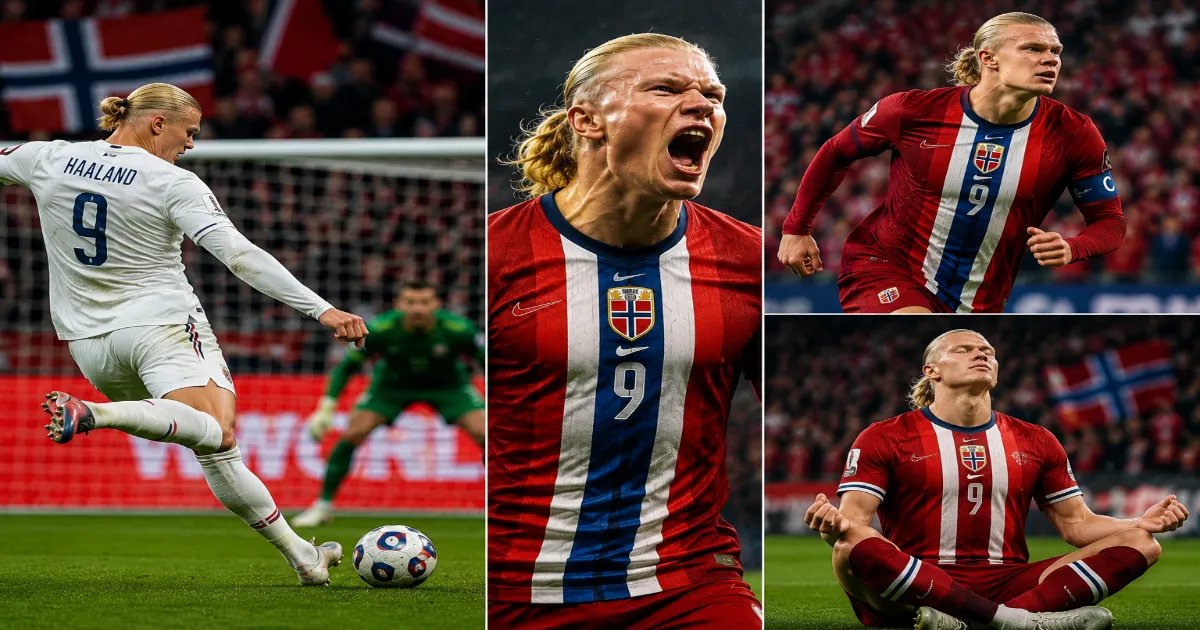
Erling Haaland the Goal Machine: Inside a World Cup for the Ages
There is a particular kind of quiet that falls over a stadium in the split second before Erling Haaland shoots. Defenders brace, goalkeepers set themselves an extra half-yard deeper than instinct tells them to, and commentators, more often than not, are already reaching for the word that has followed the Norwegian since his teenage years at Molde: machine. This isn’t lazy hyperbole. It’s a description earned across half a decade of numbers so consistent, so relentless, that “Erling Haaland the goal machine” has effectively become his job title. With his country now into a first-ever World Cup quarter-final on the back of his goals, it’s worth taking a proper analyst’s look at exactly why that nickname has stuck, what makes him so uniquely destructive in front of goal, and where his game still has room to grow.
Why He’s Called a Goal Machine
The “goal machine” tag isn’t about flair. Haaland has never been the player producing the viral nutmeg or the audacious rabona; he has built his reputation on something far more clinical — an almost industrial efficiency in the penalty box that has made him the fastest player in Premier League history to reach both 50 and 100 goals. He hit the 50-goal mark in just 48 appearances, beating Andy Cole’s long-standing record by 17 games, and reached 100 Premier League goals in 111 appearances, shattering Alan Shearer’s 1995 benchmark of 124 matches. To put that in perspective: Haaland reached a milestone that took the Premier League’s own record goalscorer well over a decade to hit inside four full seasons of English football.
His debut Premier League campaign in 2022-23 remains the standard-bearer. Thirty-six league goals in a single season broke a record that had stood since the old First Division era, and his 52 goals in all competitions that year were the most scored by any player from an English top-flight club in nearly a century, behind only Dixie Dean’s legendary 63 in 1927-28. This is a player who, from his very first year in English football, was already being measured against numbers from a different century.
A Genuinely Historic World Cup
If Haaland’s club career reads like a highlight reel of broken records, his 2026 World Cup has managed to feel even more remarkable, precisely because World Cup football punishes exactly the kind of players who thrive on repetition and space — international tournaments are supposed to be where predictable strikers get shut down by unfamiliar opposition and cautious, low-block defending. Haaland has simply ignored the script.
Through the group stage and into the knockout rounds, Haaland has racked up seven goals, placing him level with Lionel Messi and Kylian Mbappé at the very top of the Golden Boot race — extraordinary company for a player still chasing his first-ever World Cup goal before this tournament began. His brace in Norway’s stunning 2-1 Round of 16 win over five-time champions Brazil sent his country into a first-ever World Cup quarter-final, extending a personal scoring streak to 14 consecutive competitive internationals for Norway. In doing so, he became just the eighth European player in tournament history to score in each of his first four World Cup appearances, and the first to manage it since Italy’s Christian Vieri in 1998 — a statistic that places him alongside genuine World Cup royalty rather than simply among the tournament’s best current performers.
What makes this doubly striking is the manner of the goals. Against Brazil, both strikes came not from Haaland conjuring something from nothing, but from him doing the unglamorous, repeatable thing exceptionally well: arriving in the right space at the right time to finish a cutback and rising above a centre-back to power home a header. It’s the same blueprint that has defined his entire career, now playing out on football’s biggest stage.
The Anatomy of a Goal Machine: What Actually Makes Him So Lethal
Professional analysts tend to break Haaland’s game down into four core pillars, and it’s the combination — not any single trait in isolation — that makes him so difficult to legislate for.
Elite shot selection and conversion. In the 2025-26 Premier League season, Haaland has taken 126 shots in 35 matches, converting at a rate of roughly one goal for every 4.67 attempts — an outstanding return for a striker facing sustained defensive attention every week. His shooting accuracy sits at 45.24%, meaning nearly half of everything he attempts is at least on target, a remarkably high figure for a player operating almost exclusively inside congested penalty areas rather than picking up speculative efforts from distance.
Physical dominance in the box. At 6’4″, Haaland’s combination of raw power and genuine top-end speed is what separates him from most traditional target men. He isn’t simply a battering ram who waits for crosses; he times underlapping runs in behind high defensive lines as effectively as any forward in the world, turning half-yard advantages into one-on-one situations with the goalkeeper.ERLING HAALAND’S DIET, SLEEP & RECOVERY: THE SCIENCE BEHIND THE MACHINE
Movement over improvisation. Where a player like Messi manufactures goals through close control in tight spaces, Haaland manufactures them through positioning — reading where a pull-back, cutback or cross is going to arrive a full second before defenders do. It’s a less cinematic skill than dribbling past three players, but arguably a harder one to coach, and it’s the primary reason his goal tallies have proven so repeatable across different clubs, leagues and now international tournaments.
Two-footed, genuinely aerial threat. Left-footed by trade but comfortable finishing with his right, and a legitimate aerial weapon rather than a nominal one, Haaland removes the usual defensive shortcut of simply forcing a striker onto his weaker side or standing off him at corners. Both of his World Cup goals against Brazil illustrated this range perfectly — one a leaping header, the other a low right-footed finish under pressure.
Beyond the Goals: The Other Parameters That Matter
A serious analysis of any modern forward has to go beyond the scoreline, and here Haaland’s profile has genuinely evolved. This season, his 8 Premier League assists alongside 27 goals give him a goals-plus-assists rate of 1.06 per 90 minutes, and his non-penalty expected goals output of 23.63 places him in the 99th percentile of Premier League forwards — evidence that his underlying chance quality, not just finishing variance, is driving the numbers. He has also become a more willing creator for teammates than the popular caricature of a pure penalty-box poacher suggests, regularly setting up strike partners rather than simply monopolising every chance himself.
His durability is arguably as underrated a “parameter” as his finishing. Across 35 Premier League appearances this season alone, Haaland has played 2,960 minutes — evidence of a player who has largely conquered the injury interruptions of the 2024-25 campaign that briefly cost him his Golden Boot race against Mohamed Salah. Disciplinary record matters here too: just two yellow cards and zero red cards across an entire Premier League season, at a foul rate of 0.73 per 90 minutes, reflects a forward who causes defensive chaos without needing to compensate with aggression or petulance — a genuinely low-risk asset for any manager building a system around him.
His off-the-charts historical milestones extend well beyond league football. He became the fastest player ever to 50 Champions League goals, doing so in just 49 matches, and reached his 300th career goal — for club and country combined — during Manchester City’s Club World Cup campaign in 2025, becoming the second-youngest player of the 21st century to hit that mark. He has now passed 150 goals for Manchester City alone, arriving via a stoppage-time penalty against Liverpool, in barely more than three full seasons at the club.
The Making of a Machine: Career Trajectory
Part of what makes the “goal machine” tag so credible is that it isn’t a recent phenomenon manufactured by one standout season — it’s a pattern that has held at every single level Haaland has played. He announced himself with a hat-trick on his Norwegian top-flight debut for Bryne, before a prolific spell at Molde caught the attention of Red Bull Salzburg, where he scored at a rate that made him one of the most talked-about teenagers in Europe, including a hat-trick on his Champions League debut against Genk. A move to Borussia Dortmund in January 2020 only accelerated the trajectory: he scored a hat-trick in his first Bundesliga start and went on to help Dortmund win the DFB-Pokal in 2021, cementing his status as one of the most sought-after strikers on the continent before his 21st birthday.Born in Leeds, Built in Norway: The Erling Haaland Story His Country Never Stops Celebrating
His 2022 move to Manchester City for a release-clause fee of roughly €60 million now looks, with hindsight, like one of the most one-sided pieces of business in modern transfer history. Pep Guardiola, a manager previously reluctant to build his attack around a single central striker, restructured City’s entire forward line around Haaland’s runs, and the results — a continental treble in his very first season — speak for themselves. Few players in football history have moved through four different countries’ top divisions and maintained, let alone improved, a strike rate at every stop; Haaland has done exactly that.
How He Compares Historically
Placing Haaland in historical context is genuinely difficult, because so few forwards combine his raw scoring rate with his current age and injury profile. His Premier League scoring pace outstrips even Alan Shearer and Thierry Henry at the equivalent stage of their careers, while his Champions League scoring rate — fastest ever to 50 goals in the competition — surpasses prime Cristiano Ronaldo and Robert Lewandowski’s own record-breaking runs. What separates Haaland from most of the great pure poachers of the past, from Gerd Müller to Filippo Inzaghi, is the athletic profile layered on top of the finishing instinct: very few strikers in history have combined genuine top-tier sprint speed, aerial dominance and box-crashing timing in a single 6’4″ frame. It’s that rare combination of physical outlier and clinical craftsman that has pundits increasingly comparing his statistical trajectory not to any single predecessor, but to an entirely new scoring archetype.
No honest analysis stops at the highlight reel. Haaland’s critics — and there remain some, even now — point to occasional stretches of relative anonymity in matches where service dries up, a longstanding question about his link-up play in deeper areas compared to a genuine false-nine, and a reliance on service quality that makes him look human on nights when his supporting cast misfires. His penalty record, while strong at 80% conversion (40 scored from 50 attempts across his career), is not flawless, and the 10 missed spot-kicks on his record are occasionally used by detractors to puncture the “machine” mythology. These are minor dents rather than genuine weaknesses, but they matter in any full picture: Haaland remains, fundamentally, a penalty-box predator rather than an all-court playmaker, and teams that can restrict service into that box — as several defences have managed for spells — can still limit his overall influence on a game, even if they rarely stop him from finding at least one clear sight of goal.
What Comes Next
With Norway already assured of a place in the World Cup quarter-finals for the first time in the nation’s history, and Haaland sitting level atop the Golden Boot standings with Messi and Mbappé, the next fortnight carries a weight few could have predicted for Norwegian football even twelve months ago. A deep run into the latter stages would do more than add another individual milestone to an already historic résumé — it would finally answer the one meaningful gap on Haaland’s CV: a genuine international trophy to match the sheer weight of his club-level numbers.
Whatever happens from here, the underlying story is already written. Erling Haaland didn’t earn the “goal machine” label through a single explosive season or one outrageous highlight reel; he earned it through year after year of statistical consistency that has, remarkably, translated seamlessly onto the World Cup stage most modern strikers find hardest of all to conquer. Few players in the sport’s history have made scoring goals look quite so repeatable, quite so inevitable, and quite so machine-like.
Enjoyed this deep dive? Check back for more in-depth player analysis and World Cup 2026 coverage as the knockout rounds continue.
🔹🔹 follow us on facebook 🔹🔹
About the Author



2 thoughts on “Erling Haaland: The Goal Machine Rewriting Football’s Record Books”