From Ronaldo’s final World Cup to Neymar’s emotional farewell, 2026 marks the end of an era for football’s biggest stars.
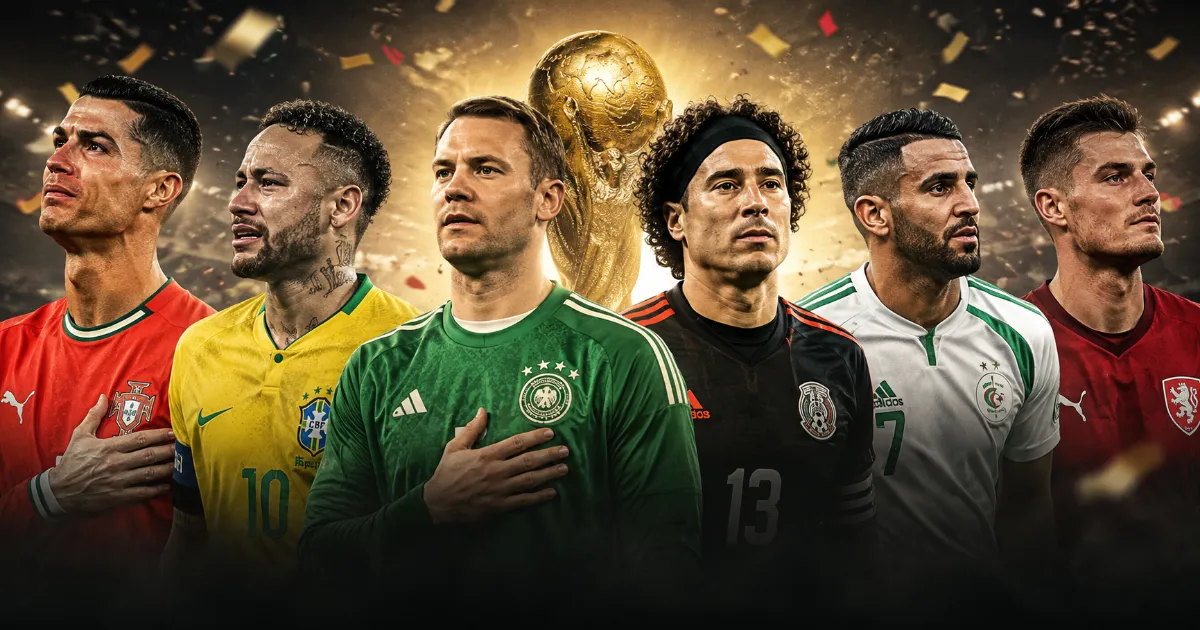
The 2026 FIFA World Cup will be remembered for spectacular goals, dramatic knockout matches and a new generation of stars. But it will also be remembered as a tournament of goodbyes.
For several football legends, the World Cup in the United States, Canada and Mexico marked the end of an international era. Some officially announced their retirement from international football, while others confirmed that this would be their final World Cup.
From Cristiano Ronaldo’s emotional exit with Portugal to Neymar’s tearful farewell in New Jersey, the 2026 tournament became a defining moment for a generation of players who had shaped international football for more than a decade.
The World Cup retirement story of 2026 was not about one player. It was about an entire generation passing the torch.
Brazil’s World Cup 2026 Ends in Heartbreak: What Comes Next for Neymar?
What Cristiano Ronaldo Doesn’t Have: The One World Cup Trophy That Couldn’t Define His Greatness
Football After Messi and Ronaldo: 7 Ways the Game Will Change After an Unforgettable Era
Cristiano Ronaldo: His Last World Cup, But Not Yet Retirement
Few departures carried the emotional weight of Cristiano Ronaldo’s.
Portugal’s captain entered the 2026 World Cup at 41, having already established himself as one of the greatest international players in football history. When Portugal lost 1-0 to Spain in the Round of 16 in Dallas, Ronaldo confirmed that he had played his final World Cup match.
The defeat ended a remarkable World Cup journey spanning six tournaments. Ronaldo became the first men’s player to score at six different World Cups and left the competition as Portugal’s all-time leader in international appearances and goals.
But there is an important distinction: Ronaldo did not announce his retirement from international football. After the defeat, he said he would take time to consider his future rather than make a decision immediately.
That makes Ronaldo’s story different from the confirmed World Cup retirement announcements made by several other veterans.
His World Cup chapter, however, is closed.
And for a player who spent more than two decades carrying Portugal’s hopes on the biggest stage, that alone represents the end of an era.
Messi’s Last World Cup? The Signs Are Hard to Ignore
Neymar: A Final Night at MetLife Stadium
If Ronaldo’s farewell was the end of a World Cup chapter, Neymar’s was the end of an international career.
Brazil’s all-time leading scorer made his senior international debut in 2010. Sixteen years later, he played his final match for the Seleção at the same New Jersey venue where his international story began.
Brazil’s 2-1 defeat to Norway in the Round of 16 brought the curtain down on Neymar’s World Cup career. Introduced from the bench, the 34-year-old scored a late penalty, but it was not enough to prevent Brazil’s elimination.
After the final whistle, Neymar was visibly emotional and confirmed that his time with Brazil was over.
He finished his international career with 130 appearances and 80 goals, making him Brazil’s leading men’s international scorer. He also leaves behind an Olympic gold medal and a legacy as one of the most gifted attacking players of his generation.
The World Cup trophy remained the major prize that escaped him.
His final appearance at MetLife Stadium gave his international career a remarkable sense of symmetry — the place where it began was also where it ended.
Manuel Neuer: The Second Goodbye Becomes the Final One
Manuel Neuer’s international retirement story was unusual even before the 2026 World Cup began.
The Germany goalkeeper had originally retired from international football after Euro 2024. But at 40, he reversed that decision and returned to the national team for one final World Cup campaign.
It was a remarkable second act for a goalkeeper who had already become one of the defining players of his position.
Neuer entered the tournament as Germany’s first-choice goalkeeper and added to his record as the most prolific goalkeeper in World Cup history. He had already surpassed Hugo Lloris for World Cup appearances by a goalkeeper, reaching 21 appearances.
Germany’s tournament ended in the Round of 32 against Paraguay. After a scoreless 120 minutes, Paraguay won the penalty shootout, sending Germany home and ending Neuer’s international career for good.
This time, there was no comeback waiting around the corner.
The goalkeeper who revolutionized the sweeper-keeper role walked away having won the 2014 World Cup and established himself as one of the most influential goalkeepers of the modern era.
Guillermo Ochoa: A Home World Cup Goodbye
For Guillermo Ochoa, the emotional weight was different.
The veteran Mexico goalkeeper experienced his farewell at a home World Cup, representing the host nation in front of Mexican supporters.
Ochoa had already become synonymous with Mexico’s World Cup campaigns. His reputation was built on spectacular saves, penalty heroics and a series of performances that made him one of the most recognizable goalkeepers of his generation.
The 2026 tournament marked his sixth World Cup appearance, an extraordinary achievement for any player.
FIFA highlighted Ochoa’s journey before the tournament through its “Letters That Unite” series, reflecting on the goalkeeper’s extraordinary career and his six World Cup appearances.
When his international career finally came to an end, Mexico lost not simply a goalkeeper but one of the most recognizable figures of its modern football history.
Riyad Mahrez: The End of Algeria’s Golden Generation
Riyad Mahrez’s departure represented another important chapter in the story of African football.
The Algeria captain had already announced before the tournament that the 2026 World Cup would be his last. After Algeria’s elimination by Switzerland, he confirmed the end of his international career.
Mahrez’s legacy extends well beyond the World Cup.
He was a central figure in Algeria’s golden generation and played a key role in the country’s 2019 Africa Cup of Nations triumph. His career also included Premier League titles with Leicester City and Manchester City, making him one of the most decorated African footballers of his era.
FIFA described Mahrez as a symbol of an Algerian generation that revitalized the country’s international football fortunes.
His retirement therefore represents more than the departure of one star. It signals the closing of a generation that gave Algerian football some of its most memorable modern moments.
Patrik Schick: A Younger Farewell With a Bigger Message
Not every World Cup retirement in 2026 belonged to a player in his late thirties or forties.
Patrik Schick announced his retirement from international football at just 30 after the Czech Republic were eliminated during the group stage.
Schick leaves international football with 56 appearances and 26 goals for the Czech Republic. He became a global name at Euro 2020 after scoring the spectacular long-range goal against Scotland that was later named the tournament’s Goal of the Tournament.
His decision was not presented as an emotional reaction to the World Cup elimination. Schick said it was something he had considered for some time.
His departure adds another dimension to the 2026 retirement story: this was not simply an old generation reaching the natural end of its careers. For some players, international retirement came because they believed it was time for their national teams to move in a different direction.
The 2026 World Cup Retirement List
The confirmed international retirements give the tournament a fascinating mixture of experience and legacy:
Neymar — Brazil: Retired from international football after Brazil’s Round of 16 defeat.
Manuel Neuer — Germany: Returned for one final World Cup before ending his Germany career.
Riyad Mahrez — Algeria: Confirmed his international retirement after the tournament.
Guillermo Ochoa — Mexico: Closed a remarkable six-World-Cup international career.
Patrik Schick — Czech Republic: Retired from international football at age 30.
Cristiano Ronaldo — Portugal: Confirmed that 2026 was his final World Cup, but left his international future open.
FIFA’s official post-tournament review specifically identified Neuer, Neymar, Mahrez, Ochoa and Schick among the major players ending their international careers.
Why the World Cup Retirement Story Matters
The significance of these departures goes beyond nostalgia.
Every international retirement creates a leadership gap. National teams that once relied on established veterans must suddenly find new captains, new playmakers and new voices inside the dressing room.
Brazil now has to move forward without Neymar’s extraordinary creative influence. Germany must build its next generation of goalkeepers without Neuer. Mexico loses one of its most experienced World Cup figures in Ochoa. Algeria begins another era without Mahrez, while the Czech Republic must replace one of its most prolific modern forwards in Schick.
Portugal faces perhaps the biggest question of all.
Even though Ronaldo has not retired from international football, his World Cup career is finished. The possibility of Portugal playing future major tournaments without its most recognizable player is no longer theoretical.
That transition will define the country’s next generation.
A Generation Says Goodbye
The 2026 World Cup was never going to last forever.
Neither were the careers of the players who defined the football era that preceded it.
Ronaldo’s final World Cup appearance, Neymar’s emotional international retirement, Neuer’s second and final goodbye, Ochoa’s home farewell, Mahrez’s passing of the torch and Schick’s unexpected decision all became part of the tournament’s larger story.
Their careers did not end in the same way. Some walked away with trophies. Others left with disappointment. Some announced retirement immediately; others simply closed the World Cup chapter.
But together, they represent something bigger: the gradual handover from one generation of football icons to the next.
That is why the World Cup retirement story of 2026 deserves to be remembered alongside the tournament’s goals, champions and dramatic matches.
The World Cup always creates new legends.
In 2026, it also said goodbye to some of the old ones.
From Roberto Carlos to Messi: Ranking the Best Free Kicks in History
Cristiano Ronaldo Jr.: Club, Lifestyle, Career and Future Prospects
🔹🔹 Follow Us on Facebook 🔹🔹
About the Author



1 thought on “World Cup Retirement: Ronaldo, Neymar and the Legends Saying Goodbye”