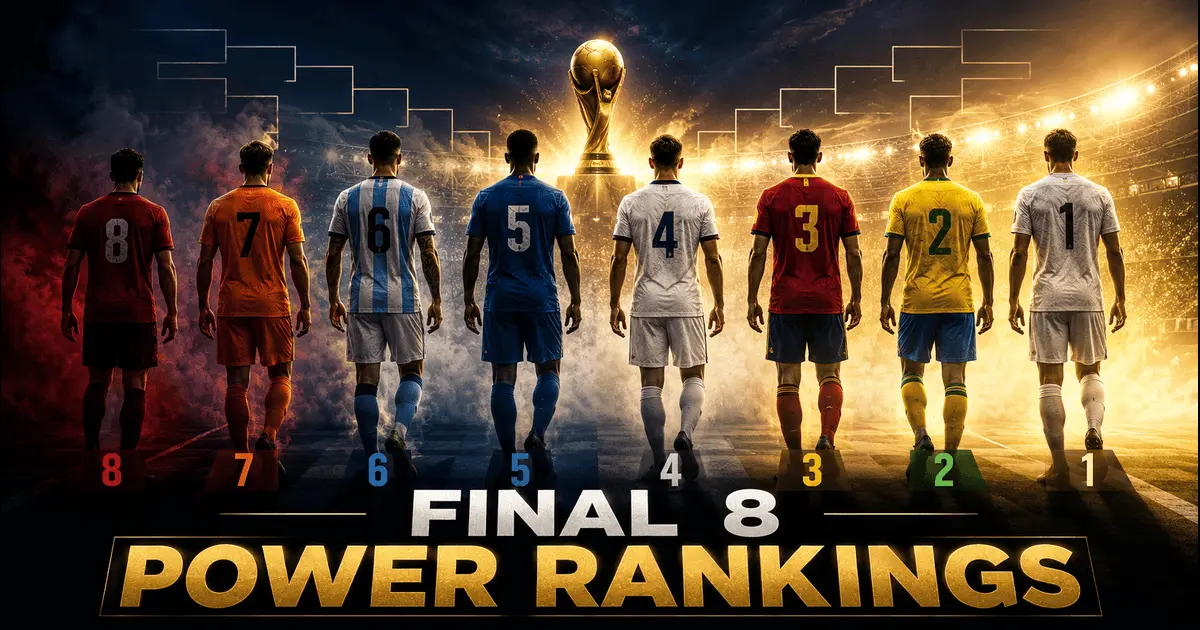
Quarterfinal Team Ranked From Weakest to Strongest
The FIFA World Cup 2026 is now in the history books, which means we can finally judge the eight quarterfinalists by what they actually accomplished rather than what we expected them to do.
Before the quarterfinals, this ranking was about potential, momentum and the question of which teams looked most likely to win the trophy. Now the picture is much clearer. Spain went all the way, Argentina reached the final, England finished third and France ended the tournament in fourth after a remarkable bronze-final thriller.
Spain Won the FIFA World Cup 2026: How La Roja Conquered the World Again
FIFA World Cup Third-Place Match Report: England Survive France Rally, 6-4
That makes a post-tournament version of Every World Cup Quarterfinal Team Ranked From Weakest to Strongest much more interesting.
Some teams exceeded expectations. Others showed flashes of championship quality but could not sustain them. And one team ultimately proved that being ranked first was not just a prediction — it was the correct answer.
8. Switzerland
Switzerland deserve enormous credit for reaching the quarterfinals.
Their run represented one of the country’s best World Cup performances in generations, and simply making the final eight was a significant achievement.
But when all eight quarterfinalists are judged against one another, Switzerland are the easiest team to place at No. 8.
Their route was built around defensive organisation, discipline and the ability to survive difficult moments rather than overwhelming opponents with attacking quality. That approach can be extremely effective in knockout football, but it also leaves very little room for error against the tournament’s elite.
Switzerland demonstrated that they could make life extremely uncomfortable for stronger opponents, but they lacked the attacking depth and individual match-winners possessed by the teams above them.
Their quarterfinal appearance should therefore be remembered as a success rather than a failure.
They were simply the least complete of the eight teams that made it this far.
Final verdict: A historic quarterfinal run built on defensive resilience, but the least complete team among the final eight.
7. Norway
Norway were one of the defining surprise stories of the 2026 World Cup.
Before the tournament, few expected them to reach the quarterfinals. Then came their stunning victory over Brazil, a result that immediately transformed their campaign from respectable to historic.
Erling Haaland was the obvious headline-maker.
The striker’s finishing ability gave Norway something that almost every underdog needs at a World Cup: a player capable of changing a match with one or two chances.
But Norway’s limitations became clearer as the competition progressed.
Haaland could produce spectacular moments, but international tournaments are eventually decided by the depth and balance of the entire squad. Norway did not possess the same collection of elite players as Spain, Argentina, England or France.
That does not diminish their achievement.
Quite the opposite.
Their quarterfinal appearance was one of the biggest surprises of the tournament, and the victory over Brazil will remain one of the defining World Cup results of 2026.
Final verdict: The tournament’s great surprise package, with Haaland providing the superstar quality that made their run possible.
6. Belgium
Belgium were perhaps the hardest quarterfinalist to read throughout the tournament.
Their early performances raised questions about whether this talented squad could finally translate its individual quality into a serious World Cup run.
Then they exploded into life in the knockout stage.
The victory over the United States demonstrated just how much attacking quality Belgium possessed when everything clicked. Charles De Ketelaere emerged as one of the key attacking figures, and suddenly Belgium looked like a team capable of causing serious problems for the remaining contenders.
The problem was consistency.
Belgium could look excellent for stretches, but they never established the same level of control and reliability as the tournament’s very best teams.
Their quarterfinal defeat to Spain ultimately confirmed the gap.
Spain were able to control the match in ways Belgium struggled to replicate against elite opposition.
Still, Belgium leave the tournament with plenty of positives and a reminder that their squad contains enough quality to compete at the highest level.
Final verdict: Dangerous and talented, but too inconsistent to join the tournament’s true championship contenders.
5. Morocco
Morocco’s 2026 World Cup campaign confirmed that their remarkable run to the 2022 semifinal was no fluke.
They reached another quarterfinal and once again showed why their defensive organisation has become one of the most difficult systems to break down in international football.
Morocco were disciplined without the ball, compact between the lines and capable of turning defensive situations into dangerous counterattacks.
Their Round of 16 victory over Canada was particularly impressive and demonstrated that they were capable of controlling matches rather than simply surviving them.
The challenge came when they faced the tournament’s most talented squads.
Morocco could restrict space and frustrate opponents, but creating enough chances against elite defences remained a more difficult task.
That eventually prevented them from progressing further.
Nevertheless, consecutive deep World Cup runs have changed the way Morocco are viewed internationally.
They are no longer a surprise package.
They are now a genuine tournament force.
Final verdict: One of the world’s best organised international sides, but still slightly short of the attacking depth required to win the tournament.
4. France
France were one of the strongest teams in the tournament, but their final position explains why they sit at No. 4 in this retrospective ranking.
They reached the semifinal, putting them among the final four teams in the world, before facing Spain.
The French squad contained extraordinary attacking talent, with Kylian Mbappé once again providing a major source of goals and individual brilliance.
Their depth was also a major advantage.
France could rotate attacking options without dramatically reducing their threat, while their midfield and defence gave them enough structure to compete against any opponent.
But ultimately, they fell short of the final.
And then came one of the most extraordinary matches of the tournament.
France faced England in the bronze final and lost 6-4, despite producing a remarkable second-half fightback. Bukayo Saka scored a hat-trick as England survived a ten-goal thriller to claim third place.
That result does not erase France’s semifinal appearance, but it does separate them from England in the final post-tournament ranking.
France finished fourth.
England finished third.
Final verdict: A semifinal-quality team with enormous individual talent, but their fourth-place finish and bronze-final defeat leave them just below England.
3. England
England move up to No. 3 in the final version of this ranking.
Before the quarterfinals, there were still questions about whether England could finally turn their consistency into a podium finish.
They answered that question emphatically.
England reached the semifinal and eventually faced Argentina, narrowly missing out on a place in the World Cup final.
Instead of allowing that defeat to define their tournament, England responded in spectacular fashion.
They defeated France 6-4 in the bronze final, with Bukayo Saka scoring a hat-trick in one of the wildest matches of the entire competition. FIFA described it as England’s best World Cup finish since their 1966 triumph.
That third-place finish matters.
England did not win the trophy, but they finished on the podium at a World Cup and demonstrated impressive resilience after the disappointment of losing the semifinal.
Jude Bellingham remained one of their most important players, while Saka’s three-goal bronze-final performance provided one of the tournament’s final individual highlights.
England’s biggest strength was their depth.
They had enough quality to survive difficult matches and enough attacking talent to punish opponents when opportunities appeared.
Final verdict: A semifinalist who responded brilliantly to disappointment and finished third in the world.
2. Argentina
Argentina were one match away from becoming back-to-back World Cup champions.
That alone makes them the second-best team on this list.
The defending champions endured difficult moments throughout the tournament, including a dramatic Round of 16 encounter against Egypt that threatened to become one of the biggest shocks of the competition.
But Argentina repeatedly demonstrated something that cannot easily be measured by statistics: the ability to survive pressure.
Their experience, individual quality and belief remained intact when matches became chaotic.
Lionel Messi once again played a central role in Argentina’s attacking game, while the team’s supporting cast provided enough quality to carry them through the knockout rounds.
Argentina then advanced through the quarterfinal and semifinal stages to reach the World Cup final.
There, they faced Spain.
The final was ultimately decided by a single goal in extra time, with Spain winning 1-0 to become world champions.
That narrow defeat does not diminish Argentina’s tournament.
They reached the final of a 48-team World Cup and came within one match of successfully defending their title.
For Messi and his teammates, it was another extraordinary chapter in Argentina’s modern football history.
Final verdict: The runners-up and the closest team to Spain, with enough quality and experience to reach another World Cup final.
1. Spain
Spain are the obvious No. 1.
And unlike the original pre-quarterfinal ranking, this time there is no prediction involved.
They are the 2026 FIFA World Cup champions.
Spain defeated Argentina 1-0 after extra time in the final at New York New Jersey Stadium, securing the country’s second men’s World Cup title.
Their tournament was defined by control.
Spain could dominate possession, dictate tempo, defend collectively and still produce individual brilliance when matches became tight.
Lamine Yamal provided one of the tournament’s most dangerous attacking outlets, while Rodri gave Spain the midfield structure needed to control matches against elite opponents.
Their knockout journey also demonstrated remarkable consistency.
They defeated Portugal, Belgium and France on their way to the final before overcoming Argentina.
FIFA’s tournament review described Spain’s campaign as one of the standout team performances of the competition, highlighting their victories over Belgium, France and Argentina on the road to the trophy.
The most important point is simple:
Spain did not merely look like the best team.
They finished as the best team.
Final verdict: World champions and the most complete team of the 2026 FIFA World Cup.
Every World Cup Quarterfinal Team Ranked: Final Ranking
| Rank | Team | Final Tournament Finish |
|---|---|---|
| 1 | Spain | 🏆 World Champions |
| 2 | Argentina | Runners-up |
| 3 | England | Third place |
| 4 | France | Fourth place |
| 5 | Morocco | Quarterfinals |
| 6 | Belgium | Quarterfinals |
| 7 | Norway | Quarterfinals |
| 8 | Switzerland | Quarterfinals |
Why England Move Above France
The biggest change in the final ranking is the switch between England and France.
Before the quarterfinals, France looked like the stronger championship candidate. Their squad depth, attacking options and form made them one of the favourites.
But a retrospective ranking has to account for what actually happened.
England reached the semifinal, while France also reached the last four. The difference came in the bronze final.
England beat France 6-4, with Saka scoring three times, to claim third place.
That gives England the higher final position and makes England No. 3 and France No. 4 in this updated ranking.
What This World Cup Quarterfinal Ranking Tells Us
The final eight produced eight very different stories.
Switzerland showed that defensive discipline can take an unfancied team deep into the competition.
Norway produced one of the tournament’s biggest shocks and gave the world another stage on which to appreciate Haaland’s extraordinary finishing.
Belgium reminded everyone that their squad still contains serious attacking talent.
Morocco proved that their 2022 semifinal was the beginning of a new era rather than a one-off miracle.
France reached another semifinal but ultimately finished fourth.
England went one step further on the podium, recovering from semifinal disappointment to win the bronze medal.
Argentina reached another World Cup final and came agonisingly close to defending their crown.
And Spain completed the journey.
The Biggest Surprise: Norway
Norway deserve a special mention because their quarterfinal run was almost impossible to predict before the tournament.
Their victory over Brazil changed the complexion of the knockout stage and established them as one of the competition’s most dangerous outsiders.
Even though they ultimately fell short of the semifinal, their run will be remembered as one of the defining stories of the 2026 World Cup.
The Biggest Disappointment: Belgium
Belgium had enough individual talent to dream about going much further.
Their best performances showed genuine championship-level quality, but they never found the consistency required to challenge Spain, Argentina or the other top contenders.
Their quarterfinal exit therefore feels like a missed opportunity rather than a historic breakthrough.
The Team That Delivered: Spain
There is ultimately only one way to settle a ranking like this.
Win the trophy.
Spain did exactly that.
They entered the knockout rounds with questions surrounding every contender, navigated three increasingly difficult knockout opponents, reached the final and then defeated Argentina in extra time.
Their reward was a second World Cup crown.
That is why, after all the predictions, debates and power rankings, Spain are the clear No. 1 in Every World Cup Quarterfinal Team Ranked From Weakest to Strongest.
Final Verdict
The original quarterfinal ranking was about which team looked strongest.
The final ranking is about which team actually proved it.
Spain proved everything.
Argentina came closest.
England finished third after beating France in a spectacular bronze final.
France finished fourth despite reaching the semifinal.
Morocco, Belgium, Norway and Switzerland all deserve credit for reaching the last eight, but none could match the consistency required to progress into the final four.
The tournament is now over, and the debate has a definitive answer.
Spain were the strongest quarterfinal team, the strongest team in the tournament and the 2026 FIFA World Cup champions.
Egypt’s World Cup 2026 Journey: How the Pharaohs’ Historic Run Ended Against Argentina
Portugal vs Spain World Cup Report: Merino’s Late Strike Ends Ronaldo’s Career
🔹🔹 follow us on facebook 🔹🔹
About the Author