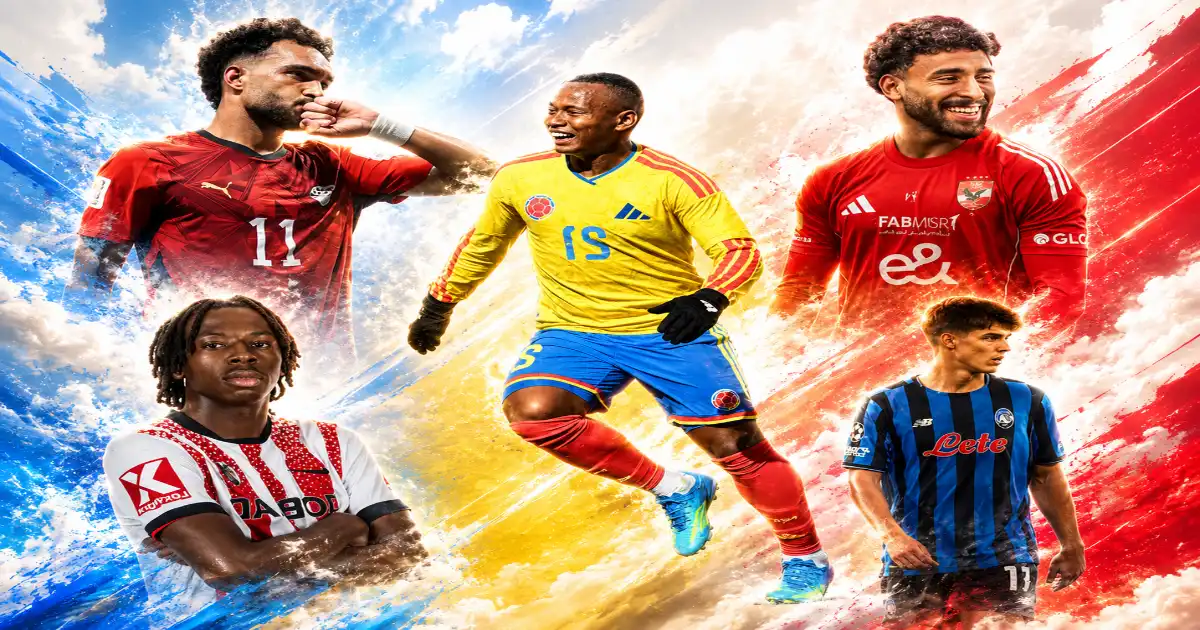
Meet the Household Names This Summer’s World Cup Created Overnight
Every World Cup has its established royalty, the Messis and Mbappés who arrive already famous and simply add to the legend. But the tournaments that stay with you are the ones that also mint entirely new names, players who walked into this summer as anonymous squad members and walked out as the reason casual fans suddenly cared about a club they’d never heard of. This year’s crop of household names this summer is a genuinely eclectic group: a teenager who wasn’t even guaranteed a squad spot, a defender who scored the goal of his life against the defending champions, and a handful of others who turned a single moment into lasting recognition.
Johan Manzambi: Switzerland’s Overnight Sensation
Before this tournament, Johan Manzambi was a promising but largely unknown attacking midfielder plying his trade at Freiburg in the German Bundesliga, the kind of player domestic Swiss football followers knew but international audiences had never had reason to notice. That changed fast. Manzambi emerged as Switzerland’s leading scorer through the group stage and into the knockout rounds, playing a central role in the country’s improbable run to a first World Cup quarterfinal since 1954. His attacking output gave a fundamentally defensive, disciplined Swiss side an unexpected cutting edge, and by the time he missed Switzerland’s Round of 16 win over Colombia, his absence was the single biggest storyline surrounding the match, a remarkable shift in profile for a player who entered the tournament as a squad afterthought in most previews. Whatever happens in the quarterfinal against Argentina, Manzambi has already ensured Swiss football fans, and plenty of neutrals besides, will be watching his club career far more closely from here on.
Mostafa Zico: Egypt’s Fearless Attacking Spark
Egypt’s remarkable run to their first-ever World Cup knockout win, and eventually a first Round of 16 appearance, produced several individual stories worth telling, but Mostafa Zico’s emergence stands out. Zico scored the goal that put Egypt 2-0 up against Argentina in the Round of 16, following an earlier effort that had been correctly disallowed by VAR, showcasing both the composure and the persistence that made him one of the most dangerous attacking outlets in Hossam Hassan’s counter-attacking setup all tournament long. That Egypt ultimately lost the match in a stunning late collapse doesn’t diminish what Zico’s performances did for his own profile; a player largely unknown outside Egyptian domestic football entered the tournament’s global conversation the moment his name started trending during one of the most dramatic Round of 16 matches in recent World Cup memory.
Jaminton Campaz: Colombia’s Nearly Man Who Still Won Hearts
Sometimes a player becomes a household name not through a goal but through a moment so close to legendary that it becomes unforgettable anyway. Jaminton Campaz spent Colombia’s Round of 16 tie against Switzerland as one of the most dangerous attacking threats on the pitch, forcing saves in extra time and, in the 116th minute, missing arguably the biggest chance of the entire knockout round after a Swiss defensive error gifted him a golden opportunity from close range. Colombia went on to lose the shootout, and Campaz’s name will forever be tied to that specific missed chance. But the broader body of work, relentless movement, direct running, and genuine end product across the tournament, has ensured that Campaz leaves this World Cup with a considerably higher profile than he arrived with, missed chance and all. Football has a strange way of making some near-misses just as memorable as the goals that go in.
Yasser Ibrahim: The Defender Who Became an Attacking Folk Hero
Center-backs rarely become household names through their attacking contributions, which is precisely what makes Yasser Ibrahim’s tournament so notable. The Egyptian defender’s headed opener against Argentina in the Round of 16, the first time Argentina had trailed at any point in the entire 2026 tournament, was a genuinely historic moment for Egyptian football, and Ibrahim’s overall defensive performances across the knockout rounds helped anchor a backline that punched dramatically above its historical pedigree. That a center-back’s individual moment became one of the most replayed clips of the entire tournament tells you something about how thoroughly Egypt’s run captured neutral attention, and Ibrahim, previously a name known mostly to domestic Egyptian football followers, is now a player European scouts are reportedly monitoring closely heading into the next transfer window.
Marwan Attia: The Assist Machine Nobody Saw Coming
Egypt’s run produced more than one unlikely name, and full-back Marwan Attia deserves mention alongside his more heralded teammates. His delivery from wide areas, including the corner that Ibrahim headed home against Argentina, was a consistent thread running through Egypt’s most dangerous moments across the tournament. Attacking full-backs who provide genuine end product from wide areas are increasingly valuable commodities in modern football, and Attia’s performances across this World Cup have given him a considerably higher public profile than a player in his position typically earns, particularly from a nation that entered the tournament with modest expectations attached.
Charles De Ketelaere: The Redemption Arc Fans Didn’t See Coming
Not every household name story is about a completely unknown player; sometimes it’s about a player rediscovering himself on the biggest possible stage. Charles De Ketelaere had spent years being discussed more for underwhelming a big move to AC Milan than for delivering on his considerable talent, but his two-goal performance in Belgium’s 4-1 demolition of co-host USA in the Round of 16 was the kind of statement that resets a public narrative overnight. De Ketelaere’s tournament has been the connecting thread in Belgium’s otherwise inconsistent campaign, and however Belgium’s quarterfinal against Spain plays out, his performances this summer have already rehabilitated a reputation that had taken a genuine hit over the previous two seasons.
The Underdog Nations’ Wider Supporting Cast
Breakout stories haven’t been limited to individual match-winners; entire supporting casts from this tournament’s underdog nations have used the spotlight to build recognition beyond their most famous teammates. Norway’s run to the quarterfinals, built heavily around Erling Haaland’s goalscoring, has still introduced global audiences more thoroughly to midfielders and defenders who’d previously only registered with dedicated followers of Norwegian or mid-tier European league football. The same is true of Morocco’s squad, where players operating just outside the more heavily covered spine of the team have used sustained tournament exposure, across both this campaign and the historic 2022 run, to build reputations that extend well beyond North African football coverage. A deep World Cup run doesn’t just create one household name; it tends to raise the profile of an entire generation simultaneously, since broadcasters and football media inevitably spend more time profiling every player on a squad that keeps winning.
The Risk of a Fleeting Spotlight
Not every player who becomes a household name this summer will still be one in twelve months. World Cup breakouts have a well-documented history of fading back into relative obscurity once the tournament ends and domestic leagues resume their usual media hierarchies, particularly for players from nations or leagues that don’t receive year-round global broadcast coverage. The players most likely to convert this summer’s attention into lasting recognition are typically those who follow up with a transfer to a bigger club or a sustained run of form at continental level immediately afterward, rather than those who simply return to their previous clubs and leagues. It’s a genuine risk facing several of the names on this list; Zico, Campaz, and Attia all now face a period where interested clubs either move quickly to sign them or the moment quietly passes, the way it has for plenty of previous tournaments’ breakout stars who never quite made the leap to sustained global recognition.One Bold Prediction for Every Quarter-Final Match of FIFA World Cup 2026
Why These Stories Matter Beyond the Tournament
There’s a reason these names stick in a way that a similarly good performance in a routine club fixture never quite does. The World Cup remains the one stage where genuinely global audiences, many of whom follow only a handful of leagues closely, get exposed simultaneously to players from every corner of the football world. A midfielder playing brilliantly for a mid-table Bundesliga side can toil in relative obscurity for years; the same player scoring or assisting in a World Cup quarterfinal run gets discovered by millions of new fans within the space of ninety minutes.
This matters practically, too. Transfer interest around several of these names has reportedly already picked up since their breakout performances, with European clubs monitoring Ibrahim, Zico, and Campaz specifically in the aftermath of their respective knockout-stage displays. That’s the other half of what makes a World Cup breakout genuinely valuable rather than a fleeting moment of attention: the players who capitalize on this kind of exposure often use it as a springboard into bigger moves and higher-profile careers, the way previous tournaments have done for players who arrived as unknowns and left as established names across European football.
The Common Thread
What connects Manzambi, Zico, Campaz, Ibrahim, and Attia isn’t really style of play or position; it’s the specific alchemy of pressure, opportunity, and a moment big enough to be seen by an audience that wouldn’t otherwise have been watching. Each of these players had, in all likelihood, produced similarly good performances in domestic football before this tournament without anyone outside their own country paying much attention. The World Cup simply provided the stage, the stakes, and the global audience that turned a good performance into a permanently attached reputation. That’s really the whole story of how a World Cup mints household names each and every cycle: the talent was probably always there. The tournament is just where everybody else finally noticed.
◾◾ follow us on facebook ◾◾
About the Author


1 thought on “The Players Who Became Household Names This Summer 2026”