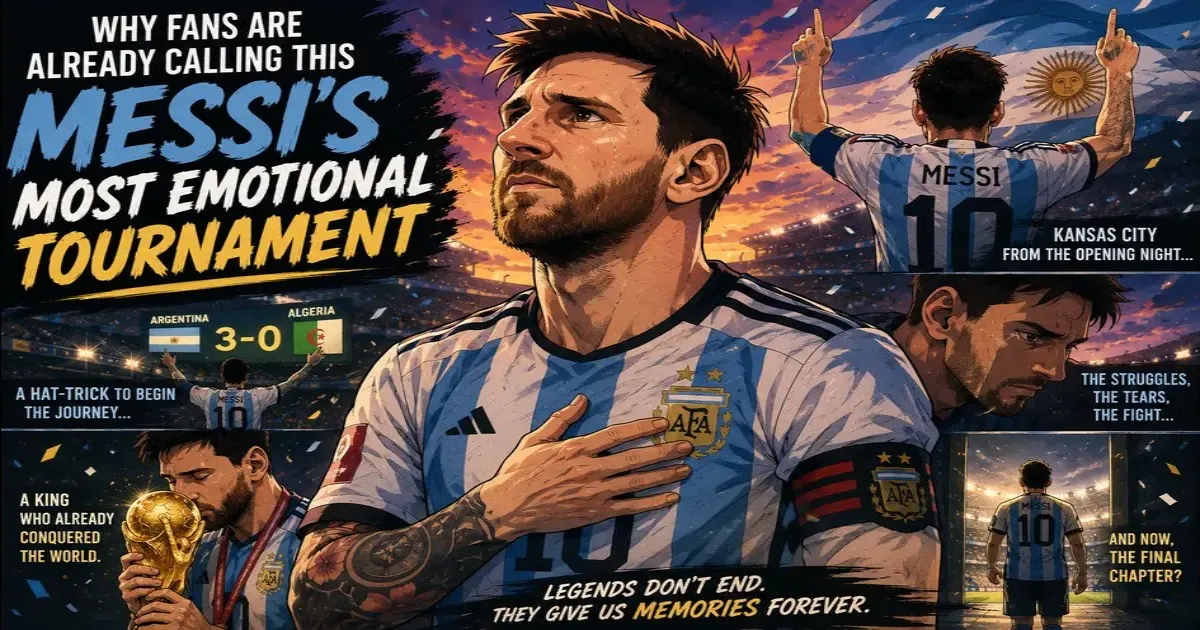
A Final World Cup Chapter Filled With Records, Resilience and Heartbreak — Messi’s Most Emotional Tournament
By StrikerReport Football Desk
Every FIFA World Cup Lionel Messi has played has carried its own emotional weight. There was the pressure of Argentina’s long wait for a world title, the pain of earlier disappointments, the comparisons with Diego Maradona, and the extraordinary rivalry with Cristiano Ronaldo that defined an entire generation of football. But the FIFA World Cup 2026 was different. At 39 years old, Messi entered what was widely expected to be his final World Cup, and what followed became one of the most remarkable and emotional chapters of his international career. From his record-breaking performances in the group stage to a dramatic comeback against Egypt, a difficult quarterfinal against Switzerland, a brilliant semifinal against England and an agonising defeat to Spain in the final, Messi’s tournament became much more than another attempt to win the World Cup. It became a celebration of longevity, resilience, leadership and a career that appeared to be approaching its final international chapter.
Thiago Messi: Club Career, Playing Style, Lifestyle and Future Prospects
Cristiano Ronaldo Jr.: Club, Lifestyle, Career and Future Prospects
That is why Messi’s Most Emotional Tournament is no longer simply a phrase describing the mood around Argentina’s campaign. Looking back at the entire competition, it is difficult to argue that any of Messi’s previous World Cups produced quite the same combination of extraordinary football, personal vulnerability and the constant awareness that every appearance could be one of his last.From Roberto Carlos to Messi: Ranking the Best Free Kicks in History
1. The World Cup Finally Became About Enjoyment, Not Redemption
When Messi lifted the World Cup in Qatar in 2022, he completed the one achievement that had followed him throughout his career. For years, every major Argentina tournament had been viewed through the question of whether he could finally deliver the trophy that Maradona had won in 1986 and that Argentina had been chasing ever since.
By 2026, that pressure had changed completely.
Messi was no longer trying to prove that he could win a World Cup. He had already done it. Instead, he arrived in North America as the defending champion and as a 39-year-old captain attempting something that seemed almost impossible for a player of his age: leading Argentina through another major tournament while still being one of its most important attacking players.
That changed the emotional character of his campaign. Every goal was celebrated not simply because it helped Argentina win, but because fans understood they might not see Messi score another World Cup goal again.
There was no longer a future tournament waiting to provide another opportunity.
There was only the present.
And that made every moment matter more.
2. Messi Started the Tournament by Making History
The emotional story began almost immediately.
Argentina opened their World Cup campaign against Algeria at Kansas City Stadium, and Messi produced a performance that immediately reminded the football world that age had not taken away his extraordinary ability.From Legend to Lightning Rod: Why Messi Is Being Criticized Now
The Argentina captain scored a hat-trick in a 3-0 victory, equalling Miroslav Klose’s record of 16 World Cup goals in the process. FIFA’s official match report described the performance as record-equalling, with Messi scoring three times against Algeria.
For a player approaching his 40th birthday, it was extraordinary.
Messi’s first goal of the tournament was particularly symbolic. He had spent the months before the competition surrounded by questions about his physical condition and whether he could still influence matches at the highest level. Within minutes of the World Cup beginning, those questions had largely disappeared.
He was still Messi.
He was still capable of deciding matches.
And he was still capable of producing moments that nobody else on the pitch could replicate.
That hat-trick immediately changed the narrative around Argentina’s campaign and gave fans an early glimpse of what would become one of the defining individual performances of the tournament.
3. His Vulnerability Made the Tournament More Human
The most emotional sporting stories are rarely built entirely on perfection.
Messi’s 2026 World Cup included moments when things went wrong.
Argentina’s Round of 16 meeting with Egypt provided perhaps the clearest example. The holders found themselves 2-0 down and facing the possibility of a stunning early elimination. Messi also saw a penalty saved during the match, adding another layer of pressure to an already difficult evening.
For perhaps the first time in the tournament, Argentina genuinely looked vulnerable.
But then came the comeback.
Cristian Romero pulled one goal back, Messi equalised four minutes later, and Enzo Fernández completed the turnaround in stoppage time to give Argentina a 3-2 victory. Messi’s equaliser was particularly significant because it extended his record of scoring in nine consecutive World Cup appearances.
That match captured something essential about Messi’s final World Cup.
He did not simply glide through the tournament.
Argentina had to fight.
They had to recover from setbacks.
And Messi had to continue producing decisive moments even when the team around him was under enormous pressure.
That made the journey feel more human.
The Messi of 2026 was still capable of brilliance, but he was also capable of frustration, pressure and visible emotion.
That combination helped make the tournament so memorable.The Weirdest Football Superstitions Even Messi, Ronaldo and Neymar Swear By
4. His Age Made Every Moment Feel Bigger
There was an unavoidable fact surrounding the entire tournament: Messi was 39.
The next World Cup will take place in 2030, when he would be 43.
While Messi has not formally announced his retirement from international football, the age factor made it difficult for supporters to imagine him returning for another World Cup. Argentina Football Association president Claudio Tapia has since stressed that the retirement decision belongs entirely to Messi and that the player should decide his future on his own terms.
That uncertainty became part of the emotional atmosphere around every Argentina match.
A normal Messi celebration suddenly felt significant.
A handshake with a teammate felt significant.
A long walk across the pitch after the final whistle felt significant.
Every time the cameras focused on him, fans knew they could be watching something they might never see again.
That is one of the defining characteristics of Messi’s Most Emotional Tournament.
The football was important, but so was the awareness that time was running out.
5. Messi Continued to Produce at an Extraordinary Level
The emotional narrative would mean far less if Messi had simply been a ceremonial figure in Argentina’s squad.
Instead, he remained one of the tournament’s most productive players.
Messi finished the 2026 World Cup with eight goals and four assists across seven appearances, giving him 12 direct goal contributions. The IFFHS subsequently named him its best player of the tournament based on its statistical performance index.
His numbers were remarkable considering his age and the defensive attention he received.
Argentina’s opponents knew exactly where the danger was.
They knew Messi would frequently drift into central areas.
They knew he could create chances from seemingly impossible angles.
They knew that giving him even a small amount of space around the penalty area could result in a decisive pass or shot.
Yet they still struggled to stop him.
Messi’s 2026 campaign therefore became more than a sentimental farewell story.
It was an elite football performance in its own right.
At 39, he was still creating, scoring and influencing games against the world’s best international teams.
6. The Quarterfinal Against Switzerland Added Another Chapter
Argentina’s quarterfinal against Switzerland at Kansas City provided another emotional moment because it brought Messi back to the stadium where he had begun the tournament with his hat-trick against Algeria.
This was not the same Argentina side that had opened the competition.
The stakes were far higher.
The Swiss pushed the defending champions to their limits, and Argentina eventually needed extra time to secure a 3-1 victory. Alexis Mac Allister opened the scoring before Switzerland equalised through Dan Ndoye. After Switzerland were reduced to 10 men, Argentina finally broke through in extra time, with Julián Álvarez scoring in the 112th minute before Lautaro Martínez added another in stoppage time.
Messi did not need to score to influence the match.
His presence continued to shape the way Switzerland defended, and his creativity remained central to Argentina’s attacking structure.
More importantly, the victory carried an emotional symbolism.
Argentina had returned to the same stadium where their campaign had begun.
They had survived another difficult knockout match.
And Messi was now just two victories away from another World Cup final.
The story was beginning to feel increasingly like a farewell tour, even though Messi himself never officially called it one.Argentina World Cup 2026 Quiz: Test Your Messi & Albiceleste Knowledge
7. The Final Made the Tournament Unforgettable
Argentina eventually reached the World Cup final against Spain, giving Messi the opportunity to finish his international career with one of the most perfect endings imaginable.
Instead, football provided something more complicated.
Spain defeated Argentina 1-0 after extra time at MetLife Stadium in New Jersey.
For Messi, it meant the end of his sixth World Cup and another painful final defeat.
Yet it also provided the clearest evidence of just how remarkable his tournament had been.
He finished with eight goals and four assists and helped Argentina reach consecutive World Cup finals. He also received the Silver Ball as the tournament’s second-best player in FIFA’s official awards, while Spain’s Rodri won the Golden Ball.
The final whistle brought the kind of emotion that had been building around Messi throughout the tournament.
There was no trophy this time.
There was no fairytale final goal.
There was no repeat of Qatar.
Instead, there was disappointment.
And perhaps that made the ending feel even more real.
Messi later reflected on the pain of losing the final while also expressing pride in what Argentina had achieved by reaching consecutive World Cup finals.
Messi and Ronaldo: The End of an Era
Another reason the 2026 World Cup carried such emotional weight was the presence of Cristiano Ronaldo in the same tournament.
For almost two decades, football had been defined in part by the Messi-Ronaldo debate.
They competed for individual awards, broke records, dominated Champions League football and became the two most recognisable players of their generation.
At the 2026 World Cup, both men were nearing the end of their international careers.
Ronaldo’s tournament ended before Messi’s, and the contrast between the two veterans added another layer to the competition. Messi ultimately went further with Argentina, reaching the final, while Ronaldo’s Portugal campaign ended earlier.
For fans who had grown up watching the two players dominate football, the possibility that both were nearing the end of their World Cup careers was difficult to ignore.
It was not simply the end of a tournament.
It felt like the closing of an era.
The Emotional Reaction Went Beyond Argentina
What made Messi’s campaign especially powerful was that the emotion was not limited to Argentina supporters.
Even neutral fans understood the significance of watching a 39-year-old Messi compete at this level.
For more than 20 years, supporters had watched him develop from a teenage prodigy into Barcelona’s greatest player, then into Argentina’s captain and eventually a World Cup champion.
By 2026, many fans were watching with a different perspective.
They were no longer asking how many trophies Messi still needed.
They were watching because they knew there might not be many more opportunities.
That distinction matters.
The emotion came not from unfinished business, but from the possibility of an ending.
A Tournament That Proved Messi Still Belonged
Perhaps the strongest argument for calling this Messi’s Most Emotional Tournament is that it was not simply a goodbye.
It was a genuine competitive achievement.
Messi did not spend the World Cup being protected by Argentina’s younger players.
He was not simply brought on for ceremonial appearances.
He remained a central figure.
Eight goals and four assists at the age of 39 is an extraordinary tournament return.
Argentina reached the final.
Messi remained one of the team’s most influential players.
And despite the heartbreak of losing to Spain, his performances ensured that his final World Cup, if it does prove to be his last, will be remembered as one of the strongest individual campaigns of his career.Messi vs Ronaldo: The Definitive Statistical Comparison — Every Number, Every Record, One Verdict
The Ending Was Painful, But That Is What Made It Real
There was never any guarantee that Messi would receive the perfect ending.
Football rarely provides those.
Argentina had already experienced the perfect ending in Qatar.
The 2026 story was different.
This time, Messi reached the final but could not lift the trophy.
He scored eight goals.
He created four more.
He carried Argentina through difficult moments.
He helped them reach another World Cup final.
And then he watched Spain celebrate.
That is not the ending many Argentina supporters wanted.
But it is an ending that feels profoundly human.
The greatest players do not always get the final scene they deserve.
Sometimes their legacy is strengthened precisely because the story ends with struggle rather than perfection.
Why This Will Be Remembered as Messi’s Most Emotional Tournament
The phrase Messi’s Most Emotional Tournament ultimately fits because the 2026 World Cup contained almost every possible emotion.
There was excitement when Messi scored his opening hat-trick.
There was tension when Argentina fell two goals behind Egypt.
There was relief when the holders completed their comeback.
There was determination during the difficult quarterfinal against Switzerland.
There was joy when Argentina reached another semifinal and then another final.
And finally, there was heartbreak when Spain ended their campaign in extra time.
Throughout it all was the same underlying question: was this the last time?
Messi never gave fans a definitive answer.
He has not formally announced his international retirement, and Argentine football officials continue to insist that the decision belongs to him.
That uncertainty may remain for some time.
But the emotional significance of the 2026 World Cup is already impossible to deny.
Messi finished the tournament with eight goals and four assists, reached another World Cup final and left the competition having once again demonstrated that age had not prevented him from performing at the highest level.
If this was indeed his final World Cup, it was not the fairytale ending Argentina wanted.
But perhaps that is why it will be remembered so strongly.
Messi’s Most Emotional Tournament was never really about whether he could prove himself again.
He had nothing left to prove.
It was about watching one of football’s greatest-ever players take one final run at the game’s biggest stage, knowing that every goal, every assist, every celebration and every tear might be part of the last chapter.
And when the final whistle eventually arrived, the sadness came not because Messi had failed to build a legacy, but because he had built one so extraordinary that the thought of football without him at a World Cup felt almost impossible.
Whatever Messi decides about 2030, the 2026 FIFA World Cup has already secured its place in his story.
It was a tournament of records, resilience, brilliance and heartbreak.
Most importantly, it was a tournament that reminded the world why watching Lionel Messi play football has felt special for so long.
StrikerReport.com will continue to follow Lionel Messi, Argentina and the next chapter of the legendary captain’s career.
◾◾ follow us on facebook ◾◾
About the Author



2 thoughts on “7 Reasons Why FIFA World Cup 2026 Became Messi’s Most Emotional Tournament”