 The Full FIFA World Cup 2026 Awards List
 The Full FIFA World Cup 2026 Awards List
FIFA handed out its full set of individual honours immediately after Spain’s 1-0 extra-time win over Argentina in Sunday’s final, and the list reads as a fitting summary of how the tournament actually unfolded — Spain’s collective control rewarded ahead of Argentina’s individual brilliance, and a host of records broken along the way. Here’s the complete FIFA World Cup 2026 awards list, and the reasoning behind each winner.Spain Are World Champions: The Story of Their 2026 Triumph
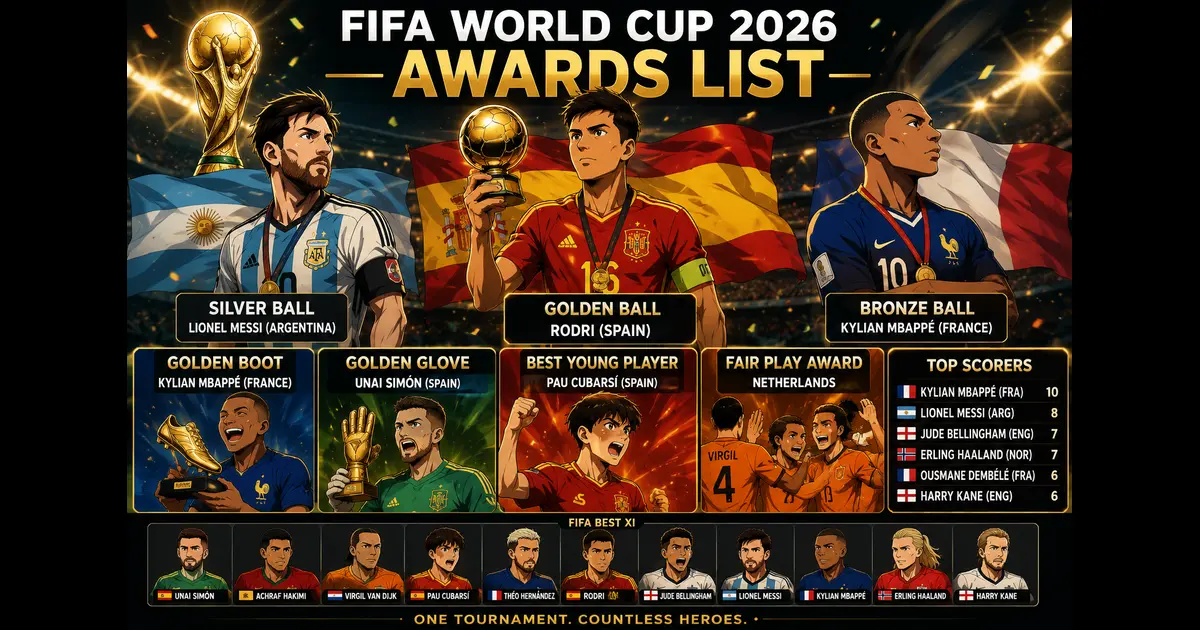
Golden Ball: Rodri (Spain)
Spain’s captain and defensive midfield anchor was named the tournament’s outstanding player, edging out Lionel Messi for the honour. Rodri’s role throughout the campaign was built around control rather than individual moments of magic — dictating tempo, screening Spain’s back four, and organizing the rest-defence structure that allowed Spain to concede just once across the entire tournament. It’s a Golden Ball win that rewards a genuinely different kind of influence than many previous winners of the award, recognizing a platform-building performance over a highlight-reel one.
Silver Ball: Lionel Messi (Argentina)
Messi’s fourth and almost certainly final World Cup produced a Silver Ball finish, capping a tournament in which he led the competition in chances created (25) and finished with eight goals and four assists — including the two assists that turned Argentina’s semifinal against England. Falling one win short of a second consecutive title, Messi’s individual campaign was still comprehensive enough to finish as the tournament’s second-best player by FIFA’s own technical study group.
Bronze Ball: Kylian Mbappé (France)
Mbappé’s Bronze Ball recognizes a campaign that fell one round short of the final itself, but still produced the tournament’s most goals and a share of the individual record books. France’s semifinal exit to Spain, followed by a wild 6-4 defeat to England in the third-place playoff, meant Mbappé’s Golden Boot-winning tournament ultimately translated to a third-place individual finish rather than a place in the final two.
Golden Boot: Kylian Mbappé (France)
Mbappé finished as the tournament’s outright top scorer with 10 goals in eight matches, two clear of Messi. It made him the first player in history to win the Golden Boot at consecutive World Cups, and his tally also pushed his career World Cup goal count to 22, overtaking Germany’s Miroslav Klose as the competition’s all-time leading scorer. The full top six finished: Mbappé (10), Messi (8), Jude Bellingham (7), Erling Haaland (7), Ousmane Dembélé (6), and Harry Kane (6).
Golden Glove: Unai Simón (Spain)
Simón conceded just one goal across eight matches — a Charles De Ketelaere strike in the quarterfinal against Belgium — finishing with a save percentage above 90% and a record seven clean sheets in a single tournament. His form was central to Spain’s title-winning defensive record, and it extended his career World Cup clean sheet tally to nine, one shy of the all-time record of ten jointly held by France’s Fabien Barthez and England’s Peter Shilton.
FIFA Best Young Player: Pau Cubarsí (Spain)
Spain’s 19-year-old centre-back beat out his own teammate, 18-year-old Lamine Yamal, for the tournament’s top young player honour. Cubarsí’s composed, commanding performances at the heart of Spain’s defence were central to their historic one-goal-conceded campaign, and the award — presented by the tournament’s Aramco partnership — capped a breakout summer that instantly established him as one of the most sought-after young defenders in world football.
FIFA Fair Play Award: Netherlands
The Netherlands were recognized with the tournament’s Fair Play award despite a painful early exit — held to a 1-1 draw by Morocco in the round of 32 before losing on penalties. The award reflects on-field discipline and conduct across a team’s matches rather than results, and it’s a distinction the Dutch squad could take some pride in even after their disappointing finish.
Best XI and Honourable Mentions
FIFA’s technical study group also named a tournament Best XI, headlined by an attacking trio of Mbappé, Erling Haaland and Messi — a front three that reflects the individual goal-scoring standings almost perfectly, even though only one of the three lifted the trophy itself. A second-best XI and an honourable mention list further recognized the breadth of standout performances across a 48-team, 104-match tournament, though the headline honours remained squarely focused on Spain’s collective triumph and the individual brilliance of the players who came closest to stopping them.
What This Awards List Says About the Tournament
Line up the full list of winners, and a clear theme emerges: Spain’s title was built on defensive structure and collective control (Rodri’s Golden Ball, Simón’s Golden Glove, Cubarsí’s Best Young Player), while the individual, highlight-reel accolades went almost entirely to players from teams that didn’t actually win the tournament (Messi’s Silver Ball, Mbappé’s Bronze Ball and Golden Boot). It’s a genuinely unusual split — most recent World Cup-winning squads have had at least one player capture one of the marquee individual awards outright — and it underlines just how different a route to the trophy Spain took compared to the tournament’s most individually brilliant performers.
How This Awards Haul Compares Historically
Winning multiple individual awards in a single tournament is relatively rare for one national federation, which makes Spain’s sweep of three of the six major honours — Golden Ball, Golden Glove, and Best Young Player — a genuinely notable haul by historical standards. It echoes, in a different configuration, West Germany’s dominant individual showing at the 1990 tournament and Brazil’s at various points across their five title-winning campaigns, where the eventual champions didn’t just lift the trophy but dominated the individual conversation around the tournament as well.
It’s also worth noting how the Golden Ball voting reflected a broader shift in how FIFA’s technical study group and media panels have come to value different kinds of contribution. Previous Golden Ball winners have often been the most spectacular attacking performer at the tournament — Diego Maradona in 1986, Ronaldo in 2002, Lionel Messi himself in 2014. Rodri’s win, for a player whose defining contributions were largely invisible to a casual viewer — positioning, tempo control, and organizing a defence that conceded only once all tournament — suggests panels are increasingly willing to reward structural, team-first influence over individual moments of magic, even when a more conventionally eye-catching campaign like Messi’s was available to choose from instead.
The Records Behind the Honours
Several of this year’s award winners arrived with genuine historical weight attached. Mbappé’s Golden Boot made him just the third player in the post-war era to win the award in consecutive tournaments in any comparable fashion, and his 22 career World Cup goals moved him clear of Miroslav Klose’s 16-goal record that had stood since 2014 — a mark many assumed would last considerably longer than it did. Simón’s seven clean sheets broke new ground for a single tournament, while his career total of nine, spread across the 2022 and 2026 editions, leaves him just one shy of the outright all-time record. Even the Fair Play award carried its own footnote: the Netherlands’ recognition came despite — or perhaps partly because of — a heartbreaking exit on penalties, a reminder that the award has always measured conduct rather than results.
Individual Awards Versus the Trophy Itself
Perhaps the most striking overall theme of this awards list is how cleanly it splits between Spain’s collective triumph and the individual brilliance of the players who ultimately fell short of it. Argentina and France, the two nations that finished second and third overall, combined to take home four of the six major individual honours — Messi’s Silver Ball, Mbappé’s Bronze Ball and Golden Boot. Only Spain’s structural dominance, built on Rodri’s platform and Simón’s shot-stopping, was enough to convert collective control into the trophy that actually mattered most.
The Bigger Picture
FIFA’s awards ceremony capped a tournament that had already rewritten several record books over the course of its 104 matches — the most goals ever scored, a new all-time World Cup scorer, and a new record for clean sheets in a single edition all confirmed within the same closing weekend. For a 48-team format still finding its footing after its first-ever staging, this awards list offered as clean a summary as the tournament could have produced: a champion built on defensive perfection, and a chasing pack of individual brilliance that, in the end, wasn’t quite enough to stop them.
🔹🔹 follow us on facebook 🔹🔹
About the Author

2 thoughts on “Complete FIFA World Cup 2026 Awards List: Every Winner”