 A complete beginner’s guide to football league structure, covering divisions, promotion, relegation, and how domestic cups fit into the picture.
If you’re new to football, one of the most confusing things to wrap your head around is how leagues actually work. Unlike most American sports, where a fixed number of teams compete in a closed league every year, football operates on an entirely different model. Understanding football league structure is essential to understanding why a small club from a small town can, in theory, climb all the way to the top division of their country within a few seasons, and why a giant club with a storied history can suddenly find itself playing in a lower tier.
LaLiga 2026/27 Schedule: Fixtures, Dates & Times
Premier League 2026/27 Schedule: This Week and Next Week
Every Confirmed Character in Avengers: Doomsday
The Basic Concept: A Pyramid, Not a Closed Club
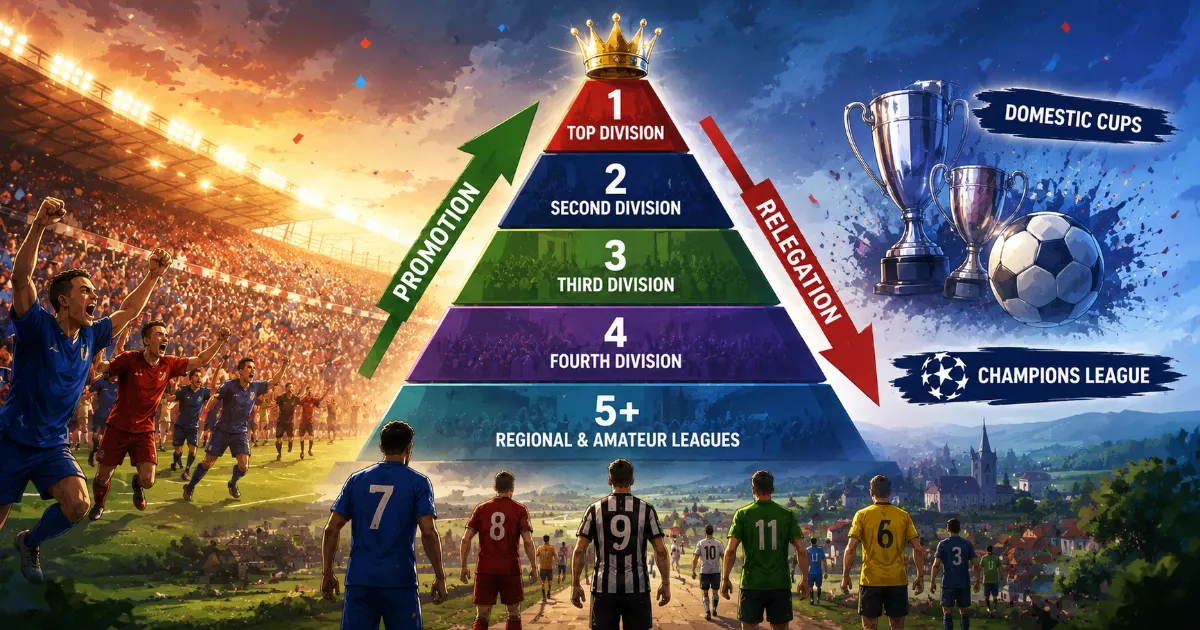
Most football-playing nations organize their domestic game as a pyramid. At the top sits the highest division, usually the one broadcast internationally and covered by major media. Below that sits a second division, then a third, then often a fourth, fifth, and so on, all the way down to regional amateur leagues. In England, for example, this pyramid technically has over twenty levels when you count every regional and county league beneath the professional tiers.
This pyramid structure means that, theoretically, any club starting in the lowest amateur league could climb all the way to the very top division through a series of promotions. It’s an extremely rare feat, but the pathway exists, and that possibility is part of what makes domestic football so compelling in countries that use this model.
Promotion and Relegation: The Engine of the Pyramid
The mechanism that connects each tier of the pyramid is promotion and relegation. At the end of each season, the best-performing teams in a lower division move up to the tier above them, while the worst-performing teams in a higher division move down to the tier below. The exact number of teams promoted and relegated varies by country and league, but it’s typically somewhere between two and four teams each way per season.
This system creates constant stakes throughout an entire season, not just at the top of the table. While the title race grabs headlines, the relegation battle at the bottom of the table is often just as dramatic, since dropping down a division can mean significant financial losses for a club, particularly at the elite level where a single relegation can cost tens of millions in broadcast revenue.
Some leagues use a playoff system for one of the promotion spots rather than pure final standings. In England’s second tier, for example, the top two teams gain automatic promotion, while the clubs finishing third through sixth compete in a playoff tournament for the final promotion spot, often dubbed the most lucrative single match in football due to the financial value of promotion.
Where Cup Competitions Fit In
Alongside the league pyramid, most footballing nations run one or more domestic cup competitions. Unlike the league, which is a season-long points competition, a cup is a knockout tournament, meaning a single loss ends a team’s involvement. What makes domestic cups particularly interesting is that they’re usually open to clubs from multiple tiers of the pyramid at once, which is how lower-league teams occasionally pull off shocking upsets against elite clubs, a phenomenon fans often call a “giant-killing.”
Most countries also have a secondary cup competition, often reserved for clubs in the top flight or top two divisions, which acts as a slightly lower-stakes trophy compared to the primary domestic cup. These competitions give clubs a second and third route to silverware and European qualification each season, on top of their league position.
How Continental Competition Connects to the Pyramid
For the biggest clubs, the domestic pyramid also determines qualification for continental club competitions like the UEFA Champions League and Europa League in Europe, or the CONCACAF Champions Cup in North America. Finishing position in the top division typically determines which clubs qualify, meaning the difference between third and fourth place in a league table can be worth tens of millions in additional revenue through European qualification. This is why the “race for the top four” (or top five, or top six, depending on the league’s continental allocation) is often just as fiercely contested as the title race itself.
Why Some Countries Use a Different Model
Not every football league uses a promotion and relegation system. Major League Soccer in the United States, along with several other leagues in North America and parts of Asia, uses a closed franchise model similar to American sports leagues like the NBA or NFL. In this system, the number of teams is fixed, and instead of a relegation battle, poor-performing teams simply miss the playoffs. There’s ongoing debate about whether MLS will eventually introduce promotion and relegation as the league continues to expand and mature, but for now it remains one of the world’s few major top-flight leagues without it.
Why This System Matters to Fans
Understanding football league structure changes how you watch the sport entirely. Suddenly, a mid-table clash between two teams with nothing obvious at stake becomes a match with real relegation or promotion implications. A domestic cup tie against lower-league opposition becomes a genuine banana-skin fixture rather than a formality. And the difference between finishing fourth and fifth in a league table becomes a financial cliff-edge rather than a minor footnote.
This pyramid model, with its promotion, relegation, and layered cup competitions, is part of what gives football its unique season-long drama, both at the top of the table and the bottom. Once you understand how the pieces fit together, following any domestic league becomes a far richer experience.
The Financial Stakes Behind Promotion and Relegation
It’s hard to overstate just how much money rides on a single promotion or relegation in the modern game. In England, for example, dropping out of the Premier League can cost a club well over one hundred million dollars in lost broadcast revenue over just a couple of seasons, even with parachute payments designed to soften the blow. That’s why relegation battles are often fought with the same intensity as title races, sometimes more, since the financial consequences of going down can threaten a club’s entire business model.
On the flip side, promotion to a top division can be transformative for a smaller club. New broadcast deals, increased matchday revenue from bigger away support, and access to a far larger pool of sponsorship money can change a club’s trajectory for years. This financial gulf between tiers is part of why the promotion playoff final in England’s second division has been nicknamed the most valuable single match in club football, with the winner gaining a windfall worth vastly more than the prize money itself.
How Football League Structure Differs Around the World
While the general pyramid concept holds true in most footballing nations, the specifics vary considerably. Some countries split their top division into a regular season followed by a championship group and relegation group, a format used in parts of Scandinavia and elsewhere to keep matches meaningful for mid-table teams late in the season. Others use a split-season format with an apertura and clausura, common across much of Latin America, where two separate mini-seasons each produce their own champion, followed by a playoff to determine an overall league winner.
These variations exist for different reasons, sometimes climate-related, since countries with harsh winters may split their season around a winter break, and sometimes for commercial reasons, since a split season can effectively double the number of “title race” storylines a broadcaster can sell to fans each year. Understanding that football league structure isn’t one single global template, but rather a set of shared principles adapted differently by each footballing nation, helps explain why the sport can look quite different depending on which country’s competition you’re watching.
Lower Leagues and the Dream of Climbing the Pyramid
One of the most romantic elements of promotion and relegation is the theoretical pathway it creates from the very bottom of a football pyramid to the very top. While genuinely rare, there are real examples throughout football history of clubs rising from regional amateur football all the way to their nation’s top flight within a decade or two, fueled by strong local investment, smart recruitment, and a run of well-timed promotions.
This possibility is a core part of what makes lower-league football compelling to a certain type of fan, one who follows a smaller club not because of the current standard of football, but because of the shared belief that, given enough time and the right decisions, that club could theoretically work its way up the entire pyramid. It’s a storyline that simply doesn’t exist in closed franchise systems, where a club’s tier is effectively fixed the moment it joins the league.
Champions League 2026/27 Schedule: Fixtures, Dates & Times
NBA Schedule 2026-27: Christmas Day Rivalries, Ring Night and the Games to Watch
🔹🔹 Follow Us on Facebook 🔹🔹
About the Author