What Egypt’s World Cup 2026 Journey Means for the Future
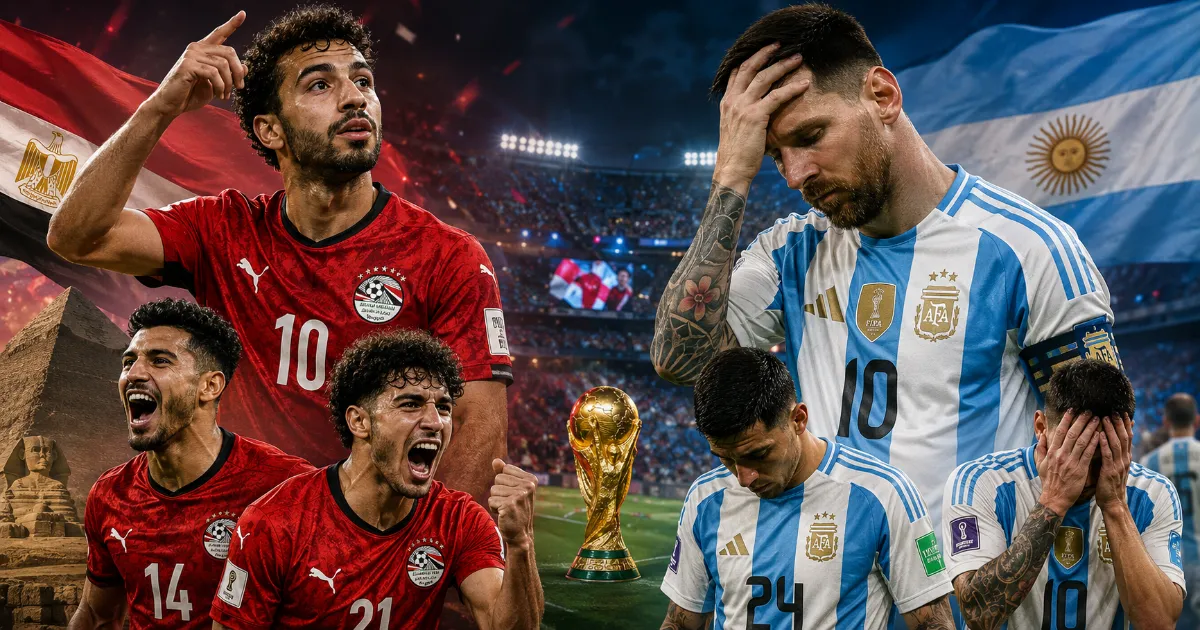
Egypt’s World Cup 2026 Journey ended in the most painful way imaginable: with the Pharaohs eleven minutes away from a historic quarterfinal before Argentina produced a stunning late comeback.
For much of their Round of 16 clash in Atlanta, Egypt looked capable of pulling off one of the biggest shocks in World Cup history. They led the defending champions 2-0, goalkeeper Mostafa Shobeir had already saved a Lionel Messi penalty, and the Egyptian defense appeared capable of holding on.
Then everything changed.
Argentina 3-2 Egypt Report: Champions Survive Egypt Scare to Reach World Cup Quarter-Finals
Spain Are World Champions: The Story of Their 2026 Triumph
Cristian Romero pulled one goal back in the 79th minute, Messi equalized four minutes later, and Enzo Fernández completed Argentina’s comeback in stoppage time. The 3-2 defeat ended Egypt’s World Cup campaign, but it did not erase what the Pharaohs had accomplished. They recorded their first World Cup knockout victory, reached the Round of 16 for the first time, and pushed the reigning champions to the brink.
According to FIFA’s own retrospective, the tournament changed the way the world viewed Egyptian football.
Egypt’s World Cup 2026 Journey Was Historic From the Start
Egypt entered the 2026 tournament with a familiar burden. The country has one of Africa’s strongest football traditions, yet World Cup success had repeatedly remained out of reach.
The 2026 tournament finally changed that narrative.
Egypt were drawn into Group G alongside Belgium, Iran and New Zealand. Rather than simply attempting to survive against stronger opposition, the Pharaohs played with confidence from the opening match. Their 1-1 draw against Belgium immediately demonstrated that they could compete with one of Europe’s strongest sides.
Emam Ashour gave Egypt the lead in that opening match, while Belgium eventually responded to secure a point. FIFA described Egypt’s performance as one of the early surprises of the tournament, particularly because the Pharaohs played with discipline and ambition rather than sitting back defensively.
The result set the tone for a campaign in which Egypt consistently exceeded expectations.
Group G: Egypt Finds a Way Through
Egypt’s group-stage campaign was not spectacular in the conventional sense, but it was effective.
The Pharaohs collected enough points to finish second in Group G behind Belgium and advance to the knockout phase. FIFA confirmed that Belgium won the group while Egypt finished as runners-up, setting up a Round of 32 meeting with Australia.
That qualification was significant because Egypt had historically struggled to turn promising performances into World Cup progression.
This time, the team showed greater tactical maturity.
Hossam Hassan’s side relied on defensive organization, compact midfield positioning and quick transitions. Mohamed Salah remained the most recognizable attacking figure, but the tournament increasingly demonstrated that Egypt were becoming more than a one-player team.
Players such as Mostafa Shobeir, Yasser Ibrahim, Emam Ashour, Mostafa Zico and Haissem Hassan all became important contributors.
The result was a team capable of surviving difficult matches without abandoning its identity.
Round of 32: Egypt Makes World Cup History Against Australia
The next step in Egypt’s World Cup 2026 Journey was arguably the most important.
Australia represented a completely different challenge from the group stage. The match was tense, physical and ultimately decided by penalties after a 1-1 draw across 120 minutes.
Egypt eventually won the shootout 4-2.
Hossam Abdelmaguid converted the decisive penalty, sending the Pharaohs into the Round of 16 for the first time in their history. The Asian Football Confederation confirmed Egypt’s 4-2 shootout victory and described the result as a historic achievement for the North African side.
The victory meant Egypt had finally broken through a barrier that had existed throughout their World Cup history.
They were no longer simply participants.
They were a knockout-stage team.
For a nation that had waited decades for a genuine World Cup breakthrough, that distinction mattered enormously.
Argentina vs Egypt: The Match That Almost Became a Miracle
If Egypt’s victory over Australia created history, the Round of 16 meeting with Argentina nearly created mythology.
The defending champions entered the match as overwhelming favorites, but Egypt immediately showed that they had no intention of playing as underdogs.
Yasser Ibrahim opened the scoring in the 15th minute with a header from a Marwan Attia delivery. It was the first time Argentina had fallen behind during the 2026 World Cup.
Argentina were then handed an opportunity to respond from the penalty spot.
Messi stepped forward.
Shobeir saved it.
That moment dramatically shifted the atmosphere. Egypt were no longer merely defending a narrow advantage. They began to believe that the reigning champions could actually be eliminated.
Shobeir continued to frustrate Argentina, making important saves as Egypt protected their lead.
Then came the moment that seemed to put the match beyond Argentina’s reach.
Mostafa Zico Makes It 2-0
In the 67th minute, Mostafa Zico doubled Egypt’s advantage.
Haissem Hassan created the opportunity, and Zico finished to put the Pharaohs 2-0 ahead with only a little over 20 minutes remaining.
The scoreline was extraordinary.
Argentina had Messi.
Mostafa Zico: The Late Bloomer Who Took Egypt’s Winger Spot and Never Looked Back
Argentina had the experience of winning the previous World Cup.
Argentina had already survived difficult moments during the tournament.
But Egypt had a two-goal lead.
For the first time, the dream of reaching the quarterfinal seemed real.
Match records show that Argentina eventually overturned the deficit with three goals between the 79th minute and stoppage time.
Zico Scores on the Counter, But VAR Rules Out Egypt’s Second Goal vs Argentina
The Final 13 Minutes That Changed Everything
The collapse began in the 79th minute.
Lionel Messi delivered the ball toward the penalty area, and Cristian Romero rose to head Argentina back into the contest.
Egypt still led 2-1.
But suddenly the defending champions had belief.
Four minutes later, Messi produced the equalizer.
His finish made it 2-2 and transformed what had looked like an Egyptian triumph into a completely open contest.
Argentina continued pushing.
Egypt tried to survive.
Then came the decisive blow.
In the second minute of stoppage time, Enzo Fernández headed home a Lautaro Martínez cross to complete Argentina’s comeback.
From 2-0 down, Argentina had won 3-2.
For Egypt, the dream was over.Thiago Messi: Club Career, Playing Style, Lifestyle and Future Prospects
Cristiano Ronaldo Jr.: Club, Lifestyle, Career and Future Prospects
Why Egypt’s Two-Goal Lead Disappeared
The defeat will naturally lead to questions about what Egypt could have done differently.
The first issue was game management.
At 2-0, Egypt increasingly found themselves defending deeper and deeper. That approach was understandable, but it allowed Argentina to maintain pressure for long periods without having to worry as much about counterattacks.
Against a team containing Messi, that is an extremely dangerous strategy.
The second factor was Argentina’s experience.
The defending champions had already demonstrated throughout the tournament that they could survive difficult situations. When Romero scored, Argentina did not panic. They continued attacking with patience.
The third factor was the quality available to Argentina from the bench.
Lautaro Martínez became involved in the decisive stages, while Enzo Fernández eventually scored the winner. Argentina could introduce players capable of changing the rhythm of the match.
Egypt had fought incredibly hard to reach this point, and the accumulated physical and emotional pressure eventually became difficult to withstand.
Mostafa Shobeir: Egypt’s Breakout Star
If one player symbolized Egypt’s run, it was arguably Mostafa Shobeir.
The goalkeeper produced one of the tournament’s most memorable individual performances against Argentina.
He saved Messi’s penalty and made further important interventions to keep Egypt ahead.
Even after Argentina’s comeback, Shobeir’s contribution to the campaign remained undeniable.
A goalkeeper’s role in an underdog tournament run is often underestimated. Egypt needed someone capable of keeping games close, and Shobeir repeatedly provided exactly that.
Against Australia, he helped the team survive a 120-minute battle that ultimately went to penalties.
Against Argentina, he kept the world’s champions frustrated for most of the match.
His performances turned him into one of the most memorable figures of Egypt’s tournament.
Mohamed Salah’s Final World Cup Chapter
For Mohamed Salah, the 2026 World Cup carried a different emotional weight.
At 34, the tournament represented what was likely his final opportunity to make a major World Cup impact.
Salah had already experienced the disappointment of previous international campaigns. Egypt’s qualification for the 2018 World Cup had been historic, but the Pharaohs exited the group stage.
In 2026, the story was different.
Salah helped lead Egypt into the knockout rounds and played an important leadership role as the team navigated the pressure of a historic campaign.
His influence was not limited to goals.
He was the player younger teammates could look toward when matches became chaotic, and his presence gave Egypt credibility against opponents with greater tournament pedigree.
The defeat against Argentina means Salah leaves the World Cup without a quarterfinal appearance, but his generation has nevertheless changed the expectations surrounding Egyptian football.
Yasser Ibrahim, Zico and the New Egypt
One of the most encouraging aspects of Egypt’s campaign was the emergence of players capable of sharing responsibility with Salah.
Yasser Ibrahim became an unlikely attacking hero when he headed Egypt into the lead against Argentina.
Mostafa Zico provided another memorable moment by scoring the second goal that put the Pharaohs on the verge of a historic quarterfinal.
Emam Ashour also played a major role during the tournament, while Haissem Hassan supplied energy and creativity from wide areas.
That balance matters.
For years, Egypt’s international hopes were often discussed almost entirely through the performances of Salah.
The 2026 tournament offered evidence that the next version of the Pharaohs can be more collective.
The Refereeing Controversy
The Argentina match also generated significant controversy.
Egypt players and staff were unhappy with several decisions during the game, particularly incidents surrounding Argentina’s comeback and a previously disallowed Egyptian goal.
Mostafa Zico was among those who publicly expressed his frustration after the defeat, with the winger questioning the fairness of the officiating. His comments became one of the major talking points surrounding the match.
However, the controversy should not completely overshadow the football.
Argentina ultimately scored three goals after falling two behind, and Egypt’s inability to protect their advantage remains the central sporting explanation for the result.
For Egypt, the frustration is understandable.
For Argentina, it was another extraordinary comeback.
For neutral viewers, it was one of the defining knockout matches of the tournament.
What Egypt’s World Cup 2026 Journey Means for the Future
The biggest question now is whether this tournament represents the beginning of a new era or simply the peak of a generation led by Salah.
There are reasons for optimism.
Egypt have demonstrated that they can compete with elite European opposition. They have won a World Cup knockout match. They have developed players capable of performing under extraordinary pressure, and they have shown greater tactical discipline than many previous Egyptian sides.
The next challenge is replacing Salah’s influence.
That will not be easy.
Marmoush represents one potential successor in the attacking department, while the emergence of Zico, Haissem Hassan, Emam Ashour and other younger players provides reasons for optimism.
The Egyptian Football Association must also decide whether Hossam Hassan remains the right coach to oversee the next phase.
Whatever decision is made, continuity may have advantages after a tournament in which Egypt clearly established a stronger identity.
Egypt’s Greatest World Cup Campaign
When the disappointment eventually fades, the achievements of this team should become clearer.
Egypt did not win the World Cup.
They did not reach the quarterfinal.
They did not eliminate Argentina.
But they accomplished something no previous Egyptian team had managed.
They won a World Cup knockout match and reached the Round of 16.
They also came within minutes of defeating the defending champions.
That is not failure.
It is a historic breakthrough.
Egypt’s World Cup 2026 Journey ended with a 3-2 defeat to Argentina, but the final score does not adequately describe what the Pharaohs achieved in North America.
They arrived carrying the weight of decades of World Cup frustration.
They left having changed the expectations of an entire football nation.
The final chapter was heartbreaking. The larger story was historic.
Egypt World Cup 2026 Journey: Key Achievements
| Achievement | Result |
|---|---|
| Group-stage finish | Runners-up in Group G |
| Group-stage highlight | 1-1 draw with Belgium |
| Round of 32 | Egypt 1-1 Australia, won 4-2 on penalties |
| Historic breakthrough | First World Cup knockout victory |
| Round of 16 | Argentina 3-2 Egypt |
| Best finish in 2026 | Round of 16 |
| Biggest moment | Led Argentina 2-0 |
| Goalkeeper hero | Mostafa Shobeir |
| Standout attacking moment | Mostafa Zico’s goal vs Argentina |
| Tournament legacy | Egypt’s most successful World Cup campaign |
Final Verdict
Egypt’s 2026 campaign should ultimately be remembered as a breakthrough rather than a collapse.
Yes, the 3-2 defeat to Argentina will hurt for years. Being 2-0 ahead against the defending champions with a quarterfinal within reach created an opportunity that may not come again for a long time.
But football history is not written only by trophies.
Sometimes it is written by teams that change what their country believes is possible.
Egypt did exactly that in 2026.
The Pharaohs arrived looking for their first World Cup knockout victory.
They found it.
They arrived hoping to escape the group stage.
They went beyond it.
They arrived with Mohamed Salah carrying the hopes of an entire generation.
They left with a younger generation having experienced the pressure of the world’s biggest stage.
Egypt’s World Cup 2026 Journey ended in heartbreak against Argentina — but it also marked the moment Egyptian football finally broke through its World Cup ceiling.
From Roberto Carlos to Messi: Ranking the Best Free Kicks in History
What Cristiano Ronaldo Doesn’t Have: The One World Cup Trophy That Couldn’t Define His Greatness
▪️▪️ follow us on facebook ▪️▪️
About the Author