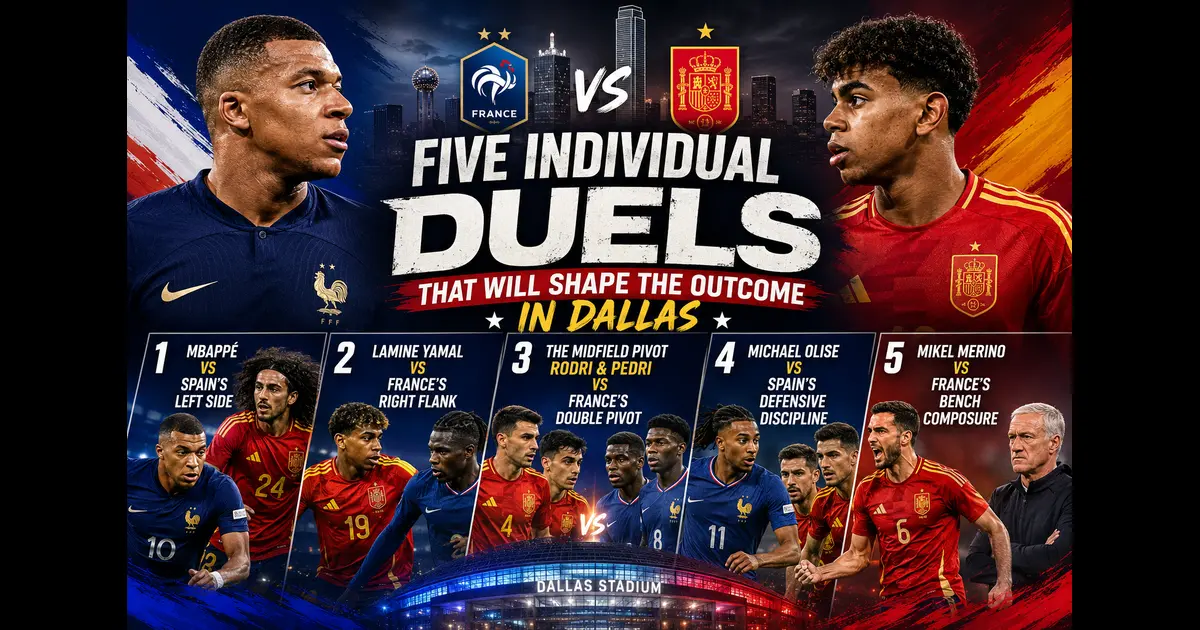
Five Individual Duels That Will Shape the Outcome in Dallas
Some matches are decided by systems. This one will be decided by moments — the split-second where one player wins the space, the shoulder, the half-step advantage over the man directly in front of him. FIFA’s top four seeds are all that remain in this tournament, and the first of the two blockbuster semifinals sees pre-tournament favorites France and Spain collide at Dallas Stadium on Tuesday, with a place in Sunday’s final on the line. Both sides have been ruthlessly efficient in getting here. Now it comes down to individuals.
Here are the five duels inside the France vs Spain semifinal most likely to swing the tie.
1. Kylian Mbappé vs. Spain’s Left-Sided Defense
This is the headline act, and for good reason. Mbappé is ranked No. 1 in the FIFA world rankings with France coming off a 2-0 quarterfinal win over Morocco, and he arrives in Dallas as the tournament’s Golden Boot frontrunner. The complication is fitness: Mbappé is expected to be fit after returning to training following an ankle scare against Morocco, but any lingering hesitancy in his movement changes the calculus entirely for Spain’s back line.
If Mbappé is at full pace, this duel tilts heavily toward France. Spain’s full-backs — Marc Cucurella and Pedro Porro in most projected lineups — are technically excellent in possession but have been tested defensively in behind, and Mbappé’s first five yards are still the fastest in the tournament. Watch whether Luis de la Fuente doubles up on him with a midfielder dropping to shade that channel; if Spain commits an extra body to Mbappé, it opens space elsewhere for France’s other attackers.
2. Lamine Yamal vs. France’s Right Flank
The mirror image duel, and arguably the more romantic subplot given the history between these two players at club level. De la Fuente will be particularly depending on Yamal to cause damage against France, and the 18-year-old talisman showed glimpses of his prowess in the previous match, with the good news being that he’s getting back to his best after recovering from injury.
Yamal’s case for being the most dangerous player on the pitch is built on precedent. Spain has beaten France in each of the last two meetings, including a 2-1 victory in the Euro 2024 semifinal, a game in which Yamal himself scored. If Malo Gusto or whoever starts at right-back for France is even a fraction slow to close him down, Yamal has already shown at the highest level that he punishes exactly that hesitation.
3. The Midfield Pivot: Rodri and Pedri vs. France’s Double Pivot
The story in the middle of the pitch is Spain’s clear structural advantage, led by Rodri, while France’s own midfield picture remains complicated by fitness questions around Aurélien Tchouaméni. This is arguably the single most important zone on the pitch, because if Spain’s midfield trio of Rodri, Pedri and the players around them can dictate tempo the way they have all tournament, France never gets the transitions their front line thrives on.
Spain’s tight defence has conceded just once at this tournament — against Belgium in the quarterfinals — while Rodri, Pedri and Dani Olmo rarely cede control in midfield, a pattern that has defined their route to the last four. France’s counter to that control has to come through directness rather than patience; if Deschamps’ side try to out-possess Spain, they are playing into exactly the game Spain wants.
4. Michael Olise vs. Spain’s Defensive Discipline
Olise has quietly been the difference-maker of this French run, and his duel with Spain’s back line deserves far more attention than it’s getting. Olise has been a revelation for France in his first World Cup, recording a tournament-high six assists in six matches — one more assist and he ties Pelé’s all-time record for most assists in a single World Cup edition.
That is not a hot streak. That is a player operating at a historic level heading into the biggest game of his career. Spain’s central defenders, Robin Le Normand and Dean Huijsen in most projected setups, will need to track his late runs into the box far more aggressively than teams have managed so far, because Olise’s final ball has been the single most productive weapon in this French squad all tournament.
5. Mikel Merino vs. France’s Bench Composure
The final duel isn’t a starter-versus-starter matchup at all — it’s about what happens after the 70th minute. Two of Spain’s match-winners at this tournament have come later than the 85th minute, with the latest arriving in stoppage time against Portugal, and Mikel Merino has repeatedly been the man delivering the decisive touch off the bench.
France cannot afford to think of this as a 90-minute problem. If the scoreline is level or tight heading into the final quarter of the match, Spain has a proven, repeated pattern of finding a winner precisely when opponents believe the door has closed. Whoever Deschamps sends on to manage that final stretch — likely fresh legs at full-back and in midfield — needs to match the intensity Spain has shown in closing out knockout games all summer.
Why These Duels Matter More Than the Formations
It’s worth stepping back for a moment to explain why this piece leans on individual matchups rather than a pure systems breakdown. This tie is genuinely a heavyweight one: France’s pace and finishing against Spain’s control and rhythm, with both teams arriving as pre-tournament favorites who have largely looked the part throughout the summer. When two sides are this evenly matched at the tactical level, tournaments this advanced are typically decided by which individual seizes his moment rather than which manager out-thinks the other on a whiteboard.
France have looked the part throughout, with six consecutive wins seeing them top Group I before eliminating Sweden, Paraguay and Morocco in the knockout rounds, scoring 16 goals in the process without conceding a single one in the knockout phase so far. That knockout-phase clean sheet run is the statistic Spain’s attacking players — Yamal and Olmo above all — need to break first if their side is going to reach the final. Conversely, Spain’s own defensive numbers put real pressure on France’s front line to find answers they haven’t needed all tournament.
The Managerial Chess Match Behind the Duels
None of these five battles exist in a vacuum — each is shaped directly by decisions Deschamps and De la Fuente make before kickoff. Deschamps has reshaped this French side significantly since the 5-4 Nations League semifinal defeat to Spain last year, shifting from a 4-3-3 to a more attacking 4-2-3-1 and bringing in younger talents like Olise and Désiré Doué from the under-23 setup. That tactical shift is precisely why the Mbappé and Olise duels carry so much extra weight this time around — France simply has more attacking configurations than the side Spain beat twice in the last two years.
De la Fuente’s counter has been less about wholesale system change and more about squeezing maximum control out of the players already proven to deliver it. The Yamal-Olmo relationship, the trust in Rodri to dictate tempo, and the willingness to lean on Merino from the bench are not new ideas — they are the same principles that have carried Spain through every knockout tie this tournament, refined rather than reinvented. Whichever managerial approach translates better into these five individual battles on the pitch in Dallas will likely be the one lifting the trophy on Sunday.
France has scored 16 goals so far, second only to Argentina’s 17, and hasn’t conceded a single goal in the knockout stages — a run that, if it continues, would make France the first European team since Italy in the 1930s to win seven consecutive World Cup matches.That is the weight of history sitting on the French dressing room. On the other side, this is remarkably only Spain’s second-ever World Cup semifinal appearance, with the only previous one coming in 2010, when La Roja went on to lift the trophy for the first and only time.
Neither side is here by accident. Both arrived as pre-tournament favorites, and both have largely justified that billing. But tournaments this advanced are rarely settled by the better team on paper — they’re settled by whichever individual wins his duel when it matters most. Watch those five matchups closely on Tuesday. One of them will likely decide who plays in New Jersey on Sunday.
🔹🔹 follow us on facebook 🔹🔹
About the Author