France vs Sweden: A Talent Gap That Eventually Became Impossible to Hide
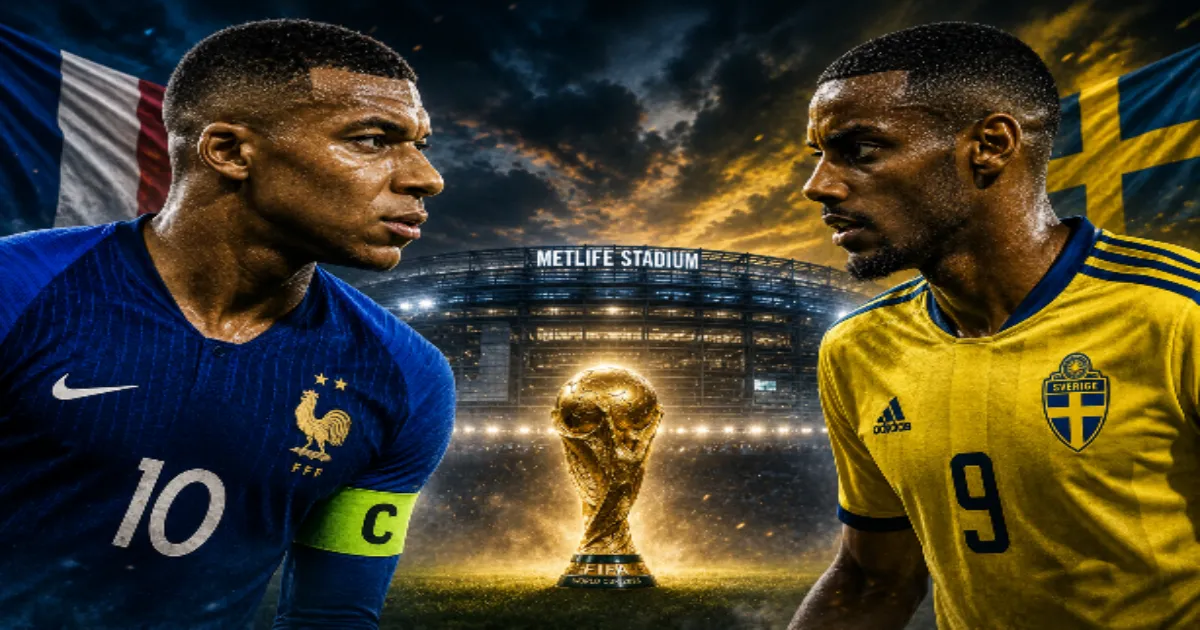
France vs Sweden was billed as one of the most uneven Round of 32 fixtures at the 2026 World Cup, and the final score at MetLife Stadium ultimately confirmed that assessment.
France defeated Sweden 3-0 on June 30, with Kylian Mbappé scoring in the 45th and 74th minutes and Bradley Barcola adding another goal in the 53rd. The victory extended France’s perfect start to the tournament and sent Didier Deschamps’ side into the Round of 16.
Sweden had entered the knockout stage as one of the eight best third-placed teams after a dramatic Group F campaign. Their 5-1 victory over Tunisia had demonstrated their attacking potential, but the subsequent 5-1 defeat to the Netherlands exposed defensive vulnerabilities that became impossible to conceal against France.
The important point about France vs Sweden, however, was not simply that France had better players. It was that France possessed multiple ways of exploiting the exact weaknesses Sweden had already displayed.
France vs Sweden — Match Snapshot
| Detail | Information |
|---|---|
| Competition | FIFA World Cup 2026 |
| Round | Round of 32 |
| Venue | MetLife Stadium, East Rutherford |
| Date | June 30, 2026 |
| Final score | France 3-0 Sweden |
| France goals | Mbappé 45′, 74′; Barcola 53′ |
| Player of the Match | Kylian Mbappé |
| Attendance | 80,663 |
| Next for France | Paraguay |
| France formation | 4-2-3-1 |
France’s Group Stage Had Already Sent a Warning
France arrived at the knockout stage after winning all three Group I matches.
They defeated Senegal 3-1, Iraq 3-0 and Norway 4-1, scoring ten goals and finishing top of the group with a perfect nine-point record.
France Group Stage Record
| Matchday | Opponent | Result | Goals |
| 1 | Senegal | 3-1 W | Mbappé 2, Barcola |
| 2 | Iraq | 3-0 W | France |
| 3 | Norway | 4-1 W | France |
| Total | — | 9 points | 10 goals |
The numbers were impressive, but the more significant development was the variety of attacking solutions available to Deschamps.
Mbappé could attack from the left or centrally. Ousmane Dembélé provided width and direct running. Michael Olise supplied creativity between the lines. Barcola offered explosive pace from the bench or starting XI, while Désiré Doué and Rayan Cherki gave France further technical options.
Sweden therefore had a problem that went beyond marking one superstar.
Stopping Mbappé was necessary.
It simply wasn’t enough.
Sweden’s Route to the Knockout Stage Was Far More Complicated
Sweden’s qualification story was almost the opposite of France’s.
They began the tournament spectacularly, defeating Tunisia 5-1. That result suggested Sweden could become one of the surprise attacking teams of the competition.
Then came the Netherlands.
The Dutch produced a 5-1 victory that exposed major problems in Sweden’s defensive organization and showed how vulnerable the team could become when opponents forced them to defend large spaces.
Sweden recovered sufficiently to draw 1-1 with Japan in their final group match. That result was enough to secure a place in the knockout rounds as one of the eight best third-placed teams. FIFA confirmed that Japan finished second in Group F while Sweden advanced as one of the best third-placed teams.
Sweden Group Stage Record
| Matchday | Opponent | Result | Key Outcome |
| 1 | Tunisia | 5-1 W | Explosive attacking display |
| 2 | Netherlands | 1-5 L | Defensive weaknesses exposed |
| 3 | Japan | 1-1 D | Qualification secured |
| Total | — | 4 points | Third place |
The reward for surviving the group was one of the most difficult possible knockout assignments.
France.
Mbappé Was the Difference
If France had one player capable of turning the tactical advantage into goals, it was Mbappé.
The French captain entered the Sweden match already among the tournament’s leading scorers. By the final whistle, he had six World Cup goals and had moved into outright second place on the competition’s all-time scoring list with 18 goals, just one behind Lionel Messi.
His first goal demonstrated the combination that makes him so difficult to defend.
France used a short corner on the left, allowing Mbappé to receive the ball and accelerate into the penalty area. Rather than forcing a cross or waiting for a teammate, he created his own shooting angle and fired a powerful effort into the far corner just before halftime.
The timing was devastating for Sweden.
A team can enter halftime at 0-0 believing that it has survived the most difficult part of the match.
Sweden did not get that luxury.
Kylian Mbappé vs Sweden
| Category | Performance |
| Goals | 2 |
| Goal minutes | 45′, 74′ |
| World Cup 2026 goals | 6 |
| World Cup career goals | 18 |
| Knockout-stage World Cup goals | 10 |
| Match impact | Decisive |
FIFA noted that Mbappé’s second goal took his tally to 18 World Cup goals and gave him a record ten knockout-stage goals.
At 27, Mbappé is no longer simply France’s future superstar.
He is now the central figure of their present.
Barcola Added the Goal That Broke Sweden’s Resistance
France’s second goal came only eight minutes after halftime, and that was the moment the contest effectively disappeared.
Michael Olise found Bradley Barcola inside the penalty area, and the French forward finished emphatically.
The goal was important because it demonstrated another feature of France’s attack: the ability to punish opponents even when Mbappé is not the immediate finisher.
Sweden had spent much of the first half trying to manage France’s attacking rotations. After conceding just before halftime, they needed to push forward and take greater risks.
That created exactly the kind of space France wanted.
Olise could receive between the lines.
Barcola could attack the space behind the defense.
Mbappé could move centrally.
Dembélé could stretch the opposite side.
The Swedish defensive structure was eventually forced into impossible choices.
Michael Olise Quietly Controlled the Attack
Mbappé understandably received the headlines, but Michael Olise was arguably France’s most important creative player during the match.
His influence came from his ability to connect midfield with the front line. Rather than simply remaining wide, Olise moved into central and right half-space positions where he could receive the ball facing forward.
His contribution to Barcola’s goal was decisive, and he later assisted Mbappé’s second goal.
FIFA’s World Cup Power Rankings also highlighted Olise’s influence, placing him at the top of the creativity rankings while Mbappé led the attacking category.
France’s Main Attacking Contributors
| Player | Role | Key Contribution |
| Kylian Mbappé | Captain / Forward | 2 goals |
| Michael Olise | Creative attacker | 2 assists |
| Bradley Barcola | Forward | 1 goal |
| Ousmane Dembélé | Wide attacker | Width and combinations |
| Aurélien Tchouaméni | Midfield | Control and progression |
This is what makes France so difficult to prepare for.
Opponents cannot simply build their defensive plan around Mbappé.
If two defenders follow him, Olise finds space.
If the full-back stays narrow, Barcola attacks the flank.
If the defensive line drops too deep, France’s midfielders have time to dictate play.
The options keep multiplying.
Sweden’s Two-Striker Threat Never Fully Materialized
The pre-match tactical question centered heavily on Viktor Gyökeres and Alexander Isak.
On paper, Sweden’s two-striker combination was dangerous enough to punish almost any opponent. Gyökeres provided physical power and direct running, while Isak offered more fluid movement and technical quality.
But against France, Sweden rarely created the sustained possession required to make the pairing truly dangerous.
That was perhaps the biggest tactical victory for Deschamps.
France did not simply defend Gyökeres and Isak individually.
They prevented Sweden from consistently delivering the ball into the areas where those forwards could become dangerous.
Sweden’s Attacking Problem
| Problem | Effect |
| Limited possession | Few sustained attacks |
| France’s pressing | Disrupted Swedish build-up |
| Defensive pressure | Strikers received poor service |
| France’s full-backs | Restricted wide progression |
| Falling behind | Forced Sweden to take greater risks |
| Mbappé’s threat | Prevented Sweden from overcommitting |
Gyökeres is at his best when he can receive the ball with space ahead of him or attack crosses and through balls.
Isak is particularly dangerous when he can drift toward the channels and combine with teammates.
France denied Sweden the rhythm required to create those situations consistently.
France’s Defensive Performance Was Just as Important
The 3-0 scoreline naturally directs attention toward France’s attack, but the clean sheet was equally significant.
Sweden’s biggest threat was the transition from defense into attack. France therefore needed to prevent turnovers from becoming counterattacking opportunities.
William Saliba and Dayot Upamecano provided the physical and positional security required behind France’s attacking players, while Tchouaméni and Rabiot offered additional protection in midfield.
That structure allowed France’s attackers to take risks.
France could push numbers forward because there was enough defensive security behind the ball.
This balance is one reason Deschamps’ side looked considerably more complete than the France team that struggled for attacking fluency at Euro 2024.
The First Half Was More Competitive Than the Final Score Suggests
The 3-0 result should not obscure the fact that Sweden remained alive for most of the first half.
France dominated territory and created the better chances, but Sweden’s defensive shape forced France to work for openings.
FIFA reported that France produced 15 attempts before halftime, including an Mbappé goal ruled out for offside and an Olise overhead kick that struck the woodwork.
That tells an important story.
Sweden were not simply destroyed from the opening minute.
They were gradually overwhelmed by pressure.
The breakthrough came at the worst possible moment for them, just before halftime.
Once France added Barcola’s goal early in the second half, the tactical equation changed completely.
The Second Half Became a Demonstration of France’s Depth
After Barcola’s goal, France were able to control the match without abandoning their attacking principles.
Sweden had to advance.
France had space.
That is exactly the scenario in which Mbappé becomes most dangerous.
His second goal in the 74th minute effectively ended the match, with Olise again providing the decisive creative contribution.
At that point, the remaining minutes were about game management.
France could conserve energy.
Sweden could no longer realistically recover.
Deschamps could also begin thinking about the next knockout match.
That is an important advantage in a tournament where recovery time becomes increasingly valuable.
What France vs Sweden Revealed About France
France vs Sweden confirmed that France were not simply winning because of individual brilliance.
They were winning because their individual brilliance existed within an increasingly sophisticated attacking structure.
Mbappé is the headline star, but the system around him is what makes him so difficult to contain.
Olise can create.
Barcola can run.
Dembélé can stretch.
Tchouaméni can control.
The center-backs can defend large spaces.
And Mbappé can finish.
That combination explains why France had scored at least three goals in every match of the tournament up to that point. The 3-0 victory over Sweden continued that attacking consistency.
Sweden’s Tournament Ends With Plenty of Credit
Despite the heavy defeat, Sweden’s World Cup should not be judged solely by France vs Sweden.
Reaching the Round of 32 after finishing third in Group F was an achievement, particularly after the chaotic nature of their group campaign.
The 5-1 victory over Tunisia demonstrated their attacking ceiling.
The 1-1 draw with Japan demonstrated resilience.
The 5-1 defeat to the Netherlands exposed the team’s limitations.
And the France match ultimately showed the distance Sweden still had to travel before becoming a consistent contender against the very best teams in international football.
Sweden coach Graham Potter acknowledged the quality gap after the defeat, saying that even a perfect performance might not have been enough against a France side of this level.
That assessment was harsh but understandable.
France vs Sweden — Final Records
| Category | France | Sweden |
| Final score | 3 | 0 |
| Group-stage position | 1st | 3rd |
| Group-stage points | 9 | 4 |
| Round of 32 result | Win | Eliminated |
| Tournament goals before match | 10 | 7 |
| Tournament goals after match | 13 | 7 |
| Leading scorer in match | Mbappé, 2 | — |
| Clean sheet | Yes | No |
Mbappé’s World Cup Legacy Continues to Grow
Perhaps the biggest individual storyline from France vs Sweden was not simply the brace.
It was what those goals meant historically.
Mbappé entered the match already established as one of the greatest World Cup scorers of the modern era. He left it with 18 career World Cup goals, just one behind Messi’s record of 19.
His ten knockout-stage goals are already a World Cup record.
At 27, Mbappé has potentially multiple major tournaments still ahead of him.
That is an extraordinary thought.
The player who won the World Cup as a teenager in 2018 is now attempting to lead France to another title while simultaneously rewriting the tournament’s scoring records.
Final Verdict: France vs Sweden Was About More Than a 3-0 Scoreline
France vs Sweden ultimately delivered a result that looked predictable before kickoff, but the tactical story was more interesting than the final score suggested.
Sweden had a dangerous attack and two forwards capable of hurting elite defenses. But to exploit those qualities, they needed possession, territory and opportunities to transition.
France denied them all three.
Mbappé provided the finishing.
Olise provided the creativity.
Barcola provided the explosive secondary threat.
And France’s defensive structure prevented Sweden from turning Gyökeres and Isak into the weapons they had hoped they could be.
The 3-0 victory sent France into the Round of 16 and reinforced their status as one of the tournament’s strongest contenders. Mbappé scored twice, Barcola added another, and Sweden’s promising knockout adventure came to an emphatic end.
More importantly, France vs Sweden showed why France’s greatest strength was never simply having one superstar. It was having too many solutions for an opponent to eliminate all of them.
Mbappé may be the face of this French generation.
But against Sweden, it was the depth behind him that made the difference.
Read more articles:
About the Author