 Ten Years On: Inside Infantino’s FIFA Presidency
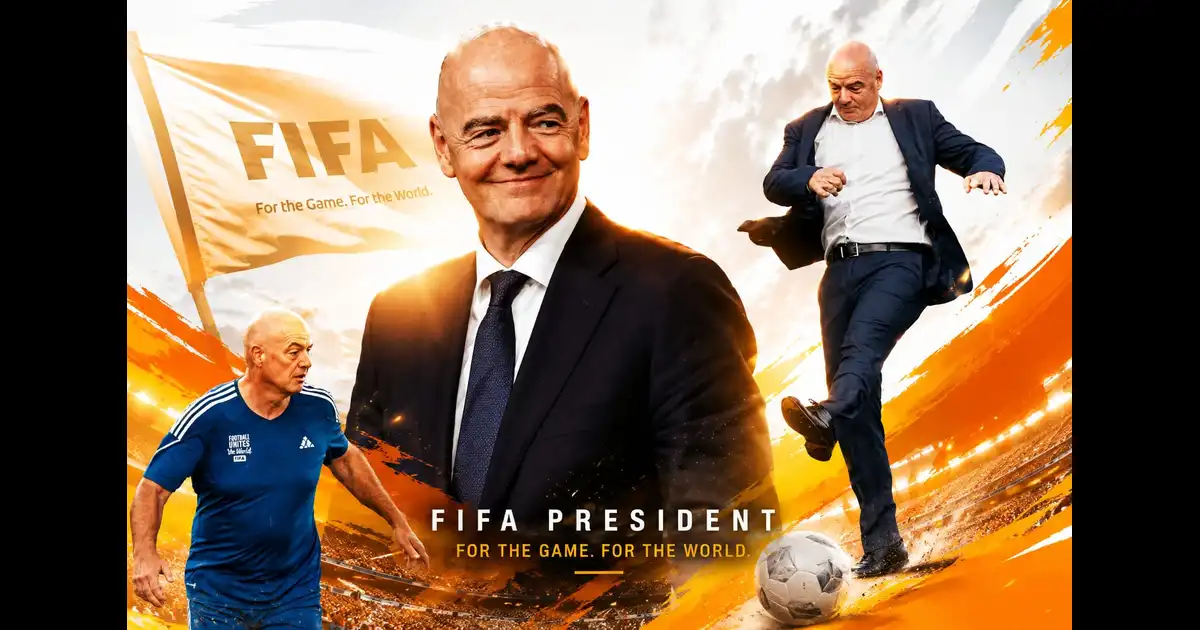
Ten years ago this February, Gianni Infantino celebrated his election as FIFA president by buying beers for journalists in a Cardiff hotel bar. A decade later, he stayed in a 17th-century castle at the same annual football conference, travels on jets provided by the state of Qatar, and keeps world leaders including Donald Trump, Vladimir Putin, and Crown Prince Mohammed bin Salman on speed dial. Infantino’s FIFA presidency has, by almost any measure, transformed both the man and the organisation he leads — and as the 2026 World Cup enters its final week amid a swirl of political and technical controversy, it is worth examining exactly how that transformation happened, and what it has cost along the way.
FIFA World Cup Bidding Process: How Host Countries Are Chosen
2034 FIFA World Cup: Saudi Arabia’s Hosting, Explained
Messi vs Ronaldo: The Definitive Statistical Comparison — Every Number, Every Record, One Verdict
How the FIFA Presidency Actually Works
FIFA’s president is elected by the organisation’s member associations — currently 211 of them — voting at the FIFA Congress, with a simple majority required to win outright. Under FIFA’s statutes, a president may serve a maximum of three four-year terms, a limit introduced as part of the governance reforms that followed the 2015 corruption scandal that brought down Infantino’s predecessor, Sepp Blatter.
Infantino first won the role at an extraordinary congress in Zurich on February 26, 2016, defeating Bahrain’s Sheikh Salman bin Ebrahim Al Khalifa by 115 votes to 88. Because that initial term was called outside the normal electoral cycle to replace the disgraced Blatter, FIFA ruled it would not count toward his three-term limit — meaning his effective 12-year clock only started with his unopposed re-election in 2019, and continued with a further unopposed re-election in 2023. In practical terms, that ruling means Infantino could legally remain FIFA president until 2031, though sources close to the organisation have indicated he is unlikely to seek a fourth term given the demands of the role.
A Working Style Built on Intensity and Omnipresence
Infantino’s approach to the job has been defined, above all, by sheer physical presence. He attended all 64 matches of the 2022 World Cup in Qatar in person, later telling FIFA’s own website that doing so had been “already a dream” fulfilled, and he has continued a similarly punishing schedule at the expanded 2026 tournament, appearing at stadiums across the United States, Mexico, and Canada throughout the group and knockout stages.
Colleagues describe a leadership style closer to a corporate chief executive than a traditional sports administrator. “Gianni operates at the same intensity as a CEO of a major multinational,” one FIFA official who works directly with him told ESPN as part of a wide-ranging review of his decade in charge. “He has an incredible attention to detail. Staff should never go underprepared to any meeting, as he will spot gaps immediately.” That same reporting noted associations have had financial experts sent to deliver accounting lessons, part of a broader message that “every dollar must now be accounted for” under his administration.
That omnipresence has occasionally worked against him. During Argentina’s dramatic Round of 32 win over Cape Verde at this year’s tournament, Infantino was caught on camera telling an Argentine journalist, “Tonight, I suffered with Argentina… but I’m neutral” — a slip that went viral and reignited long-standing fan suspicions, first raised after Qatar 2022, that FIFA’s supposedly neutral officiating has quietly favoured the tournament’s biggest commercial draws.
That omnipresence has occasionally worked against him. During Argentina’s dramatic Round of 32 win over Cape Verde at this year’s tournament, Infantino was caught on camera telling an Argentine journalist, “Tonight, I suffered with Argentina… but I’m neutral” — a slip that went viral and reignited long-standing fan suspicions, first raised after Qatar 2022, that FIFA’s supposedly neutral officiating has quietly favoured the tournament’s biggest commercial draws. Social media users resurfaced old clips and screenshots questioning refereeing decisions in Argentina’s favour across both tournaments, and the moment became one of the more widely shared controversies of the 2026 group and knockout stages, feeding a broader narrative that Infantino’s constant visibility, rather than reassuring fans of FIFA’s impartiality, has instead made every one of his public appearances a potential flashpoint.
Expansion as the Defining Policy of His Presidency
If any single decision captures Infantino’s approach to the job, it is the expansion of the World Cup itself. He campaigned for the FIFA presidency in 2015 on a promise to grow the tournament from 32 to 40 teams, a pledge he ultimately exceeded by pushing the format to 48 teams for the 2026 edition — the largest expansion in the competition’s history, adding 104 total matches compared to 64 at previous tournaments. The same expansionist instinct has extended to FIFA’s broader competition calendar, including a revamped, expanded Club World Cup and continued growth of women’s football competitions, both framed by Infantino as central to increasing global participation revenue and development funding rather than simply growing FIFA’s commercial footprint for its own sake.
Supporters of this approach point to the FIFA Forward programme’s expanded funding as tangible proof the strategy benefits football outside its traditional European and South American power centres, redistributing record revenues to national associations for infrastructure and grassroots development. Critics counter that expansion has also diluted competitive quality in the earlier rounds of the tournament, extended an already demanding calendar for elite players, and — as this year’s ticketing controversy demonstrates — created a commercial machine so large that basic fan affordability has become an afterthought to overall revenue maximisation.
Handling Criticism: A Pattern of Defiance Rather Than Retreat
Infantino’s approach to criticism throughout his tenure has been notably consistent: rarely conciliatory, often combative. He was named in the 2016 Panama Papers over a UEFA television-rights contract signed years earlier, and was investigated by FIFA’s own ethics committee in 2016 over flights taken during his first months in office, hiring practices in his president’s office, and his refusal to sign an employment contract specifying his FIFA remuneration. That investigation, along with a separate Swiss criminal inquiry into undisclosed meetings with then-Attorney General Michael Lauber, closed without any finding of a violation — outcomes Infantino has cited as vindication, though critics have argued they reflect a weakening of FIFA’s internal oversight bodies during his tenure rather than genuine exoneration.
More recently, in June 2026, former UEFA president Michel Platini filed a criminal complaint in France alleging Infantino orchestrated a campaign to derail his own 2016 presidential candidacy. FIFA has denied any wrongdoing, and the allegations remain untested in court. Infantino’s own compensation — reported at roughly $6 million annually, having risen by about a third in 2023 — has also drawn scrutiny given FIFA’s status as a non-profit organisation, particularly after leaked US tax documents detailing his earnings were reported by Le Monde earlier this year.
Perhaps most tellingly, Infantino’s defence of Qatar’s hosting rights ahead of the 2022 World Cup previewed how he would handle criticism for the rest of his presidency: not by absorbing it, but by turning it back on his critics. In a now-famous pre-tournament address, he accused Western nations of “hypocrisy” and “racism” for focusing on Qatar’s human rights record, declaring, “For what we Europeans have been doing for 3,000 years around the world, we should be apologising for the next 3,000 years before starting to give moral lessons to people.” He later announced a Legacy Fund and a “Labour Excellence Hub” for migrant workers at his closing press conference — initiatives that, according to ESPN’s follow-up reporting a year later, produced no tangible compensation payouts that could be documented, with FIFA declining to answer detailed questions about the fund’s use.
The 2022 Qatar World Cup: FIFA’s Financial and Organisational High-Water Mark
Whatever the criticism of how Infantino handled Qatar’s human rights concerns, the tournament itself stands as the clearest evidence of FIFA’s transformation under his leadership. Qatar 2022 drew more than 3.4 million spectators across 64 matches at 96.3% average capacity, with 88,966 fans packing Lusail Stadium for a final Infantino has repeatedly called “the best World Cup ever.” An estimated five billion people engaged with the tournament globally, and its 172 goals made it the highest-scoring World Cup in history.
Financially, the numbers were just as striking. FIFA’s 2019-2022 cycle generated a record $7.57 billion in revenue, driven by $3.426 billion in broadcasting rights alone — a 10% increase on the previous cycle — alongside $1.795 billion in marketing rights and $949 million from ticketing and hospitality. That financial strength has continued into the 2023-2026 cycle, with FIFA projecting revenues of approximately $11 billion, a figure the organisation has used to justify expanded funding for member associations through its FIFA Forward development programme, which now provides up to $8 million per association in the current cycle.
The Iran Situation: A Test of Infantino’s Diplomatic Balancing Act
Few episodes have tested Infantino’s crisis-management style as directly as Iran’s participation in the 2026 World Cup. The situation escalated sharply after the United States and Israel struck Iran on February 28, 2026, forcing Iran’s World Cup training base to relocate from Tucson, Arizona, to Tijuana, Mexico, while the team’s US ticket allocation was revoked days before the tournament began. Iranian federation president Mehdi Taj was denied a US visa ahead of the December 2025 World Cup draw, prompting a brief boycott threat that Iran’s federation reversed within days.The 10 Most Shocking Moments of World Cup 2026 So Far
Throughout the saga, Infantino repeatedly stepped in personally to keep Iran in the tournament, declaring at one point, “The Iranian team is coming, for sure,” even as a Trump administration envoy reportedly suggested Italy could take Iran’s place. FIFA Secretary-General Mattias Grafström travelled to Istanbul in May 2026 to reassure Iranian officials directly, while FIFA simultaneously warned Iran it could face fines or a competition ban if it withdrew. Trump himself sent mixed signals throughout, telling Infantino the Iranian team was “of course, welcome to compete,” before separately posting that he did not believe it would be “appropriate that they be there, for their own life and safety.” Iran ultimately competed as scheduled, a resolution widely credited to sustained, direct diplomatic intervention by Infantino rather than any formal FIFA process — precisely the kind of personal, relationship-driven problem-solving that has become a hallmark of his presidency.
Double Standards: Russia, Israel, and the Limits of FIFA’s Neutrality
No criticism has followed Infantino more persistently than the accusation that FIFA applies its own rules selectively. FIFA suspended Russia from all competitions within days of its 2022 invasion of Ukraine, a decision that drew broad international support at the time. By early 2026, however, Infantino had begun publicly arguing the ban should end, telling Sky News it “has not achieved anything” beyond fuelling “more frustration and hatred,” and calling for FIFA to enshrine in its statutes a principle that countries should never be banned over the actions of their political leaders.Selective Justice in Football? The Presidential Phone Call That Sparked FIFA Questions
That position has drawn direct comparisons to FIFA’s handling of Israel, whose national team and clubs have continued competing throughout the war in Gaza. Critics — including the Palestinian Football Association, more than 30 legal experts who wrote to UEFA, and former France captain Eric Cantona — have called for Israel’s suspension, pointing to a United Nations commission of inquiry that concluded Israel’s conduct in Gaza amounted to genocide, a characterisation Israel strongly disputes. Infantino has consistently declined to act, describing the matter at FIFA’s October 2025 Council meeting as a “geopolitical issue” that football “cannot solve,” while stating FIFA can only “promote football around the world by harnessing its unifying, educational, cultural and humanitarian values.”France vs Morocco Preview: The World Cup 2026 Rematch That Settles a Score
Several analysts have linked that reluctance directly to Infantino’s relationship with Trump and the commercial stakes of the 2026 tournament itself, reporting that the White House pushed back firmly against any move to sanction Israel during World Cup qualifying. FIFA has not confirmed the specifics of any such intervention. Separately, Infantino’s decision to award the 2034 World Cup to Saudi Arabia — a bidding process critics say was structured to limit competing bids — has been cited by the same critics as further evidence that FIFA’s human rights standards vary considerably depending on a nation’s political and commercial weight, a criticism Infantino has not directly addressed in public.
World Cup 2026: VAR, Ticket Prices, and a Tournament Under Strain
The 2026 tournament itself has amplified nearly every recurring criticism of Infantino’s FIFA. Ticket prices for the final at MetLife Stadium reportedly reached $11,000, prompting USMNT midfielder Timothy Weah to call prices “too expensive” and drawing accusations that dynamic pricing has left empty seats at several matches. Infantino defended the pricing directly in May 2026, insisting FIFA “had to apply market rates.”
Technology has proven an even bigger flashpoint. VAR interventions, which numbered around 20 across 64 matches at the 2018 World Cup, have been “quickly dwarfed” in the 104-match 2026 format, according to Reuters reporting, with FIFA referees’ chief Pierluigi Collina introducing four additional areas for VAR review. The fallout has been substantial: Egypt’s football association formally protested “controversial and influential refereeing incidents” after their Round of 16 exit to Argentina, Croatia great Luka Modric criticised ball-sensor technology as “used incorrectly or selectively” following his own World Cup farewell, and Trump personally lobbied Infantino over a contested red card involving USMNT striker Folarin Balogun — an intervention Infantino later said he had no role in resolving. Layered on top of ongoing boycott calls tied to Trump-era immigration enforcement at stadiums, and environmental criticism of the expanded format’s carbon footprint, the 2026 tournament has emerged as perhaps the clearest single test yet of whether Infantino’s model of FIFA leadership can survive contact with the political environment surrounding its host nation.
A Legacy Still Being Written
Measured purely by FIFA’s institutional health, Infantino’s transformation of an organisation that faced FBI raids, executive arrests, and sponsor flight in 2015 is difficult to dispute. Record revenues, an expanded 48-team World Cup format, and a reformed relationship with global political power have replaced the daily scandal coverage that defined FIFA before his arrival. But that same closeness to political power — with Trump, with Qatar, with Saudi Arabia, with Russia’s shifting status — has become the central question mark over his presidency, raising the same accusation in different forms across a decade: that Infantino’s FIFA has learned to survive controversy not by resolving it consistently, but by managing it selectively, one relationship at a time.
How history ultimately judges that trade-off will likely depend less on this tournament’s remaining matches than on what Infantino does with the years he has left in charge. Sources close to FIFA suggest he is unlikely to pursue a fourth term in 2031, which would require amending the organisation’s own constitution to do so. That gives him, by his own apparent design, roughly five more years to decide whether the institutional stability and commercial growth of the past decade can finally be matched by the kind of consistent, depoliticised governance FIFA has promised, and repeatedly failed to fully deliver, since long before he ever took the job.
◾◾ follow us on facebook ◾◾
About the Author