The Tactical Case for Rafael Leão at World Cup 2026
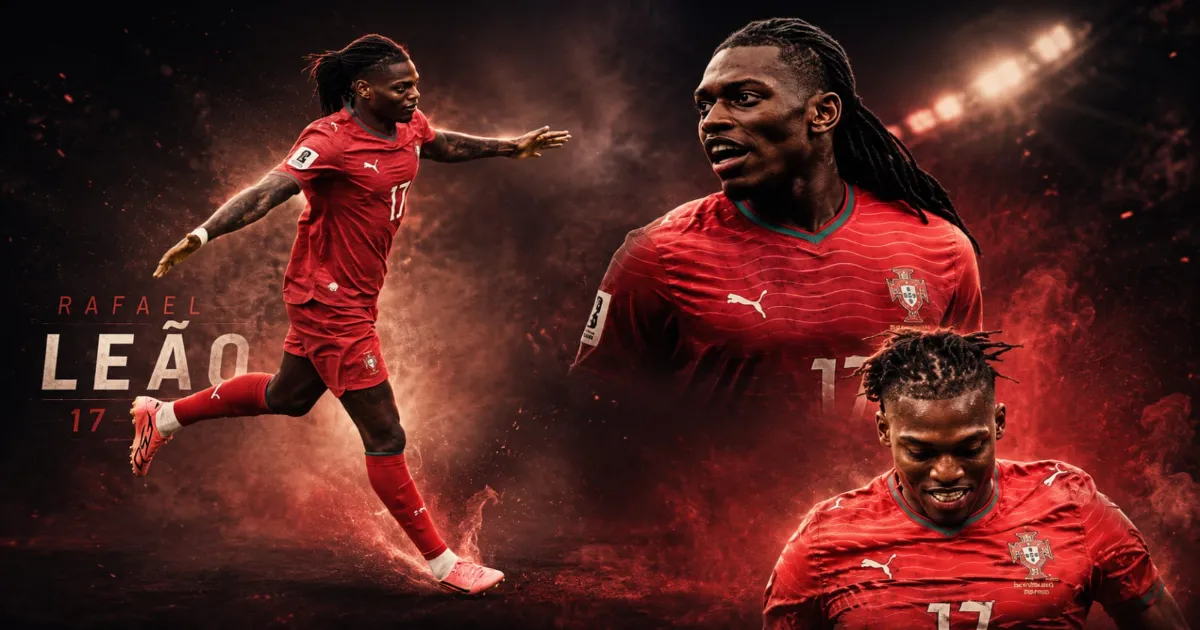
Rafael Leão: Player Profile
| Category | Details |
|---|---|
| Player | Rafael Alexandre da Conceição Leão |
| Date of Birth | June 10, 1999 |
| Age | 27 |
| National Team | Portugal |
| Club | AC Milan |
| Primary Position | Left Winger |
| Secondary Position | Forward |
| Preferred Foot | Right |
| Height | 1.88 m |
| International Debut | 2021 |
| Portugal Caps entering 2026 | 43 |
| Portugal Goals entering 2026 | 5 |
| 2022 World Cup Goals | 2 |
| 2026 World Cup Goals | 1 |
| Major Club League | Serie A |
Portugal vs Spain World Cup Report: Merino’s Late Strike Ends Ronaldo’s Career
Mikel Merino Profile: From Pamplona to Ending Ronaldo’s World Cup
Yan Diomandé Stats: The Numbers Behind Football’s Hottest Young Winger
Opta’s career database lists Leão with 227 Serie A appearances, 64 goals and 43 assists for Milan through the 2025/26 season, while his 2025/26 league campaign produced nine goals and three assists in 29 appearances. He started 23 of those 29 league matches.
Rafael Leão 2026 World Cup Performance
Leão entered the tournament with an interesting tactical status.
He was not simply Portugal’s undisputed left-wing starter. Instead, Martínez used his squad depth to manage Leão’s minutes and select different attacking combinations depending on the opponent.
That distinction became particularly important because Portugal possessed several players capable of occupying wide areas, including Pedro Neto, João Félix, Bernardo Silva and Francisco Conceição.
Leão’s World Cup campaign therefore became less about whether he could play and more about when Portugal needed his particular skill set.
World Cup 2026 Match Record
| Match | Result | Leão’s Role | Contribution |
|---|---|---|---|
| Portugal vs DR Congo | 1-1 | Substitute/rotation role | Featured |
| Portugal vs Uzbekistan | 5-0 | Substitute | Goal |
| Colombia vs Portugal | 0-0 | Rotation role | Featured |
| Portugal vs Croatia | 2-1 | Starter | Assist |
| Spain vs Portugal | 1-0 | Substitute | Featured |
Portugal finished second in Group K behind Colombia and advanced to the knockout stage. Their first knockout match against Croatia ended in a 2-1 victory, with Leão providing the cross for Gonçalo Ramos’ decisive late goal.
Portugal’s tournament ended in the Round of 16 against Spain, where João Félix replaced Leão in the starting XI.
That sequence tells an important story.
Leão was not merely a bench player. He was a weapon Martínez could deploy according to the tactical demands of the match.What Cristiano Ronaldo Doesn’t Have: The One World Cup Trophy That Couldn’t Define His Greatness
The Weirdest Football Superstitions Even Messi, Ronaldo and Neymar Swear By
Leão’s World Cup History
Leão’s international reputation was already established before 2026.
His breakthrough World Cup moments came in Qatar in 2022, when he scored twice despite not being a consistent starter. He scored against Ghana in Portugal’s 3-2 group-stage victory and then added another goal in the 6-1 demolition of Switzerland in the Round of 16.
His 2026 goal against Uzbekistan extended that World Cup scoring record.
| World Cup | Matches/Role | Goals | Notable Moment |
|---|---|---|---|
| 2022 Qatar | Rotation player | 2 | Goals vs Ghana & Switzerland |
| 2026 North America | Rotation/starter | 1 | Goal vs Uzbekistan |
| Total | — | 3 | Consistent impact from limited/variable minutes |
Leão’s two goals in Qatar were both examples of his ability to enter matches and immediately attack tired defensive structures. His 2026 goal against Uzbekistan followed a similar pattern, arriving as Portugal’s substitute threat helped turn an already dominant performance into a 5-0 victory.
This is one reason the word “impact substitute” does not quite capture his value.
Leão can change a game because the physical profile he brings is fundamentally different from many of Portugal’s other attackers.
Starting Record: Why Leão Has Not Always Been an Automatic Starter
The most interesting aspect of Leão’s Portugal career is not his talent.
It is the relationship between his talent and selection.
At club level, Leão has developed into an established starter for Milan. In the 2025/26 Serie A season, he started 23 of his 29 league appearances and accumulated 1,862 minutes, scoring nine goals and providing three assists.
International football has been different.
| Level | Role | Tactical Explanation |
|---|---|---|
| AC Milan | Regular starter | Team can build around his left-sided threat |
| Portugal | Starter/rotation player | Multiple elite attacking options |
| World Cup 2022 | Rotation option | Used to exploit tired defenses |
| World Cup 2026 | Rotation/starter | Selected according to opponent and game state |
| Knockout football | Tactical weapon | Pace and carrying become increasingly valuable |
The difference is important.
At Milan, Leão can receive the ball repeatedly and build rhythm through volume.
Portugal have enough attacking talent to use him differently.
Instead of feeding Leão constantly, Martínez can preserve his explosiveness and introduce him when Portugal need to increase the game’s tempo.
Serie A Record: Leão’s Development at AC Milan
Leão’s statistical evolution at Milan shows that the criticism surrounding his final product should not obscure his overall production.
His best Serie A season remains 2022/23, when he scored 15 league goals. He followed that with nine in 2023/24, eight in 2024/25 and nine in 2025/26.
| Serie A Season | Apps | Goals | Assists |
|---|---|---|---|
| 2019/20 | 31 | 6 | — |
| 2020/21 | 30 | 6 | — |
| 2021/22 | 34 | 11 | 8 |
| 2022/23 | 35 | 15 | 8 |
| 2023/24 | 34 | 9 | 9 |
| 2024/25 | 34 | 8 | 8 |
| 2025/26 | 29 | 9 | 3 |
| Milan Serie A total | 227 | 64 | 43 |
The broader career picture is even more revealing: Opta lists Leão with 227 Serie A appearances, 64 goals and 43 assists.
That means the argument that Leão is simply a “pace merchant” does not survive a serious examination of his production.
The more accurate criticism is that his level of influence fluctuates.
That is a different problem.
Playing Style: What Makes Rafael Leão Different?
Leão’s playing style is built around a rare combination:
size + acceleration + dribbling + carrying + transitional threat.
A 1.88-meter winger is not normally expected to possess the same explosive change of direction associated with smaller dribblers.
Leão does.
He can receive the ball near the touchline, attack the defender’s outside shoulder and then accelerate toward the penalty area. Alternatively, he can cut inside onto his right foot and attack the space between full-back and center-back.
Leão’s Core Playing Characteristics
| Attribute | Assessment | Tactical Value |
|---|---|---|
| Acceleration | Elite | Creates separation immediately |
| Top Speed | Elite | Major transition threat |
| Ball Carrying | Elite | Moves Portugal up the pitch |
| 1v1 Dribbling | Elite | Forces defensive help |
| Physicality | Excellent | Difficult to stop shoulder-to-shoulder |
| Chance Creation | Good | Can create after beating first defender |
| Finishing | Good | Capable of high-level finishes |
| Crossing | Good | Dangerous when attacking from wide areas |
| Pressing | Variable | Not always his strongest contribution |
| Defensive Work | Variable | Can be inconsistent |
| Decision Making | Improving | Still capable of forcing actions |
| Consistency | Main concern | Performance level can fluctuate |
The important point is that Leão does not have to beat his defender every time.
The threat of beating the defender can already change the defensive structure.
Strength: Isolation Football
This is where the tactical case for Leão becomes strongest.
Portugal can deliberately create a situation where Leão receives the ball against one defender.
The sequence might look simple:
- Vitinha receives possession centrally.
- Bruno Fernandes occupies the half-space.
- Nuno Mendes pushes high on the left.
- The opposition full-back must decide whether to track Mendes or hold position against Leão.
- Leão receives the ball facing the full-back.
- The defender is isolated.
- One successful dribble can completely change the attacking situation.
This is not simply winger-versus-full-back football.
It is defensive manipulation.
If the opposition sends a second defender toward Leão, Portugal can exploit the space that defender leaves.
If the second defender stays central, Leão gets his preferred one-on-one.
That creates a tactical dilemma.
And Leão is particularly valuable because Portugal have enough elite players elsewhere to punish whichever choice the opponent makes.
The Leão–Nuno Mendes Relationship
One of Portugal’s most interesting tactical combinations comes from the relationship between Leão and Nuno Mendes.
Both players possess elite athleticism.
That creates two possible problems for an opposition defense.
If Leão stays wide, Mendes can overlap.
If Mendes moves inside or holds his position, Leão can attack the full-back directly.
If both remain high, the opposition may be forced into a deep defensive block.
This means Leão’s value is not isolated from Portugal’s structure.
It is connected to it.
Left-Side Tactical Structure
| Player | Primary Function |
|---|---|
| Nuno Mendes | Overlap, width, underlap |
| Rafael Leão | Isolation, carrying, penetration |
| Bruno Fernandes | Half-space creation and final pass |
| Vitinha | Progression and circulation |
| Cristiano Ronaldo | Penalty-box occupation |
| João Neves | Ball recovery and supporting circulation |
When all six components work together, Leão becomes extremely difficult to contain.
Weakness: Consistency Over 90 Minutes
This remains the most legitimate criticism of Leão.
His ceiling is enormous.
His floor can be frustrating.
There are matches in which he dominates a defender repeatedly, carries Portugal 30 or 40 meters upfield and creates chances almost by himself.
There are others in which he becomes disconnected from the game.
This creates an unusual tactical question for Martínez:
Should Portugal build their attack around Leão’s potential or use him according to the game’s demands?
The 2026 World Cup suggested the latter approach can be effective.
Portugal did not necessarily need Leão to dominate every minute.
They needed him to provide a different attacking dimension when the match demanded it.
Leão’s Biggest Tactical Weaknesses
| Weakness | Why It Matters |
|---|---|
| Inconsistent involvement | Can disappear for long periods |
| Decision making | Sometimes chooses difficult actions |
| Defensive intensity | Pressing output can fluctuate |
| Central positioning | Less effective with his back to goal |
| Final-third efficiency | Can create more than he finishes |
| Physical management | Explosive style requires careful workload |
| Tactical discipline | Can occasionally drift away from structure |
Leão is at his best when he can see the game in front of him.
Put him against a deep defense with little space behind it and his effectiveness can decline.
Give him 30 meters of grass to attack and the equation changes completely.
Why Leão Is Better in Transition
The greatest version of Leão appears when Portugal win the ball and immediately attack.
Imagine Portugal recover possession in midfield.
Leão is already moving.
One pass reaches him.
He takes one touch forward.
The defender retreats.
The next defender has to decide whether to close him down or protect the center.
That hesitation is enough.
Leão’s acceleration turns a normal transition into a potentially decisive attack.
This is why he can be particularly dangerous against teams that commit numbers forward.
His value is not simply speed.
It is speed with the ball.
That distinction matters.
Many fast players are dangerous when running onto a pass.
Leão can generate the transition himself by carrying possession through midfield.
Leão as a Ball Progressor
Another overlooked element of Leão’s game is his ability to move the entire Portuguese team forward.
A successful 25-meter carry can accomplish several things simultaneously:
- eliminate one or two defenders;
- force midfielders backward;
- create space for Bruno Fernandes;
- push Ronaldo closer to the penalty area;
- allow Portugal’s full-backs to advance;
- create a crossing opportunity;
- generate a corner;
- or simply relieve defensive pressure.
This is why evaluating Leão solely through goals and assists misses part of his tactical contribution.
A winger who repeatedly moves the team from defensive transition into attacking territory is providing value even when the final pass does not result in a goal.
Leão vs Traditional Winger Profiles
Leão does not fit perfectly into the traditional winger category.
He is too physically dominant to be viewed purely as a touchline dribbler, yet too explosive to be treated like a conventional forward.
| Player Type | Main Characteristic | Leão Comparison |
|---|---|---|
| Traditional winger | Width and crossing | Leão offers more carrying |
| Inverted winger | Cut inside and shoot | Leão can do this but has greater transition threat |
| Inside forward | Attack penalty area | Leão can perform this role |
| Target forward | Hold-up play | Not his ideal role |
| Transition forward | Attack space quickly | Excellent fit |
| Ball-carrying winger | Progress possession | Excellent fit |
The final two categories best explain his value.
The Tactical Case for Leão at the World Cup
The argument for Leão is ultimately simple.
Portugal do not need him to be their most productive player. They need him to be their most disruptive player.
Bruno Fernandes can create.
Vitinha can control.
Nuno Mendes can overlap.
Cristiano Ronaldo can finish.
But Leão can destabilize.
That distinction becomes increasingly important in knockout football.
When matches become cagey and defenses become deeper, Portugal may struggle to create clear chances through possession alone.
That is when a player who can eliminate a defender individually becomes priceless.
Leão’s 2026 Tournament Impact
His World Cup campaign provided several examples of this role.
Against Uzbekistan, Leão came off the bench and scored the fifth goal in Portugal’s 5-0 victory. FIFA recorded the goal in the 87th minute of the match.
Against Croatia in the Round of 32, he was more directly involved from the start. His late cross created Gonçalo Ramos’ winning goal, helping Portugal survive a dramatic 2-1 match that featured extensive VAR intervention.
The contrast between those games is important.
Against Uzbekistan, Leão punished an exhausted defense.
Against Croatia, he influenced the match through his delivery and wide attacking threat.
Those are two different ways of winning football matches.
Why Martínez Sometimes Leaves Him on the Bench
Leaving Leão out of a starting XI does not necessarily mean the manager does not trust him.
It can mean the opposite.
A coach may believe that Leão’s greatest value arrives when the opposition is tired.
Consider the tactical situation.
At kickoff, a full-back may be fresh, aggressive and physically capable of staying with Leão.
After 65 minutes, that same full-back may have:
- covered 8–10 kilometers;
- defended repeated transitions;
- absorbed pressure;
- made several tackles;
- and lost some acceleration.
Then Leão enters.
The tactical equation changes immediately.
This is why his status as a substitute should not automatically be interpreted as a demotion.
It can be a tactical weapon.
Rafael Leão: Scouting Summary
| Category | Rating |
|---|---|
| Pace | 9.5/10 |
| Acceleration | 9.5/10 |
| Dribbling | 9/10 |
| Ball Carrying | 9.5/10 |
| Physical Strength | 9/10 |
| 1v1 Ability | 9/10 |
| Finishing | 8/10 |
| Chance Creation | 8/10 |
| Crossing | 8/10 |
| Pressing | 6.5/10 |
| Defensive Work | 6/10 |
| Tactical Discipline | 7/10 |
| Consistency | 7/10 |
| Transition Threat | 10/10 |
| Overall Tactical Value | 9/10 |
What Leão Needs to Improve
For Leão to become a truly complete world-class forward, the next stage of development is not necessarily more speed or better dribbling.
He already possesses those qualities.
The next step is repeatability.
He needs to turn occasional dominant performances into predictable performances.
That means:
1. Better Decision Making
After beating the first defender, Leão must consistently choose the correct final action.
Shoot?
Cross?
Cut back?
Pass?
Carry again?
Elite attackers become dangerous because they make the correct decision at high speed.
2. More Consistent Defensive Contribution
Portugal’s strongest attacking units require collective pressing.
Leão does not need to become a defensive midfielder, but his defensive positioning and willingness to press must remain consistent.
3. Greater Central Intelligence
Leão can operate centrally, but his best football generally comes when he can attack from the left and face goal.
His movement into central areas should therefore be timed rather than constant.
4. More Efficient Final Product
The raw production is already respectable.
The next step is turning his enormous volume of attacking situations into more goals and assists.
Career Snapshot
| Competition/Level | Appearances | Goals | Assists |
|---|---|---|---|
| Serie A for Milan | 227 | 64 | 43 |
| Milan overall career | 227+ | 64+ league goals | 43+ league assists |
| Portugal before 2026 | 43 | 5 | — |
| World Cup 2022 | — | 2 | — |
| World Cup 2026 | — | 1 | 1+ key contribution |
| World Cup goals total | — | 3 | — |
Opta’s current career database confirms 227 Serie A appearances, 64 goals and 43 assists for Milan, while his 2025/26 season produced nine goals and three assists in the league.
Final Verdict: Rafael Leão Is a Tactical Weapon, Not Just a Winger
Rafael Leão’s career has always produced an unusual contradiction.
The physical tools suggest a superstar.
The production is very good.
The individual moments can be extraordinary.
But the consistency has not always matched the talent.
That is precisely why his tactical value is so fascinating.
At the 2026 World Cup, Portugal did not need Leão to become Cristiano Ronaldo, Bruno Fernandes or another conventional attacking centerpiece.
They needed him to be Rafael Leão.
They needed the player who can receive the ball near the left touchline and make a defender retreat.
They needed the player who can carry the ball 30 meters through transition.
They needed the player who can force a second defender to abandon his position.
They needed the player capable of changing the geometry of an attack with one explosive run.
His goal against Uzbekistan demonstrated his finishing threat. His assist against Croatia demonstrated his creative value. His eventual omission from Portugal’s starting XI against Spain demonstrated the selection dilemma that has followed him throughout his international career.
That is ultimately the tactical case for Rafael Leão.
He does not have to touch the ball 60 times.
He does not have to score every match.
He does not even have to start every match.
Portugal simply need opponents to believe he might receive the ball in space.
Because once Leão gets isolated against a defender, the entire defensive structure has to react.
And that reaction is where his real value begins.
Rafael Leão’s Bottom Line
Best role: Left winger / transition forward
Best situation: Space to attack and isolated full-backs
Greatest weapon: Explosive ball carrying
Biggest tactical value: Defensive disruption
Biggest weakness: Consistency
Ideal usage: Starter when Portugal need penetration; impact weapon when opponents are tiring
2026 World Cup verdict: A high-value tactical weapon whose influence extends beyond his goal tally
Leão may never be Portugal’s most complete attacker.
But when Portugal need to break a defensive structure, there are few players in their squad better equipped to do it.
▪️▪️ Follow us on Facebook ▪️▪️
Messi vs Ronaldo: The Definitive Statistical Comparison — Every Number, Every Record, One Verdict
Cristiano Ronaldo at Every World Cup: From Germany 2006 to USA 2026
About the Author