Spain vs Austria Preview: The Tournament’s Most Complete Team Meets Its Most Tactically Interesting Opponent — and the Numbers Tell a Story Nobody Should Ignore
Spain vs Austria at SoFi Stadium pits a side that has not conceded a single goal in three matches against an Austria team that has scored six, conceded six, and produced the group stage’s most tactically engaging European performance — Lamine Yamal against Rangnick’s press is the World Cup’s most compelling individual-vs-system matchup in the Round of 32
📍 VENUE & KICKOFF TIMES
| Territory | Time | Date |
|---|---|---|
| 🏟️ Los Angeles, California (PT / Local) | 12:30 AM PT | Friday, July 3 |
| 🇺🇸 USA (ET) | 3:30 AM ET | Friday, July 3 |
| 🇬🇧 United Kingdom (BST) | 8:30 AM BST | Friday, July 3 |
| 🇮🇳 India (IST) | 1:00 PM IST | Friday, July 3 |
| 🇪🇸 Spain (CEST) | 9:30 AM CEST | Friday, July 3 |
| 🇦🇹 Austria (CEST) | 9:30 AM CEST | Friday, July 3 |
| 🌐 UTC | 07:30 UTC | Friday, July 3 |
Venue: SoFi Stadium, Inglewood (Los Angeles), California, USA Capacity: 70,240 | Surface: Grass Winner faces: Portugal or Croatia in Round of 16
THE NUMBERS THAT SET THE SCENE
Before a single tactical word is written about Spain vs Austria, two sets of numbers deserve to sit side by side:
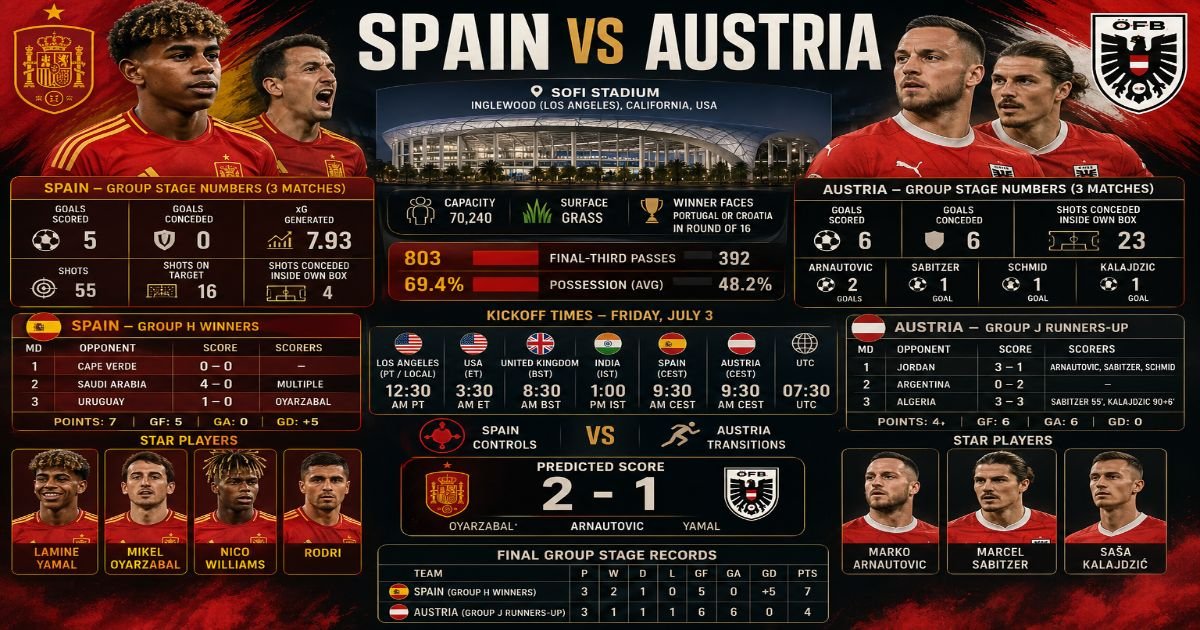
Spain across three group matches: Goals scored: 5 | Goals conceded: 0 | xG generated: 7.93 | Shots: 55 | Shots on target: 16 | Shots conceded from inside own box: 4
Austria across three group matches: Goals scored: 6 | Goals conceded: 6 | Shots conceded from inside own box: 23 | Arnautovic: 2 goals | Sabitzer: 1 goal | Schmid: 1 goal | Kalajdzic: 1 goal
These two tables describe, with mathematical precision, the entire premise of this match. Spain are a side that controls matches, generates volume, and has not once been beaten behind their defensive line. Austria are a side that scores and concedes in almost equal measure — a team that lives in football matches rather than managing them, whose six goals across three group games reflect genuine attacking intent, and whose six goals conceded reflect the specific vulnerability that Luis de la Fuente’s side are perfectly built to exploit.
Spain attempted 803 final-third passes in the group stage. Austria attempted 392. Spain averaged 69.4% possession across their three matches. Austria averaged 48.2%. One team dictates. The other reacts.
This is not, on the available evidence, a competitive football match in the traditional sense. But Austria have already demonstrated that “not competitive in the traditional sense” and “not dangerous at all” are entirely different things.
SPAIN’S GROUP STAGE — FROM FRUSTRATION TO FLUENCY
Group H Results:
| MD | Opponent | Venue | Score | Scorers |
|---|---|---|---|---|
| 1 | Cape Verde | — | 0–0 D | — |
| 2 | Saudi Arabia | — | 4–0 W | Multiple |
| 3 | Uruguay | — | 1–0 W | Oyarzabal |
Points: 7 | GF: 5 | GA: 0 | GD: +5 | Group H Winners
The group stage read as a study in gears. The Cape Verde draw was the unexpected stutter — Luis de la Fuente’s Spain contained by a defensive block that refused to open. The Saudi Arabia demolition was the corrective statement: four goals, a clean sheet, a performance that reminded the world why the reigning European champions are considered tournament favourites. The 1-0 against Uruguay was the controlled, expert conclusion — exactly enough, no more, with Spain’s defensive structure so secure that Uruguay’s forward line, one of South America’s most physical, could not find a single opening.
The reigning European champions have won 16 of their 26 World Cup appearances and lifted the trophy in 2010. Their ambition here is to go significantly further than the Round of 16 exits they suffered in 2018 and 2022. The Barcelona contingent of eight players gives the side familiarity and cohesion across all lines, while Arsenal contributes three key figures in Martín Zubimendi, Mikel Merino, and David Raya.
Star Players:
Lamine Yamal — the 18-year-old Barcelona winger who has been the tournament’s outstanding young player and arguably its most dangerous attacking individual on either side of the bracket. His combination of pace, close control, positional intelligence, and end product from wide right creates problems that cannot be solved with a single defender. Austria’s left defensive corridor — the space behind their left-back when their press goes wrong — is precisely where Yamal operates most devastatingly. Spain’s most dangerous player coming into this knockout match is Lamine Yamal, who has been the best young player in the tournament and arguably the most dangerous winger on either side of the bracket.
Mikel Oyarzabal — Spain’s leading scorer with two goals and the tournament’s most intelligent centre-forward movement in the Spanish system. His ability to drop deep, receive between the lines, and then drive into the penalty area creates the positional overloads that Spain’s 4-3-3 generates most effectively. Oyarzabal is Spain’s leading scorer at this tournament with two goals — operating as their main reference point in attack and already among the goals.
Nico Williams — the Athletic Bilbao left winger whose explosive directness from wide positions creates the mirror threat to Yamal. Williams stretches the Austrian defensive shape from the opposite flank, and when both wide players are active simultaneously, Spain’s central corridor opens for Pedri and Zubimendi to exploit.
Rodri — captaining the side from midfield with his usual authority, providing the defensive screen that allows Spain to recover possession quickly after losing it, and dictating the tempo that ensures Spain’s build-up is never rushed or pressured into errors.
Knockout Strategy: Spain will build possession patiently from deep, use their wide players to pin Austria’s full-backs, and invite Pedri and Zubimendi to find Oyarzabal’s runs in the space between Austria’s defensive and midfield lines. Defensively, the objective is to nullify Rangnick’s counter-press before it develops momentum — winning the ball back quickly after Austrian transitions is the single most important defensive task for Spain’s midfield. They do not need a goal rush. They need one goal and their defensive structure. Both are entirely achievable.
AUSTRIA’S GROUP STAGE — THE ENTERTAINER WITH A STRUCTURAL FLAW
Group J Results:
| MD | Opponent | Score | Scorers |
|---|---|---|---|
| 1 | Jordan | 3–1 W | Arnautovic, Sabitzer, Schmid |
| 2 | Argentina | 0–2 L | — |
| 3 | Algeria | 3–3 D | Sabitzer 55′, Kalajdzic 90+6′ |
Points: 4 | GF: 6 | GA: 6 | GD: 0 | Group J Runners-Up
Austria’s group stage tells the complete story of Ralf Rangnick’s creation: a system that generates goals through intensity and transition, concedes when that intensity drops or when an opponent’s quality is sufficient to play through the press, and produces football that is simultaneously admirable and structurally exposed. The 3-1 win over Jordan was the system working cleanly. The 0-2 defeat to Argentina was the ceiling of the system’s defensive ambitions made explicit. The 3-3 with Algeria — Kalajdzic’s last-second equaliser completing one of the group stage’s most dramatic finales — was the distilled essence of an Austria side that cannot be trusted to hold a lead but can also never be written off until the final whistle sounds.
Austria are back at the World Cup for the first time since 1998, playing in a knockout round at a World Cup for the first time in a generation and having nothing to lose against one of the game’s elite sides. That freedom is not nothing. The 23 shots conceded from inside their own box is the number Spain will be circling in their preparation files — and it is also the number that defines both Austria’s opportunity and their limitation in this fixture.
Star Players:
Marko Arnautovic — Austria’s talisman and joint-top scorer with two group goals. He gives them a focal point to play toward in transition and is the man most likely to punish Spain if the game opens up. His positioning, his aerial threat from set pieces, and his experience playing at the highest European club level make him the specific player Ruben Le Normand and the Spanish centre-back partnership must track from the opening whistle.
Marcel Sabitzer — the driving force of Austria’s midfield, on the scoresheet in the Algeria match and the engine behind the counter-attacks that Rangnick’s system generates. His ball-carrying through the lines and his shooting from distance represent Austria’s most direct route to threatening Spain’s defensive record. Spain’s midfield screen must specifically manage Sabitzer’s forward runs.
Saša Kalajdzić — the 6ft 7in centre-forward whose 96th-minute header rescued the Algeria draw and delivered one of the group stage’s most dramatic moments. As a late-game substitute or alternative starting option, Kalajdzic’s aerial dominance from set pieces represents the specific scenario in which Austria can threaten any defensive unit — including Spain’s.
Austria’s Knockout Strategy: Rangnick will press Spain’s build-up with the organised, suffocating intensity his system demands. The objective is simple and difficult: force Spain into errors in their own half, convert those errors into goals before Spain’s possession game establishes its dominant rhythm, and then defend with discipline. Every team that has ever faced a Rangnick side has faced this same problem. Spain, with the technical quality of Rodri and the defensive experience of their back four, are better equipped to solve it than most. But Austria’s six group-stage goals proved the system works — even against good opponents, for long enough to matter.
THE TACTICAL VERDICT
Spain’s 803 final-third passes against Austria’s 392 describes two entirely different football philosophies colliding. When Spain control this game — which they are heavily favoured to do — the result is predictable. When Austria’s press disrupts Spain’s rhythm in the opening twenty minutes, before Spain’s possession game has established its dominant pattern, the match becomes genuinely interesting.
This is the Spain vs Austria question: how long does it take Spain to solve Rangnick’s press? If the answer is thirty minutes, Spain win comfortably. If the answer is sixty minutes and Arnautovic has converted a counter-attack in between, the match becomes the knockout stage’s first genuine upset conversation.
PREDICTED SCORE: Spain 2–1 Austria Oyarzabal scores first. Arnautovic equalises from a counter. Yamal produces the decisive moment. Austria’s six-goal group campaign continues into the knockout round — for exactly long enough to remind everyone why Rangnick’s system is never simply dismissed.
Spain’s Round of 16: vs Winner of Portugal vs Croatia, Sunday July 6, Arlington, Texas
FINAL GROUP STAGE RECORDS
| Team | P | W | D | L | GF | GA | GD | Pts |
|---|---|---|---|---|---|---|---|---|
| Spain (Group H Winners) | 3 | 2 | 1 | 0 | 5 | 0 | +5 | 7 |
| Austria (Group J Runners-Up) | 3 | 1 | 1 | 1 | 6 | 6 | 0 | 4 |
▪️▪️ Follow us on Facebook ▪️▪️
About the Author