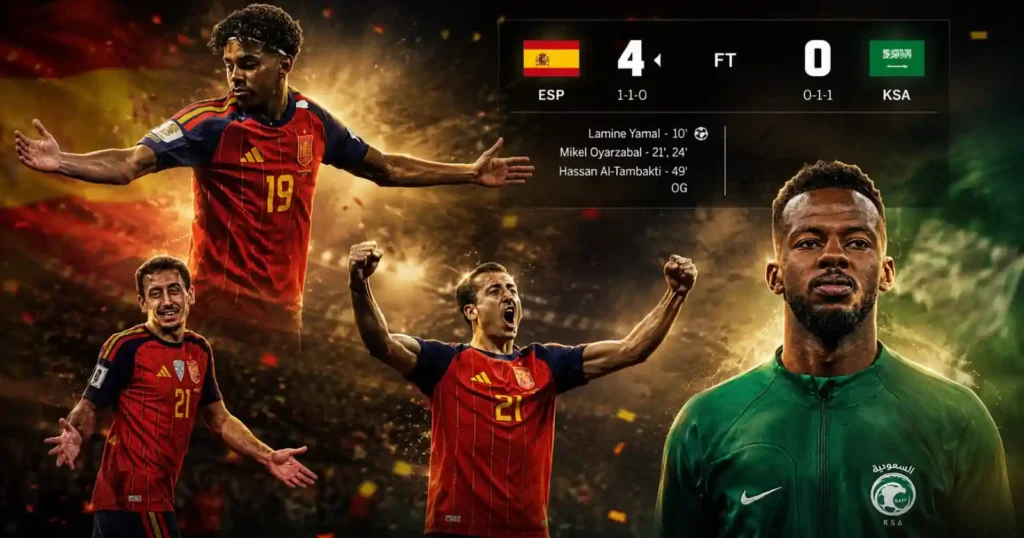
Spain delivered one of the most complete performances of the 2026 FIFA World Cup so far, sweeping aside Saudi Arabia 4-0 in Atlanta and firmly re-establishing themselves as one of the tournament favourites. After a frustrating draw against Cape Verde in their opening Group H fixture, Luis de la Fuente’s side responded in emphatic fashion, dominating possession, territory, chances, and ultimately the scoreline.
The final result reflected Spain’s superiority, but the performance itself was arguably even more impressive than the four-goal margin suggested. Saudi goalkeeper Mohammed Al Owais prevented a significantly heavier defeat with a series of excellent saves, while a late Ferran Torres goal was ruled out by VAR for a marginal offside decision.
For Saudi Arabia, who entered the match after earning a valuable draw against Uruguay, this was a sobering reality check. They were overwhelmed from the opening whistle and struggled to cope with Spain’s relentless movement, technical quality, and attacking pressure.
Spain Set the Tone Immediately
From the opening minutes, Spain looked determined to erase any doubts that emerged after their disappointing opening match. Rather than circulating possession slowly, they attacked with purpose and intensity.
Lamine Yamal was central to that approach. Starting on the right flank, the teenage sensation repeatedly drove at defenders and stretched the Saudi back line. Spain monopolized possession early and pinned Saudi Arabia deep inside their own half.
The pressure finally told in the 10th minute. Mikel Oyarzabal surged down the left and delivered an inviting low cross toward the back post, where Yamal arrived to convert from close range. The goal was historic for the young Barcelona star, who became one of the youngest goalscorers in World Cup history and finally gave Spain the breakthrough their dominance deserved.
The opening goal transformed the match. Saudi Arabia had hoped to remain compact and frustrate Spain, but once they fell behind, their defensive structure began to unravel.
Oyarzabal Takes Control
While Yamal’s goal opened the scoring, the game quickly became the Mikel Oyarzabal show.
The Real Sociedad forward produced arguably his finest World Cup performance, contributing two goals and an assist before being substituted at halftime with the match effectively won.
Spain doubled their lead in the 21st minute from a corner. The Saudi defence failed to clear its lines, allowing Aymeric Laporte to nod the ball back into a dangerous area. Oyarzabal reacted quickest, bundling the ball into the net to make it 2-0.
Just three minutes later, Spain struck again.
A beautifully constructed move saw Marc Cucurella cushion a diagonal pass before Dani Olmo cleverly nodded the ball into Oyarzabal’s path. The striker finished calmly from close range to complete his brace and put Spain 3-0 ahead before the half-hour mark.
At that stage, Saudi Arabia appeared shell-shocked. Spain were moving the ball at speed, finding spaces between the lines, and creating chances almost every time they entered the final third.
The statistics highlighted the imbalance. By halftime, Spain had recorded 17 shots, generated an expected goals figure approaching two, and controlled 71 percent possession. Saudi Arabia, meanwhile, barely ventured forward and accumulated an xG of just 0.04.
Midfield Dominance Decides the Contest
Spain’s superiority was not only about attacking quality. Their midfield completely controlled the rhythm of the game.
Rodri dictated play from deep positions, ensuring Saudi Arabia had almost no opportunity to launch counterattacks. Ahead of him, Pedri delivered one of the standout midfield performances of the tournament so far.Pedri FIFA World Cup 2026: Profile, Stats & Career | StrikerReport
Pedri’s intelligence without the ball was particularly noteworthy. His six interceptions were the highest recorded by any player in a World Cup match so far, illustrating how effectively Spain prevented Saudi Arabia from building attacks.
Whenever Saudi Arabia attempted to play through midfield, Spain swarmed around the ball and regained possession quickly. The result was wave after wave of Spanish attacks.
Dani Olmo and Alex Baena also played important supporting roles. Both found pockets of space between Saudi Arabia’s midfield and defensive lines, constantly creating numerical advantages and allowing Spain to sustain pressure.
The midfield battle was effectively over within the first 30 minutes.
Saudi Arabia’s Defensive Plan Falls Apart
Saudi Arabia entered the contest with a five-man defensive line designed to absorb pressure and limit Spain’s attacking opportunities.
On paper, the strategy made sense.
In practice, Spain’s movement proved too sophisticated.
Yamal and Oyarzabal constantly pulled defenders out of position. Cucurella and Pedro Porro advanced aggressively from full-back. Olmo drifted between lines. Pedri and Rodri recycled possession quickly enough to prevent Saudi Arabia from reorganizing.
The Green Falcons often had eight or nine players behind the ball, yet Spain still found passing lanes into dangerous areas.
Saudi Arabia’s inability to relieve pressure compounded the problem. Their forwards received little service, forcing the defence to absorb attack after attack. Eventually, the constant pressure became unsustainable.Lamine Yamal FIFA World Cup 2026: Profile, Stats & Career | StrikerReport
Goalkeeper Mohammed Al Owais deserves considerable credit for preventing a heavier defeat. He made several excellent saves throughout the match, denying Oyarzabal, Porro, Ferran Torres, and others.
Without his interventions, the scoreline could easily have reached six or seven goals.
Spain Continue After the Break
Any lingering hopes of a Saudi comeback disappeared almost immediately after halftime.
Just four minutes into the second half, Spain scored their fourth goal.
Following a corner kick delivered by Baena, Marc Cucurella’s close-range effort was saved by Al Owais. Unfortunately for Saudi Arabia, the rebound struck defender Hassan Al Tambakti and bounced into the net for an own goal.
At 4-0, the contest was effectively finished.
Spain then entered game-management mode while still creating chances. Ferran Torres, introduced at halftime, repeatedly threatened. Nico Williams added fresh energy from the bench, while Fabian Ruiz and Mikel Merino helped maintain midfield control.
The most telling statistic came midway through the second half when Spain had accumulated 21 shots compared with only two from Saudi Arabia.
Even after easing off the intensity, Spain remained in complete command.
Defensive Excellence Completes the Performance
The attacking display naturally attracted most of the attention, but Spain’s defensive work was equally impressive.
Saudi Arabia managed only a handful of attempts and did not seriously threaten Unai Simon’s goal until late in the game. Spain’s goalkeeper was largely a spectator for much of the evening.
The central defensive partnership of Pau Cubarsi and Aymeric Laporte was rarely tested, while Rodri’s screening role eliminated potential transitions before they could develop.
Spain’s pressing structure deserves special mention. Rather than allowing Saudi Arabia time to build attacks, they closed down passing lanes immediately after losing possession.
This aggressive counter-press ensured that Saudi Arabia spent most of the match trapped in their own half.
For a team that entered the tournament with questions surrounding its finishing ability after the draw against Cape Verde, this was an emphatic answer.
Group H Situation
The result significantly changes the complexion of Group H.
Spain entered the match with one point after their draw against Cape Verde. This victory moves them onto four points and places them in a strong position heading into the final round of group fixtures.
More importantly, the convincing scoreline provides a substantial boost to their goal difference, which could become crucial if qualification positions are decided on tiebreakers.
For Saudi Arabia, the defeat is painful but not fatal.
The Green Falcons remain on one point after their opening draw against Uruguay. Their final group match against Cape Verde now becomes a virtual must-win encounter. Victory would likely keep their qualification hopes alive, while anything less could leave them dependent on results elsewhere.
The group remains finely balanced because several teams are still within touching distance of the knockout places. However, Spain have placed themselves in the strongest position among the contenders.
Should they produce another performance of this quality in their final group game, they will not only qualify but potentially top the group.
What This Result Means
Beyond the three points, this match felt like a statement from Spain.
The European champions arrived in North America carrying expectations but had failed to convince in their opener. Against Saudi Arabia, they reminded everyone why they are considered one of the tournament’s elite teams.
Yamal’s brilliance, Oyarzabal’s ruthlessness, Pedri’s control, and Rodri’s authority combined to create a complete team performance. Spain were dominant in every phase of play and looked capable of overwhelming opponents through both possession and direct attacking football.
For Saudi Arabia, the defeat exposed limitations against top-level opposition, but qualification remains within reach if they can respond positively in their final group match.
As for Spain, this 4-0 victory may ultimately be remembered as the moment their World Cup campaign truly began. After a sluggish start to the tournament, La Roja have announced themselves as genuine contenders, and on this evidence, they will take some stopping in the knockout rounds.
▪️▪️ Follow us on Facebook▪️▪️
About the Author