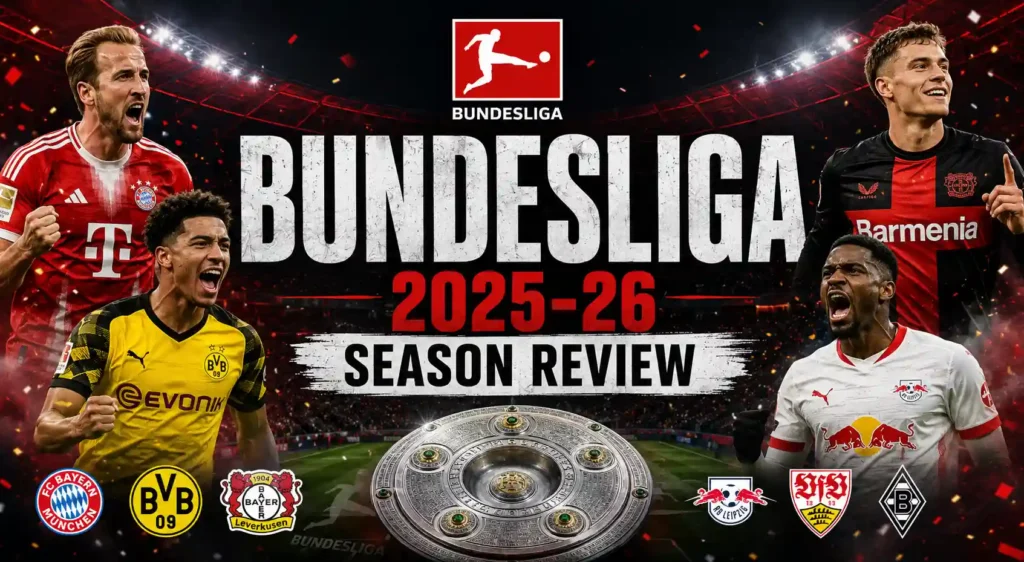
There are title races, and then there are coronations. The 2025-26 Bundesliga season was unmistakably the latter — a campaign in which Bayern Munich didn’t so much win the league as systematically dismantle every notion that anyone else might.
By the time Bayern beat VfB Stuttgart 4-2 at the Allianz Arena on Matchday 30, sealing their 34th Bundesliga title — and 35th overall German championship — with four matches still to play, the only genuine debate left in German football was how many records Vincent Kompany’s side would break before the season was finished. They broke plenty.
This is the complete story of how the 2025-26 Bundesliga season unfolded — the runaway champions, the closest challengers, the goalscoring records, and the late-season fights at both ends of the table.
Bayern Munich: A Season for the History Books
Let’s start with the only place this season’s story can start.
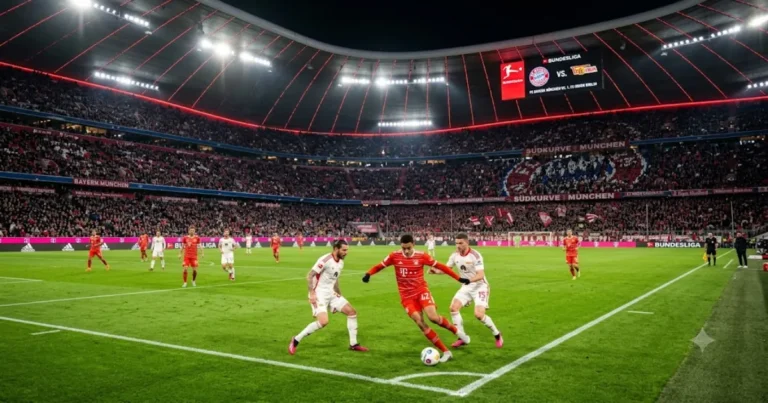
Bayern Munich finished the 2025-26 campaign with a level of dominance that even by their own extraordinary historical standards stood out. The headline numbers tell most of the story on their own: 82 points from 31 matches, a goal difference of +81, and just a single defeat across the entire campaign.
But the most remarkable statistic belongs to the goals column. Bayern didn’t just win the league — they obliterated the Bundesliga’s all-time single-season goals record, a mark of 101 goals that had stood since the 1971-72 season. Bayern broke it with five matches still to play and finished the campaign with 113 goals through their first 31 fixtures, a number that may stand for a generation.
The scorelines along the way were occasionally absurd. An 8-1 demolition of Wolfsburg. A 6-0 thrashing of Hamburger SV. A 6-2 win over Freiburg. A 5-0 statement victory away at Stuttgart, of all places, in the very match that secured the title. Bayern scored five or more goals in multiple Bundesliga fixtures across the season — a frequency that speaks to a team functioning at a level the rest of the division simply couldn’t match.
Harry Kane: The Engine of the Record-Breaking Run
If there’s a single name responsible for translating Bayern’s dominance into goals, it’s Harry Kane.
The English striker finished the season with 33 league goals — comfortably the division’s top scorer for a second consecutive campaign, and a continuation of a goalscoring run in Germany that has bordered on the absurd since his move from Tottenham. Kane scored five goals in a single match against RB Leipzig — a 6-0 win — and added a four-goal haul against Hoffenheim in a 4-1 victory, underlining a season where opposition defences simply had no answer for his movement and finishing.
Kane wasn’t operating in isolation, either. Bayern’s attacking depth across the campaign was genuinely historic:
- Harry Kane — 33 goals
- Luis Díaz — 15 goals
- Michael Olise — 13 goals
Three players inside the league’s top five goalscorers, all from a single squad, is an almost unheard-of concentration of attacking talent — and it’s a major reason why Bayern’s goal difference ended the season at a staggering +81, nearly double the next-best mark in the division.
Vincent Kompany’s Vindication
It’s worth pausing on the manager. Vincent Kompany’s appointment at Bayern was initially met with scepticism in some corners of German football — a young, relatively unproven coach taking over one of the biggest jobs in the sport. Back-to-back titles, a Bundesliga goals record, and a single defeat across an entire 31-match campaign represent about as emphatic a response to that scepticism as a manager can produce.
Bayern’s longest unbeaten run of the season stretched to 18 matches, and their longest winning run hit nine games — both figures underlining a side that didn’t just beat opponents but ground them into irrelevance for extended stretches of the campaign.
Borussia Dortmund: A Genuine Second Place, If Nothing More
If there’s a positive secondary story in this season’s title race, it belongs to Borussia Dortmund.
Niko Kovač’s side finished the campaign 16 points behind Bayern but with genuine, tangible improvement compared to the previous season — finishing 13 points better off than their 2024-25 return, securing their Champions League qualification with an emphatic win over Freiburg on Matchday 31. A 67-point, 20-win campaign with a +34 goal difference represents real progress for a club that has spent recent seasons searching for an identity capable of consistently challenging Bayern.
Dortmund’s away form was a particular highlight — a 6-0 win at Frankfurt’s Deutsche Bank Park and a thumping 4-0 victory at Augsburg were among the standout results of their campaign. Emre Can’s leadership as captain provided stability through a season that, while never genuinely threatening Bayern’s position at the summit, gave Dortmund supporters real reason for optimism heading into next season.
The honest assessment: Dortmund were the best of the rest, by a comfortable distance. They were never within touching distance of Bayern at any point after the opening months of the campaign. But “best of the rest” in a league containing Leipzig, Stuttgart, Hoffenheim, and Leverkusen is still a meaningful achievement.
The Real Title Race: The Battle for Fourth
With the actual title race effectively over by April, the genuine drama of the 2025-26 Bundesliga season shifted to the fight for Champions League qualification and the survival battle at the bottom of the table.
RB Leipzig Secure Third
RB Leipzig, under Ole Werner, secured a comfortable third-place finish with 62 points from 31 matches — enough to guarantee a return to Champions League football regardless of how the final matches played out. A +24 goal difference and 19 wins reflected a solid, if unspectacular, campaign that delivered exactly what the club needed.
The Best Football Boots of All Time, Ranked
The Three-Way Scramble for Fourth
The genuinely fascinating battle of the season’s closing weeks came in the chase for the final Champions League qualification spot — a three-way contest between VfB Stuttgart (61 points, +22 goal difference), TSG Hoffenheim (61 points, +17), and Bayer Leverkusen (58 points, +20).
This battle carried extra weight because of an unusual structural quirk in this season’s European qualification system: with the DFB-Pokal final featuring two clubs — Bayern Munich and Stuttgart — already assured of European qualification through their league position, the cup winner’s automatic Europa League berth was reassigned down the table. That meant whichever of Stuttgart, Hoffenheim, and Leverkusen missed out on the top four would still likely secure European football for next season, softening the blow of missing the Champions League places — but Champions League qualification, with its financial and prestige rewards, remained the prize all three clubs were fighting for.
Bayer Leverkusen: A Season of Transition, Not Crisis
This is where Leverkusen’s 2025-26 campaign deserves specific attention, given the scrutiny the club faced entering the season.
Following Xabi Alonso’s departure after the historic 2023-24 unbeaten title-winning campaign, Leverkusen endured a genuinely turbulent managerial situation. Erik ten Hag’s tenure lasted barely three months into the new season before he was dismissed in early September, with Leverkusen sitting in 12th place — a stunning fall from a club that had been Bundesliga champions and DFB-Pokal winners just over a year earlier.
Kasper Hjulmand’s appointment in September stabilised the situation considerably. Under the Danish coach, Leverkusen clawed their way back into genuine European contention, ultimately finishing sixth with 55 points — enough, given the European qualification quirks outlined above, to still secure Europa League football for 2026-27.
It wasn’t the campaign Leverkusen fans wanted after the heights of 2023-24, but given the managerial chaos of the opening months of the season, finishing within touching distance of a Champions League spot represents a credible recovery. Patrik Schick’s continued goalscoring contribution — finishing among the division’s top scorers once again — was a rare point of consistency through a genuinely unstable campaign.
The Bottom of the Table: A Brutal Relegation Fight
While Bayern’s procession at the top defined the season’s broader narrative, the relegation battle at the bottom provided plenty of late-season tension.
1. FC Heidenheim finished bottom of the table with just 22 points from 31 matches, suffering relegation directly back to 2. Bundesliga. Heidenheim’s season was defined by a brutal 15-match winless run — the longest of any side in the division — that proved impossible to recover from.
VfL Wolfsburg endured a genuinely chaotic campaign, going through multiple managerial changes — Paul Simonis departing in November, with Daniel Bauer taking interim charge before Dieter Hecking was appointed in March in a final attempt to arrest the slide. It wasn’t enough to prevent Wolfsburg finishing 17th and dropping into the relegation play-off, ultimately suffering relegation via that route.
FC St. Pauli completed the trio of struggling sides, finishing 16th with 26 points and the league’s worst goal difference at -27, also entering the relegation play-offs after a season defined by their longest losing run of any club in the division — nine consecutive defeats at one stage.
The bottom three’s struggles underline just how unforgiving the gap between Bundesliga survival and Bundesliga comfort can be — even in a season where the title race itself offered virtually no competitive tension whatsoever.
Season By Numbers: The 2025-26 Bundesliga in Stats
| Category | Detail |
|---|---|
| Champions | Bayern Munich (34th Bundesliga title, 35th German title) |
| Title won with games to spare | 4 |
| Bayern’s record | 26W-4D-1L from 31 matches, 82 points |
| Top scorer | Harry Kane (Bayern Munich) — 33 goals |
| Bayern’s single-season goals tally | 113 (new Bundesliga record) |
| Previous goals record | 101 (1971-72 season) |
| Relegated | 1. FC Heidenheim, VfL Wolfsburg (play-off), FC St. Pauli (play-off) |
| Champions League qualifiers | Bayern Munich, Borussia Dortmund, RB Leipzig, + 4th-place finisher |
| Bayern’s longest unbeaten run | 18 matches |
| Bayern’s longest winning run | 9 matches |
Final Word: A Season Defined Early, Decided Late Only in the Margins
The story of the 2025-26 Bundesliga season is, in the end, a simple one: Bayern Munich were better than everyone else by a distance that bordered on the historic, and the only genuine drama left for the rest of the division was fighting over the scraps of European qualification and survival.
Harry Kane’s continued evolution into one of the most prolific strikers ever to play in German football, Bayern’s record-breaking goal tally, and Vincent Kompany’s continued vindication as a top-level head coach were the dominant storylines. Dortmund’s progress under Kovač, Leipzig’s steady third-place consolidation, and the genuinely dramatic three-way fight for fourth between Stuttgart, Hoffenheim, and Leverkusen provided what competitive intrigue the season had to offer.
For Bayer Leverkusen specifically, a season that began in genuine crisis — a sacked manager just three matches in, sitting 12th in the table — ended with a respectable recovery under Hjulmand that papers over what could have been a far more troubling campaign for German football’s reigning surprise package of 2023-24.
As German football turns its attention to 2026-27, the question facing every club not named Bayern Munich remains the same one that’s persisted for much of the past decade: how, exactly, does anyone close this gap?
StrikerReport.com | Bundesliga Season Review | 2025-26 Campaign
▪️▪️Follow us on Facebook ▪️▪️
About the Author