 The 1950 World Cup Maracanazo: Uruguay’s Impossible Victory Over Brazil
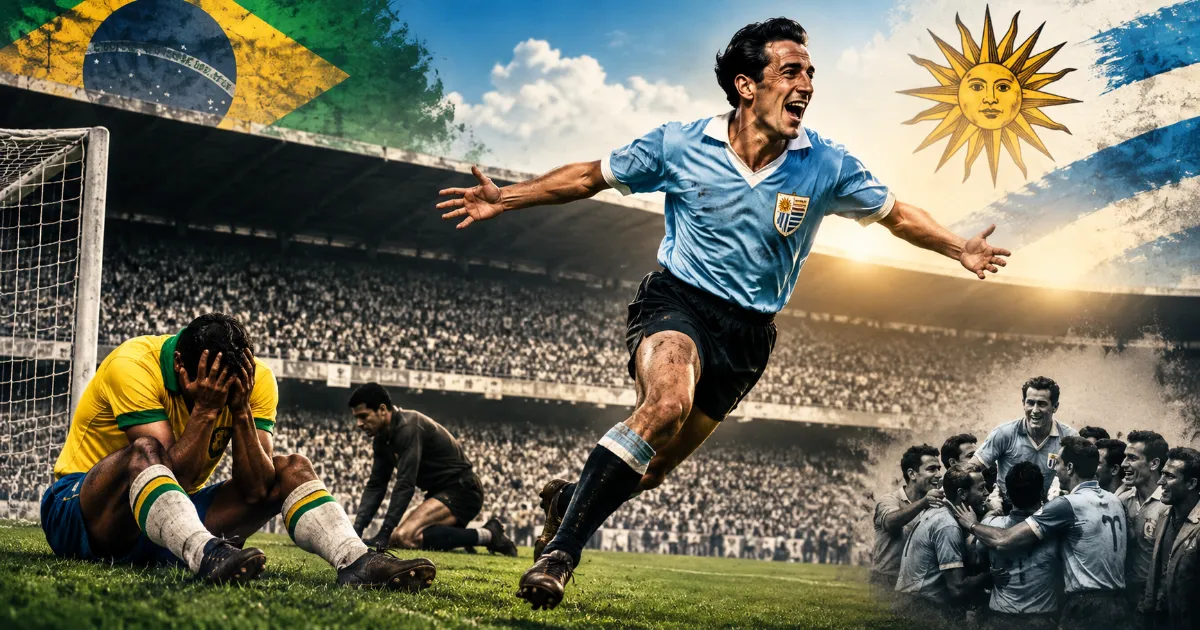
No single match in football history carries the weight of what happened at the Maracanã Stadium on July 16, 1950. A nation expecting nothing less than coronation instead witnessed one of the sport’s most devastating collapses, a result so shocking and so culturally significant that Brazilians still refer to it simply as the Maracanazo, more than seven decades later. This is the story of how Uruguay, given almost no chance by anyone outside their own dressing room, delivered the most consequential upset in World Cup history.
The History of Asian Teams at the Fifa World Cup — From South Korea 2002 to a Record 2026
A Tournament Unlike Any Before It
The 1950 World Cup was itself unusual before a ball was even kicked in the decisive match. It was the first tournament held since 1938, the intervening years consumed entirely by the Second World War, and Brazil’s hosting duties came with an ambitious centerpiece: the newly constructed Maracanã Stadium, built specifically for the tournament and designed to be, at the time, the largest football stadium anywhere on Earth. Rather than a traditional single-match final, the 1950 tournament’s format called for a four-team final round-robin group, meaning the “final” wasn’t technically a standalone match at all, but simply the last fixture in that group stage, one that happened to pit the two form teams of the tournament, Brazil and Uruguay, against each other with the title still mathematically in the balance.
Brazil arrived at that final match in an almost unassailable position, at least on paper. Having thrashed Sweden 7-1 and Spain 6-1 in their previous two group matches, Brazil needed only a draw against Uruguay to claim the title outright, while Uruguay needed an outright win to leapfrog them. Given Brazil’s overwhelming attacking form throughout the tournament and the sheer weight of home advantage, with the newly built Maracanã expected to be packed with a passionately supportive crowd, the consensus both inside and outside Brazil was that the outcome was little more than a formality.
Two Hundred Thousand Witnesses
What happened on the day of the match remains, by any measure, one of the most extraordinary spectacles in sporting history. An officially recorded crowd of 173,850 paying spectators, with total attendance including non-paying guests widely estimated at closer to 200,000 people, packed into the Maracanã, still the largest crowd ever recorded for a single football match anywhere in the world. Rio de Janeiro’s newspapers had already prepared celebratory headlines in advance of kickoff, and Brazil’s players were reportedly presented with commemorative medals inscribed with their names as champions before the match had even been played, a level of premature celebration that, in hindsight, only deepened the shock of what followed.
The mayor of Rio de Janeiro reportedly addressed the Brazilian squad before kickoff, declaring them already champions in front of the assembled crowd, a moment of civic confidence that Uruguay’s own captain, Obdulio Varela, later used as motivation in the Uruguayan dressing room, reportedly telling his teammates that Brazil had already crowned itself before a ball had even been kicked, and that Uruguay alone could still decide otherwise.
A Goal That Sparked Bedlam
Brazil struck first, just after the interval, when forward Friaça found the net to put the hosts ahead, sending the enormous crowd into scenes of pure, deafening celebration that reportedly could be heard well beyond the stadium walls. For a home crowd already convinced of the outcome before kickoff, Friaça’s goal felt less like the opening of a contest and more like confirmation of what had already been assumed, a formality being ceremonially completed in front of the largest audience the sport had ever assembled.
Varela, Uruguay’s captain and defensive anchor, immediately protested the goal to the match officials, a delay tactic widely credited by football historians with helping settle his team’s nerves and disrupt Brazil’s momentum at the exact moment the home crowd’s celebration was reaching its peak. Whatever the precise psychological impact of that protest, Uruguay regrouped in the minutes that followed, refusing to be swept away by either the score or the deafening noise surrounding them.
The Equalizer That Silenced the Stadium
Just past the hour mark, Uruguay’s Juan Alberto Schiaffino latched onto a pass from Alcides Ghiggia and drilled a shot past Brazilian goalkeeper Moacir Barbosa, leveling the score and, for the first time all tournament, introducing genuine doubt into a crowd that had arrived expecting only celebration. The equalizer didn’t yet feel decisive, Brazil still needed only a draw to claim the title, but it fundamentally shifted the emotional atmosphere inside the stadium, replacing certainty with a nervous tension that had been almost entirely absent since kickoff.
Ghiggia’s Immortal Moment
With just eleven minutes remaining, Ghiggia received the ball down the right flank, cut inside past his marker, and, rather than crossing as Barbosa reportedly anticipated, struck a low shot toward the near post that beat the Brazilian goalkeeper and nestled into the net. The goal, worth remembering, didn’t just level the tournament standings, it put Uruguay ahead outright, meaning Brazil now needed to find a second goal of their own in the remaining minutes simply to salvage the title they had entered the match already believing to be secured.
Ghiggia later described the immediate aftermath of his goal in terms that have become inseparable from how the moment is remembered in football history, famously noting that only three people had ever managed to silence the Maracanã with a single moment: the Pope, Frank Sinatra, and himself. Whether or not the phrasing was entirely his own invention or later embellished through decades of retelling, the sentiment captures precisely what happened inside the stadium in that instant, roughly 200,000 people, moments earlier engaged in raucous, expectant celebration, falling into a stunned, disbelieving silence that eyewitnesses described as almost physically unsettling.
The Final Whistle
Brazil pushed for an equalizer in the remaining minutes but couldn’t find a way through Uruguay’s resolute defense, and when the final whistle sounded, Uruguay had completed one of the most improbable title triumphs in World Cup history, their second championship following an earlier win at the inaugural 1930 tournament. For Uruguay, a nation with a fraction of Brazil’s population and footballing resources, the win remains one of the greatest underdog achievements the sport has ever produced. For Brazil, the defeat became something closer to a national trauma, one that would shape the country’s relationship with football, and with itself, for decades to come.
A Wound That Never Fully Healed
The scale of Brazil’s collective devastation following the Maracanazo is difficult to overstate. Reports from the period describe a wave of suicides linked to the result, along with widespread public mourning that treated the defeat less as a sporting disappointment and more as a genuine national tragedy. Goalkeeper Moacir Barbosa bore a disproportionate share of the public blame in the years that followed, a burden he carried for the rest of his life; he later remarked that under Brazilian law the maximum sentence for any crime was thirty years, yet he had effectively served a lifetime sentence for a mistake he didn’t consider his fault alone.
The cultural impact extended well beyond individual players. Renowned Brazilian playwright and journalist Nelson Rodrigues later coined the term “complexo de vira-lata,” or “mongrel complex,” to describe a broader Brazilian tendency toward self-doubt and inferiority in the face of the rest of the world, a psychological framework he explicitly traced back to the trauma of the Maracanazo. That phrase entered common Brazilian usage well beyond football, invoked for decades afterward whenever the nation grappled with self-doubt on the international stage in fields far removed from sport, a testament to just how deeply the events of that single afternoon embedded themselves in Brazilian national consciousness.
A New Kit for a New Beginning
One of the more tangible, lasting consequences of the Maracanazo involved Brazil’s national team kit itself. At the time of the 1950 final, Brazil played in all-white shirts with blue trim, a kit that, following the trauma of the defeat, came to be viewed as cursed, too closely associated with the nation’s most painful sporting memory to ever be worn again. In the aftermath, a Brazilian newspaper organized a public competition to design a new national kit, explicitly built around the colors of the Brazilian flag, a process that eventually produced the now-iconic yellow shirt with green trim and blue shorts first worn at the 1954 World Cup. That kit would go on to become one of the most recognizable and celebrated uniforms in all of sport, worn by Pelé, Garrincha, Ronaldo, and generations of Brazilian legends who followed, a strange and enduring silver lining born directly out of football’s most devastating single afternoon for the host nation.
Why the Maracanazo Still Resonates
More than seven decades on, the Maracanazo remains one of the most frequently referenced moments in football history, invoked whenever pundits and fans discuss the sport’s greatest shocks or the psychological weight that host nations carry into a home tournament. For Uruguay, a country of just a few million people, the victory remains a permanent source of footballing pride, still celebrated domestically as one of the defining achievements in the nation’s sporting history. For Brazil, despite going on to win a record-extending five World Cup titles in the decades since, the Maracanazo remains an unhealed scar in the country’s football history, a reminder that even the most dominant footballing nation on earth once experienced a single afternoon of collective heartbreak so profound that it reshaped the country’s national kit, its football culture, and, according to some, its broader national psychology for generations afterward.
The Tactical Story Behind the Shock
Beyond the emotional and cultural weight of the result, the Maracanazo also carries genuine tactical significance that’s sometimes overlooked amid the more dramatic elements of the story. Uruguay’s approach that day relied heavily on defensive discipline and patience, absorbing Brazil’s early pressure and waiting for opportunities to break at pace rather than attempting to match the host nation’s free-flowing attacking football directly. Obdulio Varela’s leadership at the back proved instrumental in maintaining that defensive structure even as the crowd noise and Brazil’s early goal threatened to overwhelm his teammates, and his decision to delay play after Friaça’s opener is still cited by football historians as a masterclass in game management under extraordinary pressure.
Brazil, by contrast, had built their entire tournament around devastating attacking football, having scored 21 goals across their previous four matches heading into the final round-robin fixture. That attacking approach, while spectacular against Sweden and Spain, left Brazil more vulnerable defensively than their free-scoring reputation suggested, a vulnerability Uruguay’s counter-attacking approach was specifically designed to exploit. Ghiggia’s decisive goal, cutting inside from the right flank rather than attempting an obvious cross, exploited exactly this kind of defensive uncertainty, catching Barbosa and Brazil’s back line in a moment of hesitation that a more conservatively set-up Brazilian side might have avoided.
The Players Whose Lives Were Shaped by That Afternoon
The Maracanazo left permanent marks on the individuals directly involved, in ways that extended far beyond typical sporting disappointment or triumph. For Ghiggia and Schiaffino, the two Uruguayan goalscorers, the match became the defining moment of otherwise accomplished careers, with Ghiggia in particular becoming a permanent symbol of Uruguayan footballing identity, a status he maintained through decades of subsequent public appearances and interviews revisiting the match. Both players eventually moved to Italy to continue their club careers, with Schiaffino going on to represent Italy internationally under the eligibility rules of the era, adding a further layer of complexity to a story already rich with historical footnotes.
For Brazil’s players, the aftermath proved considerably harsher. Beyond Barbosa’s decades of public scapegoating, several other members of the Brazilian squad reported facing lasting social stigma in the years following the defeat, with some describing being publicly recognized and blamed by strangers decades after the tournament had ended. This disproportionate, lasting burden placed on individual players, rather than being understood as a collective sporting result, has itself become part of the broader cultural conversation in Brazil about the sometimes excessive weight the country’s football failures have historically placed on individual scapegoats, a pattern some commentators trace directly back to how the nation processed, or failed to fully process, the trauma of 1950.
A Stadium That Still Carries the Memory
The Maracanã itself has undergone significant renovation in the decades since 1950, including major reconstructions ahead of both the 2014 World Cup and the 2016 Rio Olympics, yet the stadium’s connection to that single afternoon has never faded from Brazilian football culture. It remains one of the most storied venues in world football specifically because of the events of July 16, 1950, a reminder that the Maracanazo isn’t simply a historical footnote confined to record books, but a living, continually referenced part of how Brazilians understand their own football identity, their capacity for both extraordinary triumph and devastating collective heartbreak, whenever the national team takes the field on the biggest possible stage.
Even the attendance record set that day has proven remarkably durable, never surpassed by any football match played anywhere in the world since, a reflection both of the sheer scale of the original Maracanã before later safety-driven renovations reduced its capacity, and of just how unlikely it is that any future football match, played in an era of considerably more restrictive modern stadium safety regulations, will ever again gather quite so many people in one place to witness a single result.
The History of Asian Teams at the Fifa World Cup — From South Korea 2002 to a Record 2026
About the Author