 The Full Story of Manchester United’s 1999 Treble
How two stoppage-time goals in Barcelona capped the most dramatic single season any English club has ever produced.
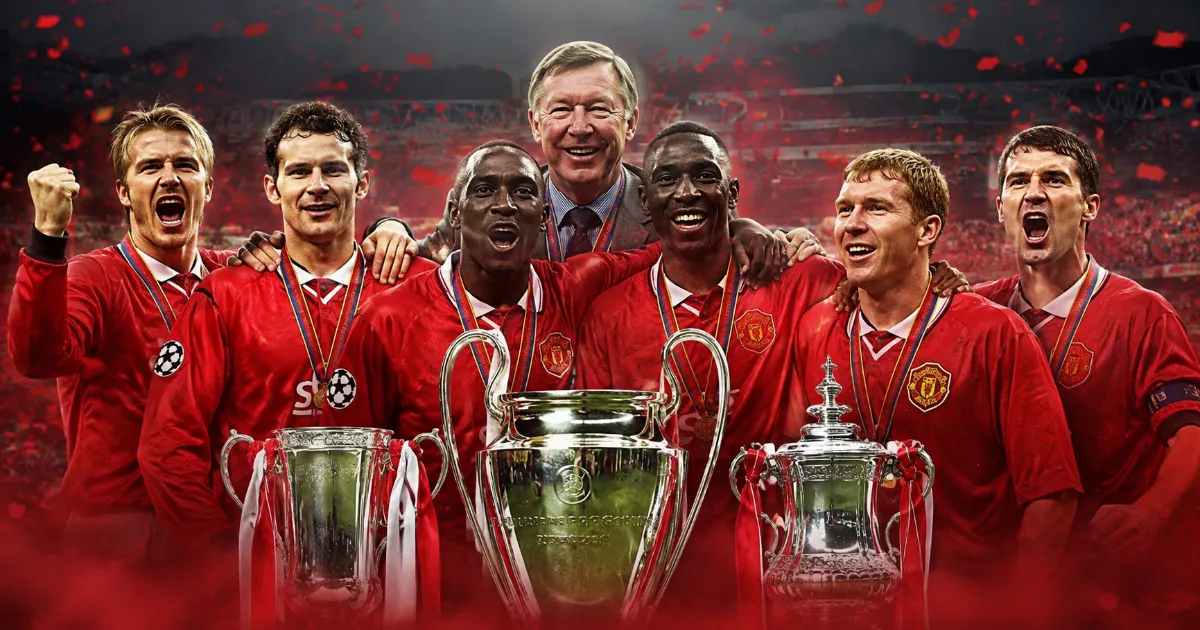
No English club, before or since, has managed what Manchester United achieved during the 1998-99 season: winning the Premier League, the FA Cup, and the Champions League in the same campaign, a genuine European treble secured through a stretch of late-season drama that remains unmatched in the country’s football history. This is the story of that extraordinary season, one decided almost entirely in the final, nerve-shredding minutes of its three separate title races.
A Season Built on Squad Depth
Alex Ferguson’s Manchester United squad heading into the 1998-99 season was built on a genuinely rare combination of homegrown talent and shrewd international signings, anchored by the “Class of ’92” graduates David Beckham, Ryan Giggs, Paul Scholes, Nicky Butt, and Gary and Phil Neville, alongside established stars like Roy Keane, Peter Schmeichel, and a strike partnership of Dwight Yorke and Andy Cole that would prove decisive across all three competitions. Ferguson’s willingness to rotate his squad heavily across an unprecedented fixture schedule, rather than relying on a fixed starting eleven, proved essential to sustaining a title challenge on three separate fronts simultaneously, a squad management approach that was still relatively unusual in English football at the time but has since become standard practice for clubs pursuing multiple competitions at once.
The Premier League: A Title Decided on the Final Day
United’s Premier League campaign came down to the tournament’s final day, locked in a tight title race with Arsenal that had seen the lead change hands repeatedly across the season’s closing months. Arsenal, chasing their own domestic double under Arsène Wenger, needed United to drop points on the final day to have any realistic chance of overhauling the table, but United’s 2-1 victory over Tottenham Hotspur, coming from behind after conceding an early goal, secured the title outright and delivered Ferguson’s fifth Premier League championship as manager. That result alone would have made for a memorable season, but it represented merely the first of three trophies United would go on to claim within the span of just nine remarkable days.
The FA Cup: Giggs’s Wonder Goal
United’s FA Cup campaign produced what remains, by wide consensus, one of the single greatest individual goals in the competition’s history. Their semifinal against fierce rivals Arsenal required a replay after the first match finished level, and the replay itself, played at Villa Park, delivered one of English football’s most dramatic single matches. Roy Keane was controversially sent off, reducing United to ten men, and Dennis Bergkamp missed a stoppage-time penalty that could have won the match for Arsenal outright, only for Peter Schmeichel to produce a crucial save. The match continued into extra time still level, until Ryan Giggs picked up the ball inside his own half, drove directly at Arsenal’s exhausted ten-man defense, beat multiple defenders in a slaloming individual run, and finished with a rising shot beyond goalkeeper David Seaman, a goal immediately hailed as one of the greatest solo efforts English football had ever produced and one that remains among the most replayed individual moments in FA Cup history.
That semifinal victory carried United through to the final against Newcastle United, a considerably more comfortable occasion by comparison, with United winning 2-0 courtesy of goals from Teddy Sheringham and Paul Scholes, securing the FA Cup and setting up an extraordinary opportunity: a chance at the treble remained alive with the Champions League final still to come, just four days later.
The Champions League: Down to Ten Men in Turin
United’s path to the Champions League final itself had required its own significant drama, most notably in a semifinal second leg against Juventus in Turin, where United found themselves 2-0 down early in the match against a Juventus side that appeared to be cruising toward the final. What followed was one of the most celebrated individual comebacks in the competition’s history, driven substantially by Roy Keane, who scored United’s first goal with a header before delivering an inspired individual performance in midfield that helped turn the entire tie, with further goals from Dwight Yorke and Andy Cole completing a stunning 3-2 victory that carried United through on aggregate. The cost of that heroic performance proved significant, however, since Keane picked up a yellow card during the match that, combined with an earlier caution in the competition, ruled him out of the final itself alongside fellow midfielder Paul Scholes, who had also accumulated a suspension.
The Final: Six Minutes That Changed Everything
United’s Champions League final against Bayern Munich at Barcelona’s Camp Nou, played without the suspended Keane and Scholes in central midfield, initially unfolded almost exactly as many observers feared it might. Bayern took the lead within the match’s opening six minutes through a Mario Basler free kick, and for long stretches of the match that followed, United struggled to generate the kind of clear scoring opportunities their reputation and domestic form might have suggested, hampered significantly by the absence of two of their most important midfield players. Bayern even had efforts strike the woodwork twice during the second half, moments that, had they gone in, would have almost certainly ended United’s treble hopes entirely.
As the match moved into its final minutes still level at 1-0, Ferguson turned to his bench, introducing substitutes Teddy Sheringham and Ole Gunnar Solskjaer in a final attempt to salvage the match. The gamble paid off with a speed and drama that remains almost unparalleled in football history. In the 91st minute, Sheringham converted from close range following a corner, leveling the match and sending it toward what appeared destined to be extra time. Then, just two minutes later, deep into stoppage time, another corner from David Beckham found its way to Solskjaer, who stabbed the ball home from close range to complete one of the most stunning last-gasp comebacks the Champions League has ever produced, securing a 2-1 victory and, with it, the treble.
A Celebration Unlike Any Other
The scenes following Solskjaer’s winning goal captured something genuinely unique in football history, not simply the emotion of winning a major trophy, but the specific disbelief of an entire stadium processing what had just happened within the space of barely two minutes. Ferguson himself later admitted he had begun mentally preparing for extra time and potentially penalties in the moments before Sheringham’s equalizer, only for Solskjaer’s follow-up strike to arrive before Bayern’s players had even fully recovered from conceding the first. The victory made Manchester United the first English club in history to complete the specific treble of league title, domestic cup, and European Cup or Champions League in a single season, a feat that had previously only been managed by a small handful of European clubs, including Celtic in 1967 and Ajax in 1972, each achieving their own version of a continental and domestic treble under somewhat different competition structures than existed by the time United achieved theirs in 1999.
Ferguson’s Knighthood and Lasting Legacy
The scale of United’s achievement was formally recognized when Alex Ferguson received a knighthood later that year, specifically in recognition of his role in delivering the treble, elevating him to Sir Alex Ferguson for the remainder of his managerial career and beyond. The 1998-99 squad’s achievement has remained the benchmark against which every subsequent great English club season is measured, referenced constantly whenever a team enters a similarly demanding period of fixture congestion across multiple competitions, and the specific manner of United’s Champions League triumph, an entire trophy secured within the final six minutes of stoppage time against the run of play for most of the match, has become one of the most frequently replayed and discussed sequences in the sport’s broader history.
Why the Treble Has Never Been Repeated by an English Club
More than two decades on, no other English club has managed to replicate United’s specific 1998-99 achievement, a fact that speaks to just how demanding sustaining a genuine title challenge across three separate competitions simultaneously actually is, even for clubs with considerably deeper financial resources than United possessed at the time. Manchester City came closest in the modern era, completing their own treble of Premier League, FA Cup, and Champions League titles during the 2022-23 season under Pep Guardiola, a genuinely comparable modern achievement built on a squad with far greater financial resources and rotation depth than Ferguson had available to him in 1999, yet City’s triumph, however statistically similar, lacked the same razor-thin, injury-time drama that defined United’s specific route to glory a generation earlier.
That combination, genuine footballing achievement paired with a finish almost too dramatic to have been scripted, is precisely why United’s 1999 treble continues to be remembered not simply as a great season, but as arguably the single greatest season any English football club has ever produced, one whose most iconic six minutes remain instantly recognizable to football fans who weren’t even alive to watch it unfold live at the time.
The Squad Depth That Made It Possible
Sustaining a genuine challenge across three separate competitions required a level of squad management that was still relatively unusual in English football at the time, and several players who featured only sporadically throughout the season proved decisive at exactly the right moments. Teddy Sheringham, who had struggled to consistently displace the first-choice striking partnership of Yorke and Cole for much of the campaign, scored crucial goals in both the FA Cup final and the Champions League final despite starting neither match, a reminder of just how vital Ferguson’s willingness to trust his full squad, rather than a fixed core eleven, proved across the season’s most pressurized moments. Ole Gunnar Solskjaer’s own super-substitute role throughout the campaign similarly became a defining storyline of the season, culminating in the single most famous late substitute contribution in the club’s history when his stoppage-time winner completed the treble in Barcelona.
This depth extended to United’s defensive options as well, with Jaap Stam’s imposing physical presence anchoring the back line throughout a campaign requiring an unusually demanding fixture schedule across domestic league, domestic cup, and European competition simultaneously, a workload considerably heavier than what most rival squads across the continent were required to manage during the same season.
The Wider Context of English Football in 1999
United’s treble arrived at a particularly significant moment for English football’s broader standing in the European game. The Premier League, still a relatively young competition having launched only in 1992, had not yet established the overwhelming financial dominance over other European leagues that would come to define the competition in later decades, and English clubs’ record in continental competition throughout the 1990s had been comparatively modest by the standards English football had set during its earlier European Cup dominance in the late 1970s and early 1980s. United’s Champions League triumph therefore carried outsized symbolic importance for English football’s broader European reputation, arriving as tangible proof that the Premier League’s rapidly growing commercial power was beginning to translate into genuine on-pitch continental success as well, a trend that would continue to accelerate through the following decade as English clubs’ financial advantages over their continental rivals grew increasingly pronounced.
How the Treble Shaped Ferguson’s Remaining Tenure
The 1999 treble fundamentally altered expectations for the remainder of Ferguson’s time at Manchester United, establishing a benchmark of sustained, multi-competition excellence that the club, and its manager, would spend much of the following decade attempting to recapture, even as United continued to win Premier League titles and reached further Champions League finals during the 2000s. Ferguson himself later reflected that the specific manner of the treble’s completion, an entire European trophy secured within six minutes of stoppage time against the run of play, created a level of dramatic expectation among United’s fanbase that arguably made even genuinely successful subsequent seasons feel comparatively less complete by comparison. That lasting shadow, a single season so dramatically perfect that it reshaped the club’s own internal standard for success, remains one of the more unusual long-term legacies of United’s extraordinary 1998-99 campaign, one that current generations of United supporters, including many born well after the actual events, continue to reference as the definitive standard against which every subsequent trophy the club wins is still measured.
A Story Still Told to New Generations
More than a quarter-century on, the 1999 treble continues to be introduced to new generations of football fans through countless documentary retrospectives, anniversary broadcasts, and the enduring popularity of clips showing Solskjaer’s winning goal and the pandemonium that followed among United’s players, staff, and supporters inside the Camp Nou. That the match remains so frequently revisited, even decades removed from the actual events and involving players now well into retirement, speaks to something genuinely rare about how the specific drama of that Barcelona night has embedded itself into football’s broader cultural memory. Few single moments in the sport’s history combine genuine competitive stakes, near-impossible late drama, and such a complete team achievement quite as perfectly as those six stoppage-time minutes did, and that rare combination is exactly why Manchester United’s 1998-99 treble remains the standard-bearer for English football’s greatest single season, more than a generation after it actually happened.
About the Author