 From 1991 to 2023: The Greatest Women’s World Cup Moments Ever
From a penalty shootout that changed a sport’s trajectory to a first-ever European champion, these are the moments that defined the Women’s World Cup.
The Women’s World Cup has produced some of football’s most culturally significant moments, on par with anything the men’s tournament has ever managed, from a single celebration that reshaped how the sport was marketed to an entire nation’s first major title. This is a look back at the moments that defined the tournament’s more than three-decade history, and shaped how the women’s game grew into the global phenomenon it has become today.
WAFCON 2026: Cameroon Champions, Malawi Runners-Up and the Biggest Surprises
NBA Schedule 2026-27: Christmas Day Rivalries, Ring Night and the Games to Watch
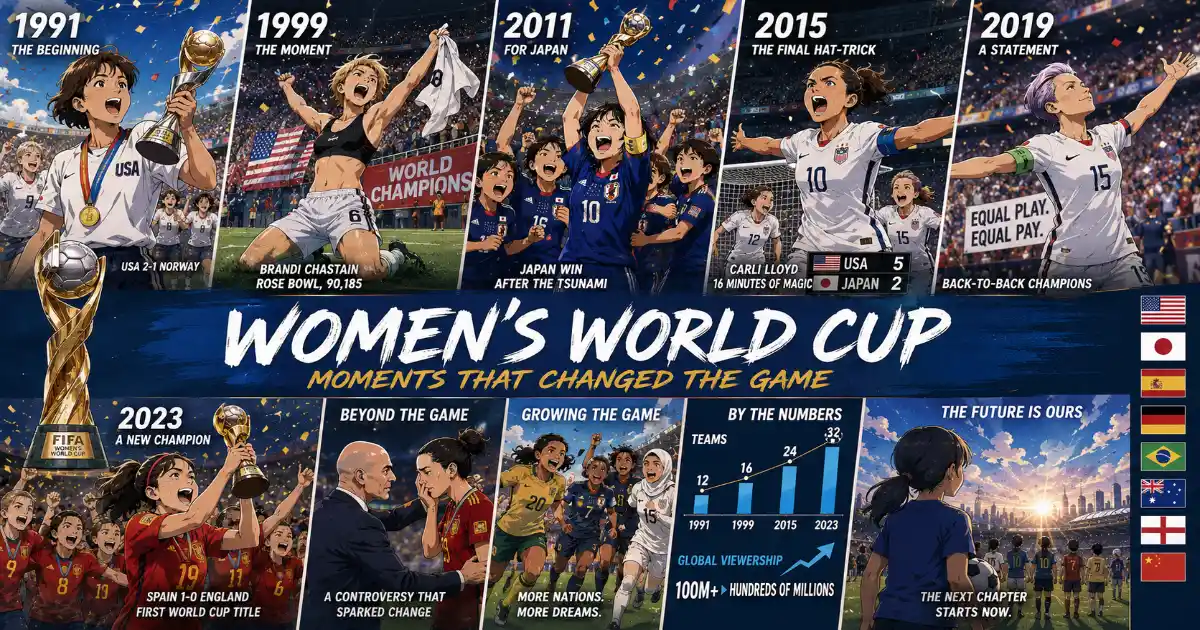
1991: The Tournament Begins in China
The very first Women’s World Cup, held in China in 1991, remains a landmark moment in its own right simply for existing at all, a genuine institutional commitment from FIFA to formalize a global women’s championship after decades in which the women’s game had received minimal organizational support or investment almost anywhere in the world. The United States won that inaugural tournament, defeating Norway 2-1 in the final, establishing the foundation for what would eventually become the sport’s most dominant women’s national program. The tournament’s relatively low profile at the time, played largely outside the global media spotlight that would eventually surround later editions, makes it easy to forget just how significant simply staging a genuine global women’s championship was for the sport’s broader development.
1999: The Shirt, the Shootout, and a Cultural Turning Point
No single moment in Women’s World Cup history carries more lasting cultural weight than Brandi Chastain’s game-winning penalty in the 1999 final against China, played in front of a sold-out Rose Bowl crowd of over 90,000 spectators, still among the largest attendances ever recorded for any women’s sporting event. Chastain’s decisive shootout conversion, followed by her spontaneous celebration removing her jersey and dropping to her knees in her sports bra, produced one of the most reproduced images in the history of women’s sports, appearing on the cover of Sports Illustrated and Newsweek simultaneously and instantly becoming shorthand for a broader cultural moment around women’s athletics in America.
Beyond the singular image itself, the entire 1999 tournament represented a genuine watershed moment for the sport’s visibility in the United States specifically, with matches drawing consistently massive crowds and television audiences that far exceeded anything American women’s soccer had previously achieved. The tournament’s success directly fueled the eventual, if initially short-lived, launch of the Women’s United Soccer Association professional league in 2001, and its cultural impact is still frequently cited by football historians as the single most consequential moment in growing the sport’s mainstream visibility in the United States.
2011: Japan’s Post-Tsunami Triumph
The 2011 Women’s World Cup final between Japan and the United States carried emotional weight extending well beyond the football itself. Just months after the devastating March 2011 earthquake and tsunami that killed nearly 20,000 people and triggered the Fukushima nuclear disaster, Japan’s national team arrived at the tournament as a source of genuine national inspiration for a country still processing the disaster’s enormous human and economic toll. Japan’s eventual penalty shootout victory over the United States, having twice come from behind in the match itself, delivered the nation’s first major senior international football title of any kind, men’s or women’s, and the team’s dedication of the victory to their country’s ongoing recovery effort turned the result into something considerably larger than a typical sporting achievement.
The tournament also introduced the world more broadly to Homare Sawa, whose five goals throughout the competition earned her both the tournament’s Golden Boot and its Golden Ball as best overall player, cementing her status as one of the most significant players in the history of Asian women’s football.
2015: Carli Lloyd’s Final Hat-Trick
The United States’ 2015 final victory over Japan produced one of the single greatest individual performances in either the men’s or women’s tournament’s history, when Carli Lloyd scored a hat-trick inside the match’s opening sixteen minutes, including an audacious, still-replayed strike from just past the halfway line that caught Japan’s goalkeeper well off her line. Lloyd’s opening-goal blitz effectively decided the final before it had barely begun, and her halfway-line finish in particular remains one of the most frequently cited individual goals in the tournament’s entire history, a moment of pure individual audacity delivered on football’s biggest women’s stage.
The victory also delivered the United States’ third World Cup title and first since that famous 1999 triumph, with the tournament as a whole drawing record-breaking American television audiences that suggested the sport’s domestic visibility, while never quite matching the men’s game’s mainstream reach, had grown into something considerably more consistent and durable than the single spike in interest generated back in 1999.
2019: Rapinoe’s Pose and the Equal Pay Fight
The United States’ back-to-back title defense at the 2019 tournament in France became inseparable from a broader cultural and political moment, with star player Megan Rapinoe’s now-iconic goal celebration pose, arms outstretched, chest forward, became one of the most recognizable images in the sport’s recent history, and her outspoken advocacy both on and off the pitch turned the tournament into a genuine platform for the ongoing US Soccer equal pay dispute between the men’s and women’s national team programs. That advocacy, combined with the team’s convincing on-field success, en route to a second consecutive title, helped accelerate a broader global conversation about pay equity and institutional investment in women’s football that extended well beyond the United States’ own specific legal dispute, influencing federations and domestic leagues across multiple countries to reassess their own approach to funding and promoting the women’s game.
The 2019 tournament also set new broadcast viewership records across multiple countries, with the final itself becoming the most-watched Women’s World Cup match in television history at the time, evidence of just how significantly the tournament’s global commercial and cultural reach had grown since the more modest broadcast footprint of the sport’s earlier editions.
2023: A First-Time Champion and a Difficult Aftermath
The 2023 tournament, co-hosted across Australia and New Zealand and expanded to 32 teams for the first time, produced a genuinely new champion, with Spain defeating England 1-0 in the final courtesy of a first-half goal from Olga Carmona, delivering the nation’s first-ever Women’s World Cup title and cementing the broader rise of Spanish women’s football following the domestic league’s own significant recent growth and investment. The tournament also featured several other historically significant storylines, including co-host nations Australia and New Zealand each recording milestone results in front of passionate home crowds, and Morocco becoming the first Arab nation to reach the tournament’s knockout stages in the country’s World Cup debut.
The tournament’s aftermath, however, became overshadowed by genuine controversy, when Spanish football federation president Luis Rubiales was filmed forcibly kissing player Jennifer Hermoso on the lips during the trophy presentation ceremony, an incident that triggered widespread public backlash, a prolonged institutional scandal within Spanish football, and Rubiales’s eventual resignation and subsequent legal prosecution. That controversy, unfolding directly alongside Spain’s historic first title, became its own significant chapter in the tournament’s broader history, a stark reminder that the fight for genuine institutional respect within women’s football remained far from fully resolved even as the sport’s on-field quality and commercial visibility continued to grow substantially.
The Growth in Numbers Across Three Decades
Tracing the tournament’s history from 1991 through 2023 also tells a clear numbers-driven story of growth. The competition expanded from twelve teams in its inaugural edition to sixteen by 1999, twenty-four by 2015, and finally thirty-two teams for the 2023 tournament, a format expansion that mirrors, with some delay, the men’s tournament’s own historical growth pattern. Broadcast audiences and overall commercial revenue have grown at an even steeper rate than the tournament’s raw team count, with 2023’s tournament drawing a cumulative global television audience estimated in the hundreds of millions, a figure that would have seemed entirely unimaginable to the organizers of that far more modest 1991 edition in China.
Why These Moments Matter Beyond the Football
What ties these landmark Women’s World Cup moments together isn’t simply their footballing significance, but how consistently each one has intersected with broader social and cultural conversations well beyond the sport itself. Chastain’s 1999 celebration became a genuine touchstone in conversations about women’s athletic visibility in American media. Japan’s 2011 triumph became inseparable from a national recovery narrative following genuine tragedy. Rapinoe’s 2019 advocacy became directly tied to ongoing legal and cultural battles over pay equity. And the Rubiales scandal following Spain’s 2023 triumph became a flashpoint in broader conversations about institutional accountability and player treatment within women’s football specifically. Few tournaments in any sport have managed to consistently generate moments carrying this much weight beyond the final scoreline, and that pattern is precisely what makes the Women’s World Cup’s history, despite still being a considerably younger competition than its men’s counterpart, feel every bit as culturally significant across its more than three decades of existence.
The Forgotten 1971 Tournament That Came Before
Any complete accounting of the Women’s World Cup’s greatest moments should acknowledge a tournament that technically predates FIFA’s own official 1991 competition by two full decades. An unofficial Women’s World Cup held in Mexico in 1971, organized outside FIFA’s sanctioning entirely, drew crowds exceeding 100,000 spectators for its final at Mexico City’s Estadio Azteca, numbers that would remain remarkable even by the standards of several subsequent officially sanctioned editions. That tournament, and its players, were largely erased from football’s official historical record for decades afterward, with FIFA itself actively discouraging women’s football competitions during this period, only regaining wider recognition in recent years through documentary films and renewed historical interest in the sport’s suppressed early history. Understanding that buried 1971 tournament adds important context to just how deliberately and consistently the women’s game was held back institutionally before FIFA’s eventual 1991 championship finally provided official recognition and a genuine pathway for the sport’s subsequent growth.
The Players Who Built the Tournament’s Legacy
Beyond the individual signature moments already covered, several players have left a lasting mark across multiple tournament cycles that deserves specific recognition. Marta, Brazil’s all-time leading scorer across both men’s and women’s World Cup competitions combined, appeared at five consecutive tournaments between 2003 and 2019, becoming the first player of either gender to score in five different World Cups and cementing her reputation as one of the most influential individual talents in the sport’s history, even without ever winning the tournament itself with Brazil. Abby Wambach’s aerial dominance and clutch late-tournament goals for the United States across multiple editions similarly built a legacy extending well beyond any single signature moment, contributing significantly to the American program’s sustained run of tournament success across nearly two decades.
More recently, players like Alexia Putellas and Aitana Bonmatí have become the individual faces of Spain’s rapid rise to the top of the women’s game, with Bonmatí in particular following up Spain’s historic 2023 title with continued individual recognition, including consecutive Ballon d’Or Féminin awards that reflected both her own individual brilliance and the broader institutional investment Spanish football has increasingly directed toward its women’s program in the years surrounding that landmark championship.
How Broadcast Coverage Transformed the Viewing Experience
The tournament’s broadcast evolution deserves its own mention among the competition’s most significant developments, even if it lacks a single iconic on-pitch moment of its own. Early tournaments in the 1990s received minimal live broadcast coverage in many countries, with highlights packages often standing in for the kind of comprehensive live match coverage that had long been standard for men’s international tournaments. By the 2019 and 2023 editions, however, full live broadcast coverage across dozens of countries, expanded pre and post-match analysis programming, and dedicated streaming platform coverage had become standard practice, a transformation that directly enabled moments like Rapinoe’s celebration or Carmona’s title-winning goal to reach truly global audiences in a way earlier tournament moments, however significant in retrospect, often couldn’t achieve in real time given the far more limited broadcast infrastructure surrounding the sport’s earlier editions.
Looking Toward the Tournament’s Continued Growth
With the Women’s World Cup continuing to expand its team count, broadcast reach, and overall commercial investment with each subsequent edition, the tournament’s list of defining moments seems certain to keep growing in the editions still ahead. Whatever specific goals, celebrations, or broader cultural flashpoints eventually join this list, the tournament’s history so far suggests a clear pattern: the Women’s World Cup’s most significant moments rarely stay confined to football alone, consistently intersecting with broader questions of visibility, equity, and institutional respect that extend well beyond any single match’s final scoreline.
That pattern shows no sign of changing as the tournament heads into its next several editions, with growing investment in domestic women’s leagues across Europe, expanding broadcast deals in previously underserved markets, and an increasingly deep global talent pool all suggesting the competition’s list of defining moments is likely to keep expanding just as rapidly as the sport itself continues to grow in the years and tournament cycles still ahead.
▪️▪️ Follow us on Facebook ▪️▪️
The History of Asian Teams at the Fifa World Cup — From South Korea 2002 to a Record 2026
Gianni Infantino’s World Cup Sell-Off Plan Collapses: Why FIFA’s Controversy Is Far From Over
About the Author