 Inside Aston Villa’s Stunning Europa League 2025-26 Triumph
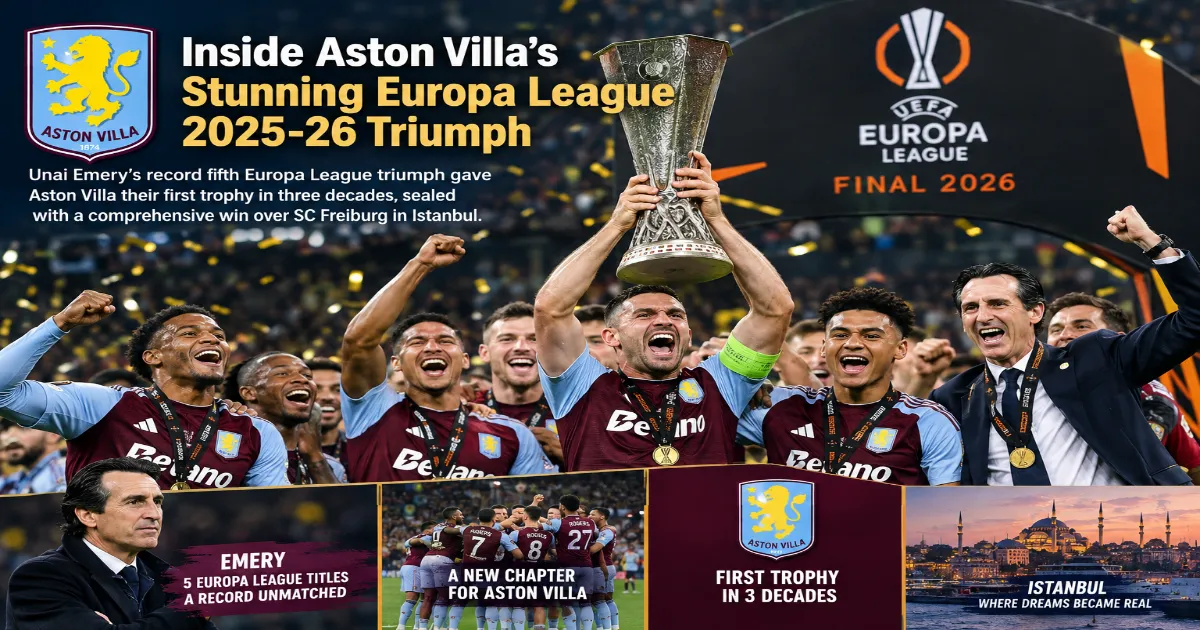
Unai Emery’s record fifth Europa League triumph gave Aston Villa their first trophy in three decades, sealed with a comprehensive win over SC Freiburg in Istanbul.
While the Champions League final in Budapest captured the bulk of the continent’s attention, the Europa League produced its own genuinely compelling story throughout the 2025-26 season, one that concluded with Aston Villa lifting the trophy for the first time in the club’s history, delivered by a manager chasing, and achieving, a genuinely unmatched personal record in the competition.
Manchester United’s 1999 Treble: The Greatest Season in English Football History
Top 5 Bundesliga Clubs by Trophy Count — All-Time League Title Rankings
From 1963 to Bayern’s 34th Title: The Full Bundesliga Story
Aston Villa’s Historic Triumph
Aston Villa’s 3-0 victory over SC Freiburg in the final at Istanbul’s Beşiktaş Stadium delivered the club’s first Europa League title and, remarkably, their first trophy of any kind in three decades. Goals from Youri Tielemans, Emiliano Buendía, and Morgan Rogers secured a comprehensive victory that reflected Villa’s overall dominance throughout the match, capping a European campaign that had begun with the club as a considerably less fancied entrant compared to several of the competition’s more traditionally decorated participants. The victory marked Villa’s second major European honor overall, following their famous 1982 European Cup triumph, and gave the club’s passionate fanbase a night of celebration that had been over three decades in the making.
Emery’s Record-Extending Achievement
For manager Unai Emery, the triumph delivered something no other manager in the competition’s history has ever achieved: a fifth Europa League title, extending his own already-record haul in the tournament across his lengthy managerial career. Emery’s specific tactical mastery of European knockout football, built on meticulous opposition scouting and disciplined defensive organization, has now delivered the trophy with multiple different clubs, cementing his reputation as arguably the finest manager in the competition’s modern history, a specialist whose Europa League record now stands entirely alone among his managerial peers.
McGinn’s Remarkable Journey
Few individual storylines from the final captured the spirit of Villa’s broader triumph quite like captain John McGinn’s own journey with the club. Having joined Aston Villa while the team was still playing in England’s second tier, McGinn’s growth alongside the club’s own rise back to Premier League relevance and now genuine European silverware embodied the kind of sustained, patient institutional progress that Villa’s ownership had been building toward across recent seasons. Though McGinn didn’t add to his own five-goal tally from earlier rounds during the final itself, his assist for Buendía’s goal and his overall leadership throughout the campaign made him one of the tournament’s most respected and recognizable figures.
The Player of the Tournament
Morgan Rogers’s individual excellence throughout the campaign, capped by his goal in the final itself, earned him recognition as the competition’s best player, a genuinely significant individual honor that reflected his growing importance to Villa’s overall attacking approach under Emery. That individual quality drew significant transfer interest in the months following the triumph, with Rogers eventually completing a British transfer record move to Chelsea that summer, a reminder of just how directly European success and individual tournament recognition can accelerate a player’s subsequent market value and career trajectory.
Freiburg’s Own Remarkable Run
While Aston Villa ultimately claimed the trophy, SC Freiburg’s own run to the final deserves genuine recognition in its own right, particularly given the club’s comparatively modest seventh-place finish in the Bundesliga that same season. Freiburg’s ability to significantly overperform their domestic league form in continental competition reflected a broader pattern that had become increasingly familiar for the club under their specific coaching setup, one capable of raising performance levels considerably for European occasions even during seasons when domestic league consistency proved harder to sustain. Freiburg’s Johan Manzambi was recognized as the tournament’s best young player, a significant individual honor that suggested the club’s continental run had helped accelerate at least one promising young talent’s broader development and visibility.
The Road to the Final
Both finalists navigated a demanding path to Istanbul under the competition’s current 36-team league-phase format, now in its second season of operation. Nottingham Forest’s own strong campaign, which saw Igor Jesus finish as one of the tournament’s joint-top scorers alongside Ludogorets Razgrad’s Petar Stanić, offered English football a further reminder of the Premier League’s growing depth extending well beyond its traditional top clubs, even as Forest ultimately fell short of reaching the final itself. Ludogorets Razgrad’s own surprising run further underlined the competition’s genuine capacity to produce unexpected individual and collective storylines from clubs outside Europe’s traditional footballing powers.
What the Trophy Meant for Villa’s Broader Trajectory
Villa’s Europa League triumph carries significance well beyond the immediate celebration, offering the club’s ownership and coaching staff concrete validation of a multi-year rebuilding project that had gradually restored the historic institution to genuine competitive relevance both domestically and in Europe. As Europa League champions, Villa automatically earned Champions League qualification for the following season, a considerable financial and competitive boost that gives the club genuine momentum heading into a new campaign, even as their status as reigning Europa League champions meant facing PSG in the 2026 UEFA Super Cup, a fixture that pitted Villa directly against the Champions League’s own reigning titleholders.
A Tournament With Its Own Genuine Prestige
The 2025-26 Europa League campaign, spanning 189 total matches and drawing a cumulative attendance of nearly five million spectators across the competition’s full run, reinforced the tournament’s own significant standing within European football’s broader competitive hierarchy, even as it inevitably operates in the shadow of the Champions League’s greater overall prestige and financial rewards. Villa’s triumph, delivered by a club with genuine historical pedigree but a considerably more modest recent trophy cabinet compared to Europe’s traditional super-clubs, offered exactly the kind of underdog storyline that has made the Europa League a genuinely compelling competition in its own right, one capable of delivering emotionally significant triumphs for clubs still building or rebuilding their way back toward the very top of the European game.
Looking Ahead
With Villa’s triumph elevating the club into Champions League contention and Emery’s record now standing as the clear benchmark for Europa League managerial excellence, the competition’s next chapter arrives with genuine anticipation about which club might next use the tournament as a platform for exactly the kind of transformative, institution-defining triumph that Aston Villa delivered in Istanbul, capping a campaign that gave English football two genuinely significant European trophies in the very same season.
Ollie Watkins and the Motivation Behind the Run
One of the more understated individual storylines behind Villa’s triumph involved striker Ollie Watkins, who entered the competition’s closing stages having been left out of England’s national team squad earlier in the year, a snub he publicly acknowledged had fueled his determination throughout the campaign’s business end. That personal motivation, combined with the broader squad’s collective hunger following years without major silverware, gave Villa’s European run an added emotional dimension that extended beyond simply Emery’s tactical organization or any single individual’s statistical output, reflecting a squad genuinely determined to prove doubters wrong across a demanding continental campaign.
How the Format Shaped Villa’s Path
Villa’s route to the final unfolded under the Europa League’s own version of the expanded 36-team league-phase format, first introduced the previous season, requiring the club to navigate eight league-phase matches before advancing through the knockout play-off round and subsequent traditional two-legged ties. That demanding structure, considerably more matches than the tournament’s older group-stage format required, tested Villa’s squad depth across a genuinely long European campaign layered on top of their domestic Premier League commitments, making Emery’s rotation management and squad-wide contribution, rather than reliance on a small core of first-choice players, an increasingly important factor in the club’s ability to sustain form deep into the tournament’s business end.
A Trophy Three Decades in the Making
For a club with Aston Villa’s considerable historical pedigree, including that famous 1982 European Cup triumph, going three decades without major silverware represented a genuinely significant drought relative to the institution’s own sense of its historical standing within English football. That context makes the specific manner of this triumph, delivered through Europe’s second-tier continental competition rather than the Premier League or Champions League itself, no less significant to a fanbase that had waited so long for any tangible reward for the club’s gradual, sustained rebuilding project under Emery’s specific management. If anything, the Europa League triumph’s arrival alongside genuine momentum toward sustained Champions League qualification suggests Villa’s broader institutional trajectory, rather than this specific trophy alone, may prove to be the more lasting legacy of this particular European campaign, one that Villa’s supporters, staff, and players will nonetheless continue celebrating as the moment their long wait for silverware finally, emphatically came to an end in Istanbul.
A Fitting Coda to a Remarkable Season
Taken together, the 2025-26 Europa League campaign offered exactly the kind of narrative richness that has increasingly defined the competition’s modern era: a historic club ending a genuine trophy drought, a manager cementing an unmatched personal record, a mid-table Bundesliga side overperforming spectacularly on the continental stage, and individual breakout performances that reshaped transfer market valuations within months of the final whistle. For a competition often discussed primarily in relation to the Champions League’s greater financial rewards, this season’s Europa League produced a story every bit as compelling as anything happening one tier above it in European club football’s hierarchy.
🔹🔹 Follow us on Facebook 🔹🔹
The 10 Best Bundesliga Players of All Time — A Definitive Ranking
About the Author