Top 5 Bundesliga Clubs by Trophy Count — All-Time League Title Rankings
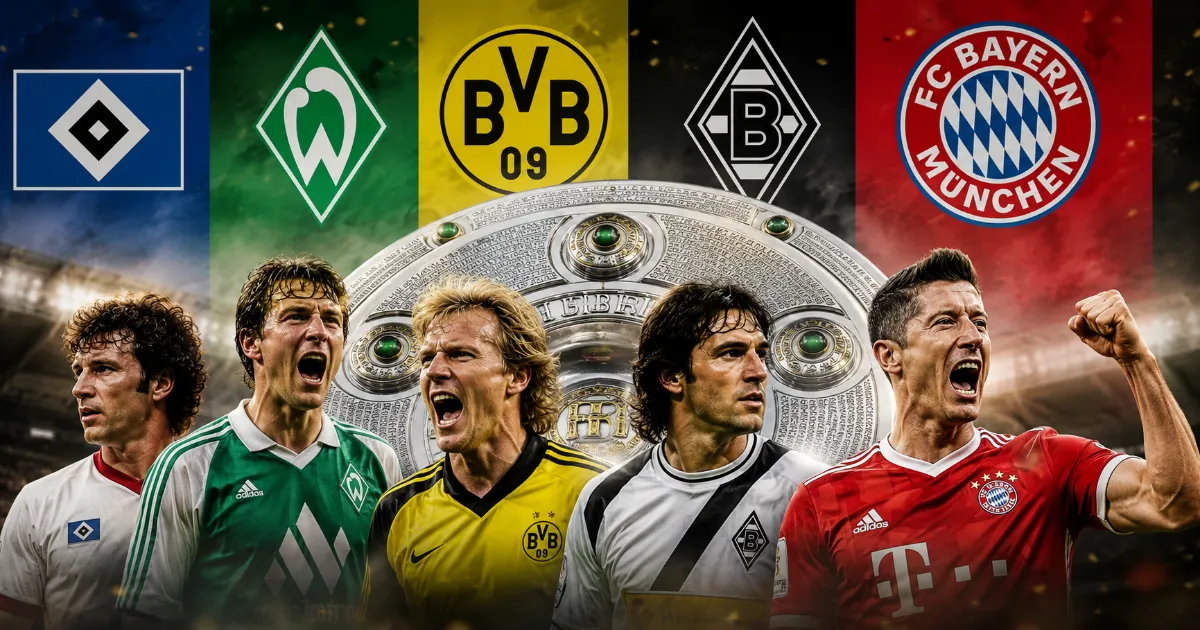 One club sits far ahead, while the battle for Bundesliga clubs by trophy count truly begins at second place.
More than sixty years into the Bundesliga’s history, the league’s all-time title table tells a story of one overwhelming institution and a genuinely competitive fight for the rest of the podium. Here’s a full ranking of the five most decorated clubs in Bundesliga history, judged purely by total league championships won since the competition’s 1963 founding.
The Top 10 Most Expensive Football Transfers in History
Messi Retires: Inside the Rise, Falls, and Redemption of a Legend
5. Hamburger SV — 3 Titles
Hamburger SV’s three Bundesliga championships, claimed in 1979, 1982, and 1983, came during one of the club’s genuine golden eras, built around the individual brilliance of Kevin Keegan and later Felix Magath’s tactical leadership on the pitch. That period also included the club’s sole European Cup triumph in 1983, cementing HSV’s status as one of German football’s most significant institutions during the early 1980s. Hamburg holds a unique distinction in Bundesliga history entirely separate from its title count: the club was the only ever-present member of the league from its 1963 founding through 2018, a remarkable 55-season unbroken run that finally ended with the club’s first-ever relegation, a fall from grace that stood in stark contrast to the sustained success of their earlier championship-winning era.
4. Werder Bremen — 4 Titles
Werder Bremen’s four Bundesliga championships, won in 1965, 1988, 1993, and 2004, span four distinct decades of the club’s history, reflecting a sustained, if not quite continuous, tradition of competitiveness at the top of German football. The club’s 2004 double-winning campaign under manager Thomas Schaaf, claiming both the Bundesliga and DFB-Pokal in the same season, remains the most recent and arguably most celebrated of Bremen’s championship triumphs, built around a talented squad that also reached the UEFA Cup final the following season. Bremen’s periodic ability to break through against considerably wealthier rivals across such a wide historical span reflects a genuine tradition of smart recruitment and tactical coaching that has kept the club competitive even during eras when its overall financial resources lagged well behind the league’s biggest spenders.
3. Borussia Dortmund — 5 Titles
Dortmund’s five Bundesliga championships, won in 1995, 1996, 2002, 2011, and 2012, reflect two genuinely distinct periods of club success separated by nearly a decade. The club’s mid-1990s titles, capped by a Champions League triumph in 1997, established Dortmund as one of European football’s genuine powers during that specific window, before financial difficulties in the early 2000s nearly pushed the club to the brink of bankruptcy entirely. Dortmund’s remarkable recovery under manager Jürgen Klopp, culminating in back-to-back titles in 2011 and 2012 built around a thrilling, high-pressing style of football and a squad featuring Mario Götze, Robert Lewandowski, and Marco Reus, remains one of the most celebrated rebuilding stories in modern Bundesliga history, restoring the club to genuine championship contention after years of financial peril.
Football’s Greatest Transfers of All Time: From Pele to Neymar to Mbappe
More Than a Footballer: How David Beckham Built a Global Brand That Will Outlast His Career
2. Borussia Mönchengladbach — 5 Titles
Gladbach’s own five Bundesliga titles, won across a remarkable run between 1970 and 1977, represent one of the most concentrated periods of sustained excellence anywhere in the league’s history, a genuine rival dynasty to Bayern Munich’s own simultaneous rise during that same decade. Built around the individual brilliance of players like Günter Netzer and later Berti Vogts, Gladbach’s attacking, fast-paced style during this era stood in direct stylistic contrast to Bayern’s more clinically efficient approach, and the rivalry between the two clubs throughout the 1970s remains one of the most celebrated head-to-head periods in Bundesliga history. Gladbach’s title count has remained unchanged since that remarkable decade, a reflection of the considerable financial gap that has opened up between the club and the Bundesliga’s wealthiest modern institutions in the decades since, even as Gladbach has remained a regular top-flight presence and occasional European qualifier.
1. Bayern Munich — 34 Titles
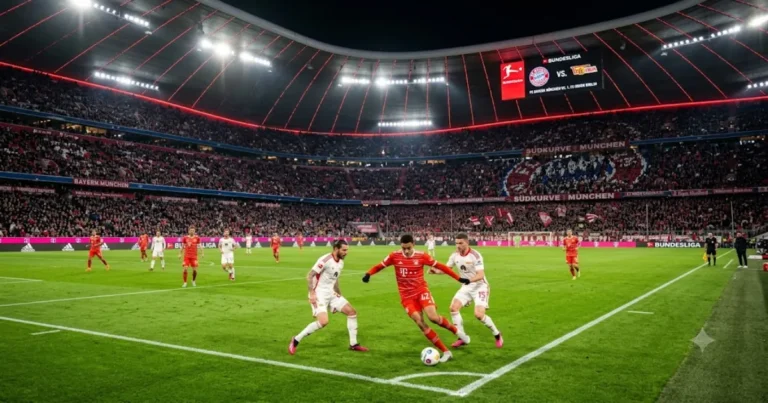
No ranking of Bundesliga trophy counts requires much suspense at the very top. Bayern Munich’s 34 league championships dwarf every other club’s total by a considerable margin, more than six times the tally of the clubs tied for second place, a gap that reflects the club’s sustained financial and structural dominance across nearly the entire history of the competition. Bayern’s title-winning eras span multiple distinct generations of players and managers, from Franz Beckenbauer and Gerd Müller’s foundational 1970s dynasty through to the modern era’s sustained dominance under a succession of managers including Pep Guardiola, Jupp Heynckes, and Vincent Kompany, each adding further championships to an already overwhelming historical tally.
What makes Bayern’s dominance particularly striking is how consistently it has continued even through the league’s supposedly more competitive modern era, with the club claiming eleven consecutive titles between 2013 and 2023 before Bayer Leverkusen’s brief, historic interruption, only for Bayern to immediately reclaim the championship the following season and again the season after that. That level of sustained excellence across six full decades makes Bayern Munich not just the most decorated club in Bundesliga history, but arguably one of the most dominant single institutions in any major European domestic league’s entire history.
The Clubs Just Outside the Top Five
Several other institutions deserve mention just below this top-five ranking. VfB Stuttgart’s three Bundesliga titles, won in 1984, 1992, and 2007, place the club just behind Hamburg on pure title count, while 1. FC Köln’s two championships include the distinction of being the league’s very first-ever champion back in the inaugural 1963-64 season. 1. FC Kaiserslautern’s own two titles, including a remarkable 1998 championship won immediately following the club’s promotion back to the Bundesliga the previous season, remains one of the most improbable title triumphs in the league’s history, a genuine underdog story that stands in sharp contrast to the far more predictable, resource-driven dominance that has defined most of the rest of this list.
Why the Gap at the Top Keeps Growing
Looking at this ranking as a whole, the most striking pattern isn’t simply Bayern’s position at number one, but how dramatically the gap between Bayern and every other club has widened in the decades since Gladbach and Dortmund’s respective championship-winning eras concluded. Modern football’s growing financial stratification, driven substantially by Champions League revenue and global commercial deals that overwhelmingly favor a small handful of Europe’s biggest brands, has made it considerably more difficult for clubs like Gladbach or even Dortmund to sustain the kind of multi-season title challenges that briefly disrupted Bayern’s dominance during earlier, less financially unequal eras of Bundesliga history.
That structural reality makes Leverkusen’s own historic, if ultimately brief, title triumph in 2023-24 all the more remarkable in hindsight, a genuine disruption to a title table that has otherwise increasingly calcified around Bayern’s overwhelming and still-growing advantage. Whether any current Bundesliga club can mount the kind of sustained, multi-season challenge needed to meaningfully add to this ranking’s lower positions in the years ahead remains one of German football’s most persistent open questions, one that Bayern’s continued financial and squad-depth dominance makes increasingly difficult to answer with genuine optimism for any of their domestic rivals.
How Title Counts Compare to Overall German Championships
It’s worth noting that this ranking specifically measures titles won since the Bundesliga’s 1963 founding, rather than each club’s total German championship count across the sport’s full history, since several clubs won national titles under the earlier, regionally fragmented league structure that predated the Bundesliga’s unified format. Bayern’s own total climbs even higher once those pre-Bundesliga championships are factored in, while several other historically significant German clubs, including 1. FC Nürnberg, hold considerably more pre-Bundesliga championships than their relatively modest Bundesliga-era title counts might otherwise suggest, a reminder that German football’s competitive landscape looked considerably different before the league’s 1963 unification reshaped the sport’s domestic structure entirely.
From 1963 to Bayern’s 34th Title: The Full Bundesliga Story
LaLiga 2026/27 Schedule: Fixtures, Dates & Times
What This Ranking Reveals About Bundesliga History
Taken together, this list tells a clear story about how German football’s competitive balance has shifted across six decades. The 1970s produced genuine, sustained rivalry at the top of the table, with Gladbach and Bayern trading championships across nearly the entire decade. The 1980s and early 1990s saw a broader spread of champions, including Hamburg, Stuttgart, and Bremen all securing titles during genuinely competitive periods for the league as a whole. But the modern era, roughly the past two decades, has increasingly consolidated around Bayern’s near-total dominance, broken only rarely and briefly by clubs like Dortmund under Klopp or Leverkusen under Xabi Alonso, each of whom needed an exceptional, once-in-a-generation combination of tactical innovation and squad development just to interrupt Bayern’s grip on the championship for a single season or two before the usual pattern reasserted itself. That trajectory, from genuine multi-club competition toward increasingly entrenched single-club dominance, mirrors broader trends playing out across several of Europe’s major domestic leagues, even if few have concentrated quite as completely around one single institution as the Bundesliga has around Bayern Munich.
🔹🔹 Follow us on Facebook 🔹🔹
Manchester United’s 1999 Treble: The Greatest Season in English Football History
Football History’s Most Unforgettable Women’s World Cup Moments
About the Author