 Goals, Records and Trophies: Celebrating the Best Bundesliga Players of All Time
From Gerd Müller’s still-unbroken goalscoring records to Robert Lewandowski’s modern dominance, these are the players who defined the Bundesliga.
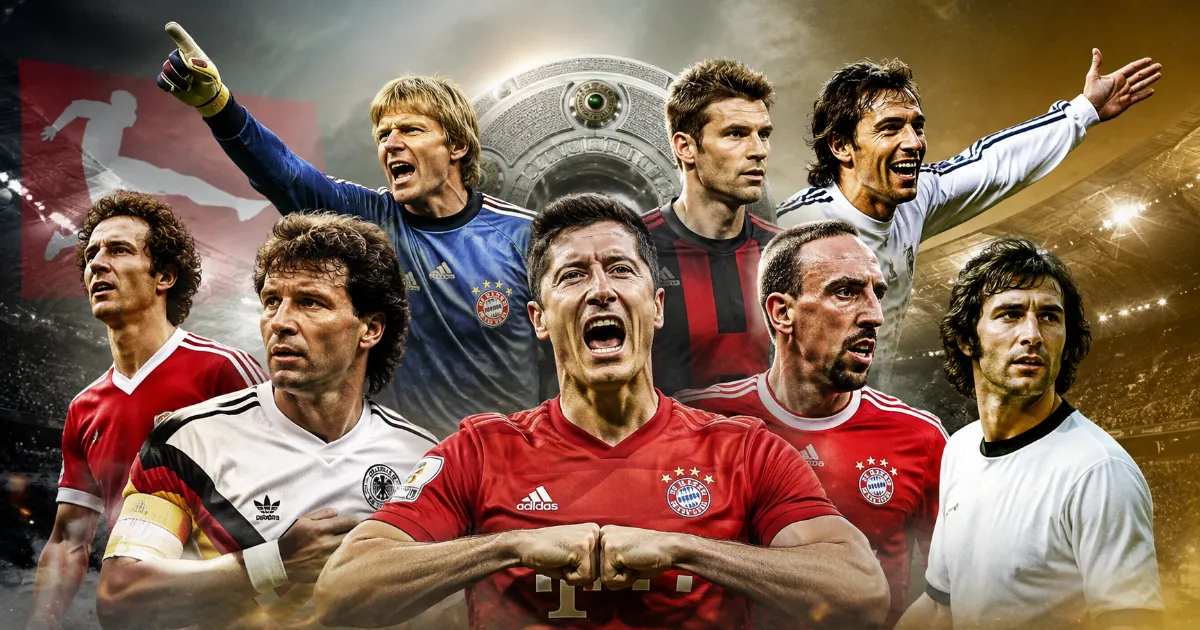
More than sixty years into its history, the Bundesliga has produced a genuinely extraordinary roll call of individual talent, from the sweeper-turned-icon who redefined defensive play to the modern-era striker whose scoring records once seemed permanently untouchable before finally falling. Here’s a ranking of the ten greatest players in Bundesliga history, judged on peak individual dominance and lasting influence on the league itself.
La Liga History 1929: From Franco’s Spain to the Era of Messi vs Ronaldo
Messi Retires: Inside the Rise, Falls, and Redemption of a Legend
10. Manfred Kaltz
A defensive pioneer for Hamburger SV throughout the 1970s and 1980s, Kaltz is widely credited with popularizing the “banana kick,” a heavily curled cross technique that became one of his signature contributions to the sport. His sustained excellence at right-back across more than two decades, combined with genuine attacking output rare for a defender of his era, makes him one of the most influential defensive players the league has produced.
9. Oliver Kahn
Bayern Munich’s imposing, fiercely competitive goalkeeper redefined what elite shot-stopping could look like during his prime years through the late 1990s and early 2000s, combining physical dominance with a level of vocal, aggressive leadership that made him one of the most intimidating presences in the league. Kahn’s numerous Bundesliga titles and his individual reputation as arguably the finest goalkeeper of his generation secure his place among the league’s true legends.
8. Michael Ballack
Ballack’s combination of physical power, technical quality, and genuine goalscoring output from midfield made him one of the most complete players the Bundesliga produced during the 2000s, starring for both Bayer Leverkusen and Bayern Munich before his eventual move to Chelsea. His near-miss 2002 season with Leverkusen, finishing runner-up in the Bundesliga, DFB-Pokal, and Champions League all in the same campaign, remains one of the most heartbreaking individual seasons in German football history, even as it cemented his status as one of the league’s most talented midfielders of his generation.
7. Franck Ribéry
Alongside Arjen Robben, Ribéry formed one of the most feared wide attacking partnerships in modern Bundesliga history, terrorizing defenses for Bayern Munich throughout the 2010s with his explosive dribbling and end product from the left flank. His individual brilliance during Bayern’s 2013 treble-winning season, in particular, remains one of the finest sustained individual campaigns any Bundesliga player has produced, and his sheer longevity at the top level across more than a decade in Munich further cements his standing among the league’s greatest ever players.
6. Jürgen Klinsmann
Klinsmann’s combination of clinical finishing and relentless work rate made him one of the most complete strikers of his generation, starring for Bayern Munich and VfB Stuttgart across a career that also included spells in Italy and England. His ability to consistently deliver in the biggest matches, combined with his subsequent influence as a manager both in Germany and internationally, gives Klinsmann a legacy extending well beyond his considerable playing statistics alone.
5. Thomas Müller
Few players have combined individual statistical output with genuine tactical uniqueness quite like Thomas Müller, whose self-described “Raumdeuter,” or “space investigator,” playing style defied conventional positional categorization throughout his lengthy Bayern Munich career. Müller’s remarkable consistency, sustained excellence across well over a decade at the highest level, and his role in nearly every major trophy Bayern has won during that stretch, including the 2013 and 2020 treble-winning campaigns, make him one of the most statistically and tactically significant players the league has ever produced.
4. Lothar Matthäus
Matthäus’s combination of box-to-box athleticism, leadership, and long-range shooting ability made him one of the most complete midfielders in Bundesliga history, starring for both Borussia Mönchengladbach and Bayern Munich across a career that also included a hugely influential spell in Italy with Inter Milan. His role as captain of West Germany’s 1990 World Cup-winning squad further cemented his status as one of German football’s most decorated and respected figures, a legacy that began and repeatedly returned to his sustained Bundesliga excellence.
3. Karl-Heinz Rummenigge
Rummenigge’s blistering pace and clinical finishing made him one of the most feared strikers in Europe during his prime years with Bayern Munich in the late 1970s and early 1980s, winning back-to-back Ballon d’Or awards in 1980 and 1981 while leading Bayern to multiple Bundesliga titles. His subsequent influence as a football executive, including a lengthy tenure as Bayern’s chairman, further extended his impact on the club and league well beyond his playing career.
2. Franz Beckenbauer
“Der Kaiser” fundamentally redefined what a defender could contribute to a team, pioneering the attacking sweeper role, or libero, that allowed him to combine defensive responsibility with genuine creative and goalscoring influence from deep positions, a tactical innovation that influenced generations of defenders who followed. Beckenbauer’s sustained excellence for Bayern Munich throughout the club’s first great era of Bundesliga and European dominance in the 1970s, combined with his subsequent success as West Germany’s 1990 World Cup-winning manager, makes him one of the most influential figures in the sport’s broader history, not just the Bundesliga’s.
1. Gerd Müller
Nobody has scored goals in the Bundesliga quite like Gerd Müller. His record of 365 career Bundesliga goals stood untouched for decades and remains one of the most extraordinary individual achievements in the league’s history, a tally built on Müller’s uncanny instinct for finding space inside the penalty area and a finishing ability that earned him the nickname “Der Bomber der Nation,” the nation’s bomber. His single-season record of 40 goals during the 1971-72 campaign stood as the Bundesliga benchmark for over four decades before finally being broken, a testament to just how far ahead of his era Müller’s goalscoring output genuinely was. Combined with his central role in Bayern Munich’s first great European dynasty and West Germany’s 1974 World Cup triumph, Müller’s case as the greatest player in Bundesliga history remains essentially unmatched.
The Modern Challenger: Robert Lewandowski
While he narrowly misses this specific top ten given the comparatively brief window since his Bundesliga departure, Robert Lewandowski’s individual scoring record deserves significant acknowledgment in any broader conversation about the league’s greatest talents. His 41-goal 2020-21 season broke Müller’s single-season record that had stood since 1972, and his sustained goalscoring output across nearly a decade at Bayern Munich places him among the most statistically dominant strikers the league has ever produced, even if the full weight of his eventual historical standing will likely continue to be debated for years to come as more time passes since his own Bundesliga career concluded.
Why These Rankings Are Never Truly Settled
Comparing players across different eras of Bundesliga history inevitably involves genuine subjectivity, since the league’s tactical style, physical demands, and overall competitive depth have shifted considerably across six decades. Müller’s goalscoring numbers were compiled in a considerably more open, less tactically structured era than the one Lewandowski or Müller’s modern namesake, Thomas Müller, played in decades later, while Beckenbauer’s positional innovations reshaped the very tactical vocabulary later generations of defenders would be judged against entirely. That inherent difficulty in cross-era comparison is precisely what keeps rankings like this one a permanent source of debate among German football fans, even as certain names, Gerd Müller and Beckenbauer chief among them, remain close to unanimous choices near the very top of any serious list.
Honorable Mentions Worth Remembering
Several other names deserve at least a passing mention in any complete accounting of Bundesliga greatness. Uwe Seeler, though his career predates the Bundesliga’s own founding for its earlier stretch, became one of the competition’s first genuine stars once the league launched in 1963, remaining loyal to Hamburger SV throughout a career in which he could easily have commanded a lucrative move abroad. Arjen Robben, Ribéry’s longtime attacking partner at Bayern Munich, produced his own genuinely era-defining highlight reel of cut-inside finishes from the right flank, and his decisive goal in the 2013 Champions League final against Borussia Dortmund remains one of the most significant individual moments in the club’s modern history. Marco Reus, despite a career frequently interrupted by injury, produced enough moments of individual brilliance for Borussia Dortmund across more than a decade to remain one of the most beloved players in the club’s history, even without matching the sheer trophy count of several other names on this list.
What Separates the Very Best From the Merely Great
Looking across this list, the players who rise to the very top share a specific combination of qualities: statistical dominance so complete it reshaped expectations for their position, sustained excellence across multiple seasons rather than a single standout campaign, and a genuine influence on how the sport itself came to be played or understood. Beckenbauer didn’t just excel as a defender, he redefined what the position could mean tactically. Müller didn’t just score goals, he set a scoring standard that took nearly half a century for anyone else to seriously challenge. That combination of individual brilliance and lasting structural influence on the sport is ultimately what separates a genuine Bundesliga legend from simply a very good player who happened to enjoy a strong run of form, and it’s the standard against which every future contender for this list, Lewandowski included, will inevitably continue to be measured.
The MLS Salary Cap Explained: Designated Players, TAM, and Roster Rules
Manchester United’s 1999 Treble: The Greatest Season in English Football History
🔹🔹 Follow us on Facebook 🔹🔹
About the Author