 One free kick against France in 1997 remains so improbable that physicists still use it to teach the Magnus effect decades later.
Some goals are remembered for their importance. Roberto Carlos’s most famous strike is remembered because, for a moment, it genuinely looked like it might be breaking the laws of physics. That single free kick against France in 1997 has become such a permanent fixture of football’s cultural memory that it occasionally overshadows the reality that Roberto Carlos built one of the most decorated and genuinely transformative careers any full-back has ever produced.
From Modest Beginnings to Palmeiras
Roberto Carlos da Silva Rocha grew up in a poor family in rural São Paulo state, his path to professional football considerably less privileged than many of the Brazilian stars who would later become his teammates. He began his senior career at Palmeiras, where his combination of blistering pace, physical power, and an increasingly obvious eye for attacking play from a defensive position quickly marked him out as one of the most exciting young full-backs in Brazilian football, even as his defensive positioning remained, at this early stage of his career, a genuine work in progress that would need considerable refinement before he reached his ultimate ceiling as a player.
A Difficult Detour to Inter Milan
Roberto Carlos’s first move to European football, joining Inter Milan in 1995, proved to be a rare setback in an otherwise remarkably successful career trajectory. Deployed within a rigid Italian tactical system that offered him considerably less license to attack than his game demanded, and playing under a manager who reportedly grew frustrated with his defensive lapses, Roberto Carlos’s single season in Italy produced little of the individual brilliance that had marked him out in Brazil. That difficult spell, while brief, offered an important lesson about tactical fit that would directly inform the next, far more successful chapter of his career.
Real Madrid: Finding the Perfect System
Roberto Carlos’s 1996 move to Real Madrid proved to be the transformative decision that unlocked his full potential. Given considerably more license to attack down the left flank within Real Madrid’s more expansive tactical system, Roberto Carlos rapidly established himself as arguably the most complete attacking full-back in world football, combining his extraordinary pace and physical power with genuinely dangerous crossing and shooting ability that made him a consistent attacking threat rather than simply a defensive player who occasionally ventured forward.
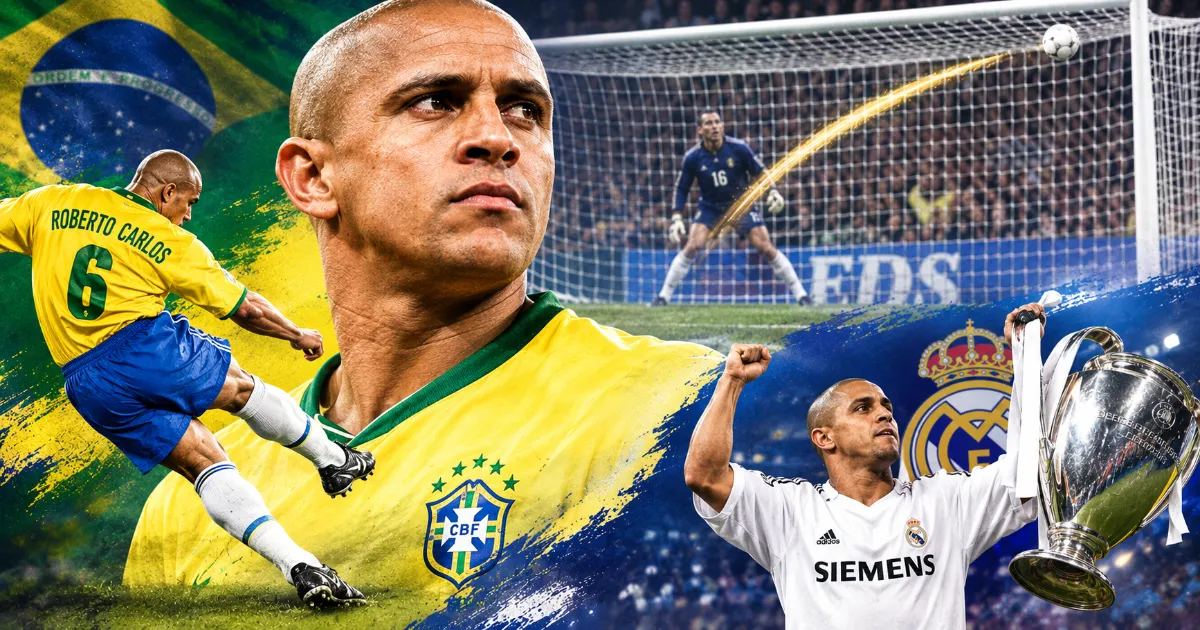
Across his eleven seasons at the club, Roberto Carlos won four La Liga titles and three Champions League trophies, becoming a central figure in the club’s famous “Galácticos” era alongside teammates like Zinedine Zidane, Luís Figo, Ronaldo, and David Beckham. His sustained excellence throughout this period, even as Real Madrid’s star-studded squad rotated through numerous different attacking talents, made him one of the most consistent and reliable figures in the club’s entire modern history, a defensive player whose individual attacking output frequently matched or exceeded that of several of his more attack-minded teammates.
The Free Kick That Defied Physics
No single moment in Roberto Carlos’s career, or arguably in the entire history of the free kick as a footballing weapon, carries quite the same lasting fame as his strike for Brazil against France at the 1997 Tournoi de France. Standing roughly 35 yards from goal at a seemingly impossible angle, Roberto Carlos struck the ball with such extreme pace and sidespin that it appeared to be sailing several yards wide of the goal entirely, so far off target that French goalkeeper Fabien Barthez didn’t even move to make a save, before the ball curved violently back at the very last instant and struck the inside of the post on its way into the net.
The physics behind the goal, now widely explained through the Magnus effect, the same aerodynamic principle that causes a spinning baseball or golf ball to curve, became a genuine subject of academic study in the years that followed, with physicists using footage of the goal to help explain principles of fluid dynamics and spin-induced trajectory changes to students who had never watched a football match in their lives. The strike remains, more than a quarter-century later, one of the most replayed and analyzed individual goals in football history, a moment so visually improbable that it transcended the sport itself to become a genuine piece of popular science culture.
World Cup Glory
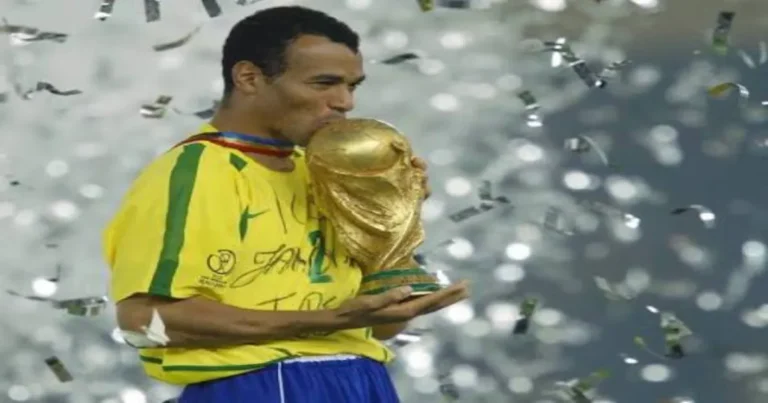
Beyond his free-kick fame, Roberto Carlos’s international career delivered genuine team success as well, forming part of Brazil’s victorious 2002 World Cup squad, the tournament that delivered the country’s fifth title. His attacking contributions from left-back throughout that campaign reflected the same qualities that had made him so effective at club level, combining defensive responsibility with a genuine attacking threat that few opposing teams were fully equipped to handle. His international career also included participation in Brazil’s runner-up campaign at the 1998 World Cup, giving him a genuinely significant body of major tournament experience across multiple World Cup cycles.
Redefining the Full-Back Position
Roberto Carlos’s broader legacy extends well beyond his individual goals and trophies, reshaping expectations for what a full-back could contribute to a team’s overall attacking output. Before his emergence, full-backs were generally viewed as primarily defensive players who occasionally supported attacking play, rather than genuine attacking weapons capable of consistently contributing goals and assists at an elite level. Roberto Carlos’s combination of genuine defensive responsibility with sustained, high-level attacking output helped establish a new template for the position, one that subsequent generations of attacking full-backs, from Dani Alves to Marcelo, his own eventual Real Madrid successor, would go on to build upon and further develop throughout the following decades.
Life After Real Madrid
Roberto Carlos’s departure from Real Madrid in 2007 began a more nomadic later career chapter, with spells at Fenerbahçe in Turkey and later Anzhi Makhachkala in Russia, where his continued individual quality and considerable star power helped raise the profile of a club still working to establish itself within Russian football’s competitive landscape. These later career stops, while considerably less prestigious than his Real Madrid peak, demonstrated that his underlying footballing gifts remained genuinely effective well into his late thirties, a testament to the sheer physical conditioning and natural athleticism that had defined his entire career.
A Career in Coaching and Ambassadorial Roles
Following his retirement from playing, Roberto Carlos moved into various coaching and club ambassadorial roles, including a stint in Russian football management and continued involvement with Real Madrid in various capacities. His genuine warmth and popularity among fans, built across more than a decade of consistent excellence at the Santiago Bernabéu, has ensured he remains one of the club’s most beloved historical figures, frequently making appearances at official club functions and continuing to serve as a genuine ambassador for the institution that defined the peak years of his playing career.
Why His Legacy Endures
More than two decades after his individual peak, Roberto Carlos’s case as one of the finest full-backs in football history remains built on a genuinely rare combination of factors: sustained trophy-winning success at one of the world’s biggest clubs, genuine international glory with Brazil’s 2002 World Cup-winning squad, and a single individual moment of such visually improbable brilliance that it transcended football entirely to become a piece of broader popular science culture. Few defenders in the sport’s history can claim to have fundamentally reshaped expectations for their position while also producing arguably the single most physically improbable goal ever scored, a combination that places Roberto Carlos in a genuinely unique position within football’s broader pantheon of legendary figures.
The Physical Gifts Behind the Legend
Understanding Roberto Carlos’s specific brand of footballing brilliance requires appreciating just how genuinely exceptional his underlying physical attributes actually were. Standing relatively short by professional footballing standards, he compensated with an extraordinary combination of raw power, explosive acceleration, and a shot that regularly registered among the hardest strikes recorded in professional football, with some measurements from his playing peak clocking his free kicks at speeds exceeding 100 miles per hour. That combination of pace and power, built through a genuinely rigorous approach to physical conditioning throughout his career, gave him the specific tools needed to execute the kind of extreme-spin, high-velocity strikes that made his free kicks so uniquely dangerous compared to those of virtually any of his defensive contemporaries.
A Legacy Measured Beyond Trophies
While Roberto Carlos’s trophy collection, spanning multiple La Liga titles, three Champions League triumphs, and a World Cup winner’s medal, would alone secure his place among football’s most decorated defenders, his broader cultural impact extends considerably further. His specific free-kick technique has been studied and imitated by generations of subsequent players hoping to replicate even a fraction of his most famous strike’s visual drama, and his overall approach to the full-back position, treating defensive responsibility and attacking contribution as equally important rather than viewing one as subordinate to the other, helped fundamentally reshape how the position has been coached and valued across the decades since his own playing peak.
Comparing Him to Today’s Attacking Full-Backs
Modern football’s tactical evolution has produced an entire generation of attacking full-backs whose games owe a direct debt to the template Roberto Carlos helped establish decades earlier. Players celebrated for combining defensive solidity with genuine goal contribution, from Trent Alexander-Arnold’s creative passing range to Achraf Hakimi’s explosive forward runs, operate within a tactical framework that treats attacking full-back play as an entirely normal, even essential, component of a modern system, a stark contrast to the more purely defensive expectations placed on the position before Roberto Carlos’s own emergence. Football analysts frequently trace this broader tactical shift directly back to the specific example Roberto Carlos set during his Real Madrid peak, when his sustained ability to contribute genuine attacking end product from a nominally defensive position first forced coaches and pundits across the sport to fundamentally reconsider what should reasonably be expected from a full-back at the very highest level.
A Single Kick, an Entire Legacy
For a player whose career will forever be most associated with a single, physics-defying moment against France in 1997, Roberto Carlos’s broader legacy as one of the most complete and genuinely transformative full-backs the sport has ever produced remains every bit as significant as that single unforgettable strike. The goal itself, endlessly replayed and analyzed by scientists and football fans alike, functions almost as a perfect symbol for his entire career: a moment so visually spectacular that it could easily stand alone as a complete legacy in its own right, yet representing just one remarkable highlight within a broader body of work spanning multiple league titles, Champions League triumphs, and a World Cup winner’s medal earned across more than a decade of sustained, genuinely transformative excellence at the very highest level of the sport.
The Galácticos Era and His Unique Role Within It
Roberto Carlos’s place within Real Madrid’s famous Galácticos era deserves particular attention, since he occupied a genuinely unusual position within a squad otherwise built almost entirely around marquee, headline-grabbing individual signings. While club president Florentino Pérez pursued one global superstar after another, Zidane, Figo, Ronaldo, Beckham, and eventually Owen, Roberto Carlos remained a holdover from an earlier Real Madrid era, having joined the club well before the Galácticos project fully took shape. That he not only survived but continued to thrive as arguably the most consistently excellent individual performer across that entire star-studded period speaks to just how genuinely elite his own individual quality actually was, holding his own defensive and attacking responsibilities at the highest possible standard even while surrounded by some of the most famous attacking talents the sport has ever assembled in a single squad.
Teaching a New Generation
In the years since his retirement, Roberto Carlos has taken an active interest in passing on his specific technical knowledge to younger players, participating in coaching clinics and technical demonstrations focused specifically on free-kick technique and full-back positioning. His willingness to break down the specific mechanics behind his most famous strikes, the exact contact point, the follow-through, the deliberate use of extreme sidespin, has offered aspiring young players a genuine technical roadmap for attempting to replicate at least elements of his signature style, even if few have ever managed to combine his specific blend of raw power and technical precision quite as completely as he did during his own playing peak.
An Icon Recognized Across Generations
Even among football fans too young to have watched his Real Madrid career live, Roberto Carlos’s name and his most famous goal remain instantly recognizable, kept alive through countless highlight compilations, social media clips, and the continued academic use of his free kick as a teaching tool for basic principles of aerodynamics. That kind of sustained cross-generational recognition, spanning both football’s own institutional memory and the broader popular science culture that continues referencing his most famous strike, ensures Roberto Carlos’s legacy remains genuinely alive and actively discussed decades after his playing career reached its conclusion, a rare achievement for any athlete regardless of sport, and one that ensures the phrase “Roberto Carlos free kick” will likely remain shorthand for footballing physics-defiance for as long as the sport itself continues to be played and discussed.
🔹🔹 Follow us on Facebook 🔹🔹
Serie A 2025-26 Season in Review: Inter’s Redemption, Milan’s Collapse
13 Best Korean Dramas Ever Made — From Romance to Revenge Thriller
About the Author