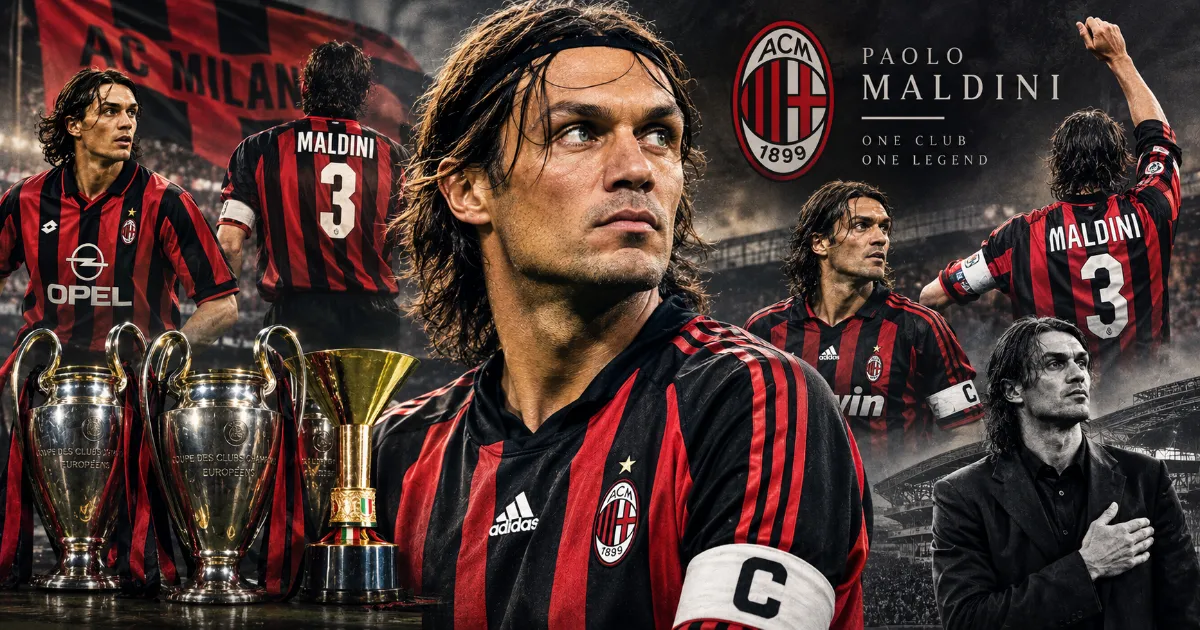
 Twenty-five years, one club, seven Serie A titles, and five European Cups: the complete story of the man many still call the greatest defender ever to play the game.
Twenty-five years. One club. Seven Serie A titles and five European Cups or Champions League triumphs. Paolo Maldini’s career reads less like a typical football biography and more like a description of an entire footballing institution, so completely was his identity intertwined with AC Milan across a quarter-century that fundamentally reshaped what football fans and pundits believed a single defender could achieve, both in terms of sustained excellence and sheer longevity at the very highest level.
Messi Retires: Inside the Rise, Falls, and Redemption of a Legend
The Fastest NBA Players Ever, Ranked
Born Into Milan Royalty
Maldini’s connection to AC Milan began before he was even born, with his father Cesare Maldini having captained the club to European Cup glory in 1963 before later managing the Italian national team. That family lineage gave Paolo a genuinely unique introduction to the club, growing up around Milan’s training facilities and first-team environment in a way few other young players could ever replicate. He made his senior debut for Milan as a sixteen-year-old in 1985, an almost unthinkably early start to a first-team career that would go on to span an entire generation of Italian and European football.
The Sacchi Revolution
Maldini’s development as a player coincided with one of the most tactically revolutionary periods in football history, as manager Arrigo Sacchi transformed AC Milan into a genuinely dominant European force built around coordinated zonal marking, aggressive collective pressing, and a defensive line that operated with unprecedented tactical cohesion. Maldini, initially deployed at right-back before eventually settling into his more iconic left-back and later central defensive roles, became a foundational figure within Sacchi’s system, his positional intelligence and tactical discipline embodying exactly the kind of collectively organized defending that Sacchi’s revolutionary approach demanded. Milan’s back-to-back European Cup triumphs in 1989 and 1990 under Sacchi gave the young Maldini his first taste of continental glory, cementing his place within a Milan side widely regarded as one of the most tactically influential club teams in the sport’s entire history.
Sustained Excellence Under Capello
Maldini’s development continued under Sacchi’s successor Fabio Capello, whose own tactical approach, while distinct from Sacchi’s specific zonal principles, continued to rely heavily on Maldini’s positional intelligence and sustained defensive excellence. Milan’s remarkable 1991-92 unbeaten Serie A campaign, and the club’s continued domestic and European success throughout the early-to-mid 1990s, including another Champions League triumph in 1994, further cemented Maldini’s status as one of the finest defenders in world football, still only in his mid-twenties but already established as a genuine generational talent.
The Captain’s Armband
Maldini’s eventual promotion to Milan’s captaincy reflected not just his footballing quality but his broader standing within the club as an institution. He wore the armband with a level of natural authority and leadership that made him one of the most respected captains in European football, a status that only grew as his career extended into the 2000s and he became one of the clearest links between Milan’s different tactical and generational eras, having played under Sacchi, Capello, and eventually Carlo Ancelotti across his lengthy career at the club.
Ancelotti’s Milan and Renewed European Glory
Maldini’s later career years, under Carlo Ancelotti’s management, produced yet another significant chapter of European success, with Milan winning the Champions League in both 2003 and 2007, the latter triumph, a redemptive win over Liverpool that avenged the club’s infamous 2005 final collapse, arriving when Maldini was already in his late thirties, a genuinely remarkable achievement for a player still competing at an elite defensive level so deep into a career that had already spanned two full decades. His continued excellence during this period, adapting his game to compensate for the natural decline in pace that comes with age by relying even more heavily on his exceptional positional intelligence and reading of the game, offered a compelling case study in how genuine footballing intelligence can extend a player’s elite-level career well beyond what pure physical attributes alone might typically allow.
A Career Measured in Remarkable Longevity
Maldini’s sheer longevity at the highest level of the sport remains one of the most remarkable aspects of his entire career. He continued playing for Milan’s first team until the age of 41, a genuinely extraordinary achievement for any outfield player, let alone one competing regularly in Serie A and the Champions League against considerably younger opposition. That longevity wasn’t simply a matter of Milan sentimentally keeping an aging legend on the books; Maldini remained a genuinely first-choice defensive option deep into his late thirties, his positional intelligence and tactical reading of the game compensating so effectively for any physical decline that opposing attackers continued to find him a genuinely difficult defender to beat even as he approached his fortieth birthday.
International Career With Italy
Maldini’s international career with Italy, spanning 126 caps and including participation in four World Cups, delivered a runner-up finish at the 1994 World Cup, where Italy fell to Brazil on penalties in the final, as the closest he came to major international silverware. Despite that near miss, his sustained excellence for the national team across such an extended international career cemented his status as one of the most significant defensive figures in Italian football history, even without the World Cup or European Championship triumph that his considerable individual talent might otherwise have suggested was achievable across such a lengthy international career.
The Perfect Defender
What made Maldini such a uniquely complete defender wasn’t simply his physical attributes, considerable as they were, but the sheer intelligence and positional discipline that defined his approach to the game. He was famously quoted as saying that if he needed to make a sliding tackle, he had already made a mistake, a philosophy that reflected his broader defensive approach: reading the game so far in advance that last-ditch, physically dramatic defensive interventions were rarely necessary in the first place. That style, built on anticipation and positioning rather than physical confrontation, made him a genuinely elegant defender to watch, a player whose brilliance often lay in what didn’t happen, dangerous attacks quietly snuffed out before they could ever fully develop, rather than in spectacular, highlight-reel defensive actions.
Life After Playing: Sporting Director
Maldini’s connection to AC Milan continued well beyond his retirement as a player, eventually taking on a significant role as the club’s technical and sporting director during a period of institutional rebuilding. In that executive capacity, he played a central role in reshaping Milan’s squad and helping guide the club back toward genuine competitive relevance, including the club’s 2022 Scudetto triumph, their first league title in over a decade, delivered substantially through recruitment and squad-building decisions made under Maldini’s direct executive oversight. That successful transition from legendary player to genuinely effective football executive added a further significant chapter to his already remarkable institutional relationship with the club, even as his eventual departure from the sporting director role in 2023 brought a complicated end to this particular phase of his post-playing Milan involvement.
A Family Legacy Continues
Maldini’s son Daniel has continued the family’s footballing lineage, breaking into professional football and carrying the Maldini name into a fourth generation of association with the sport, following Paolo’s father Cesare and Paolo’s own brother Christian, who also had a professional playing career. That multi-generational family connection to football, and specifically to AC Milan, gives the Maldini name a genuinely unique standing within Italian football culture, a dynasty spanning the sport’s evolution from the era of Cesare’s own European Cup triumph in 1963 through to the present day.
Why He Remains the Benchmark
More than a decade removed from his playing retirement, Paolo Maldini’s case as the greatest defender in football history remains remarkably durable, built on a combination of factors few other defenders in the sport’s history can match: sustained elite-level excellence across an astonishing 25-year single-club career, five Champions League or European Cup triumphs spanning multiple different tactical eras and managerial regimes, and a defensive style built on genuine footballing intelligence rather than pure physicality, one that allowed him to remain a first-choice defender at the very highest level well into his forties. That combination of longevity, sustained trophy-winning success, and a genuinely elegant, intelligence-driven approach to defending is precisely why Maldini’s name remains the first one raised whenever football fans and pundits debate who deserves to be called the finest defender the sport has ever produced.
A Statistical Case Unmatched by Nearly Anyone
Beyond the trophies and the reputation, Maldini’s underlying statistical case remains genuinely extraordinary when properly contextualized. Making over 900 total appearances for a single club across 25 years represents a level of sustained availability and consistent selection that few players in any position have ever managed to replicate, a reflection both of his genuine footballing quality and his remarkable resistance to the kind of serious injuries that have curtailed so many other elite careers prematurely. That combination of quality and durability, sustained at an elite defensive level against increasingly athletic and tactically sophisticated attacking opposition across two and a half decades of continuous top-level competition, remains one of the most singularly impressive individual achievements in the entire history of professional football, defensive or otherwise.
The Tactical Flexibility Behind His Longevity
One of the most underappreciated aspects of Maldini’s remarkable career longevity was his genuine tactical flexibility, willingly transitioning from left-back to central defender as he aged and his raw pace naturally declined. That positional shift, executed smoothly rather than as a reluctant concession to advancing age, allowed him to continue playing at an elite level well past the point when most full-backs, reliant on sustained pace to recover defensively, would have been forced into retirement or a significantly reduced role. His success in central defense, a position requiring different reading of the game and different physical demands than the flank position where he’d spent much of his earlier career, demonstrated a genuine footballing intelligence and adaptability that extended well beyond simple positional discipline, a player capable of fundamentally reshaping his own game in response to his body’s natural evolution rather than stubbornly clinging to an approach that no longer suited his changing physical capabilities.
Leadership Beyond the Captain’s Armband
Maldini’s leadership qualities extended well beyond his formal role as team captain, with teammates across multiple different Milan generations consistently describing him as a genuinely calming, authoritative presence both on the pitch and within the dressing room. Younger players coming through Milan’s ranks during his lengthy tenure frequently cited his mentorship and example as instrumental to their own development, a reflection of his broader institutional significance to the club that extended well beyond his own individual playing contributions. That leadership legacy, cultivated across multiple different managerial regimes and several distinct generations of Milan teammates, gives Maldini a coaching-adjacent influence on the club’s broader culture that, in many respects, anticipated the more formal executive leadership role he would eventually take on as sporting director decades later.
How Milan’s Rivals Viewed Him
Perhaps the clearest testament to Maldini’s genuine defensive excellence comes from how consistently opposing attackers and managers across Europe cited him as one of the most difficult defenders to play against throughout his career. Even legendary forwards who faced him regularly across multiple seasons of Serie A and Champions League competition frequently described the specific frustration of trying to create space or exploit gaps against a defender whose positioning seemed to anticipate their exact intentions before they had even fully committed to a specific run or movement. That reputation among the very attacking players tasked with directly opposing him, arguably an even more meaningful marker of true defensive greatness than statistics or trophies alone, has helped cement Maldini’s place in nearly every serious conversation about the finest defenders the sport has ever produced.
A Statue and a Permanent Place in Milan’s Identity
AC Milan’s decision to commission a statue of Maldini outside the club’s training facility reflects just how completely his identity became intertwined with the institution across his 25-year playing career and subsequent executive role. For a club with as rich and decorated a history as Milan, choosing to permanently honor a single figure in such a prominent, physical way speaks directly to the scale of his significance, not simply as a great player, but as a foundational figure whose presence helped define the club’s entire modern identity across multiple distinct eras of success, rebuilding, and renewed glory.
A Legacy That Will Likely Never Be Repeated
Given how dramatically football’s financial and structural landscape has evolved since the peak of Maldini’s playing career, with player movement between clubs now considerably more common and frequent than it was during even the latter stages of his own single-club tenure, many football historians consider it genuinely unlikely that any future player will ever match his specific combination of longevity, sustained excellence, and unbroken loyalty to a single institution. Modern football’s transfer economics, increasingly driven by clubs’ willingness to sell even highly valued players for sufficiently large fees, and players’ own increased career mobility in pursuit of fresh challenges or improved terms, make Maldini’s 25-year single-club career look less like an achievable benchmark for future generations and more like a genuinely unrepeatable product of a specific footballing era that has, in many meaningful respects, already passed. That rarity, a career increasingly unlikely to ever be matched given how thoroughly the sport’s underlying economics have shifted since his own playing days, only adds to the enduring significance of Paolo Maldini’s remarkable, singular football legacy.
🔹🔹 Follow us on Facebook 🔹🔹
13 Best Korean Dramas Ever Made — From Romance to Revenge Thriller
About the Author