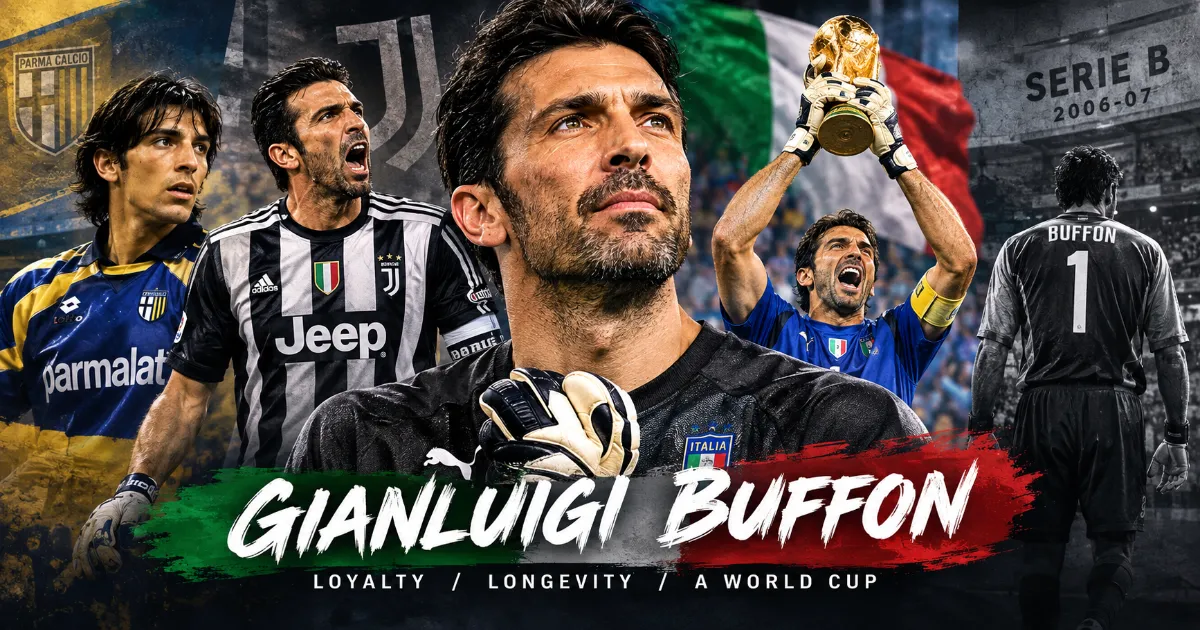
 The Gianluigi Buffon Story: Loyalty, Longevity, and a World Cup
When Juventus were stripped of their titles and relegated in disgrace, their world-record goalkeeper chose to stay and fight his way back with them.
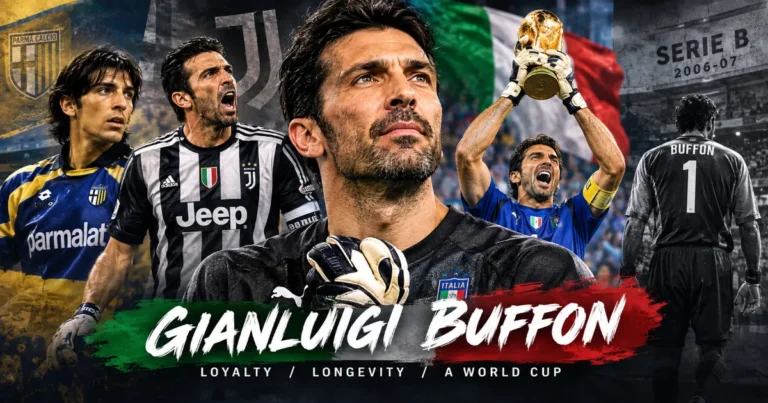
Few careers in football history span quite as many distinct eras, or contain quite as remarkable a display of institutional loyalty, as Gianluigi Buffon’s quarter-century between the posts. From a teenage debut that shattered Serie A’s youngest-goalkeeper record to a World Cup triumph, a world-record transfer fee, and a deliberate decision to stay with his club through the most humiliating chapter in its modern history, Buffon’s story remains one of Italian football’s most complete and genuinely admirable individual sagas.
MLS Best Players 2026: The 15 Stars Defining the Post-World Cup Era
The Indian Super League Story: A Football Revolution in South Asia
A Record-Breaking Debut
Buffon made his Serie A debut for Parma at just seventeen years old in 1995, a performance against AC Milan that immediately marked him out as a goalkeeping prodigy, keeping a clean sheet against a Milan side featuring genuine attacking stars in what remains one of the most celebrated debut performances by any teenage goalkeeper in Italian football history. That early promise developed rapidly over the following years, with Buffon establishing himself as Parma’s first-choice goalkeeper and one of the most exciting young talents in the position anywhere in European football, his combination of natural athleticism, positional intelligence, and an unusually mature temperament for such a young player marking him out as a genuine future star.
A World Record Transfer
Buffon’s 2001 move to Juventus, completed for a fee that briefly made him the most expensive goalkeeper in football history, reflected just how highly regarded he had become by the conclusion of his Parma years. That world-record fee carried genuine pressure and expectation, but Buffon quickly justified the investment, establishing himself as Juventus’s undisputed first-choice goalkeeper and one of the most reliable defensive presences in Italian football almost immediately following his arrival in Turin.
World Cup Glory in 2006
Buffon’s individual excellence reached a career-defining peak during Italy’s triumphant 2006 World Cup campaign, where his goalkeeping anchored one of the most statistically dominant defensive records in tournament history, with Italy conceding just two goals across the entire competition, one an own goal and the other a first-half penalty in the final itself. Buffon’s performances throughout that tournament, including a series of crucial saves during the knockout stages, earned him the Lev Yashin Award as the competition’s best goalkeeper, and his overall contribution to Italy’s fourth World Cup title remains one of the definitive individual goalkeeping performances in the tournament’s entire history.
The Calciopoli Decision
Buffon’s career reached its most significant moral and professional crossroads in the summer of 2006, immediately following his World Cup triumph, when the Calciopoli match-fixing scandal engulfed Juventus, resulting in the club being stripped of recent league titles and relegated to Serie B as punishment for the club’s role in the affair. With his World Cup-winning reputation at its absolute peak, Buffon could have easily engineered a move to any of Europe’s biggest clubs, several of whom were reportedly eager to sign him. Instead, he made the deliberate decision to remain with Juventus through their Serie B campaign, a choice built on genuine loyalty to the club and a personal commitment to helping rebuild the institution from its lowest point in decades.
That decision, made at the height of his individual career prestige, remains one of the most respected and frequently cited examples of genuine club loyalty in modern football history, a stark contrast to the increasingly transactional nature of elite player movement that has come to define much of the sport’s modern transfer culture. Buffon’s continued excellence during Juventus’s single season in Serie B helped anchor the club’s promotion campaign back to Serie A, and his sustained presence throughout that difficult period gave the institution a genuine symbol of continuity and commitment during its most humiliating chapter.
Building a New Dynasty
Buffon’s reward for that loyalty arrived in the years that followed, as Juventus gradually rebuilt into one of Europe’s most dominant domestic forces, winning nine consecutive Serie A titles between 2012 and 2020, a run that Buffon anchored for the vast majority of its duration. His sustained excellence throughout this period, even as he moved into his late thirties and eventually his forties, made him a foundational figure in one of the most statistically dominant single-league periods any club has produced anywhere in European football, a fitting long-term reward for the loyalty he had shown during the club’s darkest years.
Champions League Heartbreak
Despite his sustained domestic dominance, Champions League glory remained elusive throughout Buffon’s career, with Juventus reaching the final on three separate occasions during his time at the club, in 2003, 2015, and 2017, only to fall short each time. The 2017 final defeat to Real Madrid proved particularly painful, with Buffon, by that point already in his late thirties and playing what many assumed would be his final Champions League match, producing a performance widely praised even in defeat, unable to prevent Real Madrid’s superior attacking quality from delivering a comprehensive 4-1 victory. That recurring near-miss, a World Cup winner and one of the most decorated domestic goalkeepers in the sport’s history never quite completing the set with European club football’s biggest prize, remains one of the more poignant threads running through an otherwise remarkably complete career.
A Brief Parisian Chapter
Buffon’s 2018 move to Paris Saint-Germain, joining as a veteran squad option rather than a guaranteed starter, represented a rare departure from Juventus during his lengthy career, offering him the chance to experience a different league and squad environment relatively late in his professional journey. Though his time in Paris was comparatively brief and limited in terms of playing time, it gave Buffon the opportunity to add a domestic French title to his trophy collection before an eventual, emotional return to Juventus the following year.
A Fitting Final Chapter at Parma
Buffon’s professional career came full circle in 2021, when he returned to Parma, the club where his professional journey had originally begun a quarter-century earlier, to help the club during their own rebuilding effort in Serie B. That decision to conclude his career back where it started, rather than simply retiring from Juventus or another major club, reflected the same genuine sentimentality and loyalty that had defined his earlier decision to stay through Calciopoli, a fitting symbolic bookend to a career built as much on institutional commitment as on raw individual talent.
The Complete Goalkeeper
Buffon’s specific goalkeeping style combined elite shot-stopping reflexes with genuinely commanding presence and leadership, organizing his defense vocally and with obvious authority throughout matches in a manner that made him one of the most respected captains and vocal leaders in Italian football, not simply among goalkeepers specifically. His penalty-saving ability, combined with his positional intelligence and reading of the game, made him a genuinely complete goalkeeper by any reasonable measure, and his sustained excellence across such an extraordinarily long career, playing at an elite level from his late teens through his early forties, remains one of the most remarkable individual longevity stories the sport has ever produced.
International Legacy Beyond 2006
Beyond his World Cup triumph, Buffon’s international career with Italy spanned an extraordinary 176 caps, a national team record, across multiple decades and several different generations of Italian teammates. His continued presence as Italy’s first-choice goalkeeper well into his late thirties, including the painful experience of Italy’s failure to qualify for the 2018 World Cup, a genuine national footballing crisis that Buffon publicly and emotionally addressed at the time, further cemented his status as one of the most significant and enduring figures in the history of Italian international football, present for both the program’s greatest triumph and one of its most painful modern disappointments.
Why His Legacy Endures
More than any single statistic or trophy, Buffon’s enduring legacy rests on the combination of sustained individual excellence and genuine institutional loyalty that defined his entire career. His decision to remain with Juventus through Calciopoli, made at the absolute height of his individual prestige following a World Cup triumph, remains one of the most respected examples of genuine club commitment in the sport’s modern history, a choice that could easily have gone the other way given the considerable interest other major European clubs would certainly have shown in signing a goalkeeper of his caliber and reputation. Combined with his genuine goalkeeping excellence, sustained across an astonishing quarter-century at the highest level, Buffon’s career stands as one of the most complete and admirable individual sagas Italian football, and world football more broadly, has ever produced.
A Standard for Longevity
Buffon’s specific combination of sustained excellence and remarkable career length offers a genuine benchmark against which subsequent goalkeepers’ own longevity is frequently measured. Few players in any position have managed to remain competitive at an elite level for such an extended period, and his continued first-choice status well into his forties, both for Juventus and, briefly, for Parma during his final professional season, demonstrated that genuine goalkeeping excellence, built on positional intelligence and reading of the game rather than pure reactive athleticism alone, can be sustained for considerably longer than conventional footballing wisdom might otherwise suggest, a lesson subsequent generations of aging goalkeepers have continued to draw inspiration and practical guidance from in the years since his own eventual retirement.
The Emotional Weight of the Calciopoli Choice
It’s worth dwelling further on just how genuinely difficult Buffon’s decision to remain at Juventus during the Calciopoli scandal actually was, both professionally and emotionally. He had just delivered arguably the finest individual tournament performance of his career at the 2006 World Cup, positioning him at the absolute peak of his market value and global reputation, precisely the moment when a player in his position would typically be expected to leverage that success into a move to one of Europe’s biggest clubs. Instead, Buffon watched as several of his Juventus teammates did exactly that, departing for rival clubs amid the chaos of the club’s relegation, while he chose to remain and play Serie B football, a considerable step down in terms of both competitive level and personal prestige, purely out of loyalty to an institution that had, at that specific moment, been publicly disgraced. That choice, made with his career achievements and market value at their absolute peak, offers a genuinely rare example of a player prioritizing institutional loyalty over what would have been an entirely understandable and widely expected career advancement.
Mentoring the Next Generation
As his own playing career extended into its final years, Buffon increasingly took on an informal mentorship role for Juventus’s younger goalkeepers, including Wojciech Szczęsny, who would eventually succeed him as the club’s first-choice option. That willingness to actively support and develop his own eventual successor, rather than viewing a talented younger goalkeeper purely as a competitive threat to his own playing time, reflected the same broader institutional-mindedness that had defined his earlier Calciopoli decision, a player consistently more focused on the long-term health and success of his club than on purely protecting his own individual position or reputation.
A Voice for the Sport Beyond His Own Career
Beyond his playing achievements, Buffon has remained an active and respected voice within Italian football more broadly, taking on various ambassadorial and advisory roles with the Italian Football Federation following his retirement from playing. His continued willingness to speak candidly about both the sport’s ongoing challenges and its need for continued reform, informed directly by his own experience living through one of Italian football’s most significant institutional crises, has given his post-playing public voice a level of credibility and moral authority that few other former players can genuinely claim, a natural extension of the same institutional commitment that defined the most significant single decision of his entire career.
A Career That Will Be Studied for Generations
Between his world-record transfer fee, his World Cup triumph, his extraordinary quarter-century of sustained excellence, and above all his remarkable decision to stand by Juventus through the club’s darkest institutional crisis, Gianluigi Buffon’s career offers a genuinely rich and multifaceted case study for football historians and fans alike. It’s a story that combines elite athletic achievement with genuine moral character in a way relatively few footballing biographies quite manage, and it’s precisely that combination, rather than any single statistic or trophy alone, that ensures his name will continue to be mentioned among the very greatest goalkeepers, and indeed the very greatest professionals in any position, that the sport of football has ever produced, a legacy built as much on the strength of a single defining choice as on more than two decades of sustained, elite-level goalkeeping excellence between the posts.
A Final Reflection
When football historians eventually write the definitive account of the sport’s greatest goalkeepers, Buffon’s entry will almost certainly need more space than most, not simply to catalogue his considerable individual honors and statistical achievements, but to properly explain the specific circumstances of 2006, a World Cup winner walking away from certain suitors to stand by a disgraced institution, and why that single decision continues to matter so much to how his career is remembered nearly two decades later. In a sport increasingly defined by player mobility and short-term thinking, Gianluigi Buffon’s career remains a genuinely instructive reminder that loyalty, character, and institutional commitment can still coexist with, and even enhance, a truly legendary sporting legacy.
🔹🔹 Follow us on Facebook 🔹🔹
13 Best Korean Dramas Ever Made — From Romance to Revenge Thriller
About the Author