 Ivory Coast’s Lion and Chelsea’s Greatest Ever Player
Beyond the goals and the trophies, Didier Drogba’s most remarkable achievement may have been asking his own country to lay down its weapons, and being heard.
Some footballers are remembered purely for what they achieved on the pitch. Didier Drogba’s legacy extends considerably further, encompassing not just one of the most decorated individual careers in Chelsea’s history but a genuine, documented role in helping ease his home country’s brutal civil war, a combination of sporting excellence and real-world social impact that places him in a genuinely unique category among the game’s most significant modern figures.
The Top 10 Most Expensive Football Transfers in History
The MLS Salary Cap Explained: Designated Players, TAM, and Roster Rules
A Late-Blooming Talent
Drogba’s path to elite football looked considerably less predetermined than many of his eventual Premier League contemporaries. Born in Abidjan, Ivory Coast, he moved to France as a child to live with an uncle, and his football career developed relatively gradually through a series of French lower-division and mid-table clubs, including Le Mans and Guingamp, before his individual talent finally began attracting serious top-flight attention in his mid-twenties, a considerably later breakthrough than the teenage emergence that defines many of the sport’s other elite forwards.
The Marseille Breakthrough
Drogba’s move to Olympique de Marseille in 2003 finally gave him the platform to demonstrate his full attacking potential, producing a genuinely explosive season that saw him finish as one of Ligue 1’s most feared strikers and help carry Marseille to the UEFA Cup final. That breakout campaign transformed his reputation almost overnight, from a promising but unproven late developer into one of the most coveted attacking talents in European football, setting up the move that would come to define the remainder of his career.
Chelsea and the Mourinho Era
Drogba’s 2004 move to Chelsea, arriving as one of José Mourinho’s first major signings following the Portuguese manager’s own appointment, marked the beginning of the most significant chapter of his entire career. His combination of physical power, aerial ability, and genuinely clinical finishing made him the perfect focal point for Mourinho’s pragmatic, defensively disciplined tactical approach, and Drogba quickly established himself as one of the most feared strikers in the Premier League, his ability to hold up play, bully opposing defenders physically, and finish clinically from a variety of positions making him a genuinely complete center-forward.
Across his time at Chelsea, spanning two separate spells either side of a brief stint at Shanghai Shenhua and Galatasaray, Drogba won four Premier League titles, four FA Cups, and, most significantly, the Champions League, becoming one of the most decorated individual players in the club’s entire history and a genuine talisman for a Chelsea side that transformed from a mid-table Premier League club into one of European football’s dominant forces during his time at Stamford Bridge.
The Champions League Final That Defined His Legacy
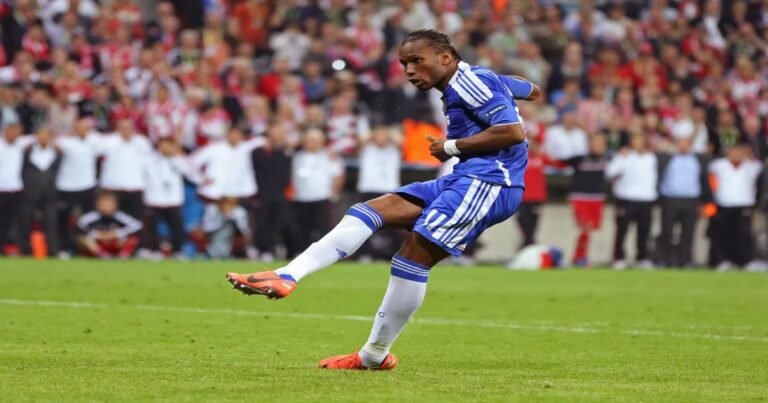
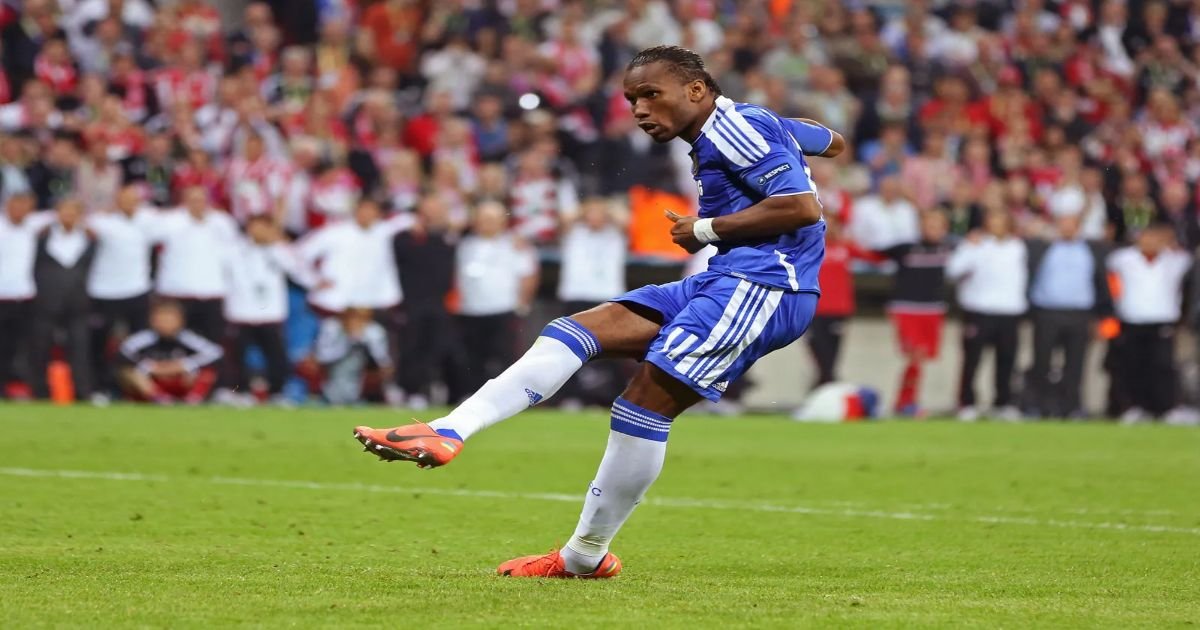
No single match in Drogba’s career carries quite the same lasting significance as Chelsea’s 2012 Champions League final victory over Bayern Munich, played, with cruel irony for the home side, at Bayern’s own Allianz Arena. With Chelsea trailing 1-0 deep into the match and facing genuine elimination, Drogba rose to head home a stoppage-time equalizer, sending the match to extra time and eventually penalties. In the shootout itself, after Bayern’s own players had missed crucial spot-kicks, it was Drogba who stepped up to convert the decisive winning penalty, delivering Chelsea’s first-ever Champions League title in what would prove to be his final act for the club before his initial departure that same summer. That combination of a crucial equalizing goal and the tournament-winning penalty, delivered in what was widely understood at the time to be his Chelsea farewell match, remains one of the most dramatically perfect individual conclusions to a single chapter of a player’s career that the sport has ever produced.
A Voice for Peace in Ivory Coast
Beyond his considerable footballing achievements, Drogba’s most historically significant contribution may have come away from any football pitch entirely. During Ivory Coast’s brutal civil war, which divided the country along regional and political lines for years, Drogba used his platform as the captain of the national team and one of the most recognizable Ivorian figures in the world to publicly appeal for peace. Following the Ivory Coast national team’s successful qualification for the 2006 World Cup, their first-ever appearance at the tournament, Drogba addressed the nation directly on television, appealing to both sides of the conflict to lay down their weapons, a moment widely credited by observers and Ivorian citizens alike with contributing to a genuine, if temporary, reduction in violence during that specific period.
Drogba’s continued advocacy extended further still, with the Ivorian national team reportedly playing a 2007 match in Bouaké, a rebel stronghold during the conflict, specifically as a gesture of national reconciliation, a decision Drogba himself was directly involved in pushing for. That willingness to use his football platform for genuine humanitarian and political purposes, at real personal risk given the volatility of the situation, remains one of the most historically significant examples of an athlete’s direct, documented impact on a real-world conflict anywhere in modern sports history.
Captain of a Golden Generation
Beyond his individual heroics, Drogba served as captain of an Ivory Coast national team widely regarded as one of the most talented squads never to fully translate that talent into major international silverware. Playing alongside fellow stars like Yaya Touré and Kolo Touré, Drogba’s Ivory Coast reached three consecutive Africa Cup of Nations finals across his captaincy, losing on each occasion, a genuinely painful pattern of near misses for a golden generation of Ivorian talent that many observers felt deserved at least one continental title given the sheer individual quality assembled within the squad during that period.
Later Career and MLS
Drogba’s later career took him across multiple continents, including a lucrative spell in China with Shanghai Shenhua, a return to familiar surroundings at Galatasaray in Turkey, and eventually a move to Major League Soccer, first with the Montreal Impact and later as a player-owner with Phoenix Rising in the USL Championship. His time in MLS specifically continued a well-established pattern of established global stars using the league as a platform to extend their careers while helping raise the domestic profile of a still-developing footballing nation, following a path that had already been established by players like Thierry Henry and David Beckham before him.
A Legacy Measured in Two Distinct Categories
Drogba’s overall legacy ultimately requires evaluation across two genuinely distinct dimensions. As a pure footballer, his Chelsea career alone secures his place among the Premier League’s most feared and decorated strikers, a player whose combination of physical dominance and clinical big-match composure delivered the club’s first-ever Champions League title through one of the most dramatic individual conclusions to a career chapter the sport has ever witnessed. As a broader public and humanitarian figure, his direct, documented role in appealing for peace during Ivory Coast’s civil war places him in an entirely different category of athletic significance, a genuine example of a footballer’s platform being used for something considerably more consequential than sporting achievement alone.
Why Chelsea Fans Still Sing His Name
Years after his final Chelsea departure, Drogba remains one of the club’s most beloved figures, his name still regularly sung by supporters at Stamford Bridge in recognition of his central role in transforming Chelsea from a talented but historically underachieving club into a genuine European power. His statistical record for the club, including a remarkable habit of scoring in cup finals that became such a recurring pattern it developed its own nickname among Chelsea supporters, cemented his reputation as a genuine big-game player, someone whose individual performances consistently rose to meet the specific magnitude of the occasion rather than simply matching his regular-season form.
A Complete Footballing and Humanitarian Legacy
Taken together, Didier Drogba’s career offers a genuinely rare combination of sustained elite sporting achievement and real, documented humanitarian impact that few other athletes in any sport can claim to have matched. His Champions League-winning penalty remains one of the most replayed individual moments in the competition’s history, but it’s his willingness to use that same platform to appeal directly for peace in his own war-torn home country that arguably represents his single most significant contribution, a reminder that football’s biggest stars can, when they choose to use their platform this way, achieve something genuinely more meaningful than any trophy or individual accolade could ever fully capture.
The Ongoing Influence of His Example
Drogba’s willingness to speak out during his home country’s civil war has continued to influence how subsequent generations of African footballers, and elite athletes more broadly, think about using their own public platforms for genuine social and political purposes beyond pure sporting achievement. Several prominent African footballers who followed in the years after Drogba’s own career have cited his example directly when discussing their own charitable foundations, political advocacy, or humanitarian work, a lasting influence that extends the practical impact of his 2006 television appeal well beyond the specific historical moment in which it was originally delivered, continuing to shape how footballers across the African continent, and indeed globally, think about the responsibilities and opportunities that come with genuine sporting fame.
The Cup Final Habit That Became Legend
Drogba’s specific reputation for delivering decisive contributions in the most important matches deserves closer examination, since it became such a defining and statistically remarkable pattern throughout his Chelsea career. Beyond the 2012 Champions League final, he scored in four separate FA Cup finals for the club, an extraordinary individual record that reflected something considerably more consistent than mere coincidence, a genuine tendency to elevate his performance level specifically for the matches that mattered most. That pattern, so pronounced that Chelsea supporters began to expect and even anticipate a decisive Drogba contribution whenever a major final arrived, speaks to a specific mental resilience and big-match temperament that separated him from strikers with comparable or even superior raw statistical output across the entirety of a normal domestic season.
Physical Presence as a Tactical Weapon
Much of Drogba’s effectiveness as a striker stemmed from his genuinely unusual physical profile for the position, combining significant size and strength with surprising pace and technical ability on the ball. Opposing defenders frequently struggled to match his physical power in aerial and hold-up play situations, while his ability to also beat defenders with pace and technical skill when required made him a genuinely difficult matchup regardless of how an opposing team chose to set up defensively. Mourinho’s Chelsea sides, and later Chelsea teams under different managers, frequently built specific tactical approaches around Drogba’s unique ability to serve as both a target for direct, long-ball approaches and a genuine creative outlet capable of holding up possession and bringing supporting attacking players into the game, a tactical versatility that made him considerably more valuable than a purely one-dimensional physical target man.
A Foundation That Continues His Work
Drogba’s humanitarian commitments extended well beyond his single, historically significant 2006 television appeal, with the Didier Drogba Foundation continuing to fund healthcare and education initiatives across Ivory Coast in the years since its founding. That sustained, ongoing charitable commitment, rather than a single isolated gesture, reflects a genuine and continued dedication to using his platform and resources for tangible humanitarian impact in his home country, extending the practical legacy of his wartime peace advocacy into a longer-term institutional commitment that has continued well beyond the specific circumstances of the civil war that first brought his political voice to international attention.
A Career Worth Remembering in Full
Didier Drogba’s story ultimately resists being reduced to either a simple footballing highlight reel or a purely humanitarian narrative in isolation, since both dimensions of his career are genuinely inseparable from how he is remembered and celebrated today. He was, by any reasonable measure, one of the finest and most clutch strikers of his generation, a Chelsea icon whose statistical record in the club’s biggest matches remains essentially unmatched. He was also, simultaneously, a footballer who used his platform to appeal directly for peace during one of his home country’s most violent periods, a gesture credited with genuine, tangible impact on a real humanitarian crisis. That combination, sporting greatness paired with genuine social significance, is precisely what makes Didier Drogba’s career one of the most complete and admirable the sport has ever produced, a legacy that extends far beyond any single goal, trophy, or highlight reel and continues to shape conversations about what elite athletes can meaningfully accomplish when they choose to use their platform for something greater than the game itself.
A Lion Remembered on Both Continents
Whether discussed in the context of Stamford Bridge’s most celebrated modern icons or as a genuine figure in Ivorian national history, Didier Drogba occupies a rare dual legacy that few footballers, in Africa or anywhere else in the world, have ever managed to achieve. Chelsea supporters will always remember the header and the penalty in Munich; Ivorians will always remember the plea for peace broadcast into homes across a divided nation. Both memories, inseparable from one another in how his story is told, ensure that Didier Drogba’s name will continue to carry weight in conversations about football’s greatest players and football’s most consequential figures alike, a distinction very few athletes in the sport’s long history have ever managed to earn on both fronts simultaneously.
🔹🔹 Follow us on Facebook 🔹🔹
13 Best Korean Dramas Ever Made — From Romance to Revenge Thriller
About the Author