 From a 149-0 protest scoreline in Madagascar to Australia’s genuine 31-goal demolition of American Samoa, a fully sourced record book of football’s most one-sided results.
Biggest Wins in Football History: The Most One-Sided Results Ever
Football’s record books for lopsided results split cleanly into two very different categories: genuine, contested blowouts between mismatched opponents, and results manufactured through protest or farce rather than actual competitive football. Both categories have produced genuinely historic scorelines, and understanding the difference between them is essential to knowing which record actually deserves the title of “biggest win in football history.” This page tracks both, fully sourced and updated as new results emerge.
The GOAT Debate: What the Data Actually Says About Football’s Four Icons
The Andres Iniesta Story: One Goal, One Generation, One Legacy
The Two Categories, Explained
Before diving into specific scorelines, it’s worth being clear about the distinction this page draws throughout. A “genuine” result is one where both teams were, in principle, playing to win or at least to compete — even if the gulf in quality between them was enormous. A “protest” or “farce” result is one where the scoreline was manufactured deliberately, typically by a losing team scoring on their own goal repeatedly in objection to a refereeing decision or federation ruling, rather than reflecting any actual difference in footballing ability. Both appear on most “biggest ever” lists circulating online, but they measure fundamentally different things, and conflating them tends to produce a misleading picture of football’s genuine competitive extremes.
The Record Table
| Result | Competition | Date | Category |
|---|---|---|---|
| AS Adema 149–0 SO l’Emyrne | Madagascar Championnat National, top division | 2002 | Protest result (deliberate own goals) |
| Arbroath 36–0 Bon Accord | Scottish Cup | 12 September 1885 | Genuine (severe quality mismatch, amateur era) |
| Dundee Harp 35–0 Aberdeen Rovers | Scottish Cup | Same day, 1885 | Genuine (severe quality mismatch, amateur era) |
| Australia 31–0 American Samoa | 2002 World Cup qualifying (OFC) | 11 April 2001 | Genuine — official FIFA world record for international matches |
| Australia 22–0 Tonga | 2002 World Cup qualifying (OFC) | 9 April 2001 | Genuine (broke Kuwait’s previous record) |
| Kuwait 20–0 Bhutan | 2002 World Cup qualifying (AFC) | 2000 | Genuine (previous international record before Australia’s run) |
| Hungary 10–1 El Salvador | 1982 FIFA World Cup, group stage | 15 June 1982 | Genuine — largest margin in men’s World Cup finals history |
| Borussia Mönchengladbach 12–0 Borussia Dortmund | Bundesliga | 1978 | Genuine — Bundesliga record margin |
| FC Infonet 36–0 Virtsu Jalgpalliklubi | Estonian domestic cup | 13 June 2015 | Genuine (severe quality mismatch, cup format) |
| Leicester City 9–0 Southampton / Southampton 0–9 Leicester City | Premier League | 2019 | Genuine — joint Premier League record margin |
AS Adema 149–0: The Number Everyone Cites, With an Asterisk
No number on this list generates more immediate shock than 149–0, and it’s genuinely the highest recorded scoreline in a match involving a top professional division anywhere in the world. But the context matters enormously: SO l’Emyrne’s players deliberately scored on their own goal, repeatedly, as an organized protest against refereeing decisions in an earlier match that had cost them their own Madagascar championship hopes. The result is recognized by some statistical bodies, including RSSSF, as an official match result, while other football historians and record-keepers exclude it from “biggest win” rankings entirely on the grounds that it wasn’t a genuine contest at all. The fallout was significant: Madagascar’s football federation suspended SO l’Emyrne’s coach for three years and handed further bans to several players involved, while the referee who oversaw the match faced no sanction.
Australia 31–0 American Samoa: The Real Record
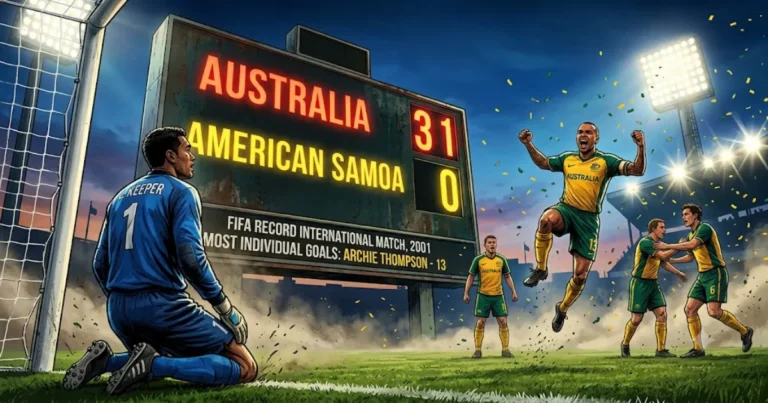
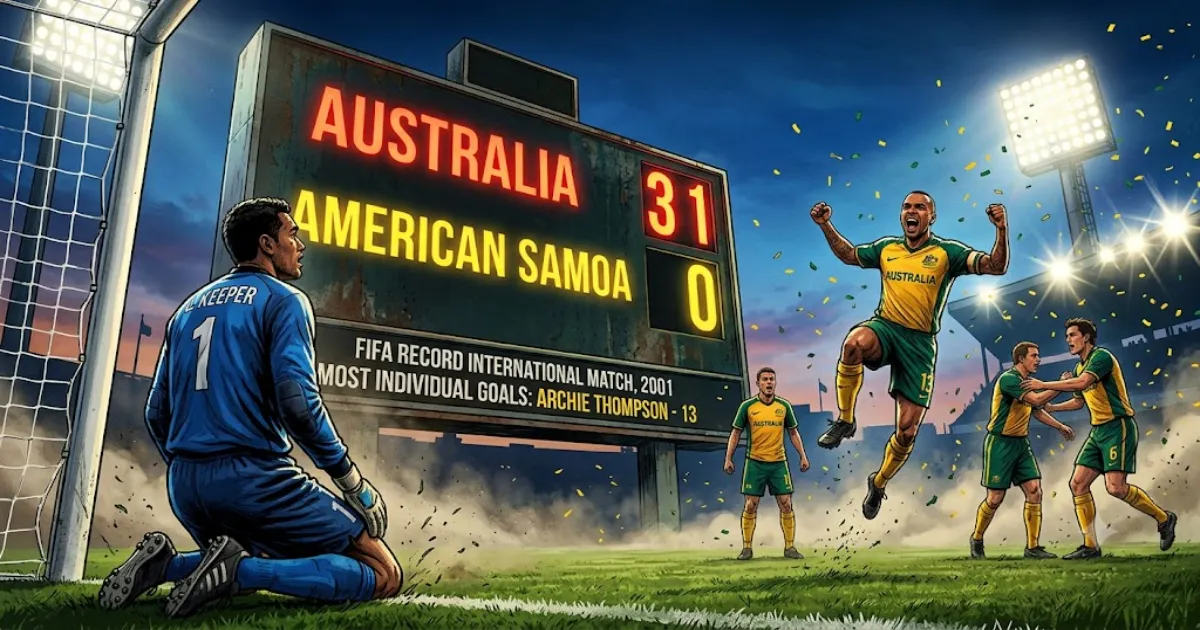
If AS Adema’s result is football’s most infamous scoreline, Australia’s 31–0 demolition of American Samoa in an April 2001 World Cup qualifier is the sport’s genuine, uncontroversial record for the largest victory margin in an official international match — a mark still recognized by FIFA today. The circumstances leading into the match were almost as remarkable as the result itself: American Samoa’s federation discovered on the eve of the game that 19 of their 20 original squad members, born in neighboring Samoa rather than American Samoa itself, were ineligible to play. Unable to call up their own under-20 squad, who were sitting school exams, the team was forced to field a scratch squad that included a pair of 15-year-olds. Head coach Tunoa Lui reportedly told reporters before kickoff that his team was “asking the Lord to help keep the score down.” No divine intervention arrived: Australia’s Archie Thompson scored 13 goals, a world record for the most goals by a single player in an international match, while David Zdrilic added eight more.
That result also wasn’t an isolated fluke — Australia had beaten Tonga 22–0 just two days earlier in the same qualifying campaign, breaking a previous international record of 20–0 set by Kuwait against Bhutan in 2000. The chaotic mismatch ultimately prompted the Oceania Football Confederation to introduce a preliminary qualifying round in future campaigns specifically to prevent similarly lopsided fixtures.
Arbroath 36–0 Bon Accord: Football’s Oldest Surviving Record
Long before Madagascar or Oceania produced their own record-breaking scorelines, Scottish football set a mark that stood, in some form, for well over a century. On 12 September 1885, Arbroath faced Bon Accord in the Scottish Cup — a match that was effectively over before kickoff. Bon Accord arrived without a proper kit, and their goalkeeper declared himself injured before the match even began, forcing an outfield half-back into goal. Arbroath led 15–0 at halftime and finished the match 36–0, a scoreline period newspapers described with almost bureaucratic understatement: “the leather was landed between the posts 41 times, but five of the times were disallowed.” Remarkably, a second lopsided result occurred the very same day barely a few miles away, when Dundee Harp beat Aberdeen Rovers 35–0 in the very same competition round.
Hungary 10–1 El Salvador: The World Cup Finals Record
Among matches played at an actual senior World Cup tournament — as opposed to qualifying rounds, where mismatches are considerably more common — Hungary’s 10–1 demolition of El Salvador at the 1982 World Cup in Spain remains the largest margin of victory ever recorded. El Salvador conceded three times before halftime and collapsed entirely after the break, with Hungary adding seven further goals in a second-half rout that remains the standard reference point whenever football writers discuss the concept of a team being utterly outclassed on the sport’s biggest stage. More than four decades on, and despite several subsequent tournament expansions bringing in weaker footballing nations, no team has come close to matching that specific margin in a men’s World Cup finals match.
Domestic League and Cup Records Worth Knowing
Beyond the international and historically curious entries above, several domestic competitions maintain their own significant record margins. Borussia Mönchengladbach’s 12–0 win over fierce rivals Borussia Dortmund in 1978 remains the Bundesliga’s largest ever margin of victory, a genuinely startling result given the size and stature of both clubs involved. In England, the Premier League’s record margin sits at nine goals, achieved on multiple occasions, including Manchester United’s 9–0 win over Ipswich Town in 1995 and, more recently, both Southampton’s 0–9 home defeat to Leicester City and Manchester City’s own 9–0 win over Watford, both occurring during the 2019–20 season.
Why These Records Matter Differently
Comparing these results side by side reveals something genuinely useful about football’s competitive landscape: the biggest gaps in quality tend to appear either in the sport’s earliest, least professionalized decades, when basic organizational failures like Bon Accord’s missing goalkeeper were still common, or in international competitions where a footballing superpower is drawn against a nation with a dramatically smaller playing population and considerably less developed domestic infrastructure. Genuine record-breaking blowouts within a single top-tier domestic league, by contrast, have become progressively rarer as professional football’s overall competitive depth and defensive organization have improved, which is exactly why Mönchengladbach’s 1978 mark and the Premier League’s shared nine-goal record have both stood for so long without a genuine challenger emerging.
A Living Record
This page treats Australia’s 31–0 win over American Samoa as the definitive “biggest win in football history” for any genuinely contested match, while continuing to note AS Adema’s 149–0 scoreline as the largest number ever recorded on a scoreboard, with the important caveat that it wasn’t the product of an actual football contest. As qualifying formats, tournament structures, and refereeing standards continue to evolve, both categories of record remain, at least in theory, breakable — though given how extreme the circumstances required to produce either mark actually were, neither looks likely to fall any time soon.
Why Protest Results Keep Happening
AS Adema’s 149–0 scoreline wasn’t actually the first time a team has deliberately scored on itself in organized protest, and it hasn’t been the last. Similar, smaller-scale incidents have occurred sporadically across lower divisions and youth football worldwide, typically triggered by a team objecting to a specific refereeing decision, a point deduction they consider unjust, or a broader grievance with their domestic federation. What made the Madagascar incident historically significant wasn’t the underlying motive, which is a recurring, if rare, phenomenon in the sport, but the sheer scale of the eventual scoreline, a genuinely unprecedented number that transformed what might otherwise have been a minor domestic controversy into an internationally reported story that continues to surface in “biggest ever” discussions more than two decades later.
How Qualifying Formats Have Changed to Prevent Repeat Blowouts
Australia’s 31–0 win, and the broader pattern of lopsided Oceania qualifying results around the same period, directly triggered structural reform within the region’s football governance. The Oceania Football Confederation introduced a preliminary qualifying round specifically designed to separate the region’s stronger footballing nations from its smallest, least-resourced programs before they were required to face each other in matches with genuine World Cup qualification stakes attached. Similar structural adjustments have occurred in other confederations over the years, with FIFA and regional bodies increasingly building tiered qualifying pathways that aim to prevent the kind of 20-plus goal margins that characterized early-2000s Oceania and Asian qualifying, even as the fundamental gap in footballing infrastructure between the world’s strongest and weakest nations remains, in most cases, still considerable.
Individual Scoring Records Tied to These Matches
Blowout scorelines have also produced some of football’s most remarkable individual statistical achievements. Archie Thompson’s 13 goals against American Samoa remains recognized as the individual record for most goals scored by a single player in an official international match, a mark that, like the 31-0 team scoreline itself, has stood since 2001 without a serious individual challenger. Several similarly lopsided domestic and cup matches have produced their own significant individual hauls, with players occasionally scoring seven, eight, or even more goals in a single fixture against dramatically overmatched opposition, though few of these individual tallies have received anything close to the same level of sustained international attention as Thompson’s specific World Cup qualifying record.
What Counts as “Official” Remains Genuinely Contested
One of the more persistent debates among football statisticians and record-keeping organizations involves exactly which of these results should count toward an “official” biggest-win record at all. FIFA formally recognizes Australia’s 31–0 win as the largest margin in a sanctioned international match, giving it a level of institutional authority that AS Adema’s protest scoreline, recorded within a purely domestic league structure and driven by deliberate manipulation rather than genuine competition, simply doesn’t carry. Even among historical results like Arbroath’s 36–0 win, some statisticians note that record-keeping standards from the 1880s were considerably less rigorous than modern match reporting, meaning even that long-standing mark carries a degree of the same uncertainty that complicates so much of football’s earliest statistical history. This page treats FIFA-recognized international records and clearly documented domestic league and cup results as the most reliable entries, while continuing to flag protest-driven and historically uncertain results with the appropriate context rather than presenting every widely circulated number with equal confidence, a distinction that matters more the deeper one digs into football’s often messy, inconsistently documented statistical past.
🔹🔹 Follow us on Facebook 🔹🔹
The GOAT Debate: What the Data Actually Says About Football’s Four Icons
About the Author