StrikerReport.com | Football Culture | Equipment History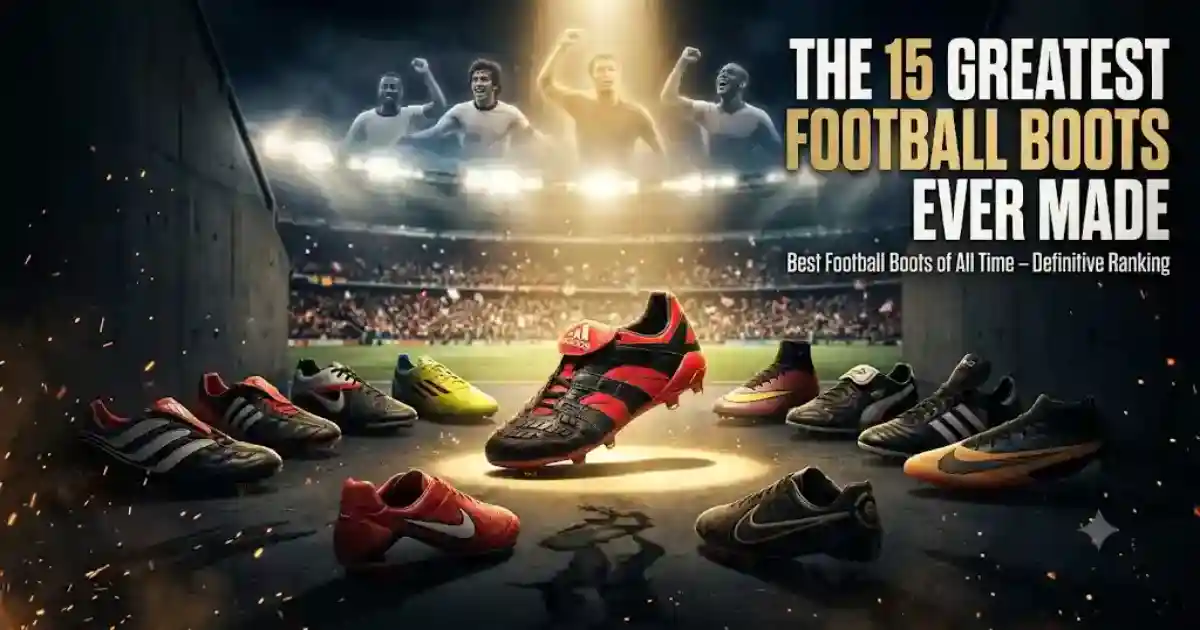
Best Football Boots of All Time
Football boots are not accessories. They are not an afterthought, a sponsorship obligation, or a fashion statement — though they can be all three simultaneously. At their finest, football boots are tools of transformation. They have changed games, extended careers, amplified talents, and in certain cases become so synonymous with greatness that the sight of a particular silhouette on a boot room floor conjures an entire era of the sport.
Golden Ball Winner Rodri: The Case for Football’s Quietest Superstar
Golden Glove Winner Unai Simon: The Historic World Cup Goalkeeping Masterclass
This is the definitive ranking of the best football boots of all time. Not just boots that sold well. Not just boots that looked good. The boots that genuinely mattered — on pitches, in dressing rooms, and in the history of football itself.
Let the arguments begin.
The Criteria
Before we rank, we establish the framework. Each boot is judged on:
- Performance impact — Did it genuinely improve the player wearing it?
- Innovation — Did it introduce something the sport hadn’t seen before?
- Cultural weight — Did it become part of football’s visual language?
- Longevity — Is it still relevant, still worn, still referenced?
- Association with greatness — Which players wore it and what did they do while wearing it?
With that established — boots on.
15. Puma King — Every Era
The Evergreen Classic
The Puma King is the oldest boot on this list and the one that has been worn in more significant matches than almost any other. Franz Beckenbauer wore them. Johan Cruyff wore them. Diego Maradona wore a version of them at the 1986 World Cup. Pelé was photographed in them. In an era before boot sponsorship had the teeth it has today, the Puma King was the default choice of the world’s best players — and they wore it because it was simply excellent.
Kangaroo leather upper. Minimal stud configuration. A last that fits the foot like a memory. The Puma King doesn’t promise you anything. It just performs. It has been reissued so many times and in so many iterations that calling any single version “the boot” is impossible. But the silhouette — slim, clean, elegant — has never gone out of style.
The legend association: Pelé, Cruyff, Beckenbauer, Maradona, Lothar Matthäus.
Why it ranks here: Too conservative for a higher position in an era of innovation, but its longevity and association with the game’s absolute greatest players is unmatched by any boot in history.
14. Nike Total 90 Laser — 2006–2010
The Set-Piece Specialist
The Total 90 Laser was designed with one obsessive purpose: accuracy. Its moulded rubber PowerShot zone on the instep was the first boot to explicitly target striking mechanics with structural engineering. You could see the technology — a textured, defined zone on the medial side that made ball contact feel different, more predictable, more precise.
Frank Lampard wore them. Steven Gerrard. Wayne Rooney at his explosive, dangerous peak. Fernando Torres in red at Anfield, destroying Premier League defences. The Total 90 Laser was the boot of a specific type of player — the powerful, technically capable midfielder and striker who wanted the ball to go where they told it to go, every time.
It was never the most glamorous boot. It was the working boot of an era. And the players who wore it produced some of their finest moments in it.
The legend association: Lampard, Gerrard, Rooney, Torres, Didier Drogba.
Why it ranks here: The structural innovation around ball-striking was genuinely ahead of its time and the association with Premier League power in the mid-2000s gives it specific weight.
13. Adidas Copa Mundial — 1979–Present
The World’s Best-Selling Football Boot
The Copa Mundial has sold more units than any other football boot in history. It has been in continuous production since 1979. That is not a marketing claim — it is a fact that speaks to what this boot does: it fits brilliantly, it performs reliably, it lasts, and it feels like football itself when you pull it on.
The upper is kangaroo leather — the same material that made the Puma King famous. The outsole is a firm ground stud configuration designed for natural pitches. It was the go-to boot for Sunday league players and professionals simultaneously — because the fundamentals work for everyone.
Does it have technological spectacle? No. Does it change the game through structural innovation? Not particularly. But the Copa Mundial is football’s most democratic boot — the choice of a 16-year-old in Manchester and a 38-year-old in São Paulo who both just want to feel the ball properly. That universality is its own kind of greatness.
Why it ranks here: Longevity, universality, and the straightforward excellence of a boot that has never tried to be more than it is.
12. Nike Mercurial Vapor III — 2004
The Boot That Changed Speed
The Mercurial line had been building since the late 1990s but the Vapor III — worn by Ronaldo (the Brazilian one, the real one, the phenomenon) at his 2002 peak — crystallised what the Mercurial was for. It was for pace. Unapologetic, singular, beautiful pace.
The Vapor III was extraordinarily light for its time. Its synthetic upper removed the break-in period that leather boots required. Its stud configuration was designed for explosive short-distance acceleration. It was, in essence, a sprint spike adapted for a football pitch — and the players it attracted reflected that philosophy.
Thierry Henry wore it at Arsenal. Ronaldo wore it. Robinho. Eventually Cristiano Ronaldo would inherit the line and make it his own. But the Vapor III established the template that the entire Mercurial range would follow for twenty years: light, fast, aggressive, purposeful.
The legend association: Ronaldo Nazário, Thierry Henry, Robinho.
Why it ranks here: Genuinely revolutionised the concept of the speed boot. Before the Vapor III, pace was a byproduct. After it, pace was a design philosophy.
11. Nike Tiempo Legend — Multiple Generations
The Artisan’s Boot
If the Mercurial is the sprint car, the Tiempo Legend is the surgeon’s instrument. Designed for control, touch, and passing precision, the Tiempo has been the choice of technically gifted, ball-oriented players who want to feel every contact as richly as possible.
The kangaroo leather upper on the classic generations offers a touch sensation that synthetic materials cannot replicate — a softness that makes receiving the ball and distributing it feel like natural extensions of the body’s movement. The Tiempo was the boot of Xavi Hernández. Of Andrés Iniesta. Of the tiki-taka generation, which is not a coincidence. Players who touch the ball 80 times a game need a boot that rewards every touch.
Later versions moved toward synthetic materials, but the classic Tiempo Legend generations remain revered for a reason: they were built for football’s artists.
The legend association: Xavi, Iniesta, Andrea Pirlo.
Why it ranks here: The definitive boot for passing precision — and its association with the Spain tiki-taka era gives it an almost philosophical significance.
10. Adidas Adipure / World Cup 2006 Edition
Zidane’s Last Boot
Zinedine Zidane wore the Adidas Adipure in the 2006 World Cup final. He scored a Panenka penalty in them. He headbutted Marco Materazzi in them. He was voted Player of the Tournament in them. If a football boot is defined by the moments that happen inside it, the Adipure’s claim on history is established by ninety of the most extraordinary minutes any player has produced in a final.
The boot itself — a clean, minimalist design with the three stripes and little else — reflected Zidane’s own approach to football. No excess. No unnecessary elements. Just quality, applied with complete certainty.
The legend association: Zinedine Zidane, exclusively and definitively.
Why it ranks here: One player. One tournament. The boot that was present at the most loaded individual moment of the 21st century World Cup.
9. Umbro Speciali — 1992–2002
The Boot of English Football’s Greatest Decade
The Umbro Speciali doesn’t have the global marketing legacy of Nike or Adidas. It doesn’t appear in global brand campaigns or retrospective documentaries. But in the 1990s Premier League, the Speciali was the boot worn by the players who defined English football’s most romanticised era.
Peter Schmeichel wore them. Mark Hughes. Eric Cantona wore them when he stood on the advertising hoardings at Selhurst Park. Roy Keane wore them driving through opponents in Manchester United’s most combative midfields. Alan Shearer wore them scoring from everywhere at Blackburn and Newcastle.
The Speciali was a working boot — leather, sturdy, slightly stiff when new, perfect when broken in — that carried no pretensions about revolutionising football. It simply enabled footballers to do what footballers do, in a decade when English football was doing it better than it ever had.
The legend association: Cantona, Shearer, Keane, Schmeichel, Ian Wright.
Why it ranks here: Cultural legacy within English football is unmatched for a boot of its era.
8. Nike Mercurial Superfly (2014–2018 Generation)
Cristiano’s Signature Era
By the mid-2010s, the Nike Mercurial had evolved through multiple generations and arrived at its most visually striking and technically refined iteration. The Superfly added a sock-like collar — a design element that every major manufacturer would subsequently copy — and retained the carbon fibre soleplate and lightweight synthetic upper that made the earlier Mercurials famous.
Cristiano Ronaldo wore this boot during his most statistically prolific seasons at Real Madrid. The 2015–16 Champions League. The 2016 European Championship. The 50-goal seasons. The hat-tricks and the free-kicks and the extraordinary, relentless accumulation of records. Whatever your feelings about Ronaldo as a footballer, the numbers he produced in this boot are unparalleled in the modern era.
The collar design was divisive initially — many players found it restrictive — but its influence on boot design for the subsequent decade was total. Every major manufacturer currently produces a boot with a sock collar. The Mercurial Superfly introduced it to the mainstream.
The legend association: Cristiano Ronaldo, Kylian Mbappé (later generations).
Why it ranks here: Design innovation plus association with the most prolific goal-scoring era in modern football.
7. Puma Future Z (Neymar Generation) — 2020–Present
The Chaotic Genius Boot
The Puma Future Z represents something unusual in modern boot design: a genuine attempt to create a boot that mirrors the unpredictability of its most prominent wearer. The FUZIONFIT+ adaptive upper — a woven, sock-like structure without a traditional tongue — wraps the foot entirely and adapts to individual foot shapes. There are no laces in the traditional sense. The boot moulds.
Neymar’s adoption of the Future Z brought it global visibility, but the boot’s technological credentials stand independently. The adaptive upper reduces pressure points and creates a lock-down fit that is unlike anything a traditional leather or synthetic upper provides. For players who use the whole foot — who need confidence in multiple touch surfaces — the Future Z’s 360-degree feel is genuinely different.
The legend association: Neymar, Antoine Griezmann.
Why it ranks here: The most innovative upper construction in modern boot history.
6. Nike Phantom GX — 2022–Present
The Passing Precision Machine
The Nike Phantom GX represents Nike’s most serious attempt to compete with Adidas in the technical boot category — and it may be the finest passing boot currently in production. The Gripknit upper creates a textured contact surface that improves ball control in wet and dry conditions. The internal lacing system keeps the dorsal surface clean for consistent striking.
Kevin De Bruyne wears them. Pedri. Gavi. The players who construct football from the inside out, who need the ball to do precisely what they tell it to. The Phantom GX’s association with the playmaking generation is not an accident — Nike designed it for them.
The legend association: Kevin De Bruyne, Pedri, Gavi.
Why it ranks here: Current-generation excellence in the technical boot category that makes it the Tiempo Legend’s spiritual successor.
5. Adidas F50 adiZero — 2010
The South Africa Sensation
At the 2010 World Cup in South Africa, Adidas introduced the F50 adiZero weighing just 165 grams — at the time, the lightest boot ever created for professional use. It caused genuine industry controversy. Boot manufacturers had competed on performance and design, but weight had never been so dramatically weaponised.
Messi wore them at South Africa 2010. Didier Drogba wore them. David Villa scored the World Cup final winner for Spain in them. The F50 adiZero didn’t just look different — it changed the conversation about what a football boot needed to be.
The legend association: Lionel Messi (early era), David Villa, Drogba.
Why it ranks here: Single most dramatic weight reduction in football boot history, changing the industry’s design philosophy overnight.
4. Adidas Predator Mania — 2002
The Boot That Had Rubber Fins
The Adidas Predator had been developing since 1994 when Craig Johnston — the Liverpool midfielder who also invented the Predator concept — first approached Adidas with the idea of rubber elements on a boot’s striking surface to increase spin and swerve. The Predator Mania, worn at the 2002 World Cup, is the version where the concept reached its architectural peak.
The rubber ridges on the instep. The distinctive scalloped edge. The aggressive colour schemes. The Predator Mania looked unlike anything else on the pitch — and it performed unlike anything else. Zidane wore them. Beckham wore them and bent free-kicks in ways that suggested the boot and the ball had made a private arrangement. Raúl wore them.
The Predator was the boot that explicitly claimed to give players superhuman ability — to swerve the ball further, to control it more precisely, to strike it with more consistent power — and the players who wore it did things that made the claim credible.
The legend association: Zidane, Beckham, Raúl, Rivaldo.
Why it ranks here: The most distinctive design language in boot history, and its association with the 2002 World Cup era gives it untouchable cultural weight.
3. Nike CTR360 Maestri — 2010–2014
The Hidden Genius Boot
The CTR360 Maestri barely gets mentioned in greatest-boots conversations and it should be in every single one. Designed specifically for playmakers, the Maestri featured a textured upper specifically engineered to improve first touch and passing precision — with a low-cut profile that allowed lateral ankle movement for quick directional changes.World Cup 2026 Kit Ranking: Argentina’s Away Is a Work of Art — Here Are the Best and least ranked Jerseys at the Tournament
Xavi wore them. Andrés Iniesta wore them. Andrea Pirlo. The Maestri was the boot of the possession-football generation — players whose games were built on receiving the ball cleanly, moving it instantly, and building patterns of play that dismantled defences through intellect rather than pace.
Spain’s 2010 World Cup and 2012 European Championship victories were played in Nike CTR360 Maestri boots by their two most important creative players. If tiki-taka was a philosophy, the Maestri was its physical instrument.
The legend association: Xavi, Iniesta, Pirlo.
Why it ranks here: Association with the most influential football philosophy of the modern era, worn by its two definitive practitioners.
2. Adidas Predator Precision — 1998–2002
Zidane’s Boot, Beckham’s Boot, Football’s Boot
Before the Mania came the Precision — and the Precision is arguably more significant. Introduced ahead of the 1998 World Cup, worn by Zidane as he scored twice in the final against Brazil, worn by Beckham as he bent free-kicks through walls in a way the sport hadn’t seen with such consistency, the Predator Precision established the rubber-element concept as a genuine performance enhancement rather than a gimmick.
The Precision is elegant in a way later Predators weren’t always. Cleaner lines, a slimmer profile, the rubber zones more refined and less overtly architectural than the Mania’s ridges. It is a boot that understood it was for extraordinary players and dressed accordingly.
France won the 1998 World Cup in them. Beckham made his penalty against Argentina in one. Rivaldo scored a bicycle kick in the 2002 World Cup wearing the Predator. This boot was present at more iconic moments in a five-year period than any boot before or since.
The legend association: Zidane, Beckham, Rivaldo, Thierry Henry (early career).
Why it ranks here: The period between 1998 and 2002 is arguably the richest in World Cup history for individual performance, and the Predator Precision was the boot most of its architects wore.
1. Adidas Predator Accelerator — 1998
The Greatest Football Boot Ever Made
The one. The standard against which everything else is measured. The Adidas Predator Accelerator is the greatest football boot in the history of the sport.
Its credentials are non-negotiable. It was worn by Zinedine Zidane in the 1998 World Cup, where he won the tournament and was named the planet’s best player. It was worn by David Beckham through the period of his greatest individual influence on English and club football. It was worn by Alessandro Del Piero, by Rivaldo, by Clarence Seedorf, by Robert Pires.
The rubber “Predator” elements — three distinct zones on the upper covering the instep, the sweetspot, and the volley area — represented the most cohesive version of Craig Johnston’s original concept. Not as architecturally elaborate as the Mania, not as refined as the Precision — but the version that first proved the concept worked at the highest level of the game.
The design is immediately, unmistakably itself. The colour schemes — the ’98 red-and-black, the royal blue, the midnight colourway — are among the most recognisable in boot history. The Accelerator looks like a great boot. It looks like it could do things other boots can’t. And when you look at what Zidane and Beckham did while wearing it, the aesthetic promise wasn’t a lie.
Forty years of boot design. One answer.
The legend association: Zidane, Beckham, Del Piero, Seedorf, Rivaldo.
Why it’s number one: The synthesis of design, technology, cultural moment, and legendary association that no other boot in history has matched simultaneously.
The Final Ranking: Quick Reference
| Rank | Boot | Era | Icon |
|---|---|---|---|
| 1 | Adidas Predator Accelerator | 1998 | Zidane, Beckham |
| 2 | Adidas Predator Precision | 1998–2002 | Zidane, Beckham |
| 3 | Nike CTR360 Maestri | 2010–2014 | Xavi, Iniesta |
| 4 | Adidas Predator Mania | 2002 | Zidane, Beckham |
| 5 | Adidas F50 adiZero | 2010 | Messi |
| 6 | Nike Phantom GX | 2022–Present | De Bruyne, Pedri |
| 7 | Puma Future Z | 2020–Present | Neymar |
| 8 | Nike Mercurial Superfly | 2014–2018 | Ronaldo |
| 9 | Umbro Speciali | 1992–2002 | Cantona, Shearer |
| 10 | Adidas Adipure | 2006 | Zidane |
| 11 | Nike Tiempo Legend | Multiple | Xavi, Iniesta, Pirlo |
| 12 | Nike Total 90 Laser | 2006–2010 | Lampard, Gerrard |
| 13 | Adidas Copa Mundial | 1979–Present | Universal |
| 14 | Nike Mercurial Vapor III | 2004 | Ronaldo, Henry |
| 15 | Puma King | Every Era | Pelé, Cruyff, Maradona |
Final Word
Great boots don’t make great players. Let’s be clear about that. But great players, wearing boots designed with genuine intelligence and craft, sometimes produce moments that feel like more than the sum of any individual’s talent.
The Predator Accelerator didn’t score against Brazil in 1998. Zinedine Zidane did. But it was there. It was part of the moment. And that, in football, is more than enough.
Follow StrikerReport.com for the complete history of football’s greatest equipment, culture, and moments.
▪️▪️ Follow us on Facebook ▪️▪️
About the Author



1 thought on “The Best Football Boots of All Time, Ranked”