The FIFA World Cup 2026 group stage is over. See all 16 teams eliminated, the biggest shocks, heartbreaking exits and unforgettable moments.
The FIFA World Cup 2026 group stage is over, and the first major chapter of football’s biggest tournament has delivered everything the expanded 48-team format promised: unexpected results, historic debuts, heartbreaking eliminations and several major shocks.
With 48 nations competing across 12 groups, the new format gave more teams a route into the knockout rounds. The top two teams from each group advanced automatically, while the eight best third-placed teams also earned places in the Round of 32.
That meant reaching the knockout stage was more achievable than ever — but it still wasn’t enough for 16 nations.
From Uruguay’s stunning early exit to South Korea’s agonising final-day collapse, the Teams Eliminated from FIFA World Cup 2026 include established football powers, returning nations and debutants who nevertheless created memories that will last long after their results are forgotten.
Here is the complete review of every eliminated team, what went wrong and the moments that defined their World Cup campaigns.
Group A: Czechia and South Korea Among the First Teams Eliminated from FIFA World Cup 2026
Czechia — 1 Point
Czechia’s return to the World Cup ended with a difficult group-stage campaign. After qualifying through the UEFA play-offs, where they overcame Denmark on penalties, the Czechs entered Group A knowing they had little room for error.
They opened with a 2-1 defeat to South Korea before producing a more encouraging performance against South Africa. The 1-1 draw gave them hope, but it ultimately proved insufficient.
A 3-0 defeat to Mexico on the final matchday ended their campaign.
Czechia’s biggest weakness was their lack of consistent attacking production. They scored only twice in three matches and struggled to create the sustained pressure required to compete for qualification.
Final record: 1 point, 2 goals scored, 5 conceded.
South Korea — 3 Points
South Korea’s elimination was one of the more painful stories of the group stage.
They began brilliantly, defeating Czechia 2-1 and immediately putting themselves in contention for the knockout rounds. However, consecutive defeats against Mexico and South Africa destroyed their hopes.
The final-day 1-0 defeat to South Africa was particularly devastating. South Korea entered the match knowing that a positive result could potentially carry them into the Round of 32, but Thapelo Maseko’s goal eventually ended their campaign.
Their elimination demonstrated one of the harsh realities of the expanded format: three points can still be insufficient when the competition among third-place teams is extremely tight.
Final record: 3 points, 2 goals scored, 3 conceded.
Group B: Qatar’s Difficult World Cup Comes to an Early End
Qatar — 1 Point
Qatar’s second consecutive World Cup appearance ended with another group-stage elimination.
A 1-1 draw with Switzerland offered encouragement, but the tournament quickly turned against them. Their 6-0 defeat to Canada became one of the most one-sided matches of the group stage, with Jonathan David scoring a hat trick.
The red card shown to Assim Madibo added to Qatar’s problems during the heavy defeat.
A final 3-1 loss to Bosnia and Herzegovina confirmed their elimination.
Qatar leave the tournament having scored twice and conceded 10 goals. The campaign highlighted the challenge facing a nation attempting to establish itself among the world’s leading football countries through sustained investment and development.
Final record: 1 point, 2 goals scored, 10 conceded.
Group C: Scotland and Haiti Leave With Different Stories
Scotland — 3 Points
Scotland returned to the World Cup for the first time since 1998, and their opening match delivered exactly the kind of moment their supporters had waited decades to experience.
A 1-0 victory over Haiti gave Scotland three precious points and genuine hope of reaching the knockout rounds.
However, defeats against Morocco and Brazil ended their campaign.
The 3-0 defeat to Brazil on the final matchday confirmed that Scotland’s initial victory would not be enough to secure a place among the best third-placed teams.
Despite the early exit, Scotland’s return itself was a success for a generation of supporters who had waited 28 years to see their country back on football’s biggest stage.
Final record: 3 points, 1 goal scored, 4 conceded.
Haiti — 0 Points
Haiti faced one of the toughest schedules in the tournament, with Brazil, Morocco and Scotland standing between them and the knockout rounds.
They lost all three matches, including defeats against Scotland and Brazil before falling 4-2 to Morocco.
The results were harsh, but Haiti showed flashes of attacking ambition and refused to simply sit back against stronger opposition.
Their World Cup journey ultimately ended without a point, but their participation remains a significant milestone for Haitian football.
Final record: 0 points, 2 goals scored, 8 conceded.
Group D: Türkiye’s Late Victory Wasn’t Enough
Türkiye — 3 Points
Türkiye’s World Cup campaign was defined by inconsistency.
A 2-0 defeat to Australia and a 1-0 loss to Paraguay left them in serious trouble before the final matchday. Their 3-2 victory over the United States provided a late reminder of the talent within the squad, but the recovery came too late.
Arda Güler was one of the players under the spotlight throughout the tournament. The Real Madrid midfielder showed flashes of his enormous ability, but Türkiye struggled to create the structure necessary to make him the central figure of their attack.
The final victory gave supporters something to celebrate, but Türkiye’s three points were not enough to extend their tournament.
Final record: 3 points, 5 goals scored, 6 conceded.
Group E: Curaçao’s Historic Debut Ends With Pride
Curaçao — 1 Point
Curaçao may have finished their debut World Cup at the bottom of their group, but their tournament cannot be judged simply by their final position.
The island nation suffered a heavy 7-1 defeat to Germany in their opening match. However, goalkeeper Eloy Room produced an extraordinary performance despite the scoreline and became one of the surprise individual stories of the group stage.
Curaçao then produced one of the tournament’s most memorable results by drawing 1-1 with Ecuador.
For a nation of roughly 150,000 people making its first appearance at a World Cup, securing a point against an established international side represented a historic achievement.
A 3-1 defeat to Ivory Coast ended their campaign, but Curaçao leave with enormous credit.
Final record: 1 point, 2 goals scored, 9 conceded.
Group F: Tunisia’s Tournament Ends Without a Point
Tunisia — 0 Points
Tunisia endured one of the most difficult campaigns among the eliminated nations.
The Carthage Eagles lost all three group matches and scored only once, conceding 10 goals.
A heavy 5-1 defeat to Sweden immediately placed them under pressure. Subsequent losses against Japan and the Netherlands confirmed their elimination.
For a nation with considerable World Cup experience, the campaign represented a disappointing return and highlighted the need for greater attacking production and defensive stability at international level.
Final record: 0 points, 1 goal scored, 10 conceded.
Group G: New Zealand and Iran Miss Out
New Zealand — 1 Point
New Zealand entered a challenging group featuring Belgium, Egypt and Iran.
Their campaign began with a heavy 5-1 defeat to Belgium, but they recovered to earn a 1-1 draw with Iran.
That result represented the high point of their tournament, but a second defeat in the group prevented them from accumulating enough points to reach the knockout stage.
The All Whites leave with another World Cup experience to build upon.
Final record: 1 point, 2 goals scored, 8 conceded.
Iran — 2 Points
Iran came painfully close to surviving the group stage.
Two draws — against New Zealand and Egypt — gave them two points, but a narrow defeat to Belgium left them outside the eight best third-placed teams.
Their elimination demonstrates how unforgiving the expanded World Cup can still be.
Iran did not suffer a disastrous campaign. Instead, they were eliminated because a handful of small margins went against them.
Final record: 2 points, 3 goals scored, 4 conceded.
Group H: Uruguay’s Shock Exit Headlines the Teams Eliminated from FIFA World Cup 2026
Uruguay — 2 Points
If there was one result that stunned the football world during the group stage, it was Uruguay’s elimination.
The two-time world champions arrived with expectations of progressing comfortably from Group H. Instead, they finished without a single victory.
A 1-1 draw against Saudi Arabia was followed by a shocking 1-0 defeat to Cape Verde.
Uruguay then drew 1-1 with Spain, but the result wasn’t enough to save them.
Their attacking struggles were particularly damaging. Uruguay scored only twice across three matches and repeatedly found themselves frustrated by compact defensive systems.
For a nation with Uruguay’s history, the early exit will be remembered as one of the biggest disappointments of the tournament.
Final record: 2 points, 2 goals scored, 3 conceded.
Saudi Arabia — 2 Points
Saudi Arabia could not reproduce their famous 2022 victory over Argentina, but they still produced a competitive group-stage campaign.
They drew with Uruguay and Cape Verde before losing 3-1 to Spain.
Their two points left them level with Uruguay, but disciplinary tiebreakers ultimately worked against them.
The margins were incredibly fine. A single different result could have transformed Saudi Arabia’s tournament.
Final record: 2 points, 2 goals scored, 3 conceded.
Group I: Iraq’s Historic Return Ends Early
Iraq — 0 Points
Iraq returned to the World Cup after a 40-year absence, making their participation one of the tournament’s major historical stories.
Unfortunately, their group was brutal.
They faced Norway, France and Senegal and lost all three matches.
Iraq conceded 12 goals without scoring, leaving them with the tournament’s worst goal difference among the eliminated teams.
The results were painful, but simply returning to the World Cup after such a long absence remains a major achievement for Iraqi football.
Final record: 0 points, 0 goals scored, 12 conceded.
Group J: Jordan Make History Despite Three Defeats
Jordan — 0 Points
Jordan’s World Cup debut ended without a point, but the nation created historic moments that will be remembered for generations.
Ali Olwan scored Jordan’s first-ever World Cup goal against Austria, producing one of the most emotional celebrations of the group stage.
Jordan also found the net against Algeria before eventually losing the match.
Their final game against Argentina ended in defeat, but the experience of playing against the reigning world champions gave Jordan’s players an invaluable taste of football at the highest level.
For Jordan, the final table tells only part of the story.
Final record: 0 points, 2 goals scored, 7 conceded.
Group K: Uzbekistan’s World Cup Debut Ends in Disappointment
Uzbekistan — 0 Points
Uzbekistan qualified for their first World Cup after an impressive campaign in AFC qualifying, creating expectations that they could become one of the tournament’s surprise packages.
Instead, the debut proved extremely difficult.
They lost 3-1 to Colombia, suffered a heavy 5-0 defeat against Portugal and then lost 3-1 to Congo DR.
The two goals they scored came in their final match, but by then their elimination was already confirmed.
Uzbekistan will nevertheless leave with valuable experience that could prove important for future tournaments.
Final record: 0 points, 2 goals scored, 9 conceded.
Group L: Panama’s Attack Never Gets Going
Panama — 0 Points
Panama’s tournament ended with three defeats and, most painfully, zero goals.
They lost 1-0 to Ghana, 1-0 to Croatia and 2-0 to England.
Their defensive organisation kept matches competitive, but their inability to produce an attacking threat ultimately proved decisive.
Panama leave without a point or a goal, but their qualification itself represented another important step for a country continuing to grow on the international stage.
Final record: 0 points, 0 goals scored, 3 conceded.
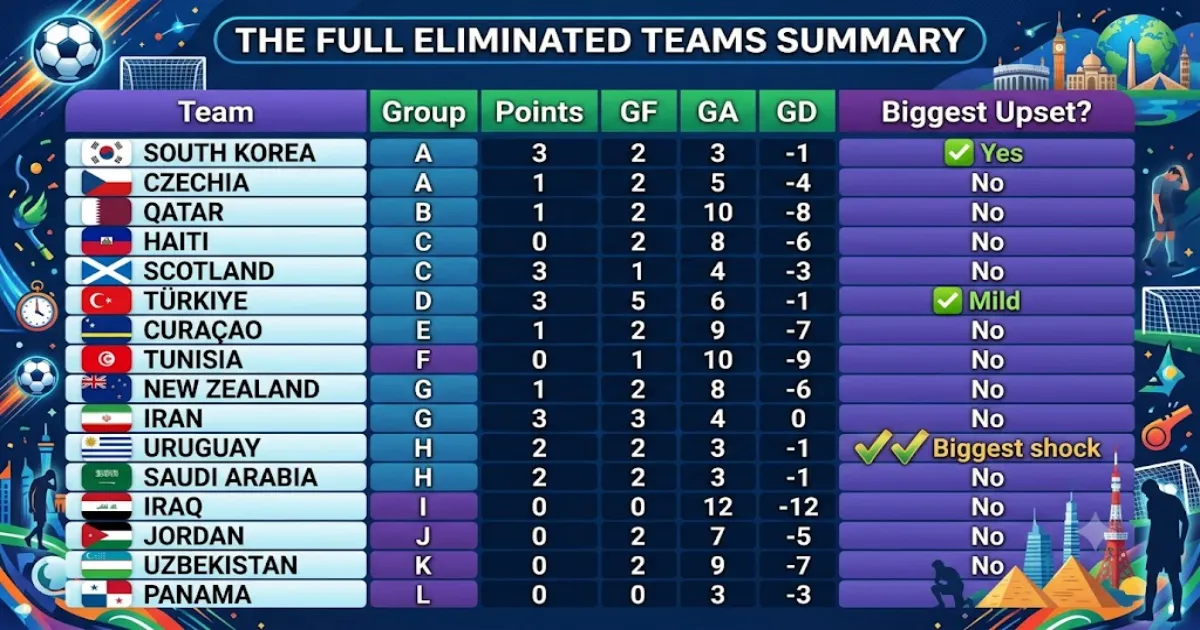
Complete List of Teams Eliminated from FIFA World Cup 2026
| Team | Group | Points | Goals For | Goals Against | Goal Difference |
|---|---|---|---|---|---|
| South Korea | A | 3 | 2 | 3 | -1 |
| Czechia | A | 1 | 2 | 5 | -3 |
| Qatar | B | 1 | 2 | 10 | -8 |
| Scotland | C | 3 | 1 | 4 | -3 |
| Haiti | C | 0 | 2 | 8 | -6 |
| Türkiye | D | 3 | 5 | 6 | -1 |
| Curaçao | E | 1 | 2 | 9 | -7 |
| Tunisia | F | 0 | 1 | 10 | -9 |
| New Zealand | G | 1 | 2 | 8 | -6 |
| Iran | G | 2 | 3 | 4 | -1 |
| Uruguay | H | 2 | 2 | 3 | -1 |
| Saudi Arabia | H | 2 | 2 | 3 | -1 |
| Iraq | I | 0 | 0 | 12 | -12 |
| Jordan | J | 0 | 2 | 7 | -5 |
| Uzbekistan | K | 0 | 2 | 9 | -7 |
| Panama | L | 0 | 0 | 3 | -3 |
The Biggest Shock Among the Eliminated Teams
Uruguay’s exit stands above the rest.
A nation with two World Cup titles, a proud footballing culture and a squad capable of competing with the world’s best failed to win a single match.
Their defeat against Cape Verde was particularly damaging because it transformed what looked like a straightforward qualification campaign into a fight for survival.
South Korea’s elimination was another major disappointment, while Iran demonstrated how brutally the third-place qualification system can punish teams that perform reasonably well but fail to collect enough points.
The Debutants Who Left Their Mark
Not every eliminated team leaves the tournament as a failure.
Curaçao, Jordan and Uzbekistan all made their World Cup debuts, while their results varied dramatically.
Curaçao’s draw against Ecuador was arguably the standout achievement. Jordan’s first World Cup goal created an unforgettable national moment, while Uzbekistan gained invaluable experience against elite opposition.
For these nations, the 2026 tournament should be viewed as a beginning rather than an ending.
What We Learned From the 16 Eliminations
The group stage proved that the expanded World Cup has created more opportunities, but it has not eliminated the pressure of international football.
For some nations, three points were enough to remain in contention. For others, even two points were insufficient.
The tournament also showed that experience does not guarantee survival. Uruguay’s exit proved that reputation means little once the matches begin, while debutants such as Curaçao demonstrated that smaller football nations can still produce memorable results.
The difference between advancing and going home often came down to a single goal, a missed opportunity or a tiebreaker.
Final Verdict: The Stories Behind the Teams Eliminated from FIFA World Cup 2026
The Teams Eliminated from FIFA World Cup 2026 represent much more than a list of nations that failed to reach the knockout rounds.
There were disappointments, including Uruguay’s stunning elimination and South Korea’s heartbreaking final-day defeat. There were difficult campaigns, such as those experienced by Iraq, Tunisia and Panama. And there were inspirational stories from Curaçao and Jordan, nations that made history simply by reaching the world’s biggest football tournament.
That is what makes the World Cup so compelling.
The knockout stage now begins without these 16 nations, but their stories remain part of the tournament’s history. Some will return stronger in 2030. Others will rebuild around a new generation. And for a few, the 2026 World Cup may become the tournament remembered as the moment their footballing story truly began.
The group stage is over. The survivors continue their journey toward the trophy. For the eliminated nations, the long road home has begun.
Messi vs Ronaldo: The Definitive Statistical Comparison — Every Number, Every Record, One Verdict
▪️▪️ Follow us on Facebook ▪️▪️
About the Author








2 thoughts on “Gone Too Soon: Every Team Eliminated from FIFA World Cup 2026 and the Stories Behind Their Exits”