Inside the World Cup 2026 Worst Referee Decision Nobody Can Defend
Every World Cup produces at least one decision that referees, players, and fans simply cannot agree on. This summer’s tournament has thrown up several candidates already, but one call stands above the rest as the single worst referee decision of World Cup 2026 — and it didn’t come from a split-second judgment in real time. It came after a full video review, on the pitch-side monitor, with every available angle in front of the official. That’s what makes it so hard to explain away.
The Moment Everyone Is Still Talking About
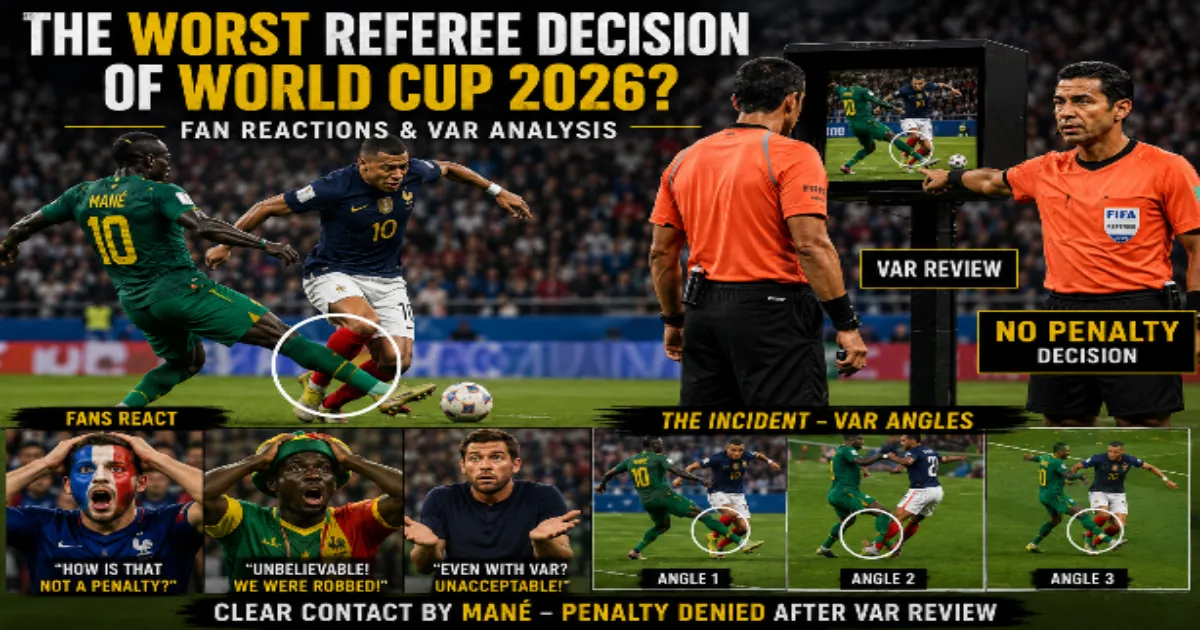
The incident happened in the second half of France’s Group I opener against Senegal at MetLife Stadium. With the score still level, Kylian Mbappé drove into the penalty area and went to ground under a challenge from Senegal defender Sadio Mané. Replays showed Mané’s leg making contact with Mbappé’s standing foot as the Frenchman carried the ball along the edge of the box. On the field, referee Alireza Faghani initially waved play on. Then VAR stepped in and sent him to the monitor for a personal review — exactly the kind of intervention the system was designed for.
What happened next is the part that’s still being dissected. After watching multiple replays at the screen, Faghani emerged, pointed toward the penalty area as if marking the location of the incident, and ruled that Mbappé himself had initiated the contact. No penalty. A goal kick to Senegal instead. France went on to win the match comfortably regardless, with Mbappé scoring twice to become his country’s all-time leading scorer, but the decision itself has refused to fade from the conversation.
What the Replays Actually Showed
This is where the World Cup 2026 referee decision becomes genuinely difficult to defend. Multiple camera angles showed Mané’s trailing leg catching Mbappé’s foot as the Frenchman carried the ball forward, with minimal contribution from Mbappé himself toward causing the collision. Pat Nevin, working for BBC Radio 5 Live, said flatly that he saw no possible way Mbappé could be blamed for initiating contact while running in front of his opponent. Alan Shearer, on BBC television, expressed similar bewilderment, noting that Mané’s lunge was the only action that altered the outcome of the play.
Perhaps the most damning reaction came from inside officiating circles rather than the media boxes. Darren Cann, a former assistant referee with World Cup and Champions League final experience, said his phone had filled with messages from elite referees who could not understand the final call either. When people whose entire careers are built on understanding these exact situations are equally confused, that’s usually a sign the system has broken down somewhere between the monitor and the final decision.
Why This One Tops the List
To be clear, this was far from the only contentious World Cup 2026 referee decision through the group stage. Ghana’s coaching staff were furious when no penalty was given after Ezri Konsa appeared to catch Prince Kwabena Adu inside the box against England, a non-call that prompted Carlo Queiroz’s now-famous line that “VAR went for a coffee.” Iran had a stoppage-time goal against Egypt chalked off for offside in a moment that would have sent them into the knockout rounds for the first time in their history. Brazil had a Vinícius Júnior goal against Scotland overturned for a soft foul in the build-up, prompting a formal letter from the Brazilian federation to FIFA requesting more consistency in how VAR interventions are applied.
Each of those decisions has a reasonable defense, even if it’s not a popular one. Marginal contact, genuinely tight offside calls, and matters of interpretation around fouls in buildup play are the kind of close-judgment situations that have always divided opinion in football, long before VAR existed. The Mbappé non-penalty is different because it isn’t really a matter of opinion once you watch the replay. The referee had every advantage the system offers — multiple angles, no time pressure, a second look with fresh eyes — and still arrived at a conclusion that the overwhelming majority of pundits, former officials, and ordinary fans found impossible to support. That combination of total information and a widely rejected outcome is precisely why this sits at the top of the list of bad calls this tournament has produced.
Fan Reactions From Both Sides
The fallout online followed a familiar pattern but with unusually broad agreement across fanbases that don’t normally see eye to eye. French supporters inside MetLife Stadium were initially confused rather than relieved, with several clips showing fans in the away end applauding ironically once the no-penalty decision was confirmed — including, notably, France’s own players. Senegalese supporters, who had traveled in smaller numbers due to U.S. entry restrictions affecting visa processing, were left to watch their team’s protest go nowhere on the biggest possible stage.
Beyond the two fanbases directly involved, the broader football conversation treated the decision as a kind of shared punchline about the state of officiating at this World Cup. Clips of Faghani pointing toward the penalty spot, seemingly indicating where the incident took place rather than awarding anything, circulated widely, with many viewers interpreting the gesture as an unintentional admission that something had clearly happened in the box. Neutral fans who had no stake in the result still found themselves drawn into the debate purely because the gap between what the monitor showed and what the referee concluded was so wide.
What FIFA Has and Hasn’t Said
Unlike some other contentious calls this tournament, where FIFA’s officiating department has occasionally offered public clarification, there has been no formal explanation issued for the Mbappé decision specifically. FIFA is under no obligation to release the audio exchange between Faghani and the VAR booth, and as of now it hasn’t. What is known is that referee performances are reviewed internally after the tournament, and significant errors have historically affected which officials receive marquee appointments later in the competition, including the final itself. Faghani, taking charge of his fourth World Cup, had been mentioned by some as a candidate for the final at MetLife Stadium before this incident. Whether that remains realistic is now an open question inside refereeing circles.
The Bigger Pattern Behind the Headlines
It’s worth stepping back from this single incident to note what it represents about the wider state of officiating at this tournament. FIFA expanded VAR’s review powers for 2026, giving officials more scope to intervene in situations that previously would have stayed as on-field judgment calls. The intention was clearly to reduce exactly the kind of error this World Cup 2026 referee decision represents. Instead, it has occasionally produced the opposite effect: a referee given every tool to get a decision right, and still getting it wrong in full view of the review process that was meant to prevent it.
That’s a more uncomfortable problem for FIFA than a simple human error in real time, because it suggests the issue isn’t a lack of information but how that information gets interpreted once it reaches the referee. Expanding video review only helps if the final judgment improves alongside it. So far in this tournament, the evidence on that front has been mixed at best.
Where This Leaves the Knockout Rounds
As the World Cup 2026 moves into its knockout phase, every contentious call will now be viewed through the lens of what happened to France and Senegal. Fans, players, and even broadcasters have made it clear they expect more transparency from officials willing to explain their reasoning clearly when a major decision swings a result. Whether that pressure changes anything in how referees approach the monitor in the rounds ahead remains to be seen, but the appetite for accountability has rarely felt stronger.
For now, the Mbappé non-penalty stands as the defining officiating controversy of the group stage — not because it was the most disputable in isolation, but because it was the one decision where the system worked exactly as designed, and the outcome still left almost everyone watching with the same question: how was that not a penalty?
How This Compares to Past World Cup Controversies
Bad officiating at the World Cup is not a new phenomenon, and putting this decision in historical context actually makes the frustration easier to understand. Diego Maradona’s infamous “Hand of God” goal against England in 1986 survived because there was no review system at all. Frank Lampard’s disallowed goal against Germany in 2010, where the ball clearly crossed the line before Manuel Neuer scooped it away, became the single biggest argument for introducing goal-line technology in the first place. Both of those moments are remembered, in part, because there was no mechanism in place to correct them in real time.
That’s precisely what makes this World Cup 2026 referee decision sting differently. The technology existed. The review process happened exactly as FIFA designed it to. The referee walked to the monitor, watched the replay from multiple angles, and still reached a conclusion that almost no neutral observer could support. Past controversies were failures of available tools. This was, by contrast, a failure that happened despite every available tool being used correctly. That distinction is exactly why pundits and former officials have struggled to let it go, even with France winning comfortably regardless of the call.
The Players’ Perspective
Mbappé himself offered a fairly restrained response in his post-match comments, choosing not to dwell on the decision given the result was never in serious doubt. Didier Deschamps was more pointed in his assessment, suggesting that the explanation given pitch-side did not match what the footage actually showed, though he stopped short of directly criticizing Faghani by name, aware of the disciplinary sensitivities around publicly attacking match officials at a World Cup. Senegal’s players, for their part, were simply relieved the decision had gone in their favor, even if several admitted afterward that they expected the penalty to be awarded once Faghani walked toward the screen.
That mixed reaction from the players directly involved is itself telling. When even the team that benefited from a contentious call seems mildly surprised it survived review, it usually signals that the decision sits well outside the range of what either set of players or coaching staffs anticipated walking in.
What Referees and Pundits Want Changed
In the aftermath, several voices inside the game have called for FIFA to release more context around major review decisions, even if not full audio transcripts. The argument is straightforward: when a call this contentious goes unexplained beyond a brief on-field announcement, it leaves space for speculation that can be far more damaging to confidence in officiating than transparency would be. Several broadcasters covering the tournament have pointed to other major sports, including rugby and cricket, where referees explain decisions to a stadium microphone in real time, as a model FIFA might eventually consider adopting more fully at World Cups.
Whether that kind of transparency arrives before the knockout stage concludes is unclear, but the appetite for it has grown noticeably since this particular decision. Fans no longer just want to know what was decided. Increasingly, they want to understand why, in a way that actually withstands scrutiny once the replays are shown again and again on social media in the hours and days that follow.
A Decision the Tournament Will Remember
World Cups are remembered for their goals, their upsets, and occasionally for their officiating disasters, and 2026 will likely be no exception. Whatever happens across the knockout rounds — and there is still a great deal of football left to be played before a champion is crowned at MetLife Stadium on July 19 — this particular World Cup 2026 referee decision has already secured its place in the tournament’s folklore. It will be replayed in retrospectives, cited in debates about expanding VAR’s powers further, and used as a cautionary example of how even the most advanced review system in football history still depends, in the end, on the judgment of the person standing in front of the screen.
That, more than any single missed call, is the real lesson of the France-Senegal penalty incident. Technology can show a referee everything. It still can’t make the decision for him.
Kylian Mbappé Golden Boot Prediction: Can Anyone Stop Him in 2026?
▪️▪️Follow us on Facebook▪️▪️
About the Author


2 thoughts on “The Worst Referee Decision of World Cup 2026 — Fan Reactions & VAR Analysis”