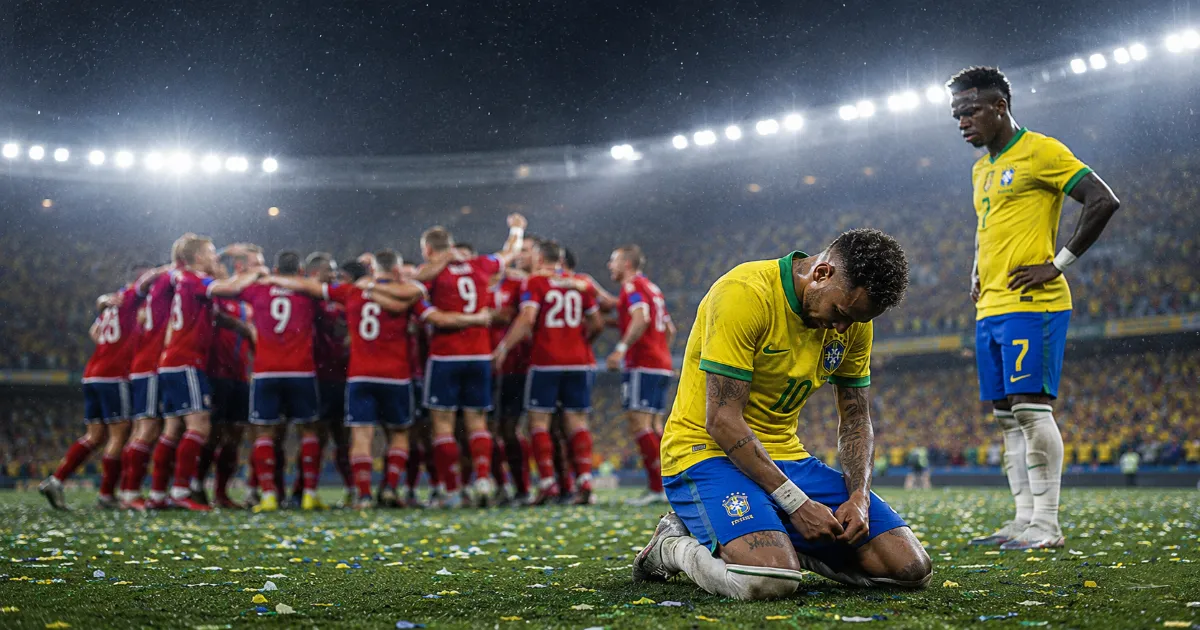
Brazil’s pursuit of a record-extending sixth World Cup title is over. Carlo Ancelotti’s Selecao, five-time champions and the only nation to have played in every World Cup since 1930, were eliminated in the Round of 16 on July 5 after a 2-1 defeat to Norway at MetLife Stadium in New Jersey — Brazil’s earliest exit from the tournament since 1990, and their sixth consecutive World Cup without silverware.
It is a result that will be dissected in Brazilian football for years, not only because of who beat them — a Norway side appearing in the knockout rounds for the first time in the nation’s history — but because of how it happened, and what it means for the closing chapter of Neymar’s international career.
Here is a full breakdown of Brazil’s road through the tournament, match by match, along with an honest look at where it went wrong and where the Selecao go from here.
NBA Schedule 2026-27: Christmas Day Rivalries, Ring Night and the Games to Watch
Bangladesh Create History in Darwin, Defeat Australia by Nine Wickets in Landmark Test Victory
PSG v Arsenal: How Paris Won the Champions League Final on Penalties
Group C: A Cautious Start, Then Business as Usual
Brazil opened their campaign with a goalless-in-attack 1-1 draw against Morocco, a result that raised early eyebrows given the expectations attached to a squad featuring Vinícius Júnior, Casemiro, and Alisson. Ancelotti’s side looked short of rhythm, unable to break down a well-organised Moroccan block, and the draw meant qualification from the group was not yet secured.
The response came quickly. Brazil beat Haiti 3-0 in their second fixture, with Vinícius Júnior beginning to find the kind of form that had made him a Ballon d’Or contender at club level. A third straight clean sheet at the back end of the group followed with a 3-0 win over Scotland, a result that eliminated the Tartan Army from realistic knockout contention and confirmed Brazil as Group C winners.
By the end of the group stage, Vinícius Júnior had scored four goals, including a brace against Scotland, establishing himself as Brazil’s most dangerous attacking outlet heading into the knockout rounds. Neymar, meanwhile, was an unused substitute for the opening two matches before making his tournament debut off the bench against Scotland — his first World Cup appearance since returning from a long ACL rehabilitation.
Round of 32: A Nervy Escape Against Japan
Brazil’s first knockout test came against Japan, and it was far closer than the eventual 2-1 scoreline suggests. Japan took the lead and pushed Brazil onto the back foot for long spells, reviving memories of past Brazilian struggles against organised, high-intensity Asian sides. Brazil needed a second-half rally to level the tie, and it was not until Gabriel Martinelli’s dramatic 96th-minute winner that the five-time champions booked their place in the Round of 16.
It was a result that flattered Brazil’s control of the game. The warning signs — a defence occasionally exposed in transition, a midfield that struggled to dictate tempo against a well-drilled press — were there for anyone paying close attention, even in victory.
Round of 16: Norway, Haaland, and a Historic Upset
Brazil’s tournament ended on July 5 against a Norway side built around Erling Haaland and Martin Ødegaard, appearing in the World Cup knockouts for the first time since 1938. Norway had never previously beaten Brazil, a run stretching back decades, but that changed emphatically.
Haaland scored twice — a header in the 79th minute and a low finish from outside the box in the 90th — either side of a Neymar penalty that pulled a goal back deep into stoppage time and offered only cosmetic consolation. The two goals took Haaland to seven for the tournament, level with Lionel Messi and Kylian Mbappe at the top of the Golden Boot standings.
By most independent assessments, it was a lacklustre performance from Brazil: a game short on service to the front line, short on midfield control, and short on the incisiveness Vinícius Júnior and Neymar need to be dangerous. Norway’s press in the second half forced Brazil into uncomfortable defensive shapes, and Ancelotti’s introduction of 19-year-old Endrick in the 58th minute — described by the manager afterward as giving the side “more depth” — arrived too late to change the outcome.Brazil vs Norway: Haaland Scores Twice as Norway Shock Brazil 2-1 to Reach First World Cup Quarter-Final
One tactical decision has drawn particular scrutiny: Ancelotti’s choice of penalty takers in a match that ultimately turned on moments of composure at both ends. The manager defended his selections as statistically informed, but postmatch reaction in Brazil has focused heavily on Endrick’s limited game time throughout the tournament — just 102 minutes across five matches before the Norway defeat — as a symptom of a broader identity problem within the squad.
Star Player Analysis: Vinícius Júnior’s Rise, Neymar’s Farewell, Endrick’s Frustration
Vinícius Júnior was comfortably Brazil’s most important player through the group stage, translating his club form into four goals and consistent movement in behind opposition defences. His inability to find the same rhythm against Norway’s deeper, more disciplined defensive setup was symptomatic of Brazil’s broader struggle to unlock low blocks in the knockout rounds.
Neymar’s tournament was defined by circumstance as much as performance. At 34, and playing his fourth World Cup after a long-term ACL injury threatened to rule him out of the squad entirely, his involvement was managed carefully by Ancelotti — an unused substitute in the opening two group games before a bench cameo against Scotland marked his tournament debut. His penalty against Norway was his only goal of the competition, scored in the closing minutes of what was, by most reasonable expectations, his final World Cup appearance. Visibly emotional at the final whistle, Neymar’s farewell was not the storybook ending Brazilian football had hoped for when he made the squad.Neymar Lifestyle Comeback: The Fortune, the Fight, and the Final World Cup
Endrick, still only 19, offered glimpses of impact in limited minutes but was left visibly distraught after the elimination, prompting teammates to console him on the pitch. His underuse throughout the tournament — a talking point among Brazilian media for the final three weeks of the campaign — has become one of the more contentious subplots of Ancelotti’s tactical approach.
What’s Next for Neymar?
Neymar’s immediate football future remains centred on Santos, the boyhood club he returned to after his time in Saudi Arabia and at Al-Hilal, and there has been no indication of an imminent retirement announcement from international football. But at 34, coming off a long ACL layoff, and with this now standing as his most realistic final World Cup, the conversation in Brazil has shifted from “what can Neymar still do for the Selecao” to “what does Neymar’s legacy look like without ever delivering the World Cup Brazilian fans have waited 24 years for.”
Whether he continues to be part of Ancelotti’s plans for future international friendlies and competitions, or whether this marks a natural point for Brazil to fully hand the attacking reins to Vinícius Júnior and Endrick, is likely to be one of the defining storylines of Brazilian football over the next 12 months.
Analysing the Exit: Why Brazil Fell Short of the Quarterfinals
Several factors stand out in explaining Brazil’s earliest World Cup exit since 1990:
- A recurring European hoodoo. This marks the fifth time in Brazil’s last six World Cups that they have lost to the first European opponent they faced in the knockout rounds — a pattern Ancelotti was specifically brought in to break, and one that has now followed his tenure too.
- Underwhelming knockout-stage control. Both the Japan and Norway matches saw Brazil concede tactical and territorial ground for extended periods, relying on individual moments rather than sustained collective control.
- Squad balance questions. The limited use of Endrick, alongside a reliance on an ageing, recently-injured Neymar in a managed role, left Brazil short of attacking fluidity when their primary knockout-stage game plan stalled.
- Set-piece and transition vulnerability. Norway’s two goals — a header from a cross and a well-taken finish from outside the box — both stemmed from moments Brazil’s defensive structure failed to control decisively.
What Comes Next for Brazil
The defeat extends Brazil’s title drought to six consecutive World Cups and raises pointed questions about Ancelotti’s approach and future with the national team, questions that will likely dominate Brazilian football discourse through the rest of 2026. For a nation whose football identity has long been built around World Cup success, back-to-back-to-back shortfalls have triggered what several observers are already calling an identity crisis for the Selecao heading into the next World Cup cycle.
For now, Norway advance to face the winner of Mexico vs. England in the quarterfinals, while Brazil’s players and coaching staff fly home to a football nation once again searching for answers — and for the next chapter after Neymar.
Who Has Won the Most World Cups? Every Champion Nation Ranked
Erling Haaland: The Goal Machine Rewriting Football’s Record Books
🔹🔹 follow us on facebook 🔹🔹
About the Author