The Complete Guide to Football Positions
From the goalkeeper to the false nine — a complete breakdown of every football position, what each role demands, and the players who defined them
Football looks simple from the stands: eleven players a side, one ball, two goals. But underneath that simplicity sits a detailed system of specialized roles, each with its own responsibilities, skill demands, and tactical purpose. Understanding football positions is the fastest way to actually understand the sport itself — why a manager picks a certain lineup, why a certain player thrives in one system and disappears in another, and why the “best player on the pitch” isn’t always the one with the ball at his feet.
This guide walks through every major position in football, line by line from the goalkeeper outward, explaining what each role actually requires and naming the legend most associated with defining it.
How Football Positions Are Organized
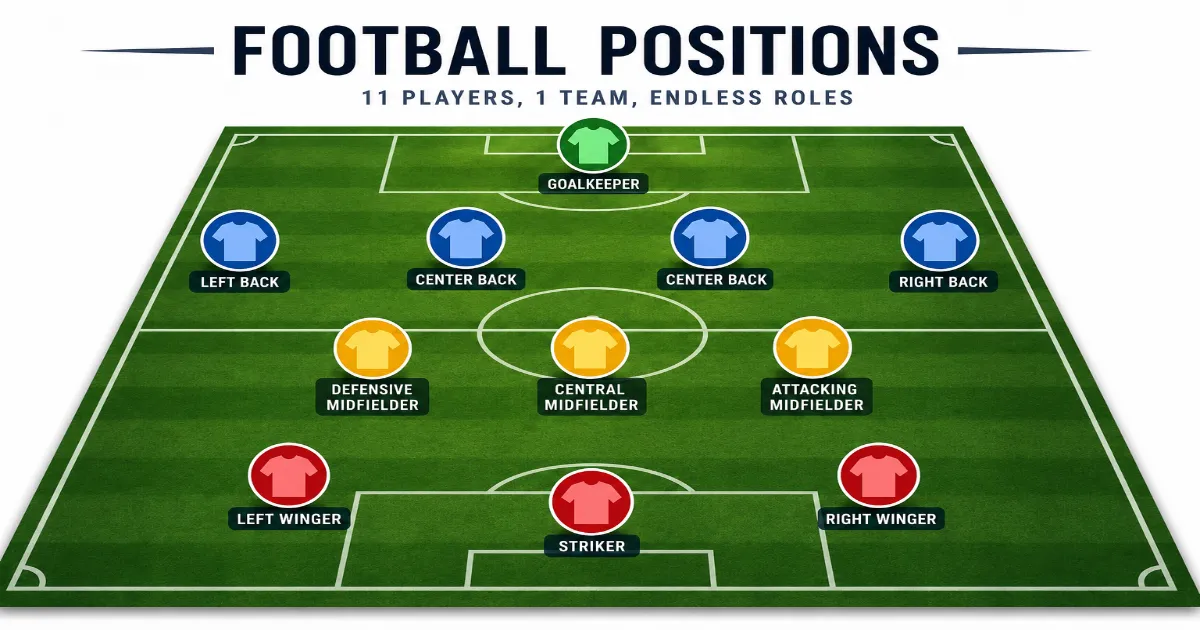
Before breaking down individual roles, it helps to understand the broad structure. A football team is generally organized into four lines:
- Goalkeeper — the last line of defense, and the only player permitted to use their hands (within the penalty area).
- Defenders — center-backs and full-backs (or wing-backs), tasked primarily with stopping opposition attacks.
- Midfielders — the connective tissue of the team, split between defensive, central and attacking roles.
- Forwards — wingers and strikers, whose primary job is scoring and creating goals.
The exact number of players in each line depends on the formation a manager chooses — a 4-4-2 uses four defenders, four midfielders and two forwards, while a 4-3-3 shifts one midfielder into a wide forward role. But regardless of formation, the underlying football positions and their responsibilities remain largely consistent across the sport.
Goalkeeper (GK)
Primary job: Prevent the ball from crossing the goal line.
The goalkeeper is football’s most specialized position by a wide margin — the only role with a genuinely different skill set from the rest of the team. Shot-stopping is the obvious requirement, but the modern goalkeeper is also expected to be comfortable with the ball at their feet, capable of starting attacks with accurate distribution under pressure, a shift often credited to Pep Guardiola’s tactical influence over the past 15 years.
Legend: Gianluigi Buffon is widely regarded as one of the greatest goalkeepers ever, combining elite shot-stopping with a two-decade career at the top of the sport for Juventus and Italy. Manuel Neuer, meanwhile, is often cited as the pioneer of the modern “sweeper-keeper” style, redefining how far outside the box a goalkeeper is expected to operate.
Center-Back (CB)
Primary job: Defend the central areas of the pitch, win aerial duels, and organize the defensive line.
Center-backs are typically deployed in pairs (or occasionally trios), tasked with marking opposition forwards, intercepting passes into dangerous areas, and clearing crosses. The role demands physical strength, positional discipline, and increasingly, comfort in possession — modern center-backs are often the players who begin a team’s build-up play from the back.
Legend: Franco Baresi redefined defending in the 1980s and 90s with his reading of the game for AC Milan, while Sergio Ramos combined defensive toughness with a remarkable knack for scoring decisive goals for Real Madrid and Spain. Virgil van Dijk has become the modern template — a center-back whose composure on the ball is as valuable as his defending.
Full-Back and Wing-Back (LB/RB, LWB/RWB)
Primary job: Defend the wide areas while also supporting attacks down the flank.
The full-back has undergone the most dramatic transformation of any position in modern football. Once viewed as a purely defensive role, full-backs are now some of the most attacking players on the pitch, overlapping with wingers, delivering crosses, and even cutting inside to join midfield play. In a back three system, this role extends further up the pitch as a wing-back, with even greater attacking responsibility and less defensive cover.
Legend: Cafu and Roberto Carlos, both Brazilian, set the standard in the late 1990s and 2000s for attacking full-back play, effectively functioning as extra wingers. More recently, Trent Alexander-Arnold has been credited with reshaping the position further, operating almost as a auxiliary playmaker from right-back for Liverpool.
Sweeper / Libero (Historical Role)
Primary job: Play behind the defensive line as a free-roaming last defender.
Though largely phased out of the modern game due to the offside law and pressing tactics, the sweeper (or “libero”) was once one of the most prestigious football positions. Positioned just behind the main defensive line, the sweeper was free to read the game, step into midfield, and even launch attacks, rather than being tied to marking a specific opponent.
Legend: Franz Beckenbauer is the definitive example, essentially inventing the modern interpretation of the role for Bayern Munich and West Germany in the 1970s, captaining his country to World Cup glory in 1974 while playing as an attacking sweeper.
Defensive Midfielder (CDM)
Primary job: Shield the back line, break up opposition attacks, and recycle possession.
The defensive midfielder — often called a “number six” — sits in front of the defense, tasked with intercepting passes, winning duels, and providing the platform for more attacking teammates to play with freedom further forward. Some defensive midfielders lean purely destructive; others, known as “deep-lying playmakers,” combine that defensive discipline with the passing range to dictate a game’s tempo from deep.
Legend: Claude Makélélé was so influential in this role for Chelsea and France that the position is sometimes still referred to as “the Makélélé role” in football punditry. Andrea Pirlo, by contrast, represents the deep-lying playmaker variant, controlling entire matches from deep positions for AC Milan, Juventus and Italy.
Central / Box-to-Box Midfielder (CM)
Primary job: Link defense and attack, cover ground in both directions, and contribute to both phases of play.
The box-to-box midfielder is football’s ultimate all-rounder, expected to defend when the team is out of possession and support the attack when it isn’t — often covering more distance per match than any other position. This role demands a rare mix of stamina, tackling ability, passing range, and, in the best examples, a genuine goalscoring threat from midfield.
Legend: Steven Gerrard and Frank Lampard defined this role in England during the 2000s, each capable of covering vast areas of the pitch while also scoring 20-plus goals a season from midfield. N’Golo Kanté brought a more modern, pressing-focused interpretation of the role during Leicester City’s title-winning 2015–16 campaign and Chelsea and France’s subsequent successes.
Attacking Midfielder (CAM)
Primary job: Operate between the opposition’s midfield and defense, creating chances and scoring goals.
Often called the “number ten,” the attacking midfielder is typically a team’s chief creative outlet, tasked with unlocking defenses through incisive passing, dribbling, and movement into pockets of space. This role demands vision and technical quality above all else, and the best number tens are often the most naturally gifted players on their team.
Legend: Zinedine Zidane brought elegance and control to the role for Real Madrid and France, while Lionel Messi and Kaká have both operated as devastating attacking midfielders at various points in their careers, drifting inside from wider starting positions to combine creativity with a genuine scoring threat.
Winger (LW/RW)
Primary job: Attack from wide areas, beat full-backs one-on-one, and deliver crosses or cut inside to shoot.
Wingers have evolved significantly over the decades. Traditional wingers stayed close to the touchline and focused on crossing, while the modern “inverted winger” — playing on the opposite flank to their strongest foot — cuts infield to shoot or combine with teammates centrally, a shift popularized heavily by Arjen Robben and, later, by Mohamed Salah.
Legend: George Best and Garrincha were among the earliest icons of pure wing play, dazzling defenders with dribbling ability decades before the position’s modern tactical evolution. In the current era, Lionel Messi’s evolution from a traditional right winger into one of the greatest goalscorers ever illustrates just how far the position’s ceiling can stretch.
Striker / Center-Forward (ST/CF)
Primary job: Score goals.
The striker’s job is, in theory, the simplest of any football position — put the ball in the net. In practice, elite strikers combine movement, finishing, aerial ability, and hold-up play to consistently find space and convert chances against organized defenses. Some strikers thrive as pure poachers inside the penalty area, while others, known as target men, use physicality to bring teammates into play.
Legend: Ronaldo Nazário combined blistering pace with elite finishing to become one of the most feared strikers ever for Brazil, Barcelona, Inter Milan and Real Madrid. Cristiano Ronaldo represents the modern hybrid — part winger, part striker — whose goal output across two decades has made him one of the two most statistically prolific players in football history.
False Nine
Primary job: Drop deep from a central striking position to disrupt opposition defenders and create space for teammates.
The false nine is one of football’s most tactically fascinating roles. Rather than staying high and central like a traditional striker, the false nine drops into midfield areas, pulling opposition center-backs out of position and creating gaps for onrushing teammates to exploit. It’s a role that demands elite football intelligence rather than raw physical presence.
Legend: Lionel Messi’s use as a false nine under Pep Guardiola at Barcelona between 2009 and 2012 is widely considered the definitive modern execution of the role, contributing to one of the most dominant club spells in football history.
Why Understanding Football Positions Matters
Knowing the names of football positions is one thing; understanding how they interact is what actually unlocks the tactical side of the sport. A manager’s choice to play a false nine instead of a traditional striker, or an inverted winger instead of a classic wide player, isn’t cosmetic — it changes how an entire team attacks and defends. Recognizing these roles allows fans to watch a match and understand why a certain player is positioned where they are, why a substitution changes a team’s shape, and why certain players excel in one system but struggle in another.
Final Word
From the specialized shot-stopping of the goalkeeper to the free-roaming creativity of the false nine, every football position carries its own demands, history, and hall of legendary players who redefined what the role could be. As tactics continue to evolve — full-backs becoming playmakers, strikers dropping deep, goalkeepers turning into auxiliary defenders — the boundaries between these positions keep shifting. But the fundamentals outlined here remain the foundation for understanding how a football team, and the sport itself, actually works.
Who Has Won the Most World Cups? Every Champion Nation Ranked
Inside Football Academies: How Elite Clubs Build Tomorrow’s Superstars
Chinese Super League: The Rise, Fall and Uncertain Future of China’s Top Flight
🔹🔹 follow us on facebook 🔹🔹
About the Author