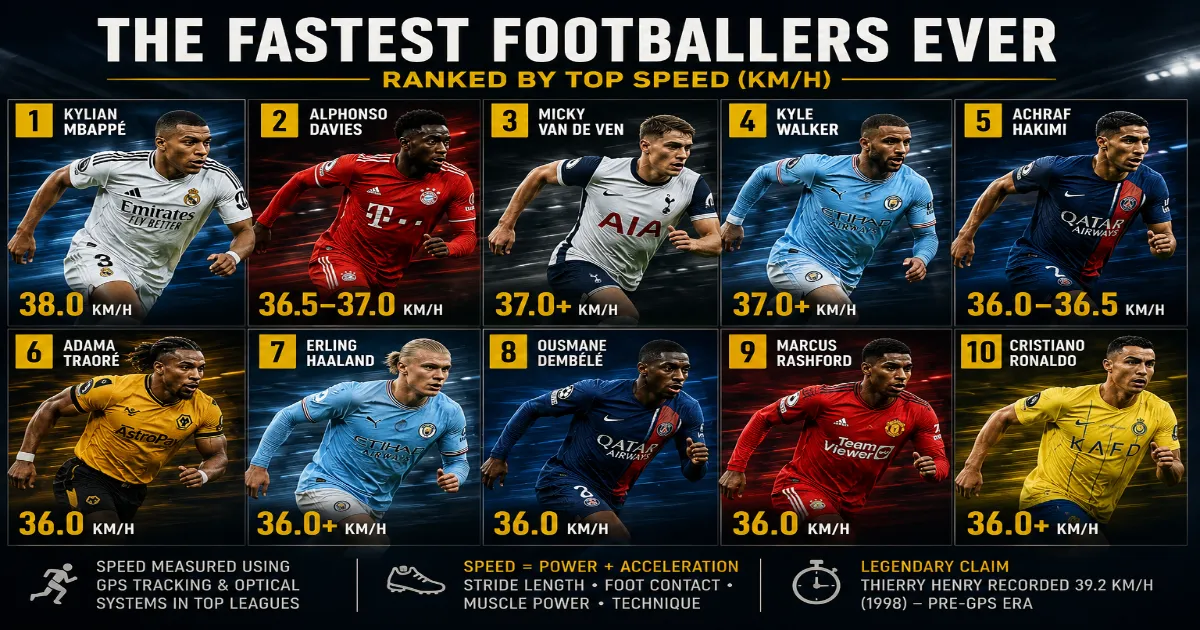
 Ranking the fastest footballers in the game using GPS tracking data, official speed records, and the biomechanics behind elite sprinting on grass.
Pace has always been football’s most cinematic attribute. A well-timed pass is elegant, a perfectly weighted through-ball is clever, but nothing gets a stadium out of its seat quite like a player hitting top gear in open space with a defender trailing hopelessly behind. Thanks to GPS tracking vests, radar-based broadcast graphics, and league-wide data partnerships, we no longer have to rely on gut feeling to settle the “who’s actually the fastest” debate. We can measure it, in kilometers per hour, down to two decimal places.
This countdown ranks the fastest footballers ever recorded, using officially logged match data where available, and puts those numbers in context with a bit of the sports science behind why some players are simply built to fly.
How Football Actually Measures Speed
Before diving into the rankings, it’s worth understanding where these numbers come from, because it explains why lists like this one can vary slightly depending on the source. Leagues including the Premier League and the Bundesliga use GPS-based tracking systems built into player performance vests, capturing position data many times per second throughout a match. From that raw data, providers calculate top speed, distance covered, and the number of high-intensity sprints a player completes.
Not every league publishes this data publicly, and measurement methods have varied over the years — older claims, particularly from the 1990s and 2000s, often relied on stopwatch timing or broadcast radar guns rather than continuous GPS tracking. That’s an important caveat for any all-time list: comparing a sprint measured by modern optical tracking to one estimated decades ago is not a perfectly clean comparison. With that context in mind, here is the countdown.
10. Cristiano Ronaldo — Longevity at the Top
Even well into his thirties, Cristiano Ronaldo has continued to clock speeds above 36 km/h, an extraordinary feat of physical conditioning that reflects one of the most disciplined training regimes in the sport’s history. What makes Ronaldo’s inclusion notable isn’t a single blistering sprint but the sheer consistency of his pace across two decades at the elite level, from his early wing-play at Manchester United through to his current career in Saudi Arabia. Few athletes in any sport maintain top-end speed this deep into their careers.Ronaldo World Cup 2026: Six Tournaments, One Missing Trophy, One Last Chance
9. Marcus Rashford — Explosive Acceleration
Marcus Rashford has been repeatedly clocked above 36 km/h during Manchester United matches, and his game is built around that first explosive burst rather than sustained straight-line speed. Rashford’s acceleration off a standing or near-standing start — the kind of speed that matters most in tight transition moments — has made him one of the most difficult wide forwards in the Premier League to contain in a footrace over the first ten meters.
8. Ousmane Dembélé — Speed Rediscovered
After injury-disrupted years in Barcelona, Ousmane Dembélé’s move to Paris Saint-Germain coincided with a rediscovery of the electric pace that made him a wonderkid in the first place, with recorded sprints in the region of 36 km/h during his standout campaign. Dembélé’s combination of raw speed and close control at full tilt is rare even among this list’s company — most players lose a step of ball control the faster they run, but his dribbling barely suffers.Ousmane Dembélé Hat-Trick: The Numbers Behind the Most Clinical 32 Minutes of the Tournament
7. Erling Haaland — Deceptive Pace for His Size
At close to 195 centimeters tall, Erling Haaland doesn’t look like a sprinter in the conventional mold, yet he’s been recorded above 36 km/h in Premier League matches, an unusual number for a player of his frame. Haaland’s long stride length means he covers ground in fewer steps than most forwards, and once he reaches full speed in behind a defensive line, few center-backs in the world can live with him stride for stride.Erling Haaland: The Goal Machine Rewriting Football’s Record Books
6. Adama Traoré — The Physical Freak
Adama Traoré built an entire reputation around a rare combination of low center of gravity, heavy muscle mass, and explosive top speed, a profile that made him almost impossible to dispossess once he hit full stride during his time at Wolverhampton Wanderers. Traoré has been described by rival defenders and pundits alike as one of the toughest one-on-one match-ups in the Premier League specifically because his pace holds up even while carrying the ball, a trait that separates him from pure straight-line sprinters.
5. Achraf Hakimi — The Fastest Full-Back
Achraf Hakimi has consistently recorded top speeds in the 36 to 36.5 km/h range across his time at Inter Milan and now Paris Saint-Germain, numbers that would be impressive for a winger, let alone a defender. Hakimi’s pace fundamentally changes how his teams can set up defensively, since coaches trust him to recover ground that would be catastrophic for a slower full-back to concede, freeing up more attacking risk-taking further up the pitch.Achraf Hakimi FIFA World Cup 2026: Profile, Stats & Career | StrikerReport
4. Kyle Walker — Speed That Defied Age
Kyle Walker spent over a decade as the reference point for Premier League full-back speed, recording some of the fastest sprints ever logged by the league’s tracking system, including a mark above 37 km/h during Manchester City’s treble-winning season at an age when most full-backs have long since lost their explosiveness. Walker’s ability to still be one of the division’s fastest players well into his thirties made him a rare exception to the usual pattern of speed peaking in a player’s early twenties.
3. Micky van de Ven — The Premier League Record Holder
Tottenham’s Micky van de Ven currently holds the Premier League’s official top-speed record since GPS tracking began in the 2020-21 season, having been clocked above 37 km/h on multiple separate occasions, an almost unheard-of level of repeatability at that speed. What makes van de Ven’s numbers particularly striking is that he’s a center-back rather than a winger or full-back, using his recovery pace to play a high defensive line that would be far riskier for a less explosive defender.
2. Alphonso Davies — “The Roadrunner”
Bayern Munich’s Alphonso Davies has recorded top speeds in the region of 36.5 to 37 km/h during Bundesliga matches, numbers that earned him the nickname “the Roadrunner” among teammates and pundits. Davies’ background as a track athlete before his football career took off is often cited as the foundation for his sprinting mechanics, which coaches have praised as close to textbook in terms of stride length, arm drive, and ground contact time.
1. Kylian Mbappé — The Modern Benchmark
Kylian Mbappé sits at the top of most current rankings of the fastest footballers alive today, having been clocked at around 38 km/h during high-profile matches for both club and country. What separates Mbappé from other elite sprinters in football is the combination of that top-end speed with an unusually quick first few steps of acceleration, meaning defenders rarely get the chance to build a footrace on their own terms — by the time they’ve reacted, Mbappé is already at close to full speed. It’s a big part of why he has remained one of the most feared counter-attacking forwards in the world across his time at Paris Saint-Germain, Monaco, and now Real Madrid.Kylian Mbappé Golden Boot Prediction: Can Anyone Stop Him in 2026?
Beyond the Modern Era: The Legendary Claims
No conversation about the fastest footballers is complete without mentioning Thierry Henry, whose reported sprint of 39.2 km/h during a Premier League match in the late 1990s is still cited by many as the fastest speed ever recorded in the sport, ahead of every modern GPS-era figure on this list. The catch is that this number predates the standardized optical and GPS tracking systems used today, so it’s typically treated as a widely repeated historical claim rather than a verified data point on equal footing with Mbappé’s or van de Ven’s officially logged sprints. Similar asterisks apply to other often-cited names from earlier eras, including Arjen Robben and Ronaldo Nazário, whose reputations for blistering pace were built largely on eyewitness and broadcast-era impressions rather than continuous tracking data.
The Science Behind Elite Football Speed
What actually separates a 34 km/h sprinter from a 38 km/h sprinter? Sports scientists point to a handful of measurable factors. Stride length and stride frequency are the two basic components of any sprint speed, and elite footballers tend to optimize a combination of both rather than maximizing either one alone — Haaland’s long stride and Mbappé’s rapid turnover are two different routes to a similar top-end result. Ground contact time, meaning how briefly a sprinter’s foot touches the turf on each stride, is another key differentiator; shorter, more explosive contact generates more forward propulsion per stride.
Muscle fiber composition also plays a significant role. Sprinters, in football as in track and field, tend to have a higher proportion of fast-twitch muscle fibers, which contract quickly and generate short bursts of high force, compared to the slow-twitch fibers better suited to endurance running. This is partly genetic, which is why speed is often described as one of the harder physical attributes to coach compared to technical skill or tactical awareness — though targeted sprint mechanics training, plyometrics, and strength work can meaningfully improve a player’s acceleration and top speed within those genetic limits.
Football speed also differs meaningfully from pure track sprinting because it rarely happens from a clean standing start on a straight line. Elite footballers need to reach high speed while changing direction, receiving a pass, or shielding an opponent, which is why metrics like ten-meter acceleration time are often considered just as important as outright top speed when scouts and coaches evaluate a player’s real match pace.
Why Speed Records Will Keep Falling
As tracking technology becomes more precise and more widely adopted across leagues, it’s likely that today’s records will keep being broken. More leagues publishing GPS data means a larger sample size of elite athletes being measured under comparable conditions, and modern sports science means players are arriving at the top level fitter, faster, and more explosively powerful than previous generations. Whether the next name to top this list is already playing in a top academy somewhere or hasn’t been scouted yet, one thing is close to certain: football’s obsession with pace, and its ability to measure it more precisely than ever, means the record for the fastest footballers ever will not stand still for long.
What World Cup 2026 Means for MLS: A Host Country’s Football Revolution
How High Is the Mountain? Messi’s Scoring Records and Who Is Closest to Climbing Them
🔹🔹 follow us on facebook 🔹🔹
About the Author