Selective Justice in Football: A Presidential Phone Call and the Rules That Bend
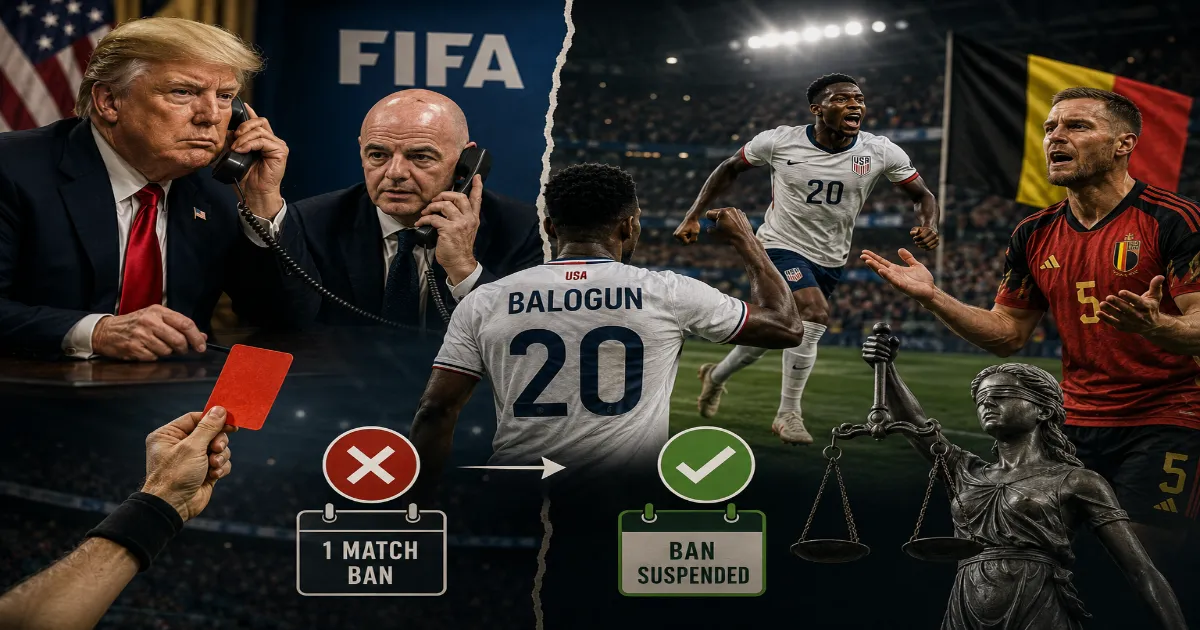
Let’s start with the part everyone can agree on. Folarin Balogun got a straight red card. Under FIFA’s rules, that means an automatic one-match ban. No appeal, no committee vote, no wiggle room. That’s how it’s worked for every World Cup since 1962. That’s how it worked last week, too, for about four days.
Then the phone rang in Zurich. And suddenly, for the first time in the sixty-plus year history of this tournament, the ban wasn’t really a ban anymore.
I’ve covered this sport long enough to know that FIFA is no stranger to controversy. But this one is different, because it isn’t hiding. It’s not a backroom deal we’re piecing together years later from leaked documents. We know exactly who called whom, what was said, and why. And that, honestly, might be the most remarkable part of the whole story.
What Actually Happened, in Plain English
Balogun caught a Bosnian defender awkwardly on the ankle during USA’s win in the round of 32. Red card, straight off. Automatic one-game suspension. He was going to miss the round-of-16 match against Belgium, a genuinely huge game for a USA side co-hosting this World Cup and chasing something special on home soil.
Then President Trump called FIFA president Gianni Infantino. Directly. Reportedly to ask why Balogun got sent off and why that carried an automatic ban. American officials say they handed over “additional evidence,” reportedly focused on how the referee reviewed the slow-motion replay. Within days, FIFA announced Balogun’s ban would be suspended for a one-year probationary period. He played against Belgium.
Trump, never one to stay quiet about a win, posted on Truth Social thanking FIFA for “reversing a great injustice.” Belgium’s federation called itself “astonished” and started looking into its legal options. Their head coach compared FIFA’s decision to an April Fools’ joke, four months late. Gary Neville, never shy with an opinion, said the whole thing “stinks.” I don’t think he was wrong.
Here’s My Problem With It
It’s not that I think Balogun deserved a red card over a yellow. Honestly, plenty of neutral observers thought the challenge was borderline, and Balogun himself said he thought yellow would have been fairer. Referees get calls wrong all the time, and if genuinely new evidence about how the officials reviewed the replay came to light, a review process makes sense in theory.
My problem is with how that review got triggered. It didn’t come from an independent appeals board acting on its own initiative. It came from a head of state calling the head of FIFA directly, on behalf of his own country’s player, during his own country’s World Cup. That’s not a disciplinary process. That’s a favor, dressed up in the language of Article 27.
And look, FIFA does have a rule that technically allows this. Article 27 lets the disciplinary committee suspend the implementation of a sanction and put a player on probation instead. Fine. But rules that exist on paper for everyone tend to get used, in practice, for the very few. This is where selective justice in football stops being an abstract phrase and starts looking like a pattern with names attached.
The Pattern Nobody Wants to Talk About
Because Balogun isn’t actually the first. Not even close.
Cristiano Ronaldo had the final two games of a three-match ban deferred after a red card in a World Cup qualifier against Ireland, which conveniently let him play from the start of this tournament instead of missing its opening games. Argentina’s Nicolás Otamendi and Ecuador’s Moisés Caicedo both had one-game bans from qualifiers deferred too, ensuring neither missed their team’s World Cup opener. None of them needed a presidential phone call. They just needed to be stars, on teams FIFA didn’t want weakened at kickoff.
Go back further and it gets almost funny, in a bleak way. Brazil’s Garrincha was sent off in the 1962 semifinal but still played the final against Chile, after political pressure got applied on his behalf. Sixty-plus years later, and we’re still watching the same movie with a different cast.
Now put that next to Russia. Since 2022, Russian national teams and clubs have been shut out of FIFA and UEFA competition entirely. No case-by-case appeals process softened that. No probationary period. No individual review of any player’s circumstances. Just a blanket ban that has held up through multiple legal challenges. Whatever you think about the reasons behind that exclusion, and there are serious arguments on both sides, the method could not look more different from what just happened with Balogun. One nation gets locked out for years with zero flexibility. One player gets a call from the Oval Office and plays four days later.
“But We Were Still Punished,” Says USA
I want to be fair here, because USA boss Mauricio Pochettino made a real argument, not just spin. He pointed out his team still played thirty-five minutes a man down in a knockout game they had to win. “If anyone was harmed in this whole situation, it was the United States,” he said, and he’s not wrong that USA didn’t get some free pass out of nothing. They paid a price on the pitch before any reversal came.Messi World Cup Goals Record Hits 12, Passing Pele and Mbappe
That’s fair. But it doesn’t really answer the question everyone’s actually asking, which isn’t “did USA suffer during the Bosnia game.” It’s “why did this particular ban get lifted, through this particular channel, when nobody else’s does.” Pochettino’s defense explains why USA aren’t villains. It doesn’t explain why they got an exception that Belgium, or Bosnia, or any smaller federation, would never dream of receiving.
Zoom Out and the Pattern Gets Worse
Here’s the thing that really bugs me about all this. It’s not an isolated blip. Think about how doping cases have historically played out for big footballing nations compared to smaller ones, where the powerful federations somehow always seem to find a longer appeals runway. Think about transfer bans, where a mid-table club gets hammered for a paperwork breach while a giant club with better lawyers negotiates its way to a lighter sanction, or a delayed one. Think about how often, across World Cup after World Cup, the host nation seems to catch the friendlier whistle in the biggest moments. None of these are carbon copies of the Balogun situation. But they’re all cousins of it. Same family resemblance: the sanction bends for whoever has the most leverage to make it bend.
That’s really what selective justice in football means when you strip away the jargon. It’s not that rules don’t exist. It’s that the rules apply with different elasticity depending on who’s standing in front of them. And once you start looking for that pattern, you can’t really unsee it.Erling Haaland: The Goal Machine Rewriting Football’s Record Books
Where This Goes Next Time
Here’s what worries me most, and it’s not really about this specific match. It’s about the template this creates. If a phone call from a head of state, backed up by some video evidence, can get an automatic ban lifted in four days, that becomes a playbook. Every future red card involving a politically connected player, a rich federation, a government willing to make a call, becomes a test of leverage rather than a test of the actual incident. Smaller federations don’t get to run that play. Bosnia and Herzegovina doesn’t have a president dialing Zurich on its behalf. Most of FIFA’s member nations don’t. That’s not a hypothetical risk. That’s just how the world works, and now it’s baked into how World Cup discipline works too.
Fans notice this stuff, even when they can’t always articulate it precisely. Belgian supporters who traveled to Seattle expecting a level playing field watched something happen that had never happened before in the tournament’s history. Whether or not you buy the “it was just correcting a bad call” explanation, the optics alone do damage. Trust in officiating is fragile enough without adding a diplomatic back channel into the mix.
The Article 27 Defense, and Why It Doesn’t Fully Hold Up
FIFA’s official line rests on Article 27 of its disciplinary code, the provision that lets a judicial body suspend a sanction and put a player on probation instead of serving it out immediately. On paper, it’s a reasonable tool. Not every red card is equally deserving of an identical punishment, and a rigid, zero-discretion system would create its own injustices. If a challenge genuinely looked worse in real time than it did on slow-motion replay, a review mechanism should exist to catch that.
My issue isn’t with the existence of Article 27. It’s with who gets to trigger it and how quickly it moves when the right person asks. An independent disciplinary committee reviewing footage on its own initiative, applying the same standard to every red card at the tournament, is one thing. A review that only happens after a president picks up the phone is something else entirely, even if the underlying legal mechanism is identical. The rule being real doesn’t make its selective application fair. Plenty of technically legal decisions still manage to look, and function, like favors.
And if this really was just about correcting a bad call, the obvious fix would be consistency: publish the review, and commit to applying the same standard the next time any nation, not just a World Cup co-host, requests the same kind of look. Somehow, I doubt Bosnia and Herzegovina would get a four-day turnaround if they called Zurich tomorrow asking for a second look at how their own player’s yellow card record was handled this tournament.
Why This Isn’t Really About Balogun At All
I don’t think Balogun did anything wrong here. He’s a footballer who got a big World Cup break go his way, and I doubt many players in his position would turn that down. This isn’t about him. It’s about what it says when the difference between missing a World Cup knockout game and playing in one comes down to whether your country’s president happens to pick up the phone.
Football likes to sell itself as a meritocracy. You earn your place, you follow the same rules as everyone else, and the scoreboard doesn’t care who you know. Moments like this quietly chip away at that idea every time they happen, and they happen more than fans probably realize; we just don’t usually get to see the phone call.
If FIFA wants to keep Article 27 on the books, fine, discretion in disciplinary matters isn’t inherently wrong. But it needs to come with real transparency. Publish the evidence. Publish the reasoning. Apply the same review standard to Bosnia and Herzegovina’s grievances as you would to the United States’. Otherwise, every future red card at a major tournament comes with an asterisk: automatic ban, unless you know somebody.
Belgium’s still weighing its legal options. UEFA says it’ll comment further. None of that will change what happened here. But it should change what happens next time, because there will absolutely be a next time. Selective justice in football doesn’t fix itself. It just waits for whoever picks up the next phone call.
For what it’s worth, I don’t think Trump or Balogun set out to break anything. Presidents champion their national teams all the time, and players take the breaks their federations hand them. The failure sits with the institution that let a four-day, high-profile phone call outrun sixty years of stated precedent. Fix that, and the rest of this story becomes a footnote. Leave it alone, and Balogun’s ban becomes the opening chapter of a much longer one.
Inside Football Academies: How Elite Clubs Build Tomorrow’s Superstars
The Worst Referee Decision of World Cup 2026 — Fan Reactions & VAR Analysis
UEFA Champions League Explained: Format, History & How Teams Qualify
🔹🔹 follow us on facebook 🔹🔹
About the Author