Modern football is a multi-billion-euro industry, but the way individual clubs actually generate their income is often misunderstood. Ticket sales, while visible and emotionally central to the fan experience, are no longer the primary driver of revenue for the world’s biggest clubs. Instead, broadcasting deals and commercial partnerships now do the heaviest lifting.
According to the latest Deloitte Football Money League, the world’s 20 highest-earning clubs generated a combined €12.4 billion in the 2024/25 season, up 11% year-on-year — a record figure driven by growth across all three of football’s core revenue streams: matchday, broadcasting, and commercial income. Here is a complete breakdown of where that money actually comes from.
1. Matchday Revenue
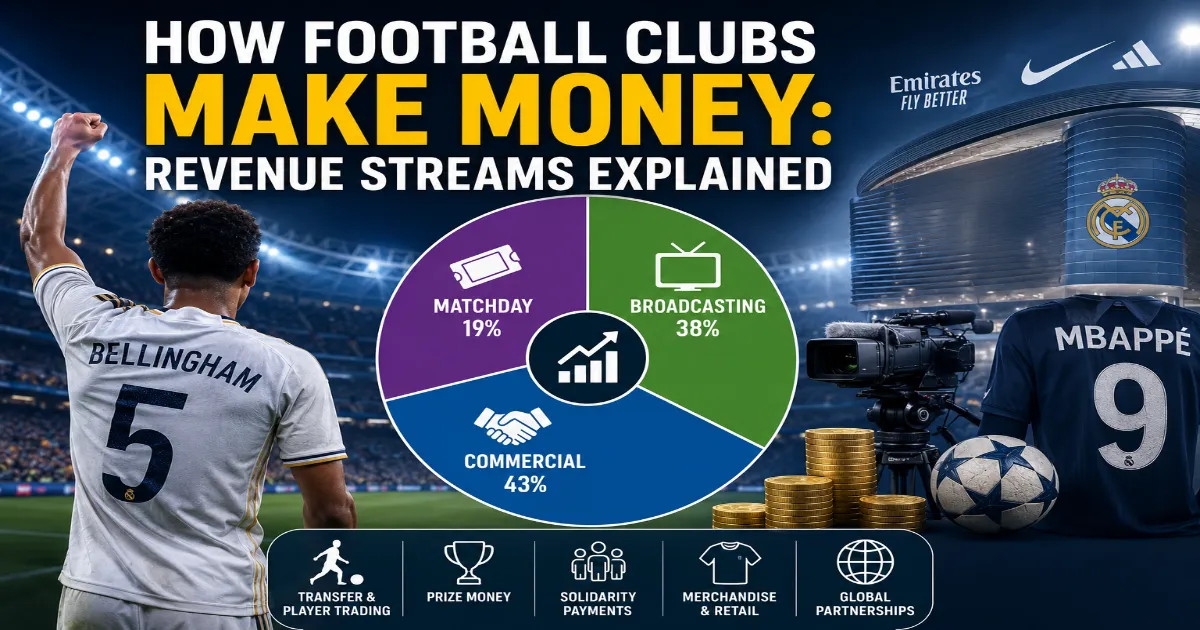
Matchday revenue covers everything a club earns from fans physically attending games: ticket sales, season tickets, premium hospitality boxes, and in-stadium spending on food, drink, and merchandise. Across the top 20 Money League clubs, matchday revenue reached €2.4 billion in 2024/25, accounting for roughly 19% of total revenue — and it was, notably, the fastest-growing of the three revenue streams that year, up 16% on the previous season.
Clubs have increasingly turned to Personal Seat Licenses, premium hospitality tiers, and expanded stadium capacities to grow this income stream. Real Madrid’s renovated Santiago Bernabéu, for example, has become a significant matchday revenue driver in its own right, while a growing number of clubs now treat their stadiums as year-round entertainment venues — hosting concerts, tours, restaurants, and even on-site breweries and hotels to generate income on non-matchdays.
2. Broadcasting Revenue
Broadcasting revenue — the money clubs receive from domestic and international television deals for league and cup competitions — remains the single largest revenue category for most clubs outside the very top tier, and it reached €4.7 billion across the Money League’s top 20 clubs in 2024/25.
This income is generated through several layers:
- Domestic league broadcast deals, negotiated collectively (as in the Premier League) or in some cases individually by club, depending on the league’s model.
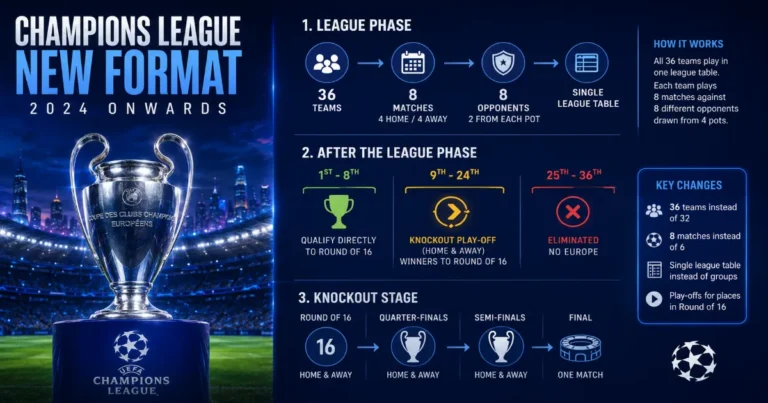
- UEFA competition distributions, from the Champions League, Europa League, and Conference League, which reward clubs based on both participation and performance, plus a market-value coefficient tied to a club’s broadcast appeal.
- Global tournament windfalls, such as the expanded FIFA Club World Cup, which delivered a reported 17% average uplift in broadcast revenue for the ten Money League clubs that participated in 2025.
Broadcasting revenue can swing significantly based on on-pitch performance. Manchester United’s broadcast income, for instance, fell from €258m to €206m in a single season largely due to the club’s absence from the Champions League — a reminder that qualification for European competition is as much a financial necessity as a sporting ambition for clubs at this level.
3. Commercial Revenue
Commercial revenue has become the dominant income stream for the world’s biggest clubs, and for the third consecutive year, it represented the largest share of total revenue among Money League clubs — reaching a record €5.3 billion in 2024/25, the first time any single revenue stream has exceeded the €5 billion mark.
This category includes:
- Shirt and stadium sponsorship deals, such as Real Madrid’s reported €75 million annual sleeve sponsorship agreement.
- Kit manufacturer partnerships with brands like Nike, Adidas, and Puma.
- Retail and merchandising, from replica shirts to licensed products.
- Global partnership and tour income, generated through pre-season tours, brand ambassadorships, and regional sponsorship deals in growth markets such as Asia and North America.
Commercial revenue now accounts for close to half of total income for the very top clubs, and it is increasingly the metric that separates the game’s superclubs from the rest of the elite tier. Real Madrid’s commercial revenue alone — €594 million in 2024/25 — would be enough on its own to place the club among the top ten revenue generators in world football.
4. Transfer and Player Trading Revenue
Beyond the three core streams tracked by the Deloitte Money League, player trading is a major revenue source for many clubs, particularly those outside the very top bracket. This includes:
- Transfer fees received for outgoing players.
- Sell-on clauses, entitling a selling club to a percentage of any future transfer fee if a player is later sold on.
- Loan fees, for temporarily transferring player registrations to other clubs.
For clubs with strong academy systems or effective scouting networks, player trading can be transformed into a genuine profit centre — developing or acquiring players cheaply and selling them on for significant fees. This model has become especially important under Financial Fair Play and Squad Cost Rules, since profit generated through player sales can help clubs stay compliant with spending regulations while still competing for talent.
5. Prize Money and Solidarity Payments
Domestic cup competitions, league finishing position, and continental competitions all carry prize money attached to results, adding another (often unpredictable) layer of income tied directly to sporting performance. Additionally, solidarity payments and training compensation mechanisms mean smaller clubs can earn a financial return when a player they once developed moves on and generates fees or performance-related bonuses further up the football pyramid.Inside Football’s Financial Fair Play Rule and the New Squad Cost Era
Why the Balance of Revenue Streams Matters
The mix between these revenue streams varies enormously depending on a club’s size and market position. Top-ten Money League clubs generate roughly half their income from commercial sources, reflecting their ability to leverage global brand power. Clubs ranked just outside the very elite tier, by contrast, remain considerably more dependent on broadcast revenue — meaning a poor season or failure to qualify for Europe can hit their finances disproportionately hard.
This growing gap between commercially powerful superclubs and broadcast-dependent mid-tier clubs is one of the defining financial storylines in football today, with several clubs actively working to diversify their income — through stadium redevelopment, expanded retail operations, and non-matchday events — to reduce their reliance on the more volatile broadcast and prize-money streams.
The Bottom Line
Modern football clubs are best understood as diversified media and entertainment businesses rather than pure sporting institutions. Matchday income keeps stadiums full and atmospheres alive, broadcasting deals fund the majority of day-to-day operations for most clubs, and commercial partnerships increasingly determine which clubs can compete at the very top of the financial pyramid. Understanding how these revenue streams interact — and which ones a given club depends on most — is essential to understanding the modern game’s underlying economics, transfer strategies, and competitive balance.
▪️▪️ follow us on facebook ▪️▪️
About the Author