Libero : The story of the free-roaming defender who turned Italian football’s back line into an art form
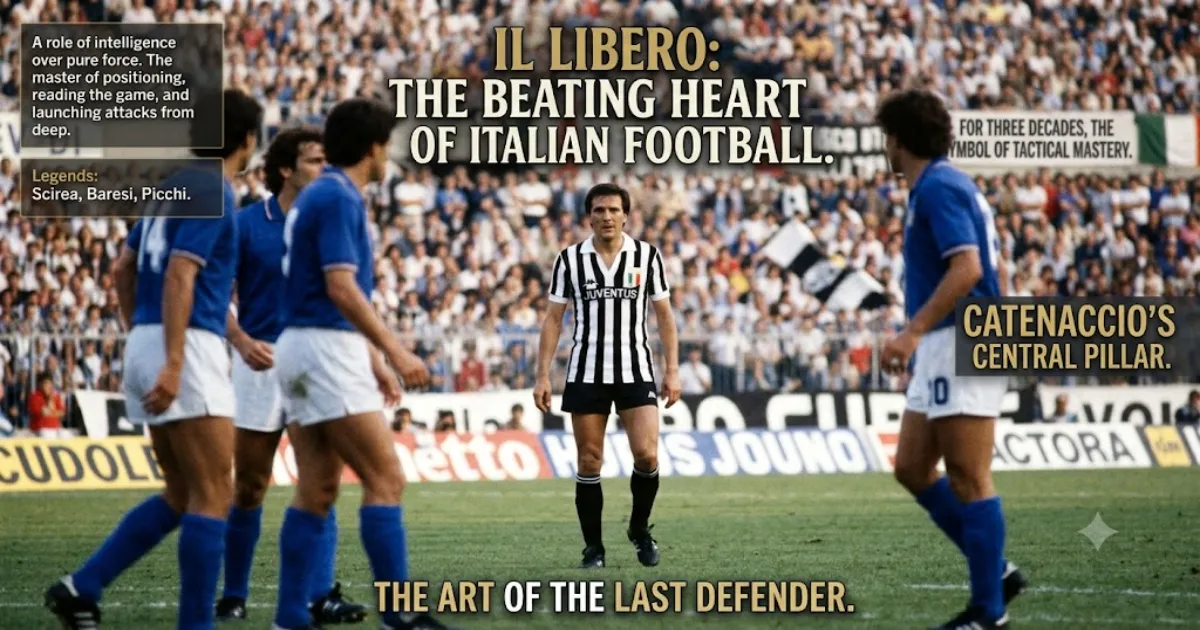
Football has produced plenty of glamorous positions — the playmaker, the winger, the poacher. But few roles have shaped an entire national footballing identity quite like the libero. Italian for “free,” the libero was the free-roaming sweeper who operated behind a team’s back line, unshackled from marking a specific opponent, reading the game, and stepping into midfield whenever the moment demanded it. For three decades, the position was the beating heart of Italian defensive football, and understanding it is essential to understanding how Italy became one of the most tactically influential footballing nations on earth.
Where the Libero Actually Came From
The idea of a free defender wasn’t originally Italian at all. It’s generally traced back to Karl Rappan, an Austrian coach working in Switzerland during the 1930s, who devised a system called the “verrou” — French for “lock” or “bolt.” Rappan’s system used an extra defender positioned behind the rest of the back line, free to cover for teammates and snuff out any attacker who broke through. It was a defensive innovation built for an era when attacking football was starting to overwhelm traditional man-marking systems.
Italian football adopted and refined the concept during the 1950s and 60s, eventually giving it the name catenaccio — “door-bolt” — and the libero became its central pillar. Rather than marking a single opponent like the rest of the defense, the libero sat just behind the last line, ready to intercept anything that slipped through, clear danger, and, crucially, launch attacks the moment possession was won back.
The Grande Inter and the Birth of a Legend
No club did more to popularize the libero than Inter Milan under Argentine-born coach Helenio Herrera in the 1960s. Herrera’s “Grande Inter” side won back-to-back European Cups in 1964 and 1965, built around a defensive structure that suffocated opponents before releasing devastating counter-attacks. At the center of that system was Armando Picchi, an unassuming but supremely intelligent defender who operated as Inter’s libero, reading danger a half-step before it materialized and organizing the defensive line with quiet authority.
Herrera’s system paired Picchi’s sweeping role with an attacking full-back, Giacinto Facchetti, who was given license to bomb forward down the flank — a genuinely radical idea at the time. The combination worked spectacularly. Inter’s catenaccio, built around the libero’s positional freedom, became the most feared defensive setup in European football and heavily influenced how Italian clubs — and eventually the Italian national team — approached the game for a generation.
Gaetano Scirea: The Libero as Artist
If Picchi proved the concept could win trophies, Gaetano Scirea proved it could be beautiful. Playing for Juventus throughout the 1970s and 80s, Scirea redefined what a libero could look like on the pitch — composed under pressure, elegant in possession, and almost impossible to provoke into a rash challenge. He won virtually everything available to a European club defender, including the 1985 European Cup, and was a key figure for Italy’s 1982 World Cup-winning side in Spain, marshaling a defense that shipped remarkably few goals across a tournament studded with attacking talent.
What made Scirea’s version of the libero so influential was his calmness on the ball. Rather than treating the position as purely defensive, Scirea used his freedom from man-marking duties to step into midfield and dictate tempo, effectively functioning as an auxiliary playmaker from deep — a blueprint that later resurfaced in modern ball-playing center-backs decades after his career ended.
Franco Baresi and the Modern Peak
By the 1980s and into the 1990s, Franco Baresi had become the position’s defining figure at AC Milan. Under coach Arrigo Sacchi, Milan actually began shifting away from strict man-marking catenaccio toward a more zonal, pressing-based defensive structure — a tactical revolution in its own right. Yet within that structure, Baresi continued to embody many of the libero’s core principles: reading danger before it developed, sweeping up behind a high defensive line, and stepping forward to launch attacks with a single, incisive pass.
Baresi captained both Milan and Italy for years, anchoring a Milan defense in the late 1980s and early 90s that is still regularly cited among the greatest club backlines ever assembled. His leadership and anticipation made him the last great embodiment of the libero at the very top of the sport, even as football’s tactical trends were beginning to move away from the role entirely.
Franz Beckenbauer: The Libero Beyond Italy
While the position is most closely associated with Italian football, its most famous global ambassador was actually German. Franz Beckenbauer effectively reinvented the libero role for Bayern Munich and West Germany in the 1970s, turning what had traditionally been a purely defensive position into a platform for genuinely attacking football. Rather than simply sweeping up behind his defense, Beckenbauer regularly carried the ball forward himself, orchestrating attacks from deep in a way few defenders before him had attempted. He captained West Germany to World Cup glory in 1974, doing so as an attacking libero — proof that the role, wherever it was played, could be shaped entirely around a single player’s ability to see the game differently than everyone else on the pitch.
Why the Libero Disappeared
If the libero was so effective, why did it vanish from the modern game? Several tactical shifts conspired against it. The introduction of a stricter offside law in the early 1990s made deep, passive defending far riskier, rewarding teams that pushed their entire defensive line higher up the pitch in a coordinated unit rather than relying on one free defender covering behind it. At the same time, the rise of pressing-based football — pioneered by coaches like Sacchi himself — demanded that every outfield player, including defenders, follow strict zonal responsibilities rather than roam freely.
The back four gradually became the default defensive structure across world football, with two center-backs sharing marking duties in a coordinated line rather than one being deployed as a free-roaming sweeper. By the early 2000s, the pure libero had all but disappeared from the elite game, surviving mostly as a tactical relic discussed by coaches and pundits rather than a role clubs actively sought to fill.
The Libero’s Legacy in Today’s Game
Though the position itself has faded, its DNA lives on in modern football more than fans might realize. Today’s ball-playing center-backs — comfortable stepping into midfield, launching attacks with long, precise passing, and reading danger before it fully develops — owe a clear tactical debt to the libero’s original blueprint. The demand for defenders who can do more than simply defend, pioneered by Scirea’s elegance and Beckenbauer’s attacking instincts, is now a basic expectation at the top level of the sport, even if the free, unmarked positioning that defined the role has long since given way to disciplined, zonal defensive lines.
Final Word
The libero was never just a defensive position — it was a statement about how football could be played: with intelligence over pure physicality, and vision over rigid structure. From Karl Rappan’s original defensive lock in Switzerland to Armando Picchi’s quiet authority at Inter, Gaetano Scirea’s elegance at Juventus, and Franco Baresi’s commanding presence at Milan, the role became inseparable from Italy’s footballing identity across three decades of European dominance. Even though the pure libero no longer exists in the modern game, its influence is still visible every time a center-back steps forward with the ball and turns defense into the first act of attack.
How Football Clubs Make Money: Revenue Streams Explained
What Is Gegenpressing? Jurgen Klopp’s Counter-Press Philosophy Explained
How Do Football Agents Work? The Business Behind Every Transfer
▪️▪️ follow us on facebook ▪️▪️
About the Author