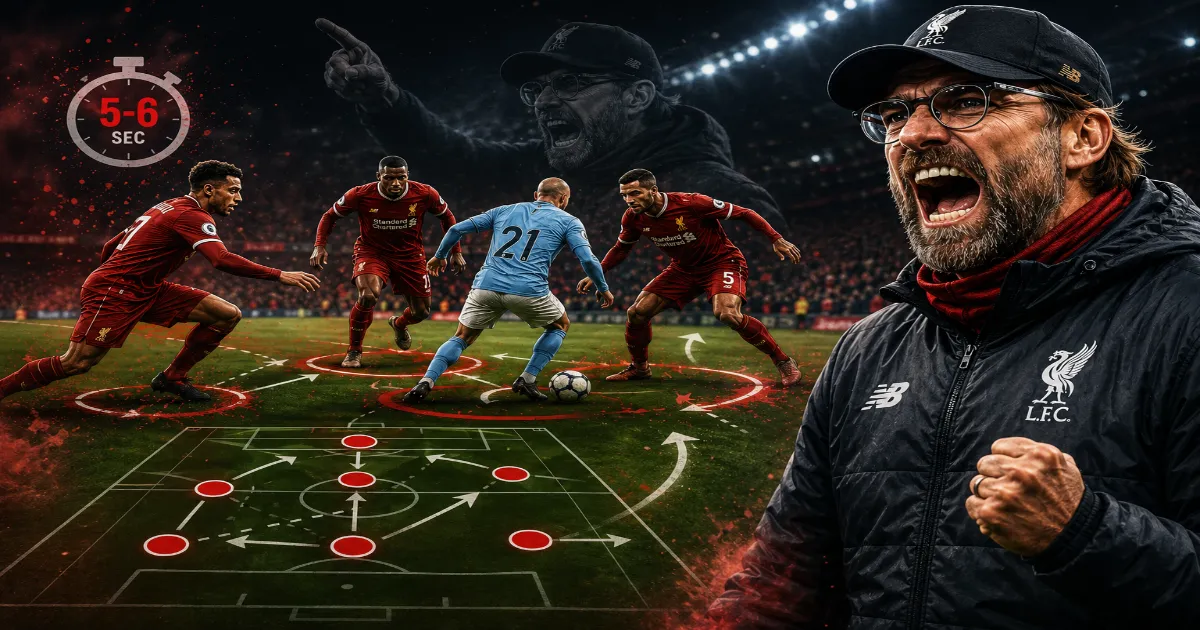
The Philosophy Behind Jurgen Klopp’s System- Gegenpressing
Few tactical terms have entered mainstream football conversation the way gegenpressing has. Translated loosely from German as “counter-pressing,” it is the idea most closely associated with Jurgen Klopp, the manager who turned it from a niche pressing trigger into a full-blown footballing identity at Borussia Dortmund and later Liverpool. But gegenpressing is more than a buzzword — it is a specific, disciplined way of thinking about the moment a team loses the ball, and it reshaped how much of modern football approaches transitions.
LaLiga 2026/27 Schedule: Fixtures, Dates & Times
What Is Tiki-Taka? Spain’s Football Philosophy Explained Simply
The Tactical Trends That Defined World Cup 2026
This piece breaks down what gegenpressing actually is, how it works on the pitch, why Klopp built his entire footballing philosophy around it, and where the idea sits in football today.The Tactical Trends That Defined World Cup 2026
What Does Gegenpressing Actually Mean?
At its simplest, gegenpressing is the act of pressing the opponent immediately after losing possession, rather than retreating into a defensive shape. Instead of treating a turnover as the moment to regroup, gegenpressing treats it as the best possible moment to win the ball back — because the opponent has just switched from a defensive mindset to an attacking one, and their shape is at its most disorganised.
Klopp himself has described the logic in blunt terms over the years: no playmaker in the world is as good as a well-executed counter-press, because it turns the opponent’s own attacking transition into a defensive crisis for them, often within five or six seconds of losing the ball.Every Football Position Explained: What Each Player Actually Does
The Core Principles Behind the System
Gegenpressing is not simply “press hard after losing the ball.” It is built on a set of specific principles that separate it from generic high-intensity football.
1. The five-second rule. Klopp’s teams are drilled to swarm the ball-carrier the instant possession is lost, with the aim of regaining the ball within roughly five to six seconds. If the ball isn’t won back in that window, the team drops into its regular defensive block rather than continuing to chase.
2. Compact vertical spacing. Gegenpressing only works if the distance between the front line and the defensive line is short. Klopp’s sides typically play with a high defensive line and a front line pushed up close behind it, minimising the space an opponent can exploit if they escape the initial press.
3. Pressing triggers, not blind chasing. Specific situations — a heavy touch, a pass played backward or square, a receiver with their back to goal — act as triggers that tell the team when to spring the press collectively, rather than individual players chasing the ball in isolation.Every Football Position Explained: What Each Player Actually Does
4. Central overloads. The press is usually most aggressive in central areas, since winning the ball back there creates the highest-value attacking opportunities — shorter distances to goal and fewer defenders to beat.
5. Fitness as a tactical weapon. Gegenpressing places enormous physical demands on players, which is why Klopp’s most effective sides have always been built around exceptional conditioning programs, rotation policies, and squads capable of sustaining high-intensity pressing across a full 90 minutes and a long season.
How Klopp Built the Philosophy: Mainz, Dortmund, Liverpool
Klopp’s association with gegenpressing began at Mainz 05 in the early 2000s, but it was at Borussia Dortmund, between 2008 and 2015, that the system became a genuine footballing identity. Dortmund’s back-to-back Bundesliga titles in 2011 and 2012, built around a young, athletic squad including Mario Götze, Robert Lewandowski, and İlkay Gündoğan, showcased gegenpressing at its most devastating — a team that could turn defensive transitions into some of the fastest, most direct attacking sequences in Europe.The Tactical Case for Rafael Leão at World Cup 2026
At Liverpool, from 2015 to 2024, Klopp refined the system further, pairing it with a front three of Mohamed Salah, Sadio Mané, and Roberto Firmino whose work rate off the ball was as important as their output in front of goal. Firmino in particular became the archetypal gegenpressing forward — a player whose defensive positioning and pressing intelligence often mattered more to the system than his goal tally. The result was a Premier League title in 2020 and a Champions League triumph in 2019, delivered by a Liverpool side widely regarded as one of the most cohesive pressing units English football has seen.
Why Gegenpressing Changed Modern Football
Before gegenpressing became mainstream, most teams treated losing the ball as a cue to retreat and reorganise. Klopp’s version of the idea — refined alongside contemporaries like Ralf Rangnick, who is often credited as an early pioneer of counter-pressing principles in the Bundesliga — helped popularise a broader shift in football toward viewing the transition moments, both winning and losing the ball, as equally important tactical phases as settled possession.The 10 Fastest Footballers Ever — Science, Stats & Records
Its influence is visible well beyond Klopp’s own teams. Elements of gegenpressing principles have been absorbed into the pressing structures used by managers across Europe’s top leagues, even among sides that don’t set out to be “gegenpressing teams” in the purest sense. The idea that the first five seconds after losing the ball are a genuine attacking opportunity, rather than purely a defensive emergency, is now a standard part of elite coaching education.
Where Gegenpressing Sits Today
Klopp left Liverpool in 2024 after nine years in charge, citing a need to step back from the intensity of week-to-week club management, and has since worked as Red Bull’s global head of football — a role that has put him at the center of pressing philosophy across the group’s network of clubs, including RB Leipzig, a side long associated with high-press principles. Reports in July 2026 have linked Klopp with a return to the touchline as Germany’s national team manager, following Julian Nagelsmann’s departure after Germany’s World Cup exit — a move that, if confirmed, would bring gegenpressing principles to the international stage for the first time under Klopp’s own direction.
Whether or not that move materialises, gegenpressing’s place in football’s tactical vocabulary is already secure. It remains one of the clearest examples of a single coach’s philosophy reshaping how an entire sport thinks about the moment the ball changes hands.
Champions League 2026/27 Schedule: Fixtures, Dates & Times
Premier League 2026/27 Schedule: This Week and Next Week
Bangladesh Create History in Darwin, Defeat Australia by Nine Wickets in Landmark Test Victory
▪️▪️ follow us on facebook ▪️▪️
About the Author