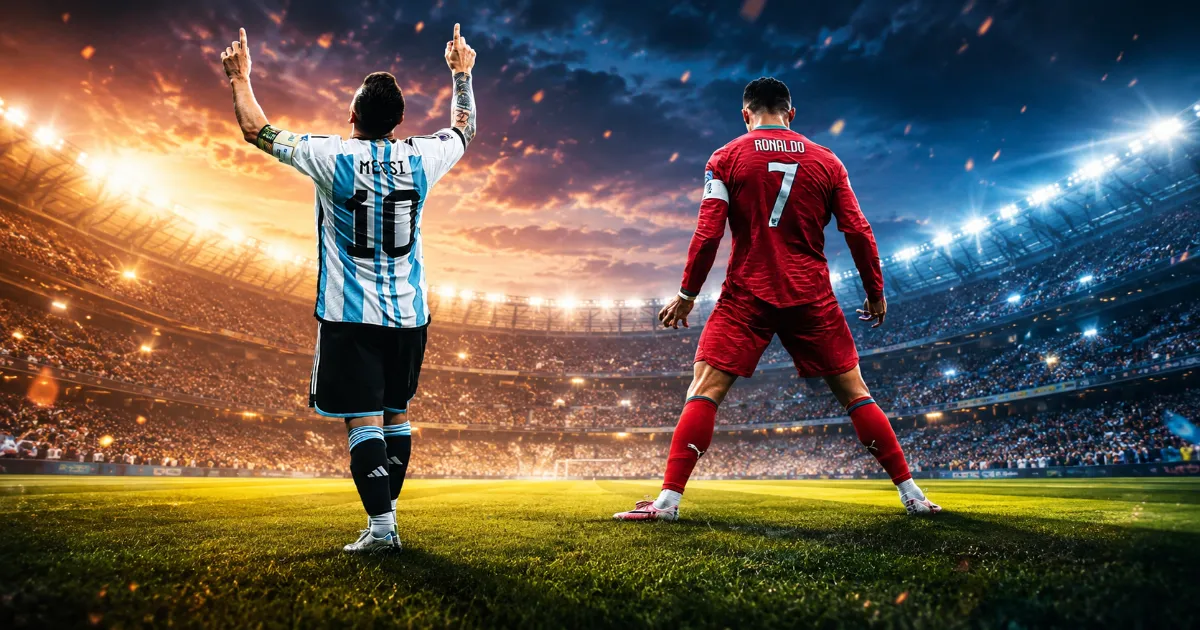
 The End of an Era: What Football After Messi and Ronaldo Will Look Like
For more than a decade, football has revolved around a question that seemed almost impossible to answer: Lionel Messi or Cristiano Ronaldo? The argument was never simply about goals. It was about style, trophies, records, longevity, leadership, personality and the ability to repeatedly produce decisive moments on the biggest stages. Now, after the 2026 FIFA World Cup, that debate has entered a very different phase. Both players have completed six World Cup appearances, both have written records that may survive for generations, and both are approaching the closing stages of careers that fundamentally changed how greatness is measured.
Messi’s Last World Cup? The Signs Are Hard to Ignore
Ronaldo World Cup 2026: Six Tournaments, One Missing Trophy, One Last Chance
Messi’s 2026 campaign was particularly remarkable. At 39, he helped Argentina reach another World Cup final, scoring eight goals and providing four assists across the tournament. Argentina ultimately lost 1-0 to Spain after extra time, but Messi finished the competition with another major individual accolade and added several records to an already extraordinary World Cup résumé.
Ronaldo’s tournament ended earlier. Portugal were eliminated by Spain in the Round of 16, but the Portuguese forward still became the first player to score at six different World Cups. His 2026 campaign added another chapter to a World Cup career that began with Portugal in Germany in 2006.
The important point is that this is not necessarily the story of two players suddenly becoming irrelevant. It is the story of football finally moving toward a future in which neither man can reasonably be expected to define every major conversation.Messi vs Ronaldo: The Definitive Statistical Comparison — Every Number, Every Record, One Verdict
Two Players Who Created Their Own Statistical Universe
The Messi-Ronaldo rivalry was extraordinary because both players became statistical outliers at the same time. In most generations, one exceptional forward dominates the scoring charts for several years before another takes over. Messi and Ronaldo instead pushed each other to unprecedented levels for roughly fifteen years.
Messi developed into perhaps the most complete attacking creator of his generation, combining goals, assists, dribbling, passing and chance creation. Ronaldo evolved from an explosive winger into an extraordinarily efficient penalty-box scorer whose movement, aerial ability and finishing remained elite long after his explosive pace began to decline.
Their career records illustrate just how unusual the era has been.From Roberto Carlos to Messi: Ranking the Best Free Kicks in History
Messi vs Ronaldo: Career Record Snapshot
| Category | Lionel Messi | Cristiano Ronaldo |
|---|---|---|
| Birth year | 1987 | 1985 |
| Senior international debut | 2005 | 2003 |
| Argentina/Portugal caps | 206 | 233 |
| International goals | 125 | 146 |
| World Cups played | 6 | 6 |
| World Cup appearances | 34 | 27 |
| World Cup goals | 21 | 11 |
| World Cup assists | 12 | 2 |
| World Cup titles | 1 | 0 |
| Champions League titles | 4* | 5 |
| Ballon d’Or | 8 | 5 |
| UEFA Champions League goals | 129* | 140 |
| Copa America/Euro major international titles | 2 Copa América + Finalissima | Euro 2016 + 2 Nations League |
| Current club in 2026 | Inter Miami | Al Nassr |
*Messi’s Champions League title total includes three wins with Barcelona after his first-team breakthrough; UEFA notes that he was not part of Barcelona’s 2006 final squad. Ronaldo remains the Champions League’s leading scorer with 140 goals and has won the competition five times.
The international numbers are especially striking. Messi now holds Argentina records for appearances and goals, with 206 caps and 125 goals according to UEFA’s latest record summary. Ronaldo holds the corresponding global men’s records for international appearances and goals with 233 and 146.The Weirdest Football Superstitions Even Messi, Ronaldo and Neymar Swear By
Their League Records Tell Two Very Different Stories
The domestic careers of Messi and Ronaldo also reveal how differently their games developed. Messi spent the overwhelming majority of his European prime at Barcelona, where his relationship with the club’s possession-based football allowed him to become both scorer and creator. His later spells at Paris Saint-Germain and Inter Miami demonstrated that he could remain influential even after leaving Barcelona’s familiar tactical environment.
Ronaldo’s league career was more geographically diverse. He established himself at Manchester United, became a global superstar at Real Madrid, won Serie A with Juventus and then moved to Al Nassr. His ability to produce goals across England, Spain, Italy and Saudi Arabia is one of the strongest arguments for his extraordinary adaptability.
Major Domestic League Records
| League / Category | Lionel Messi | Cristiano Ronaldo |
|---|---|---|
| La Liga | 474 goals | 311 goals |
| Premier League | — | 103 goals |
| Serie A | — | 81 goals |
| Ligue 1 | 22 goals | — |
| MLS | Continued scoring/creating for Inter Miami | — |
| Saudi Pro League | — | 2025/26: 28 goals in 30 appearances |
| European Golden Shoes | 6 | 4 |
| Major European leagues won | La Liga multiple times | Premier League, La Liga, Serie A |
| League clubs | Barcelona, PSG, Inter Miami | Sporting CP, Manchester United, Real Madrid, Juventus, Al Nassr |
Ronaldo’s most recent Saudi league campaign reinforces the point that his scoring ability has not disappeared with age. The Saudi Pro League records him with 28 goals in 30 appearances during 2025/26, helping Al Nassr win the league title.
That is an important distinction when discussing the end of the era. Neither player is simply surviving on reputation. Their environments have changed, their physical profiles have changed and their responsibilities have changed, but both have continued to produce.
Club Records: Messi’s Creation vs Ronaldo’s Scoring
The club comparison is where the rivalry becomes particularly fascinating. Ronaldo has the stronger Champions League résumé, while Messi’s Barcelona career produced an extraordinary combination of goals and creative output.
Ronaldo owns the major Champions League scoring records: 140 goals, 183 appearances and 67 knockout-stage goals according to UEFA. He also holds the competition’s single-season scoring record of 17 goals, achieved during Real Madrid’s 2013/14 campaign.How Lionel Messi Has Inspired Argentina’s Journey to Another World Cup Final
Cristiano Ronaldo Retirement: What Comes Next After His Final World Cup
Messi’s European record is different. UEFA lists him among the players to have scored more than 100 goals in UEFA club competitions and notes that he reached 700 club goals during his time at Paris Saint-Germain.
Champions League and Club Competition Records
| Record | Lionel Messi | Cristiano Ronaldo |
|---|---|---|
| Champions League titles | 4 | 5 |
| Champions League goals | 129* | 140 |
| Champions League appearances | 163* | 183 |
| Champions League knockout goals | — | 67 |
| Most goals in one UCL season | 14 | 17 |
| UEFA club competition goals | 129+ | 145 |
| European clubs | Barcelona, PSG | Sporting CP, Man United, Real Madrid, Juventus |
Ronaldo’s Champions League dominance is arguably the clearest statistical area where he has separated himself from Messi. UEFA describes him as the competition’s all-time leading scorer and the first player to win the trophy five times.
International Football: Messi Has the World Cup, Ronaldo Has the Numbers
If club football gives Ronaldo a significant advantage in Champions League history, international football produces a much more complicated comparison.
Messi’s greatest achievement is obvious: he won the World Cup in 2022. He also won Copa América in 2021 and 2024 and the Finalissima in 2022, transforming an Argentina career that once contained repeated disappointments into one of the most successful international résumés in the country’s history.
Ronaldo’s Portugal won Euro 2016 and the UEFA Nations League twice, but he never lifted the World Cup. That missing trophy remains the one obvious gap in an otherwise extraordinary international career.
International Records
| International Record | Lionel Messi | Cristiano Ronaldo |
|---|---|---|
| National team | Argentina | Portugal |
| Caps | 206 | 233 |
| Goals | 125 | 146 |
| World Cups | 6 | 6 |
| World Cup goals | 21 | 11 |
| World Cup appearances | 34 | 27 |
| Major World Cup title | 2022 | None |
| Continental major title | Copa América 2021, 2024 | Euro 2016 |
| Nations League | — | 2019, 2025 |
| Finalissima | 2022 | — |
| World Cup Golden Ball awards | 2 | 0 |
| International scoring record | Argentina/South America | Men’s world record |
Messi’s 2026 tournament pushed him to 21 World Cup goals and 34 appearances, while also taking his World Cup assists total to 12. UEFA lists him as Argentina’s record holder for appearances, goals and several World Cup milestones.
Ronaldo, meanwhile, finished his World Cup career with 11 goals and 27 appearances. His defining record is different: he scored at six separate World Cups, something no other men’s player had previously achieved.
World Cup Records: The Greatest Tournament Comparison
The World Cup is where Messi and Ronaldo’s careers can be compared most cleanly because both played in six editions.
Messi debuted in 2006 as a teenager and ultimately appeared at six tournaments: 2006, 2010, 2014, 2018, 2022 and 2026. Ronaldo followed the same six-tournament path from 2006 through 2026.
But their tournament stories were very different.
Previous FIFA World Cup Performance
| World Cup | Lionel Messi | Cristiano Ronaldo |
|---|---|---|
| 2006 | Quarter-final | Semi-final |
| 2010 | Quarter-final | Round of 16 |
| 2014 | Runner-up | Group stage |
| 2018 | Round of 16 | Round of 16 |
| 2022 | Champion | Quarter-final |
| 2026 | Runner-up | Round of 16 |
| Total appearances | 34 | 27 |
| Total goals | 21 | 11 |
| Total assists | 12 | 2 |
Messi’s World Cup trajectory is particularly unusual because his first four tournaments ended without a title, including the 2014 final defeat to Germany. He then captained Argentina to the trophy in Qatar in 2022 before leading the team back to the final in 2026.
Ronaldo reached the semifinals in his first World Cup in 2006 but never returned to that stage. His best subsequent finishes were the quarter-finals in 2022 and the Round of 16 in 2018 and 2026.
FIFA World Cup 2026: Messi’s Final Masterpiece
The 2026 World Cup may ultimately be remembered as Messi’s most extraordinary individual tournament even though Argentina did not win it.
At 39, Messi produced eight goals and four assists in seven matches, according to Reuters, helping Argentina reach the final.
His campaign combined production with longevity. He finished the tournament with 34 World Cup appearances overall, the most ever, and 21 goals. His nine-match scoring streak across World Cup appearances is another record that now defines his tournament legacy. UEFA also records him as the only player to score across the group stage, Round of 16, quarter-final, semifinal and final during a World Cup career.
Messi’s 2026 World Cup Record
| Statistic | Messi — 2026 |
|---|---|
| Matches | 7 |
| Goals | 8 |
| Assists | 4 |
| Goal contributions | 12 |
| Final | Argentina 0-1 Spain |
| Finish | Runner-up |
| World Cup appearances after tournament | 34 |
| World Cup goals after tournament | 21 |
| World Cup assists after tournament | 12 |
| Tournament distinction | Silver Ball |
| Age | 39 |
The final against Spain was ultimately the only missing piece. Argentina lost 1-0 after extra time, meaning Messi finished his sixth World Cup as runner-up rather than champion.
FIFA World Cup 2026: Ronaldo’s Final Tournament
Ronaldo’s 2026 World Cup was a very different experience. Portugal progressed from the group stage but were eliminated by Spain 1-0 in the Round of 16. He scored three goals during the tournament and finished with five appearances. IFFHS records his 2026 campaign at five matches, three goals and 441 minutes.
Ronaldo’s 2026 World Cup Record
| Statistic | Ronaldo — 2026 |
|---|---|
| Matches | 5 |
| Goals | 3 |
| Assists | 0 |
| Minutes | 441 |
| Portugal’s finish | Round of 16 |
| Eliminated by | Spain, 0-1 |
| World Cups | 6 |
| World Cup goals | 11 |
| World Cup appearances | 27 |
| Historic record | Scored at six World Cups |
The tournament therefore delivered a mixture of achievement and disappointment. Ronaldo became the first man to score at six World Cups, but Portugal could not reproduce the deep run required to give him a realistic opportunity to challenge for the trophy he never won.
The Awards Table: Another Extraordinary Duel
The Ballon d’Or is probably the single clearest measurement of how completely these two players dominated individual football awards.
Messi has won the award eight times, while Ronaldo has five. The most recent winner from this era was Messi in 2023; Ousmane Dembélé won the 2025 edition.
Major Individual Awards
| Award / Achievement | Lionel Messi | Cristiano Ronaldo |
|---|---|---|
| Ballon d’Or | 8 | 5 |
| FIFA World Player/The Best-era major awards | Multiple | Multiple |
| European Golden Shoe | 6 | 4 |
| World Cup Golden Ball | 2 | 0 |
| Champions League top scorer awards | 6 | 7 |
| UCL Player/Best Player-type UEFA awards | — | 4 |
| World Cup titles | 1 | 0 |
| Champions League titles | 4 | 5 |
Messi’s two World Cup Golden Balls are particularly significant because they span eight years: he won the award in 2014 despite Argentina losing the final and again in 2022 when Argentina lifted the trophy. UEFA confirms that he is the only player with two World Cup Golden Balls.
The Records That May Never Be Broken
Some records are likely to survive the Messi-Ronaldo era simply because modern football makes them extremely difficult to reproduce.
Ronaldo’s 140 Champions League goals, five Champions League titles and 183 appearances create a statistical mountain for any future player. UEFA also credits him with 67 knockout-stage goals and 17 goals in a single Champions League season.
Messi’s World Cup numbers could prove equally difficult to approach. His 34 appearances, 21 goals, 12 assists, nine-match scoring streak and two Golden Balls represent an extraordinary combination of longevity and tournament productivity.
The Most Difficult Records to Chase
| Record | Holder |
|---|---|
| Most international men’s goals | Cristiano Ronaldo — 146 |
| Most international men’s appearances | Cristiano Ronaldo — 233 |
| Most World Cup appearances | Lionel Messi — 34 |
| Most World Cup goals | Lionel Messi — 21 |
| Most World Cup assists | Lionel Messi — 12 |
| Most World Cup match wins | Lionel Messi — 23 |
| Most World Cup Golden Balls | Lionel Messi — 2 |
| Most World Cups scored in | Cristiano Ronaldo — 6 |
| Most Champions League goals | Cristiano Ronaldo — 140 |
| Most Champions League titles by a player | Cristiano Ronaldo — 5 |
| Most UCL goals in one season | Cristiano Ronaldo — 17 |
| Most Ballon d’Or awards | Lionel Messi — 8 |
What Happens to Football After Messi and Ronaldo?
This is where the story becomes much more interesting than a simple statistical comparison.
Football will not suddenly become less talented when Messi and Ronaldo leave. In fact, the opposite is likely. Kylian Mbappé, Erling Haaland, Lamine Yamal and a growing group of younger stars are already capable of producing numbers that would have been considered extraordinary in previous generations.
What disappears is concentration.
For almost twenty years, two players occupied an enormous percentage of football’s attention. Every Champions League campaign became a chance to compare their numbers. Every Ballon d’Or race became a referendum on their performances. Every World Cup created another chapter in their parallel international stories.
That will probably not happen again in quite the same way.
The next generation is likely to produce several superstars rather than another two-player monopoly. Mbappé has already established himself as a historic World Cup scorer, while Haaland represents a completely different type of attacking dominance. Younger players such as Yamal could eventually become the faces of the sport, but expecting any one player to replicate the combined longevity, production and global rivalry of Messi and Ronaldo would be unrealistic.
The Biggest Difference Between Their Legacies
Ultimately, the Messi-Ronaldo debate may never have a universally accepted answer because their greatness came from different places.
Messi’s legacy is built around extraordinary technical control, creativity, playmaking, goals and the ability to dictate matches from multiple positions. His international career also finished with the one trophy that had been missing for so long: the World Cup.
Ronaldo’s legacy is built around evolution. He transformed himself from a talented winger into one of football’s greatest goal scorers, conquered multiple leagues, became the Champions League’s record scorer and maintained extraordinary international production into his forties.
The final statistics therefore tell two different stories rather than one definitive verdict.
Messi owns the stronger World Cup résumé and more Ballon d’Or awards. Ronaldo owns the Champions League scoring record, more international goals and more international appearances. Messi has the World Cup trophy; Ronaldo has five Champions League titles. Messi has 21 World Cup goals; Ronaldo has scored at six different tournaments.
That is why the rivalry survived for so long. There was never one category in which every argument ended.
The End of the Era Is Finally Visible
The 2026 World Cup did not necessarily provide a definitive farewell for either player. Messi has not announced a retirement, and Argentina Football Association president Claudio Tapia recently stressed that Messi alone will decide when he wants to stop playing. Ronaldo’s future also remains tied to Al Nassr, where he remains a major part of the club’s plans after a 28-goal Saudi Pro League season.
But something has undeniably changed.
The question is no longer whether Messi and Ronaldo will eventually leave football. It is what football will feel like when neither is there.
For a generation of supporters, they were not simply two great footballers. They were the reference points through which greatness itself was measured.
And that is what makes the end of this era so significant. Football will continue. New rivalries will emerge. New records will fall. New teenagers will become global stars.
But there will probably never again be another generation in which two players simultaneously reached this level, maintained it for this long, and forced the entire football world to spend nearly two decades asking the same impossible question:
Messi or Ronaldo?
🔹🔹 Follow Us on Facebook 🔹🔹
About the Author

1 thought on “Football After Messi and Ronaldo: 7 Ways the Game Will Change After an Unforgettable Era”