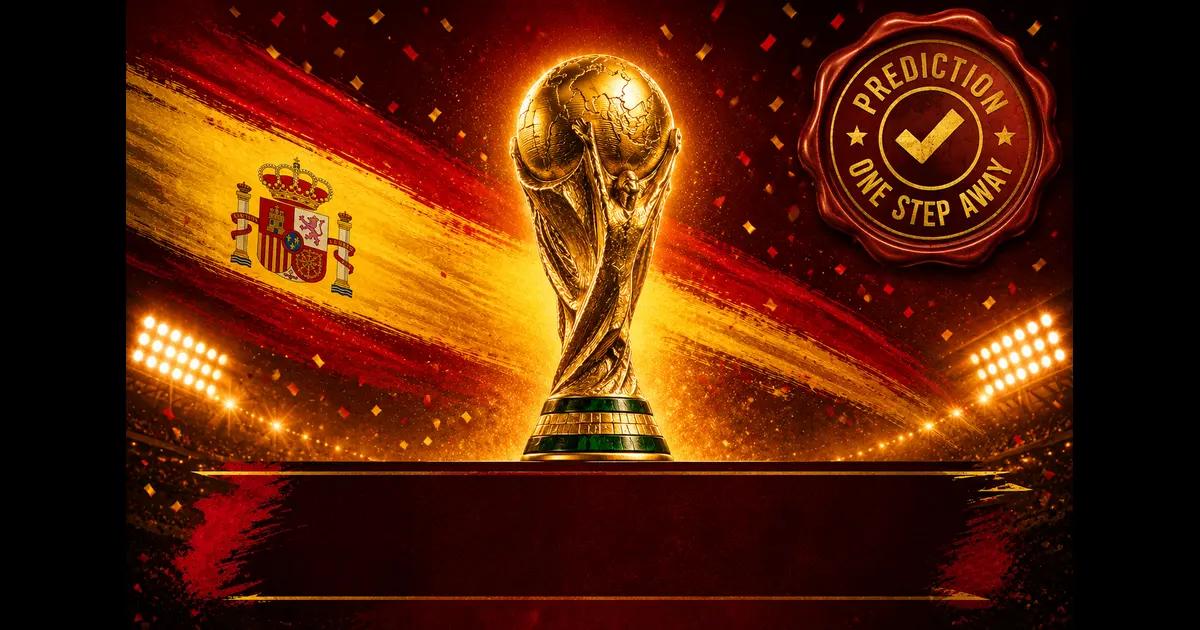
 After reaching the FIFA World Cup Final, Spain are one victory away from fulfilling our Spain World Cup Prediction.
On June 5, before a ball had been kicked at the 2026 FIFA World Cup, StrikerReport predicted Spain would lift the trophy. Six weeks later, Luis de la Fuente’s side stand one victory away from turning that call into history.
There is a meaningful difference between a prediction made after a tournament has already revealed its shape and one made before the opening whistle has even sounded. Once matches begin, every opinion is inevitably colored by results, injuries, momentum and the narratives that inevitably attach themselves to a month-long competition. Before the 2026 World Cup kicked off, none of that context existed. There was only analysis, instinct and a genuine willingness to back a judgment that carried real risk.
On June 5, 2026, StrikerReport published its official tournament prediction and backed Spain to be crowned world champions.
LaLiga 2026/27 Schedule: Fixtures, Dates & Times
Champions League 2026/27 Schedule: Fixtures, Dates & Times
Premier League 2026/27 Schedule: This Week and Next Week
At the time, it was far from the obvious pick. Argentina arrived as the defending champions, chasing a feat no side had managed since Brazil’s back-to-back titles in 1958 and 1962. France came in with Kylian Mbappé chasing history, still riding the momentum of his unforgettable performances at Qatar 2022. England possessed arguably their deepest and most talented squad in a generation, while Brazil and Portugal sat among the bookmakers’ favorites in their own right.
Spain, by comparison, entered the tournament with quieter expectations. They were respected, certainly, as the reigning European champions. But they were not widely feared.
Six weeks later, they are one match away from lifting the World Cup.
Why Spain Stood Out Before a Ball Was Kicked
The prediction was never built around a single transcendent superstar, the way a case for Argentina or France so obviously could be. It was built around something considerably harder to quantify in advance, but which often matters more across a month of knockout football: balance.
Spain arrived with one of the youngest squads among the tournament’s genuine contenders, yet also one of the most tactically mature. Luis de la Fuente had spent months constructing a team capable of dominating possession without becoming predictable, pressing aggressively without leaving itself exposed in behind, and adjusting its approach from opponent to opponent without ever abandoning its underlying identity.
That combination looked, on paper, tailor-made for tournament football — the kind of team equipped to survive not just the matches it was favored to win, but the ones in which it wouldn’t be.
Unlike several of the tournament’s other contenders, who leaned heavily on one or two individual match-winners, Spain entered the competition with credible goal threats scattered across the pitch. Midfield remained the team’s clearest strength, anchored by Rodri’s control and range, while defensive organization had quietly become one of the side’s defining characteristics rather than an afterthought behind a flashier attack.
Those qualities have proven decisive at every stage of the tournament since.
A World Cup Built on Control, Not Chaos
Spain’s route to the final has not been paved with dramatic late escapes or knockout-stage miracles, at least not until they were the ones administering the damage. Instead, it has reflected a team that has consistently seized control of matches before its opponents could ever establish momentum of their own.
The midfield dictated tempo. The defensive line stayed compact and disciplined. Possession was rarely surrendered cheaply, and even against elite opposition, Spain looked comfortable without ever needing to chase a game from behind. Heading into the semifinal, La Roja had not conceded a single goal across their first five matches of the tournament — a defensive record matched by almost no other contender in the competition.
Every knockout victory reinforced the same underlying impression: this was not simply a talented collection of individuals, but a team playing with a clear, coherent footballing identity. As several of the tournament’s other pre-tournament favorites stumbled through inconsistent form, Spain grew more convincing with every round they survived.
The Semifinal That Confirmed Everything
If there remained any lingering doubt about Spain’s credentials, the semifinal against France erased it entirely.
France arrived in Arlington, Texas, having won all six of their previous matches and scored 16 goals along the way, riding another sensational individual tournament from Mbappé. Didier Deschamps’ side looked capable of becoming just the third nation in history to reach three consecutive World Cup finals. Instead, Spain produced arguably the most complete performance of the entire tournament, winning 2-0 at AT&T Stadium to book their first World Cup final appearance since 2010.
Mikel Oyarzabal opened the scoring in the 22nd minute, converting a penalty won by 19-year-old Lamine Yamal — celebrating his birthday just a day earlier — after French left-back Lucas Digne caught him with a mistimed clearance inside the box. Pedro Porro doubled Spain’s advantage in the 58th minute, finishing a move crafted by Dani Olmo to put the result beyond meaningful doubt. Spain repeatedly crowded Mbappé in transition throughout, limiting his touches in dangerous areas and neutralizing the player who had entered the match as the tournament’s Golden Boot leader. Ousmane Dembélé and Michael Olise, both central to France’s attacking surge through the earlier rounds, were similarly subdued.
“We didn’t play the game we wanted, technically or tactically,” Mbappé admitted afterward. “When you don’t do what you have to do in a World Cup semifinal, you don’t win.” It was a rare moment of a genuine superstar conceding, without qualification, that he had been outplayed — and it stood as the clearest confirmation yet of exactly why Spain had been selected as StrikerReport’s pre-tournament favorites in the first place. This was a victory built on structure, patience and collective intelligence, not individual improvisation.
The Players Who Have Defined Spain’s Run
While Spain have operated throughout this tournament as one of its strongest collective units, several individuals have elevated the team precisely when it mattered most.
Lamine Yamal has continued to show a level of composure that belies his age, repeatedly influencing matches against far more experienced international defenders — his role in winning the decisive penalty against France arriving, fittingly, the day after his 19th birthday. Pedri has controlled the rhythm of matches from midfield with a maturity beyond his own years, while Rodri has once again reminded the football world why he is regarded as among the most complete holding midfielders in the sport.
Further forward, Dani Olmo and Mikel Oyarzabal have delivered crucial, momentum-shifting goals at key moments, while goalkeeper Unai Simón has produced the composed, timely saves that a team built on defensive control ultimately depends on to protect its advantage.
Perhaps Spain’s greatest collective strength, though, is that no single player has been forced to carry the entire burden alone. Different heroes have emerged in different matches, at different stages of the competition. That, more often than not, is the hallmark of genuine champions rather than a team simply riding one exceptional talent.
One Final Obstacle
Standing between Spain and the trophy is Argentina.
The defending champions once again demonstrated their particular brand of championship resilience in a dramatic semifinal victory over England in Atlanta, coming from behind to win 2-1. Anthony Gordon had given England the lead, and Thomas Tuchel’s side held that advantage deep into the second half before Argentina, trailing for the fourth consecutive knockout match this tournament, once again refused to fold. Enzo Fernández leveled the match, before Lautaro Martínez rose to head home the winner in the second minute of nine minutes of stoppage time — both goals created by Lionel Messi, who continues to produce decisive moments precisely when his country has needed him most.
“I think that this team plays its best when we are facing a difficult situation, with adversity,” Argentina coach Lionel Scaloni said afterward. “We had a challenging game, a challenging situation. There was blood in the water, and we went for it.”
It means Sunday’s final at MetLife Stadium in New Jersey brings together two teams that reached this stage through almost entirely opposite journeys. Spain have advanced through tactical control and remarkable consistency, conceding just once across six matches. Argentina have relied on resilience, hard-earned experience and the continued, extraordinary influence of a 39-year-old Messi playing what may be the final World Cup match of his career.
It is a final entirely worthy of football’s biggest stage.
The Prediction Is Not Complete Yet
There remains an important distinction between reaching a World Cup final and actually lifting the trophy.
The prediction StrikerReport published on June 5 has not yet been proven correct. Spain still have ninety minutes — quite possibly more, given how both finalists have handled adversity throughout this tournament — to negotiate against the defending world champions.
If they win, the analysis published before a single ball was kicked will have correctly identified the 2026 World Cup champion months in advance. If they fall short, Spain’s run to the final will still stand as confirmation that they belonged among the tournament’s genuine elite from the very beginning, exactly as predicted.
Either way, one fact remains unchanged. On June 5, before the FIFA World Cup 2026 kicked off, StrikerReport backed Spain to become world champions. Now, with the trophy finally in sight, that prediction sits just one match away from becoming reality.
🔹🔹 follow us on facebook 🔹🔹
About the Author


5 thoughts on “Spain World Cup Prediction: We Backed Spain on June 5—Now They’re One Match Away”